A Real Science of Mind

Stone_perpetual-tmagArticle Tyler Burge in the NYT:

Imagine that reports of the mid-20th-century breakthroughs in biology had focused entirely on quantum mechanical interactions among elementary particles. Imagine that the reports neglected to discuss the structure or functions of DNA. Inheritance would not have been understood. The level of explanation would have been wrong. Quantum mechanics lacks a notion of function, and its relation to biology is too complex to replace biological understanding. To understand biology, one must think in biological terms.

Discussing psychology in neural terms makes a similar mistake. Explanations of neural phenomena are not themselves explanations of psychological phenomena. Some expect the neural level to replace the psychological level. This expectation is as naive as expecting a single cure for cancer. Science is almost never so simple. See John Cleese’s apt spoof of such reductionism.

The third thing wrong with neurobabble is that it has pernicious feedback effects on science itself. Too much immature science has received massive funding, on the assumption that it illuminates psychology. The idea that the neural can replace the psychological is the same idea that led to thinking that all psychological ills can be cured with drugs.

Correlations between localized neural activity and specific psychological phenomena are important facts. But they merely set the stage for explanation. Being purely descriptive, they explain nothing. Some correlations do aid psychological explanation. For example, identifying neural events underlying vision constrains explanations of timing in psychological processes and has helped predict psychological effects. We will understand both the correlations and the psychology, however, only through psychological explanation.
Beyond Borders: From Vienna to Beirut

Frederic Lezmi in lensculture:

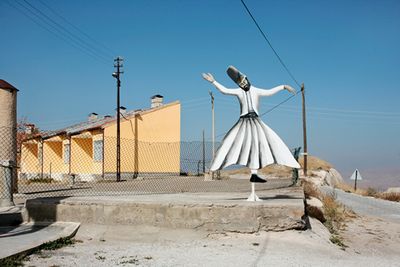
Lezmi_25 I have been searching for the “in between” – whatever lies geographically as well as culturally between my world here in the midst of Europe and my long term focus of interest in the Middle and Near East. Being half Lebanese myself, I have been studying cultural interfaces within the distant Arabic World. From August to December 2008 I traveled between Vienna and Beirut. I encountered people in versatile worlds, inside or in front of architectural places, both real and artificial, public and private. In my photographs, people emerge either as just passers-by or while waiting, as subjects and objects of the viewer’s eye, moving about in their urban or rural environment. These are distanced views in which locals and tourists are on similar paths, randomly congregating and forming elusive compositions. These pictures represent neither precise documents nor do they create artistic worlds. They are constructions of multicolored, fragmented impressions, like looking through a kaleidoscope.

More here.

This Will Change Everything

From The Telegraph:

Everything_1786961b It is not hard to think of examples of wide-eyed predictions that have proved somewhat wide of the mark. Personal jetpacks, holidays on the moon, the paperless office and the age of leisure all underline how futurologists are doomed to fail. Any predictions should thus be taken with a heap of salt, but that does not mean crystal ball-gazing is worthless: on the contrary, even if it turns out to be bunk, it gives you an intriguing glimpse of current fads and fascinations. A few weeks ago, a science festival in Genoa, Italy, gathered together some leading lights to discuss the one aspect of futurology that excites us all: cosa farà cambiare tutto — this will change everything. The event was organised by John Brockman, a master convener, both online and in real life, and founder of the Edge Foundation, a kind of crucible for big new ideas. With him were two leading lights of contemporary thought: Stewart Brand, the father of the Whole Earth Catalog, co-founder of a pioneering online community called The Well and of the Global Business Network; and Clay Shirky, web guru and author of Cognitive Surplus: Creativity and Generosity in a Connected Age.

Shirky meditated on how, during his formative years, it was thought that the decades to come would be dominated by nuclear power and the great adventure of space flight. Decades later, it is now clear that those technologies may have dominated discussions of the day but their direct influence remained firmly with the technological elite. With the benefit of hindsight, his early years were the age of the transistor and birth control. When it comes to the forces shaping our lives today, Shirky points to how coordinated voluntary participation is on the rise, thanks to online tools. With the help of the internet, people are now learning how to make use of the increasing amounts of free time that have been afforded to them since the 1940s for creative acts rather than consumptive ones.

More here.

Sunday Poem

A Letter in October

Dawn comes later and later now,
and I, who only a month ago
could sit with coffee every morning
watching the light walk down the hill
to the edge of the pond and place
a doe there, shyly drinking,
then see the light step out upon
the water, sowing reflections
to either side—a garden
of trees that grew as if by magic—
now see no more than my face,
mirrored by darkness, pale and odd,
startled by time. While I slept,
night in its thick winter jacket
bridled the doe with a twist
of wet leaves and led her away,
then brought its black horse with harness
that creaked like a cricket, and turned
the water garden under. I woke,
and at the waiting window found
the curtains open to my open face;
beyond me, darkness. And I,
who only wished to keep looking out,
must now keep looking in.

by Ted Kooser
from Weather Central
University of Pittsburgh Press
Copyright 1994

Saturday, December 18, 2010

Twelve theses on WikiLeaks

Geert Lovink and Patrice Riemens in Eurozine:

Thesis 5

The steady decline of investigative journalism caused by diminishing funding is an undeniable fact. Journalism these days amounts to little more than outsourced PR remixing. The continuous acceleration and over-crowding of the so-called attention economy ensures there is no longer enough room for complicated stories. The corporate owners of mass circulation media are increasingly disinclined to see the workings and the politics of the global neoliberal economy discussed at length. The shift from information to infotainment has been embraced by journalists themselves, making it difficult to publish complex stories. WikiLeaks enters this state of affairs as an outsider, enveloped by the steamy ambiance of “citizen journalism”, DIY news reporting in the blogosphere and even faster social media like Twitter. What WikiLeaks anticipates, but so far has been unable to organize, is the “crowd sourcing” of the interpretation of its leaked documents. That work, oddly, is left to the few remaining staff journalists of selected “quality” news media. Later, academics pick up the scraps and spin the stories behind the closed gates of publishing stables. But where is networked critical commentariat? Certainly, we are all busy with our minor critiques; but it remains the case that WikiLeaks generates its capacity to inspire irritation at the big end of town precisely because of the transversal and symbiotic relation it holds with establishment media institutions. There's a lesson here for the multitudes – get out of the ghetto and connect with the Oedipal other. Therein lies the conflictual terrain of the political.

Science’s Breakthrough of the Year: The First Quantum Machine

Over at Eurekalert:

Science and its publisher, AAAS, the nonprofit science society, have recognized this first quantum machine as the 2010 Breakthrough of the Year. They have also compiled nine other important scientific accomplishments from this past year into a top ten list, appearing in a special news feature in the journal's 17 December 2010 issue. Additionally, Science news writers and editors have chosen to spotlight 10 “Insights of the Decade” that have transformed the landscape of science in the 21st Century.

“This year's Breakthrough of the Year represents the first time that scientists have demonstrated quantum effects in the motion of a human-made object,” said Adrian Cho, a news writer for Science. “On a conceptual level that's cool because it extends quantum mechanics into a whole new realm. On a practical level, it opens up a variety of possibilities ranging from new experiments that meld quantum control over light, electrical currents and motion to, perhaps someday, tests of the bounds of quantum mechanics and our sense of reality.”

The quantum machine proves that the principles of quantum mechanics can apply to the motion of macroscopic objects, as well as atomic and subatomic particles. It provides the key first step toward gaining complete control over an object's vibrations at the quantum level. Such control over the motion of an engineered device should allow scientists to manipulate those minuscule movements, much as they now control electrical currents and particles of light. In turn, that capability may lead to new devices to control the quantum states of light, ultra-sensitive force detectors and, ultimately, investigations into the bounds of quantum mechanics and our sense of reality. (This last grand goal might be achieved by trying to put a macroscopic object in a state in which it's literally in two slightly different places at the same time—an experiment that might reveal precisely why something as big as a human can't be in two places at the same time.)

Strauss and Schmitt Go to China

Leo_strauss

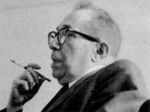
A few years ago, when I was still teaching at the University of Chicago, I had my first Chinese graduate students, a couple of earnest Beijingers who had come to the Committee on Social Thought hoping to bump into the ghost of Leo Strauss, the German-Jewish political philosopher who established his career at the university. Given the mute deference they were accustomed to giving their professors, it was hard to make out just what these young men were looking for, in Chicago or Strauss. They attended courses and worked diligently, but otherwise kept to themselves. They were in but not of Hyde Park. At the end of their first year, I called one of them into my office to offer a little advice. He was obviously thoughtful and serious, and was already well known in Beijing intellectual circles for his writings and his translations of Western books in sociology and philosophy into Chinese. But his inability to express himself in written or spoken English had frustrated us both in a course of mine he had just taken. I began asking about his summer plans, eventually steering the conversation to the subject of English immersion programs, which I suggested he look into. “Why?” he asked. A little flummoxed, I said the obvious thing: that mastering English would allow him to engage with foreign scholars and advance his career at home. He smiled in a slightly patronizing way and said, “I am not so sure.” Now fully flummoxed, I asked what he would be doing instead. “Oh, I will do language, but Latin, not English.” It was my turn to ask why. “I think it very important we study Romans, not just Greeks. Romans built an empire over many centuries. We must learn from them.” When he left, it was clear that I was being dismissed, not him.

more from Mark Lilla at TNR here.

In praise of older women

563d7aea-080e-11e0-8527-00144feabdc0

If the pram in the hall is the enemy of good art, what happens when the babies grow up and the pram is replaced by a Zimmer frame? Until recently, most women did not live long enough for us to find out. But now old age among female artists and writers is the new chic, as increased longevity trumps the time-worn complaint that after 50 a woman is socially and professionally invisible. In the 21st century, creative women in their eighties and nineties such as Louise Bourgeois (born 1911), Leonora Carrington (born 1917) and Diana Athill (born 1917) emerged from the tunnel of obscure middle-age to become glamorous if not household, at least drawing-room names. In 2010 the prominence of such figures in the visual arts became inescapable. The National Gallery in London is currently showing 79-year-old Bridget Riley’s engagement with the Old Masters (to May 22). At Frankfurt’s Städel Museum the furious neo-expressionist work of 91-year-old Austrian Maria Lassnig concludes a survey of paintings from the 14th to the 21st centuries (to June 26). In Paris, the most flamboyant installation in the Tuileries for this autumn’s FIAC was the mirrored sculpture “Narcissus Garden” by Yayoi Kusama, who is 81 and lives in a Tokyo mental hospital. Surreal Friends, a British touring exhibition which closed last week, introduced 93-year-old English-Mexican artist Carrington’s menacing surreal paintings to a wide new audience.

more from Jackie Wullschlager at the FT here.

e-books be good

Ipad_touch_mock_up

Take heart, readers. A Pew Internet & American Life Project report released this month found that just “[e]ight percent of the American adults who use the Internet are Twitter users.” I can’t be the only one to find this heartening in a culture awash in instant information, in the slings and arrows of the 140- character tweet. For a long time, I’ve regarded Twitter as the ultimate expression of our shared distraction, a virtual game of telephone in which the chatter is by its nature reductive, stripped of complexity, nuance, all those subtle shades of gray. And yet, what may be most interesting about the Pew study is its timing, since this is the year e-readers took off. What does it say about us that, on the one hand, we don’t seem so enthralled by the hit-and-run of Twitter while on the other, we can’t get enough of electronic books? Only this: that technology is not a barrier to depth, to engagement, to the cultural discussion, and that perhaps we want the same thing from our reading as we always have, regardless of the form it takes. E-books, after all, are the story in publishing this year, with more than seven million iPads sold in the eight months since the device went on sale in April, joining millions of Kindles, Sony Readers, Kobos and Nooks. Just a week or so ago, Google launched Google Editions, an e-book retailer designed to compete with the iBook and Kindle stores.

more from David L. Ulin at the LA Times here.

From The Two Cultures to no culture

From Spiked:

It is one of the great ironies of modern times, observed the New York Times last year, that CP Snow’s The Two Cultures remains one of the most frequently cited, yet least read, books of the past 50 years.

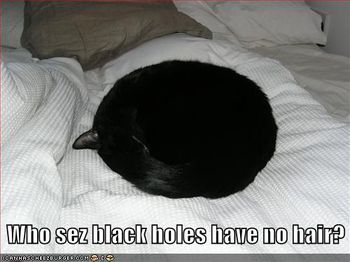
Black-hole-cat After all, Snow’s thesis was that the pool of human knowledge was at risk of being drained by a potentially insurmountable gulf between scientists and literary intellectuals, who were at that time regarded as the guardians of culture. As an example, he recounted going to a cocktail party where fellow scientists admitted to knowing no Dickens and the literati revelled in their ignorance of basic scientific terminology. So he started one of the great spats of post-war intellectual life, provoking literary critic FR Leavis into a fantastically bad-tempered attack on Snow, stating that the scientist-turned-novelist had perhaps overestimated his own understanding of intellectual greatness. The first canapé in the cocktail war – sorry, culture war – had been thrown. Anyone who read Ian McEwan’s novel Solar – featuring a Nobel Prize-winning physicist taken aback by non-scientists’ claims to know anything at all – will recognise that Snow’s warning still lingers in the literary imagination. It has clearly stirred the minds of the culturati on the BBC’s niche arts channel, BBC4, who have opened their doors for a whole season of programmes on The Tools of Science.

More here.

The Patriarch

From The New York Times:

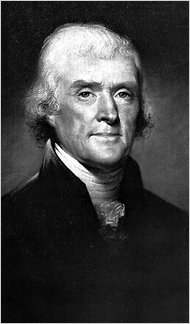
Jeff Thomas Jefferson’s mother, who came from a rich and influential Virginia family, was in the first generation of colonial women brought up to run a plantation. But although her husband died when Jefferson was only 14, she allowed his executors to manage her son’s inheritance. And when Jefferson married a wealthy widow, Martha Wayles Skelton, he added to that estate. Martha was not only rich, she was also beautiful, and she shared Jefferson’s love of music. With her he pursued his dream of domestic tranquility — one in which he ran the plantation and she organized the household. Women, Jefferson believed, should not “wrinkle their foreheads with politics” but instead “soothe and calm the minds of their husbands.” There are no surviving letters between Jefferson and his wife, or between Jefferson and his mother, and too often Scharff must resort to phrases like “We have no way of knowing” and “She may have disagreed.” Sometimes, though, an entry in an account book succeeds in bringing Martha alive — when, say, a little sketch of two birds summons up the image of her doodling and dreaming over her housekeeping. It’s only Jefferson’s grief after her death, in 1782, that opens a window onto their relationship. For weeks he shut himself in his room or feverishly roamed the forests and mountains.

Two years later, Jefferson traveled to Paris with his oldest daughter, Patsy, to join Benjamin Franklin and John Adams as an American diplomat in Europe, leaving his two younger daughters, Polly and Lucy, behind. When he received news that Lucy had died of the whooping cough, he once again fell into a deep depression. In the aftermath, he sent for Polly, who crossed the Atlantic at the age of 9, accompanied by 14-year-old Sally Hemings, a slave who was also Martha Jefferson’s half-sister. (She was the daughter of Jefferson’s father-in-law, John Wayles, and his slave Elizabeth Hemings.) As Annette Gordon-Reed has convincingly argued in “The Hemingses of Monticello,” it was in Paris that Sally probably began her lifelong job as Jefferson’s chambermaid — and also became his mistress. Like his father-in-law, Jefferson would have a shadow family: Sally and their children. His was a world of complicated relationships hidden behind a veil of silence.

More here.

Friday, December 17, 2010

A Bayesian Take on Julian Assange

230px-Julian_Assange_(Norway,_March_2010) Nate Silver in 538 (h/t: mr goodbar):

Psychologists and behavioral economists have conducted a lot of experiments along these lines, testing our ability to think through problems that involve what statisticians call Bayesian inference: those that require to us to infer the likelihood of various possibilities based on a combination of prior, underlying conditions (we are in Japan: most people we encounter here will be of Japanese ancestry) and new information (but based on this woman’s appearance, it is hard to tell whether she is Caucasian or Japanese!) They’ve found that, in general, we do pretty badly with them: we tend to get lost in the most immediate details and we forget the underlying context.

I was reminded about this recently when reading WikiLeaks founder Julian Assange, who is wanted for questioning by Swedish authorities on charges that that he has committed sexual assault. People have spent a lot of time debating the details of the charges, which invoke a number of difficult questions about what constitutes consent during a sexual encounter. Commenters differ in their interpretations both about the facts intrinsic to the case and in their readings of Swedish law.

I certainly do not intend to resolve those debates, although they are by no means uninteresting or unimportant. What I would suggest, however, is that it would be a mistake, from the standpoint of Bayesian reasoning, to think we can separate out the merits of the charges from their political motivations.

There is virtually no chance that the case against Mr. Assange would have proceeded in quite the same manner if he were instead an itinerant painter named Jens Andersen, or a traveling salesman named John Andrews — instead of an internationally renowned provocateur. Indeed, the charges might not have been brought against Mr. Assange in the first place. Sweden has among the highest rates of reported rape cases in the European Union. But unfortunately, few cases are brought to trial (only between 10 and 20 percent, according to various reports), and fewer still result in convictions.

That alone might not tell us much. There are other ways, however, in which the behavior of the authorities has been quite unusual.

The initial warrant in the case against Mr. Assange had been issued in August. But it was revoked the next day, due to what the lead prosecutor cited as a lack of evidence. It was only last month – just as WikiLeaks was preparing to release a set of confidential diplomatic cables – that Sweden again issued a warrant to detain him.

Photo from wikipedia.

Mark Twain’s Riverboat Ramblings

Keillor-popupGarrison Keillor in the NYT:

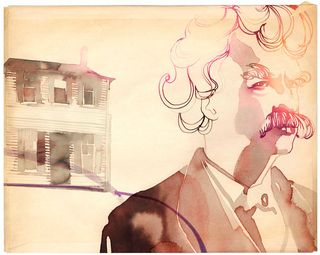
Samuel L. Clemens was a cheerful promoter of himself, and even after he’d retired from the lecture circuit, the old man liked to dress up as Mark Twain in a fresh white suit and take a Sunday morning stroll up Fifth Avenue just as churches were letting out and see the heads turn and hear his name murmured, the crowds of Presbyterians and Episcopalians standing awe-struck as the most beloved mustache in America passed by, tipping his silk hat to the ladies. Mr. Twain’s autobiography was meant to be a last stroll around the block, and to build up suspense and improve sales, Sam told everybody that he was writing one and that it contained material so explosive it would need to be embargoed for a hundred years. That century has passed now and here it is, Volume 1 of “The Complete Authentic Unexpurgated Edition, Nothing Has Been Omitted, Not Even Scandalous Passages Likely to Cause Grown Men to Gasp and Women to Collapse in Tears — No Children Under 7 Allowed to Read This Book Under Any Circumstance,” which made Sam front-page news when all three volumes of the “Autobiography of Mark Twain” were announced last spring. The book turns out to be a wonderful fraud on the order of the Duke and the Dauphin in their Shakespearean romp, and bravo to Samuel Clemens, still able to catch the public’s attention a century after he expired.

He speaks from the grave, he writes, so that he can speak freely — “as frank and free and unembarrassed as a love letter” — but there’s precious little frankness and freedom here and plenty of proof that Mark Twain, in the hands of academics, can be just as tedious as anybody else when he is under the burden of his own reputation. Here, sandwiched between a 58-page barrage of an introduction and 180 pages of footnotes, is a ragbag of scraps, some of interest, most of them not: travel notes, the dictated reminiscences of an old man in a dithery voice (“Shortly after my marriage, in 1870, I received a letter from a young man in St. Louis who was possibly a distant relative of mine — I don’t remember now about that” begins one story that goes nowhere), various false starts, anecdotes that must have been amusing at one time, a rough essay (with the author’s revisions carefully delineated) on Joan of Arc, a critique of the lecture performance of Petroleum V. Nasby, a recap of the clipper ship Hornet’s ill-fated voyage that ended in Hawaii in 1866, a piece about German compound words, an account of medicine on the frontier, well-worn passages from lectures, a fair amount of self-congratulation (“I expected the speech to go off well — and it did”), a detailed report on the testimony of Henry H. Rogers in a lawsuit in Boston, newspaper clippings, generous quotations from his daughter Susy’s writing about her father (“He always walks up and down the room while thinking and between each course at meals”), ruminations on his methodology of autobiographicizing (“I shall talk about the matter which for the moment interests me, and cast it aside and talk about something else the moment its interest for me is exhausted; . . . a complete and purposed jumble”), recollections of Reuel Gridley and other Hannibal classmates, and there is precious little that could be considered scandalous — maybe a rant against James W. Paige, the inventor of a typesetting machine that Sam lost $170,000 on: “If I had his nuts in a steel trap I would shut out all human succor and watch that trap till he died” — but you have to wade through 18 pages of mind-numbing inventory of the Countess Massiglia’s Villa di Quarto, which he leased in Florence (“I shall go into the details of this house, not because I imagine it differs much from any other old-time palace or new-time palace on the continent of Europe, but because ­every one of its crazy details interests me, and therefore may be expected to interest others of the human race, particularly women”), the only point of which is that the man can afford to rent a palace that is fancier than anything you’d find in Missouri.

Some Shit I’m Sick of Hearing Regarding Rape and Assange

Kate Harding over at her blog (via Sullivan):

Claim: Because nobody cares about prosecuting rape under normal circumstances, it is somehow an insult to rape survivors to prosecute Assange for it now.

Someone really fucking said that? Yeah, Naomi Wolf in the Huffington Post, for instance. Money quote:

Of course ‘No means No’, even after consent has been given, whether you are male or female; and of course condoms should always be used if agreed upon. As my fifteen-year-old would say: Duh.

But for all the tens of thousands of women who have been kidnapped and raped, raped at gunpoint, gang-raped, raped with sharp objects, beaten and raped, raped as children, raped by acquaintances — who are still awaiting the least whisper of justice — the highly unusual reaction of Sweden and Britain to this situation is a slap in the face.

Wait, what? Yeah, she actually seems to be arguing that out of respect for rape survivors who never saw justice, Britain and Sweden should not prosecute an accused rapist. It’s all of them or none of them. Or something.

Doesn’t she have a good point somewhere in there, though? Sure. To wit, “Here is what I mean: men are pretty much never treated the way Assange is being treated in the face of sex crime charges.” Usually, rapists go free.

BUT: That doesn’t mean these charges shouldn’t be taken seriously. See above. And as someone who’s worked extensively with rape survivors, Naomi Wolf should damn well know better than to smear alleged victims long before all the facts are in, perpetuate a flat-out lie about the seriousness of the charges, and generally act like a cheerleader for rape culture, under the guise of someone concerned about “real” victims. Which we all know these women are not, duh, because Assange has already been tried and found not OH WAIT.

Better idea: Decry the routine dismissal of rape allegations and shameful treatment of victims all over the damned world, but maybe skip the part about how prosecuting an accused rapist somehow makes it worse.

Herzen in London

Alexander-Herzen-by-Nikolai-Ge-1867-233x300 Sarah Young over at her website:

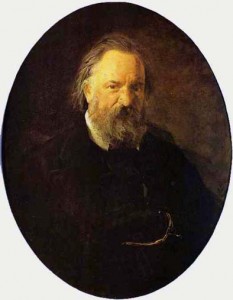
When researching the history of Russians in London, Alexander Herzen presents a considerable problem. He is without doubt the most significant of all the writers and activists who visited London in the nineteenth century, not only because he settled in the capital for some years (1852-64), but also because many of his compatriots — Turgenev, Chernyshevsky, Tolstoy, Dostoevsky, Nekrasov, Pavel Annenkov, Vasily Botkin, Vasily Sleptsov — came specifically to see him. It’s certainly true to say that neither his closest friend Nikolai Ogarev nor Bakunin would have ended up in London if Herzen hadn’t been here. He is also the author of one of the greatest memoirs ever written, My Past and Thoughts, which is a massively important source on the Russian intelligentsia as well as being a very entertaining read. So he would seem like the ideal subject.

But for all the wealth of detail he presents, relatively little of My Past and Thoughts is devoted to his London life, and in general Herzen does not provide us with much commentary in other sources either. This may have been because he did not feel any rapport with the English, so failed to establish any real friendships, as Isaiah Berlin suggests. Perhaps, as London was the first long-term home he established after the disillusionment and failure of the revolutions of 1848, he was in no mood to seek out new acquaintances. Certainly, his description of his first days in London speak to preference for isolation: ‘I grew unaccustomed to others’; ‘Nowhere could I have the same hermit-like seclusion as in London’; ‘There is no town in the world which is more adapted for training one away from people and training one into solitude than London’ (My Past and Thoughts, pp. 445-7). According to Bernard Porter (Exiles, p. 43), such negative feelings about Britain were common among the political refugees who arrives after 1848 – most of them had no desire to be here.

Schwitters and Blinky

Schwabskyhiresblue_img

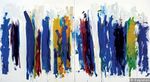
In 1984, while preparing for the great Kurt Schwitters retrospective that MoMA was to mount the next year, a member of the museum’s curatorial staff noticed a discrepancy between one of its Schwitters assemblages, The Cherry Picture (Merzbild 32A. Das Kirschbild), from 1921, and a photograph taken of the structure in 1954, when it entered the collection: a cork attached to the surface of the piece had somehow migrated to a different spot altogether. Worse still, a photograph of The Cherry Picture published in 1924 shows no cork at all. Was the wayward bottle stop a belated addition by Schwitters, an artist known to have kept fiddling with his works when he could? And if so, where does it really belong? Or did someone else add the cork and yet another person unknown move it? After reviewing the evidence, MoMA conservator Antoinette King (in an essay published in 1992) found it to be inconclusive. The prominence of the cork “creates a particular formal unity in the assemblage elements,” she noted, “entirely changing Schwitters’s original work, if it is indeed not his own addition”—going on to cite the artist’s conviction that “all that matters in a work of art is that all parts should be interrelated and evaluated against each other.” But what if the parts tend to drift? I was sorry not to find The Cherry Picture in “Kurt Schwitters: Color and Collage,” the first American museum show devoted to the artist since the one at MoMA twenty-five years ago, now on view at the Menil Collection in Houston through January 30. (The show also tours the Princeton University Art Museum, March 26–June 26, and the Berkeley Art Museum at the University of California, August 3–November 27.) It would have been nice to see whether that little cork has continued to bob around as a reminder that even now there is something very difficult to pin down in Schwitters’s art—which, it’s been said, “was never about the object itself, but the dynamic of relations that appeared in the course of its making.” If so, that’s a problem for museums: all we have left are the objects.

more from Barry Schwabsky at The Nation here.

weeds

TLS_Cooper_732533a

In his biography of Gilbert White (1986), Richard Mabey suggested that the “greatest legacy” of The Natural History of Selborne was a “blending” of scientific responses to nature with emotional ones, including “respect” for living things and a sense of “kindredness” with them. The Natural History, Mabey added, also “helped pioneer that affectionate writing about place” and natural life which has become “part of the mainstream of English literature”. His dozen or more books – which include Flora Britannica (1996) and Nature Cure (2005) – have established Mabey himself as the most distinguished exponent of this “affectionate writing” and, alongside his late friend, Roger Deakin, the main inspiration for such younger writers as Mark Cocker and Robert Macfarlane. He has done more than anyone, perhaps, to ensure that “modern British nature writing”, as anthologies and publishers like to call it, remains in the mainstream of English literature. The word “blending” in Mabey’s tribute to White’s legacy needs stressing. For what characterizes the best nature writing is not an oscillation between two quite separate ways of responding to nature – scientific and emotional, drily objective and merely subjective. Mabey’s books are, instead, ways of presenting or rendering nature in which understanding, insight, mood, sensibility and appreciation are inseparably combined. The presentation, an artful blending of these ingredients, is doubtless a personal one, but not therefore idiosyncratic – no more than the depictions of nature found in, say, the landscapes of Turner. Or, more relevantly, in Albrecht Dürer’s “Large Piece of Turf”, a picture of “a clump of weeds” which Mabey, in his new book, Weeds, admires not least for its fusion of ecological insight and scientific accuracy with “reverence” and “a new humanistic attitude towards nature”.

more from David E. Cooper at the TLS here.