The Power of Ruins

Our own Morgan Meis in The Smart Set:

ScreenHunter_03 Apr. 01 20.10 “Will it make a beautiful ruin?” That was the question Basil Spence asked about the nuclear power station he was designing in Trawsfynydd, Wales. This was back in the 1960s, but it was forward looking. Spence, an architect (he designed the famous Coventry Cathedral in England), was aware of one simple fact: Nuclear power plants are functional for a relatively short period of time before they are put out of commission and replaced by newer, safer designs and technology. The abandoned plant is filled with radioactivity that makes it unusable for anything for a long time. A cathedral is designed with the idea that it should stand, and function, for a very long time — perhaps beyond time. A nuclear power plant is designed with the knowledge that it must become a ruin, and rather quickly. It is born to die, and then to sit as a corpse, a testimony to the strange and unsettling function it once had.

The human comfort level with nuclear energy has, arguably, increased in the last few decades. But radiation will always be scary. Perhaps our fear is in inverse proportion to our ability to feel or understand the effects of radiation with any immediacy. It is the silence of radiation that is troubling, the invisibility. It is disturbing to think that you could have received a lethal dose of radiation and never know until it is too late, until the body has been corrupted from the inside out. The fear in Japan right now, as the crisis at the Fukushima Daiichi nuclear plant continues, is one driven by not-knowing, by the impossibility of knowing exactly what is going on. This ignorance mingles with the realization that silent powers are reshaping the landscape. A nuclear ruin is being born.

More here.

Rare dinosaur footprints in Pakistan

Suhail Yusuf in Dawn:

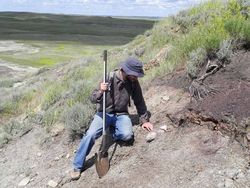
ScreenHunter_02 Apr. 01 20.01 After leaving the mild winter of Karachi, it was quite difficult to deal with the shivering cold while balancing ourselves on paths made of rocks and pebbles – but we hiked along, eager to reach our destination soon.

When we finally did reach, Sadiq Malkani – the geologist and explorer of the mid Jurassic dinosaurs trackways – was almost shocked to see the amazing site brutally cut down by hydraulic machines recently.

“Look! I discovered two types of dinosaurs’ foot prints on this wall in 2006. The first one belonged to plant eater titanosaurian sauropods and the other was from a carnivore theropod. The theropod tracks were very clear but the local coal miners destroyed this world class site,” he shouted.

‘For the past 160 million years, nature preserved the wonderful dinosaur site for us but we ruined it within hours,’ I thought to myself with immense feeling of cold, despair and fatigue.

More here.

Festo Built An Artificial Bird

Aaron Saenz in Singularity Hub:

The latest addition to the robotic zoo moves so gracefully you can hardly believe it’s a machine. Festo’s Bionic Learning Network has been creating robots based off of nature’s biological secrets for years now, but their SmartBird is a step ahead of the game. Modeled after a seagull, the SmartBird uses a single drive system for flight – but that simple system is enough for the robot to take off, maneuver, and land autonomously. Using Zigbee radio communication, the SmartBird continuously passes information on its flight to an off-board computer that tracks, and improves, its movements. The result is a robot that seems to glide as smoothly and easily as the real thing. It’s pretty amazing to watch it in action. Check out the SmartBird in the video below, followed by an animation that gives you a peak inside its frame. Festo’s biologically inspired engineering may help catapult the field of robotics years ahead.

More here. [Thanks to Moshe Behar.]

re-watching The Wire

6293_omar

A wire taps privacies; it transmits information that’s clear or opaque; it bears whole sentences or fragments; it can close a circuit that connects numerous points of contact; it’s a straight line that’s really a web. If a wire lets cops follow the drugs, everything stays under control of official entities. But, as Lester says, if it lets them follow the money, nobody’s in control. The wire will lead you into complex corruptions at every level of society. The Wire has its own tenacity of consciousness. It won’t let go of things, and every bit at least seems wired to some other bit. Sometimes it carries and connects coherent stories, sometimes not. It’s a dark essay on illusion and delusion. It tells us as often as we can stand to hear it that there are no simple answers, that much of the time we don’t really know to ask the right questions. It dramatizes, sometimes in the bawdiest byplay I’ve ever seen on TV, how we reveal our natures. A melancholy procession of images—city neighborhoods, industrial sites, people at work, street action, weathers—ends the series as it began, in instability, disorientation, uncertainty, and irresoluteness. It welcomes us again, if we need it, to the world of adults and adult-making.

more from W. S. Di Piero at Threepenny Review here.

the recognition of utter loss

TLS_Perry_735705a

“Wanted: Good Hardy Critic”, announced Philip Larkin in a review in 1966, unimpressed by some recent attempts to fill that vacancy. There has certainly been no shortfall in applicants for the job since then, as this weighty and miscellaneous new guide to the Hardy industry amply testifies. Much criticism takes a companionable form these days and Hardy has had his share: Rosemarie Morgan’s book follows a Cambridge Companion (1999), an Oxford Reader’s Companion (2000), and a more recent Companion from Blackwell (2009). Putting “Research” into the title is a sign that this is a book geared to the perceived needs of faculty and graduate students, and its analysis of the current state of play (“Perhaps the most interesting development in recent Hardy and Film criticism has been its fusion with gender studies”, and so on) would certainly be useful to someone working out a topic for a thesis. Undergraduates and other more normal readers – of whom Hardy, thankfully, still has many – might do better with one of the other companion volumes, which find something to say about all the different elements of the oeuvre in a slightly more programmatic way. The Ashgate Research Companion does include some illuminating interpretative essays, including Andrew Radford on Hardy’s humanism and Dennis Taylor, always excellent, on Hardy’s reading of Shakespeare; there is an admirable account of Moments of Vision by Gillian Beer, and a deft study of hands in Hardy by J. Hillis Miller; but the book’s main contribution lies in its very full surveys of the secondary literature, of Hardy on film and in illustrations, its census of Hardy manuscripts, and its extensive bibliography: I imagine it will soon be appearing at the top of reading lists for Masters courses.

more from Seamus Perry at the TLS here.

Mapping the Rift

Raja Shehadeh in Guernica:

On the verge of arrest, a Palestinian lawyer and author recounts the flight from arrest of an ancestor active during the Ottoman years.

Palestinemap “They’re coming to arrest you,” Hanan, my sister-in-law, called to warn me in her strong, matter-of-fact voice. “Samer is on his way.” My mother had just called Hanan in a panic to dispatch my brother to my aid, convinced that the Palestinian security police would be at my door any minute. She was frantic. An anonymous official from the office of the Attorney General had rung her to ask about me because they did not have my phone number. Prudently, she refused to reveal it. “Don’t worry. We’ll find him,” he had menacingly said before hanging up. I wasted no time. I quickly put on thick underwear, tucked my toothbrush in a pocket and pulled on an extra sweater, prison survival tips learned from experienced security detainees I had represented in the past in Israeli military courts. Jericho, the site of the new Palestinian security prison and the old Israeli military government headquarters, can get very cold at night. On that evening of September 18, 1996, I sat huddled in the courtyard of our new house and waited for the knock on the door, trying to pretend I was neither worried nor angry.

Those first years of the transitional rule of the Palestinian Authority were strange times.

More here.

Affectiva technology taps into people’s emotions

From PhysOrg:

Affectivacof Computers may soon understand people better than their spouses do, courtesy of innovations from startup Affectiva that expand on groundbreaking sensing research at the Massachusetts Institute of Technology (MIT). Affectiva co-founder and MIT professor Rosalind Picard showed off the fledgling firm's feelings-sensing applications at a Web 2.0 Expo that ended Thursday in San Francisco. “Feelings are complicated,” she said. “Now, we can begin to measure them and learn.” Affectiva technology enables computers powering websites to scan web camera imagery for facial expressions, eye movements, and gestures that provide clues to emotional reactions to anything from film scenes, to game action or ads.

“It is getting past wishful thinking and wondering to understanding what is really going on, and that makes it much more actionable,” Picard told AFP. “We all have trouble reading emotional cues when we are on the Web,” she continued. “Everybody who has been there for a while has been misunderstood at some time.” People with Web cameras connected to computers were invited to try the technology by viewing a set of ads online at an “Interactive: Analyze Your Smile” page at forbes.com. Picard provided a glimpse at a “Q Sensor” that can be strapped to a wrist or ankle to assess when people are excited or bored. The sensor measures electricity being conducted through the skin to determine arousal. A research version of the Q Sensor was available, with a consumer model due out by the end of the year. “There are therapists using this, there are parents using this, we had a lawyer buy one the other day to measure his own stress,” Picard said as she pointed to a Q Sensor on her wrist. “Anywhere there is emotion, there is an application.”

More here.

Friday Poem

A Note

Life is the only way
to get covered in leaves,
catch your breath on the sand,
rise on wings;

to be a dog,
or stroke its warm fur;

to tell pain
from everything it's not;

to squeeze inside events,
dawdle in views,
to seek the least of all possible mistakes.

An extraordinary chance
to remember for a moment
a conversation held
with the lamp switched off;

and if only once
to stumble upon a stone,
end up soaked in one downpour or another,

mislay your keys in the grass;
and to follow a spark on the wind with your eyes;
and to keep on not knowing
something important.

by Wislawa Szymborska

from Monologue of a Dog
translated by S. Baranczak and C. Cavanagh

Why War Is Never Really Rational

Scott Atran in the Huffington Post:

ScreenHunter_01 Apr. 01 11.16 For despite the popular delusion that war is, or ought to be, primarily a matter of political strategy and pragmatic execution, it almost never is. Squaring the circle of war and politics, morality and material interests, is not just Obama's or America's quandary, it is a species-wide dilemma that results from wanting to believe with Aristotle that we humans are fundamentally rational beings, when in fact recent advances in psychology and neuroscience strongly indicate that Enlightenment philosopher David Hume was right to say that “Reason is, and ought only to be, the slave of the passions.”

Models of rational behavior predict many of society's patterns, such as favored strategies for maximizing profit or likelihood for criminal behavior in terms of “opportunity costs.” But seemingly irrational behaviors like war — in which the measurable costs often far outweigh the measurable benefits — have stumped thinkers for centuries. The prospect of crippling economic burdens and huge numbers of deaths doesn't necessarily sway people from their positions on whether going to war is the right or wrong choice. One possible explanation is that people are not weighing the pros and cons for advancing material interests at all, but rather using a moral logic of “sacred values” — convictions that trump all other considerations — that cannot be quantified.

As Darwin noted in The Descent of Man, and Sun Tzu millennia before in The Art of War, the brave person is the one who is often intensely moral, undismayed by danger and demonstrably willing to kill and die for his beliefs. In the competition between groups of genetic strangers, such as empires and nations or transnational movements and ideologies, the society with greater bravery will win, all things being equal. Consider the American revolutionaries who, defying the greatest empire of the age, pledged “our lives, our fortunes, our sacred honor” in the cause of “Liberty or Death,” where the desired outcome was highly doubtful.

How many lives should a leader be willing to sacrifice to remove a murderous dictator like Muammar Gaddafi or Saddam Hussein?

More here.

Thursday, March 31, 2011

Paris, Home of the Avant-Garde

Paris-street-with-giant-p-007 Adam Thirlwell in The Guardian:

I suppose I should worry that the French and military codeword avant-garde still seduces me. This word, after all, can conceal so much snobisme. But then: there's no reason to dismiss something just because it's impure, and this idea of the avant-garde, in its essence, is a noble ideal. The avant-garde is wildness: a wildness of content, and a wildness of form.

And this is one reason why I harbour another complicated attraction. My idea of the avant-garde is so often Parisian.

This isn't, of course, entirely a form of romance. In the bourgeois 19th century, Paris was where the avant-garde was invented. But even then, the ideal of wildness was precarious. It was Walter Benjamin who observed how the association of art and isolation was “all the more dangerous because, as it flatters the self-esteem of the productive person, it effectively guards the interests of a social order that is hostile to him”. And he sardonically quoted Marx: “The bourgeois have very good reasons for imputing supernatural creative power to labour . . .”

As for now: well, you know it. You take the Eurostar to the avant-garde and you end up shopping. The avant-garde is much more likely to be found in Hamra. Paris, I think, can still be useful – but an imaginary, historical Paris: a jukebox of wild examples.

Because you can rehearse the usual arguments about how impossible it might be for writing to be avant-garde, in this era when everything can be recuperated as orthodoxy. Or, say, you can consider the ambiguous pleasures of the trial in Paris in 1956, to determine whether to allow the republication of four novels by the Marquis de Sade. Among the witnesses for the defence were two famous literary figures: Jean Paulhan and Georges Bataille.

When the judge asked Paulhan if he didn't find Sade's dismantling of moral values dangerous, Paulhan sadly agreed. “I knew a young girl who entered a convent after reading Sade's works, and because she had read them.” Was entering a convent, he was asked, such a bad result? “I note that it's a result,” shrugged Paulhan.

And then Bataille came to the stand. Bataille was a man who, in his novel Story of the Eye, had imagined scenes with bull testicles, pissing, the whole shemozzle. Now, 30 years later, in a courtroom, he soberly observed that he couldn't see how Sade's works could be harmful to the public. “I have to say,” he added solemnly, “that I have a lot of confidence in human nature.” To which the judge replied: “I congratulate you, Monsieur. Your optimism does you honour.”

Football as Before

Image Dushko Petrovich in n+1:

Before he became famous for headbutting, Zinadine Zidane was actually known for his composure. At Bordeaux, Juventus, and Real Madrid, his hallmarks as a midfielder were Spartan efficiency of movement, incisive passing, and magnetic control of the ball in tight circumstances. Unlike Pele or Maradona (the greats who came before him) and Chrisiano Ronaldo (probably the most outstanding player since), Zidane wasn’t particularly flashy. When France won the ’98 World Cup, he didn’t even score until the final, against Brazil, when he converted two corner kicks with unfussy, short-range headers to make it 2-0 by halftime. He was known to complete the occasional 360-degree turn, and he did have some smart footwork, but overall, he was more metronome than drum solo. His way of controlling the game was to control—and then suddenly change—the tempo.

In this sense, the real-time structure of Phillipe Parreno and Douglas Gordon’s 2006 movie, Zidane: A 21st Century Portrait, was somewhat suited to the Frenchman. With the ninety-minute montage (assembled from seventeen cameras placed around the 80,000-person capacity Santiago Bernabeu stadium) focusing entirely on Zidane, even soccer aficionados suffered through spells of cinematic stasis that exceeded the sport’s native tedium. Interrupted only by a few clips from the original TV broadcast, and occasionally augmented by the pleasing Mogwai soundtrack, the iconic image of Zidane himself—sometimes grunting, sometimes sprinting, but mainly just jogging and looking around—was meant to sustain viewers for the full hour and a half.

Usually citing the cool music, or Zidane’s gladiatorial good looks, people uninterested in soccer have often told me the movie exceeded their expectations. For die-hard fans, on the other hand, the film was something of a disappointment. It was hard to put your finger on, but something was missing. It wasn’t only the lack of suspense that came from knowing that Real Madrid would beat Villareal—many of us happily watch taped replays, tributes to past legends, countless YouTube clips. And it wasn’t exactly that we couldn’t see the other players—in fact, David Beckham and Juan Carlos both had entertaining cameos, coaxing laughter from the otherwise stoical Zidane. And there was no lack of sporting drama: Zidane chipped the ball to Ronaldo for a crucial goal, and curiously, in the closing minutes of the April 23, 2005 match Gordon and Parreno happened to record, the leading man was sent off for brawling.

But even before the portentous red card, Zidane’s essence as a player was omitted from the film.

Crossing Erez

Erez2-575 Richard Moore in Guernica:

I’m ready to return to Israel through the Erez Crossing, the northern exit from Gaza. As the afternoon meeting wears on, I start to check the time, increasingly anxious about getting to Erez. I never know whether the crossing itself will take an hour, or three, or even days. Since Erez is subject to closing without notice, I ask my secretary to check just before I leave, trying to ensure I’ll be able to cross.

As the expatriate director of the largest maternal and child health project in the West Bank and Gaza, I come to Gaza at least once every month. The Gaza Strip is forty-five kilometers long and ranges from five to twelve kilometers in width. It is bounded by Israel in the north and east, by Egypt in the south, and in the west by the Mediterranean Sea. Approximately one and a half million mostly impoverished Palestinians live within its mere three hundred and sixty square kilometers, about twice the area of Washington, DC. More than half of the population is made up of refugees from the 1948 Arab-Israeli War. Entrance to and exit from the strip—for Palestinians or anyone else—is strictly controlled by the Israel Defense Forces (IDF). All entries and exits occur only through the few surface checkpoints. This is only one of the draconian Israeli policies involving Gaza. Others include controlling the amount of food and medicines and other essentials that can enter the Strip, as well as restrictions on fishing and exporting. The only cars I ever saw entering Gaza had UNRWA markings, or belonged to other UN or aid agencies. Most people cannot drive from one side to the other. Instead, they have to leave their cars or taxis and walk through one of the checkpoints.

Lula’s Brazil

Perry Anderson in the LRB:

From the start, Lula had been committed to helping the poor. Accommodation of the rich and powerful would be necessary, but misery had to be tackled more seriously than in the past. His first attempt, a Zero Hunger scheme to assure minimum sustenance to every Brazilian, was a mismanaged fiasco. In his second year, however, consolidating various pre-existent partial schemes and expanding their coverage, he launched the programme that is now indelibly associated with him, the Bolsa Família, a monthly cash transfer to mothers in the lowest income strata, against proof that they are sending their children to school and getting their health checked. The payments are very small – currently $12 per child, or an average $35 a month. But they are made directly by the federal government, cutting out local malversation, and now reach more than 12 million households, a quarter of the population. The effective cost of the programme is a trifle. But its political impact has been huge. This is not only because it has helped, however modestly, to reduce poverty and stimulate demand in the worst afflicted regions of the country. No less important has been the symbolic message it delivers: that the state cares for the lot of every Brazilian, no matter how wretched or downtrodden, as citizens with social rights in their country. Popular identification of Lula with this change became his most unshakeable political asset.

Materially, a succession of substantial increases in the minimum wage was to be of much greater significance. These began just as the corruption scandals were breaking. In 2005, the rise was double that of the previous year in real terms. In the election year of 2006, the rise was still greater. By 2010, the cumulative increase in the rate was 50 per cent. At about $300 a month, it remains well below the earnings of virtually any worker in formal employment. But since pensions are indexed to the minimum wage, its steady increase has directly benefited at least 18 million people – the Statute of the Elderly, passed under Lula, consolidating their gains. Indirectly, too, it has encouraged workers in the informal sector not covered by the official rate, who make up the majority of the Brazilian workforce, to use the minimum as a benchmark to improve what they can get from their employers. Reinforcing these effects was the introduction early on of crédito consignado: bank loans for household purchases to those who had never before had bank accounts, with repayment automatically deducted from monthly wages or pensions. Together, conditional cash transfers, higher minimum wages and novel access to credit set off a sustained rise in popular consumption, and an expansion of the domestic market that finally, after a long drought, created more jobs.

Crime and Punishment in Bahrain

Pearl-monument Justin Gengler over at Religion and Politics in Bahrain [h/t: Alex Cooley]:

While the United States is busy providing air cover for government opponents in Libya, its friends in the Arab Gulf have nearly finished mopping the floor with theirs. Backed by some 2,000 ground troops from Saudi Arabia, the United Arab Emirates, and Qatar, along with a Kuwaiti naval detachment, the Bahraini government has all but stamped out the Shi‘a-led pro-democracy movement that had brought this small island nation to a standstill since mid-February.

In the violent crackdown that followed only one day after the arrival of the “Peninsula Shield” force, more than a dozen people were killed, hundreds were injured, and still more remain missing. The leaders of all but one of the main opposition groups were arrested in turn. The military “liberated” Bahrain’s main hospital, where relatives of those killed and injured had been camped. At last, martial law was declared and the symbol of the entire uprising–the Pearl monument–was unceremoniously demolished. If it’s gone that means nothing ever happened, right?

While no one is likely soon to forget the patch of barren land that just two weeks ago was “Martyrs’ Square,” life in Bahrain is indeed slowly returning to normal. Curfews have been shortened. Roads have been reopened. First elementary and now middle school students have returned to classes. Malls, hit hard by the turmoil as has Bahrain’s entire economy, have been keen to bring back shoppers, advertising their hours on Twitter and Facebook. And, most telling of all, the thousands who gathered last Friday for the sermon of Bahrain’s highest Shi‘a religious authority, Sheikh ‘Isa Qasim, did not continue on to a customary post-prayer rally; they simply returned home.

At the same time, however, untouched by this outward improvement remains Bahrain’s underlying political conflict, which today is no closer to resolution than when protests began.

Tunisia: What comes next?

From Prospect Magazine:

Tunis Tunis is oddly calm and normal for the capital of a country that has just triggered the greatest upheaval in the Arab world since the end of the first world war. Nor would you guess from the current provisional government that the revolution was driven by frustrated young people using the latest networking technologies; the combined ages of the new Tunisian president and prime minister is 161 years. But the two old men are bridging the generation gap and, for now, keeping the show on the road. The attention of the world has of course moved elsewhere since Tunisia, much to its own amazement, lit the torch at the end of December. But on a recent trip to Tunis I discovered that the Tunisians have not been idle since the president of 23 years, Ben Ali, fled the country on 14th January.

They are now on to their third government, having got rid of Ben Ali’s unpopular prime minister, Mohamed Ghannouchi, at the end of February. The new prime minister, 84-year-old Beji Caid Essebsi, a veteran of the 1950s independence movement and largely untainted by the Ben Ali regime, announced elections on 24th July for an assembly to draw up a new constitution. From not having had a proper election, ever, Tunisia is poised to have three in quick succession—culminating with elections for a new president and parliament, perhaps at the end of the year. This modest former French colony could now set the pattern for the next, trickier stage of Arab democratic reform. “We can be the test-bed for the whole Arab world, but we must not rush,” says Raoudha Ben Othman, professor of linguistics at Tunis University.

More here.

Thursday Poem

One Hundred White-sided Dolphins on a Summer Day

1.

Fat,
black, slick,
galloping in the pitch
of the waves, in the pearly

fields of the sea,
they leap toward us,
they rise, sparkling, and vanish, and rise sparkling,
they breathe little clouds of mist, they lift perpetual smile,

they slap their tails on the waves, grandmothers and grandfathers
enjoying the old jokes,
they circle around us,
they swim with us –

2.

a hundred white-sided dolphins
on a summer day,
each one, as God himself
could not appear more acceptable

a hundred times,
in a body blue and black threading through
the sea foam,
and lifting himself up from the opened

tents of the waves on his fishtail,
to look
with the moon of his eye
into my heart,

3.

and find there
pure, sudden, steep, sharp, painful
gratitude
that falls –

I don't know – either
unbearable tons
or the pale, bearable hand
of salvation

on my neck,
lifting me
from the boat's plain plank seat
into the world's

4.

unspeakable kindness.
It is my sixty-third summer on earth
and, for a moment, I have almost vanished
into the body of the dolphin,

into the moon-eye of God,
into the white fan that lies at the bottom of the sea
with everything
that ever was, or ever will be,

supple, wild, rising on flank or fishtail –
singing or whistling or breathing damply through blowhole
at top of head. Then, in our little boat, the dolphins suddenly gone,
we sailed on through the brisk, cheerful day.


by Mary Oliver
from What Do We Know
© Da Capo Press, 2002

Dying for a long life

From Nature:

Worm A chemical dye that lights up the protein clumps characteristic of Alzheimer's disease also slows ageing in worms. The lifespan-boosting effects of the dye — called Thioflavin T or Basic Yellow 1 — support the idea that the build-up of misshapen proteins underlies ageing. Drugs that recognize such toxic detritus and alert the cell's natural repair and protein-recycling systems could, therefore, be used to treat diseases of old age, says Gordon Lithgow, a molecular geneticist at the Buck Institute in Novato, California, who led the study, published today in Nature1.

Proteins are essential for almost everything a cell does, from communicating with other cells to generating energy. But sometimes proteins form the wrong three-dimensional shapes. Misfolded proteins don't function properly and, worse, tend to accumulate and gum up other cellular systems. To prevent this from happening, cells deploy 'chaperones', whose job it is to refold misshapen proteins. In more extreme cases, cells can degrade these potentially dangerous proteins. “There's a growing appreciation that protein misfolding may be one of the very fundamental events of ageing,” says Richard Morimoto, a molecular biologist at Northwestern University in Evanston, Illinois, who was not involved with the study. Worms genetically engineered to have a revved-up protein-recycling system, for instance, live longer than normal worms23.

More here.

Wednesday, March 30, 2011

India beat Pakistan to reach World Cup final

From Times of India:

World-Cup-2011 Twenty-eight long years after that magical Indian summer in England, the Men in Blue are one victory away from proving that India is truly cricket’s superpower, not just commercially but also on the field. One victory away from being world No.1 in ODIs, in addition to Tests. One victory away from giving the ultimate thank you gift to the greatest cricketer since Don Bradman, and a fitting farewell to a coach who has contributed so much to their rise. And one victory away from giving millions of young Indians born after 1983 – including several members of the present team – the joy of knowing what it actually feels like to have your squad lift the Cup that counts before your jubilant eyes. Kumar Sangakkara – Sanga to millions of fans – is waiting with his formidable Lankans. But so is the opportunity of a lifetime for Dhoni’s Daredevils.

More here.

Wednesday Poem

The Wish to be Generous

All that I serve will die, all my delights,
the flesh kindled from my flesh, garden and field,
the silent lilies standing in the woods,
the woods, the hill, the whole earth, all
will burn in man's evil, or dwindle
in its own age. Let the world bring on me
the sleep of darkness without stars, so I may know
my little light taken from me into the seed
of the beginning and the end, so I may bow
to mystery, and take my stand on the earth
like a tree in a field, passing without haste
or regret toward what will be, my life
a patient willing descent into the grass.

by Wendell Berry
from The Collected Poems, 1957-1982