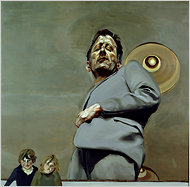
Orozco and the treaure house of art

Clar05_3304_01

I can’t for the life of me remember why I was so bad-tempered the first time I saw a show of Gabriel Orozco years ago in New York. Orozco’s mid-career retrospective at Tate Modern (till 25 April) seems so genial and ingenious and above all so modest. It puts together a body of well-made and various work: good photographs, peculiar abstract paintings, found objects (usually modified), small sculptures in terracotta or plasticine, larger ones made from burst tyres or lint from the laundromat, etchings, drawings, and some show-stopping art-world toys: a squeezed Citroën DS, a version of billiards with the red ball hanging from a Foucault pendulum-string (you’re invited to play and it’s fun), an empty shoebox on the floor. Maybe when I saw Orozco in New York in the 1990s I was still partly living in the past. The found objects and useless devices seemed to issue from a dim Dada high ground, and therefore I expected them to hurt, or be biting. But they were friendly. They asked me and the art world to calm down. Art was play. And I see now what the best critics saw then: that this was a welcome, post-adolescent reaction to the Sturm und Drang of the previous decade – all those Nazi/anti-Nazi pictures made from straw and dung – and also, possibly, a way of keeping the Dada flame lightly burning. Well, possibly – that remains the Orozco question.

more from T.J. Clark at the LRB here.

diagnosing genius

ID_PI_GOLBE_CHOPI_AP_001 In her Histoire de Ma Vie, the author George Sand describes an encounter with Frédéric Chopin upon returning one night from a trip to Palma. Chopin was playing a melody on the piano, in the grip of a strange delirium. “He saw himself drowned in a lake,” she wrote:

heavy and ice-cold drops of water fell at regular intervals upon his breast, and when I drew his attention to those drops of water which were actually falling at regular intervals upon the roof, he denied having heard them. He was even vexed at what I translated by imitative harmony…. His genius was full of mysterious harmonies of nature, translated by sublime equivalents into his musical thought, and not by a servile repetition of external sounds.

The work that Chopin was playing that night — according to “The hallucinations of Frédéric Chopin,” an article published recently in the journal Medical Humanities — is thought to be the Prelude in D flat major, or Prelude in F sharp minor, or even Prelude in B minor. But for the authors of the article — Manuel Vázquez Caruncho and Franciso Brañas Fernández — the exact piece Chopin was playing, or how it got composed, is less interesting than what might have been happening in Chopin’s mind while he was composing.

more from Stefany Anne Golberg at The Smart Set here.

Wednesday Poem

The Dancer

Mama,
they tell me you were a dancer
they tell me you had long
beautiful legs to carry your graceful body
they tell me you were a dancer

Mama,
they tell me you sang beautiful solos
they tell me you closed your eyes
always when the feeling of the song
was right, and lifted your face up to the sky
they tell me you were an enchanting dancer

Mama,
they tell me you were always so gentle
they talk of a willow tree
swaying lovingly over clear running water
in early Spring when they talk of you
they tell me you were a slow dancer

Read more »

Inside the Convoluted Plot to Bring Down WikiLeaks

Nate Anderson in Wired:

ScreenHunter_03 Feb. 16 12.56 When Aaron Barr was finalizing a recent computer security presentation for the U.S. Transportation Security Administration, a colleague had a bit of good-natured advice for him: “Scare the shit out of them!”

In retrospect, this may not have been the advice Barr needed. As CEO of the government-focused infosec company HBGary Federal, Barr had to bring in big clients — and quickly — as the startup business hemorrhaged cash. To do so, he had no problem with trying to “scare the sh*t out of them.” When working with a major DC law firm in late 2010 on a potential deal involving social media, for instance, Barr decided that scraping Facebook to stalk a key partner and his family might be a good idea. When he sent his law firm contact a note filled with personal information about the partner, his wife, her family and her photography business, the result was immediate.

“Thanks. I am not sure I will share what you sent last night — he might freak out.”

This rather creepy behavior became common; Barr used it as a sign of his social media prowess. Another target of his investigations went to “a Jewish Church in DC, the Temple Micah.” Someone else “married @ the Inn at Perry Cabin in St. Michaels, MD (non-denominational ceremony).” Barr was even willing to helpfully guesstimate the ages of children in photographs (“they have 2 kids, son and daughter look to be 7 and 4″).

More here.

Muhammad Ali: 1942-

From Biographyonline.com:

“I'm not the greatest. I'm the double greatest. Not only do I knock 'em out, I pick the round. I'm the boldest, the prettiest, the most superior, most scientific, most skilfullest fighter in the ring today”

Muhammad-ali2 Standing at 6'3″ (1.91 m), Ali had a highly unorthodox style for a heavyweight boxer. Rather than the normal boxing style of carrying the hands high to defend the face, he instead relied on his ability to avoid a punch. In Louisville, October 29, 1960, Cassius Clay won his first professional fight. He won a six-round decision over Tunney Hunsaker, who was the police chief of Fayetteville, West Virginia. From 1960 to 1963, the young fighter amassed a record of 19-0, with 15 knockouts. He defeated such boxers as Tony Esperti, Jim Robinson, Donnie Fleeman, Alonzo Johnson, George Logan, Willi Besmanoff, Lamar Clark (who had won his previous 40 bouts by knockout), Doug Jones, and Henry Cooper. Among Clay's victories were versus Sonny Banks (who knocked him down during the bout), Alejandro Lavorante, and the aged Archie Moore (a boxing legend who had fought over 200 previous fights, and who had been Clay's trainer prior to Angelo Dundee).

Muhammad Ali quotes:

“Sonny Liston is nothing. The man can't talk. The man can't fight. The man needs talking lessons. The man needs boxing lessons. And since he's gonna fight me, he needs falling lessons”

“Stay in College, get the knowledge, stay there until you are through. If they can make penicillin out of moldy bread, they can sure make something of you!”

“Clean out my cell and take my tail.On the trail for the jail without bail.Because it's better in jail Watchin' television fed Than in Vietnam somewhere, dead”

“It's hard to be humble when you're as great as I am”

More here.

Computer crushes human ‘Jeopardy!’ champs

From PhysOrg:

Comp Most of the banter and gentle humor that usually pepper the popular quiz show was gone as the supercomputer dominated the game by beating his human opponents to the buzzer again and again. Ken Jennings — who holds the “Jeopardy!” record of 74 straight wins — shook his buzzer in silent frustration as the computer's artificial voice answered the first dozen challenges without pause, getting all but one right. “Watson” – named after Thomas Watson, the founder of the US technology giant — receives the clues electronically by text message at the same time as they are revealed to the human contestants. The first player to hit the buzzer gets to answer the question. The others only get a chance if the first player gets the answer wrong.

Watson, which is not connected to the Internet, plays the game by crunching through multiple algorithms at dizzying speed and attaching a percentage score to what it believes is the correct response. It beat Jennings and Brad Rutter — who won a record $3.25 million on the show — to the buzzer on 24 of 30 questions. Five-time “Jeopardy!” champion Jeffrey Spoeri sympathized with Jennings and Rutter, and said the computer's speed to the buzzer seemed like an unfair advantage. “I gotta root for the humans,” said Spoeri, who won 105,000 dollars on the show in November 2006. But he was deeply impressed with the computer's skills. “The actual game play was just amazing, that it would know the answers and discern which one is the correct one,” Spoeri told AFP after viewing the first show.

“It's a terrific experiment.”

More here.

The Long Arab Revolution

Vijay Prasad in CounterPunch:

ScreenHunter_02 Feb. 16 11.45 The Arab Revolt of 2011 is unabated. Protests continue in such unlikely places as Bahrain. On Valentine’s Day, a protest march in Manama had no love for the al-Khalifah royals. It wanted to deliver its message. “Our demand is a constitution written by the people,” the protestors chanted. Opposition leader Abdul Wahab Hussain told the press, “The number of riot police is huge, but we have shown using violence against us only makes us stronger.” The police fired rubber bullets and dispersed the as yet small crowd. “This is just the beginning,” Hussain said after he had been beaten off the streets.

Such protests appear unlikely only because the wave of struggle that broke out in the late 1950s and peaked in the 1970s was crushed by the early 1980s. Encouraged by the overthrow of the monarch in Egypt by the coup led by Gamal Abdel Nasser, ordinary people across the Arab world wanted their own revolts. Iraq and Lebanon followed. On the peninsula, the people wanted what Fred Halliday called “Arabia without Sultans.” The People’s Front for the Liberation of the Occupied Arab Gulf emerged out of the Dhofar (Oman) struggle. It wished to take its local campaign to the entire peninsula. In Bahrain, its more timid branch was the Popular Front. It did not last long. With Nasserism in decline by the 1970s, the new momentum came to this Arabian republicanism from the Iranian Revolution of 1979. The Islamic Front of the Liberation of Bahrain attempted a coup in 1981. They had the inspiration, but not the organization. This Arab archipelago could not go the way of Yemen, where a revolution allowed a Marxist organization to seize power in 1967.

More here.

Amitava Kumar interviews Arundhati Roy

In Guernica:

ScreenHunter_01 Feb. 15 23.37 In November 2010, following a public speech she had made on the freedom struggle in Kashmir, a case of sedition was threatened against Roy. Several prominent members of the educated middle class in India spoke up on Roy’s behalf but a sizable section of this liberal set made it clear that their support of Roy was a support for the right to free speech, not for her views. What is it about Roy that so irks the Indian middle-class and elite? Is it the fact that she has no truck with the sober, scholarly, Brahmanical discourse of the respectable middle-of-the-road protectors of the status-quo? Her critics, among whom are some of my friends, are also serious people. But their objections appear hollow to me because they have never courted unpopularity. They air their opinions in op-eds, dine at the corporate table, are fêted on national TV, and collect followers on Twitter. They don’t have to face court orders. Naturally, I wanted to ask Roy whether she feels estranged from the people around her. She does, but also not. Her point is, which people? A bit melodramatically, I asked, “Are you lonely?” Roy’s wonderfully self-confident response: “If I were lonely, I’d be doing something else. But I’m not. I deploy my writing from the heart of the crowd.”

When I sat down for dinner with her I noticed the pile of papers on the far end of the wooden table. These were legal charges filed against Roy because of her statements against Indian state atrocities. Roy said to me, “These are our paper napkins these days.” What toll had these trials taken on her writing? Was her activism a source of a new political imagining or was her political experience one of loneliness and exile in her own land? What would be the shape of any new fiction she would write? These and other questions were on my mind when I began an exchange with Roy by email and then met with her twice at her home in Delhi in mid-January.

Guernica: Before we begin, can you give me an example of a stupid question you are asked at interviews?

Arundhati Roy: It is difficult to answer extremely stupid questions. Very, very, difficult. Stupidity defeats you in some way. Especially when time is at a premium. And sometimes these questions are themselves mischievous.

Guernica: Give me an example.

Arundhati Roy: “The Maoists are blowing up schools and killing children. Do you approve? Is it right to kill children?” Where do you start?

More here.

Tuesday, February 15, 2011

The Bobby Fischer Defense

Kasparov_1-031011_jpg_470x396_q85 Garry Kasparov reviews Frank Brady's Endgame: Bobby Fischer’s Remarkable Rise and Fall—from America’s Brightest Prodigy to the Edge of Madness:

It would be impossible for me to write dispassionately about Bobby Fischer even if I were to try. I was born the year he achieved a perfect score at the US Championship in 1963, eleven wins with no losses or draws. He was only twenty at that point but it had been obvious for years that he was destined to become a legendary figure. His book My 60 Memorable Games was one of my earliest and most treasured chess possessions. When Fischer took the world championship crown from my countryman Boris Spassky in 1972 I was already a strong club player following every move as it came in from Reykjavík. The American had crushed two other Soviet grandmasters en route to the title match, but there were many in the USSR who quietly admired his brash individuality along with his amazing talent.

I dreamed of playing Fischer one day, and we eventually did become competitors after a fashion, though in the history books and not across the chessboard. He left competitive chess in 1975, walking away from the title he coveted so dearly his entire life. Ten more years passed before I took the title from Fischer’s successor, Anatoly Karpov, but rarely did an interviewer miss a chance to bring up Fischer’s name to me. “Would you beat Fischer?” “Would you play Fischer if he came back?” “Do you know where Bobby Fischer is?”

Occasionally I felt as though I were playing a one-sided match against a phantasm. Nobody knew where Fischer was, or if he, still the most famous chess player in the world at the time, was out there plotting a comeback. After all, at forty-two in 1985 he was still much younger than two of the players I had just faced in the world championship qualification matches. But thirteen years away from the board is a long time. As for playing him, I suppose I would have liked my chances and I said as much, but how can you play a myth? I had Karpov to worry about, and he was no ghost. Chess had moved on without the great Bobby, even if many in the chess world had not.

To the End of the Land

David Grossman (B Heine) 1

David Grossman is the Israeli writer of the hour. Although a celebrated novelist, he is also a distinguished journalist who, over the last 30 years, has written steadily in newspapers and magazines in response to almost every social and political event of any size or significance that has taken place in his country. The difference between the story-telling Grossman and the essayistic Grossman is instructive. In 1987 Grossman wrote The Yellow Wind, a journalistic account of three months spent in the West Bank, where he looked hard at Palestinian life under the Israeli occupation. Until that time, he had lived all of his 33 years in Jerusalem. By his own admission, when he looked at an Arab he saw not a fellow creature; he saw only an Arab. Those three months in the West Bank radicalized him. When, upon its publication, I read the book, it reminded me of books that had been written by white, middle-class American kids who’d gone south in the ’60s to discover for themselves what it really meant to be black in America.

more from Vivian Gornick at Boston Review here.

After Nature

2.-Mockery

W.G. Sebald’s long poem Nach der Natur (1988) contributed significantly to the swift recognition of his literary talent among fellow writers and poets, yet it received scant attention by the larger public and literary scholars alike.1 To the English-speaking world it was not even available until 2002, a year after its author’s death, when it appeared in Michael Hamburger’s excellent translation under the title After Nature. Like a triptych, it is divided into three untitled parts, each with a distinct thematic concern involving a specific historical period and a writer or artist: the first focuses on the Renaissance painter Matthias Grünewald, the second on the eighteenth-century naturalist, travel writer, and Arctic explorer Georg Wilhelm Steller, and the last on elements from Sebald’s own biography.2 As opposed to Sebald’s later practice, apart from the landscape photographs that are reproduced on the end sheets of the first edition of Nach der Natur, there are no visuals in the volume, although paintings play a prominent role, especially in the first and final sections of the poem. In what follows, I shall support my reading of Sebald’s poem with reproductions of Grünewald’s paintings. I do so, however, in an attempt to provide a glossary, and I do not want to confuse this with Sebald’s own, later practice of including visuals in his texts.

more from Dorothea von Mücke at Nonsite here.

The Negro as an American

From EmersonKent.com

Robert C. Weaver's The Negro as an American speech, delivered at Chicago, Illinois — June 13, 1963.

Weaver_lbj When the average well-informed and well-intentioned white American discusses the issue of race with his Negro counterpart there are many areas of agreement. There are also certain significant areas of disagreement. Negro Americans usually feel that whites exaggerate progress; while whites frequently feel that Negroes minimize gains. Then there are differences relative to the responsibility of Negro leadership. It is in these areas of dispute that some of the most subtle and revealing aspects of white-white relationships reside. And it is to the subtle and less obvious aspects of this problem that I wish to direct my remarks.

Most middle-class white Americans frequently ask, “Why do Negroes push so? They have made phenomenal progress in 100 years of freedom, so why don't their leaders do something about the crime rate and illegitimacy?” To them I would reply that when Negroes press for full equality now they are behaving as all other Americans would under similar circumstances. Every American has the right to be treated as a human being and striving for human dignity is a national characteristic. Also, there is nothing inconsistent in such action and realistic self-appraisal. Indeed, as I shall develop, self-help programs among non-whites, if they are to be effective, must go hand-in-glove with the opening of new opportunities. Negroes who are constantly confronted or threatened by discrimination and inequality articulate a sense of outrage. Many react with hostility, sometimes translating their feelings into overt anti-social actions. In parts of the Negro community a separate culture with deviant values develops. To the members of this subculture I would observe that ours is a middle-class society and those who fail to evidence most of its values and behavior are headed toward difficulties. But I am reminded that the rewards for those who do are often minimal, providing insufficient inducement for large numbers to emulate them.

More here.

One benefit to a world hooked on oil and gas: Al Jazeera

Our own Morgan Meis in The Smart Set:

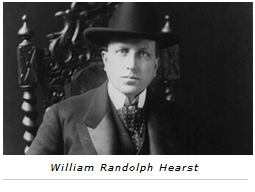
ScreenHunter_02 Feb. 15 01.45 The old models by which newspapers once thrived no longer seem viable. The new models have yet to be born. Media guru Clay Shirky and others have reminded us that the media landscape that held sway over the last century was something of an historical accident. High ideals aside, newspapers were a business. They had to make money. Think of William Randolph Hearst. The great newspapers made money, primarily, through advertising. The publishers needed journalism to provide the content through which they could fill up the non-advertising space of their newspapers. A symbiotic relationship was formed. As Shirky summarizes it:

The high expense of printing has created an environment where Wal-Mart is essentially subsidizing the Baghdad bureau. This isn’t because of any deep link between advertising and reporting, nor is it about any real desire on the part of Wal-Mart to have their marketing budget go to international correspondents. It was just an accident of economics. Advertisers had little choice other than to have their money used that way, since they didn’t have any other vehicle for display ads.

One of the big questions, then, is who is going to pay for all the investigative reporting and in-depth analysis that used to get paid for by the big media giants and their advertisers? The quick answer is that no one has any idea. But there is another answer, temporary and partial as it may be. It is called Al Jazeera.

More here.

Tuesday poem

Blizzard

Snow:
years of anger following
hours that float idly down —
the blizzard
drifts its weight
deeper and deeper for three days
or sixty years, eh? Then
the sun! a clutter of
yellow and blue flakes —
Hairy looking trees stand out
in long alleys
over a wild solitude.
The man turns and there —
his solitary track stretched out
upon the world.
……………..
by William Carlos Williams

Experts determine age of book ‘nobody can read’

Daniel Stolte in Physorg.com:

Uaexpertsdet University of Arizona researchers have cracked one of the puzzles surrounding what has been called “the world's most mysterious manuscript” – the Voynich manuscript, a book filled with drawings and writings nobody has been able to make sense of to this day.

Using radiocarbon dating, a team led by Greg Hodgins in the UA's department of physics has found the manuscript's parchment pages date back to the early 15th century, making the book a century older than scholars had previously thought.

This tome makes the “DaVinci Code” look downright lackluster: Rows of text scrawled on visibly aged parchment, flowing around intricately drawn illustrations depicting plants, astronomical charts and human figures bathing in – perhaps – the fountain of youth. At first glance, the “Voynich manuscript” appears to be not unlike any other antique work of writing and drawing.

But a second, closer look reveals that nothing here is what it seems. Alien characters, some resembling Latin letters, others unlike anything used in any known language, are arranged into what appear to be words and sentences, except they don't resemble anything written – or read – by human beings.

More here.

The Looting and Protection of Egypt’s Treasures

Christopher Heaney in Not Even Past:

ScreenHunter_01 Feb. 15 01.09 This weekend, as Cairo’s protestors struck their tents and tidied up Tahrir Square, a clean-up operation of another sort was underway nearby: in the Egyptian Museum, home to King Tutankhamen and countless other archaeological treasures.

The museum had haunted the protests since they began in late January. In the first few days of the unrest that toppled President Hosni Mubarak on Friday, newspapers were quick to note that a group of looters had broken through a skylight, apparently searching for gold. Although Tut’s famous mask was thankfully under lock-and-key, the intruders knocked over or damaged approximately 70 artifacts. In one of the many exciting turns of the last several weeks, however, Egyptian neighborhood patrols surrounded the museum and caught the would-be thieves.

“I’m standing here to defend and to protect our national treasure,” one man told the AP. “We are not like Baghdad!” shouted another. The looting of Iraq’s National Museum in 2003 was on every observer’s mind.

The Egyptian military arrived soon after, took the looters into custody and made the museum a base of operations. Just outside, Tahrir Square became the protests’ center. It seemed to be a victory for Egypt’s people and its military.

More here.