9 Things The Rich Don’t Want You To Know About Taxes

Lede_3723_pig.widea David Cay Johnston in Willamette Week:

1. Poor Americans do pay taxes.

Gretchen Carlson, the Fox News host, said last year “47 percent of Americans don’t pay any taxes.” John McCain and Sarah Palin both said similar things during the 2008 campaign about the bottom half of Americans.

Ari Fleischer, the former Bush White House spokesman, once said “50 percent of the country gets benefits without paying for them.”

Actually, they pay lots of taxes—just not lots of federal income taxes.

Data from the Tax Foundation show that in 2008, the average income for the bottom half of taxpayers was $15,300.

This year the first $9,350 of income is exempt from taxes for singles and $18,700 for married couples, just slightly more than in 2008. That means millions of the poor do not make enough to owe income taxes.

But they still pay plenty of other taxes, including federal payroll taxes. Between gas taxes, sales taxes, utility taxes and other taxes, no one lives tax-free in America.

When it comes to state and local taxes, the poor bear a heavier burden than the rich in every state except Vermont, the Institute on Taxation and Economic Policy calculated from official data. In Alabama, for example, the burden on the poor is more than twice that of the top 1 percent. The one-fifth of Alabama families making less than $13,000 pay almost 11 percent of their income in state and local taxes, compared with less than 4 percent for those who make $229,000 or more.
‘How Manhattan Drum-Taps Led’

Disunion_chaffin_whitman-articleInline Tom Chaffin in the NYT:

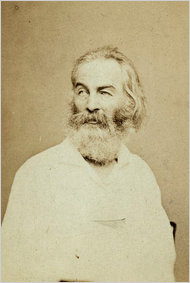
On the evening of April 12, 1861, Walt Whitman attended a performance of Gaetano Donizetti’s opera “Linda di Chamounix” at the Academy of Music, on 14th Street and Irving Place in Manhattan. Just before midnight he was walking down the west side of Broadway, toward the Fulton Ferry to return to his home, in Brooklyn. Suddenly, he later recalled, he “heard in the distance the loud cries of the newsboys, who came presently tearing and yelling up the street, rushing from side to side more furiously than usual.”

Whitman bought a paper and, near Prince Street, crossed Broadway, where he found a crowd reading the papers under the gas lamps of the Metropolitan Hotel. Fort Sumter, they reported, had been shelled in the wee hours of that same day. “For the benefit of some who had no papers, one of us read the telegram aloud, while all listen’d silently and attentively,” he wrote. “No remark was made by any of the crowd, which had increas’d from thirty or forty, but all stood a minute or two, I remember, before they dispers’d.”

In the coming days, the news from Charleston unified skeptics in the North behind a belief that “secession slavery” constituted a palpable evil that had to be confronted. But perhaps no one more so than Whitman: “The volcanic upheaval of the nation, after that firing on the flag at Fort Sumter, proved for certain something which had been previously in great doubt.” Indeed, the beginning of the war would mark the end of his bohemian days and set him on another, more purposeful course.

liquid modernity

Images

Alain Ehrenberg, a uniquely insightful analyst of the modern individual’s short yet dramatic history, attempted to pinpoint the birthdate of the late-modern cultural revolution (at least of its French branch) that ushered in the liquid-modern world we continue to inhabit, to design, as well as to overhaul and refurbish day in day out. Ehrenberg chose an autumnal Wednesday evening in the 1980s, on which a certain Vivienne, an “ordinary French woman,” declared during a television talk show in front of several million viewers that her husband Michel was afflicted with premature ejaculation, for which reason she had never experienced an orgasm throughout her marital life. What was so revolutionary about Vivienne’s pronouncement that it justified Ehrenberg’s choice? Two reciprocally connected aspects: first, something quintessentially, even eponymically private was being made public—that is, it was told in front of everyone who wished or just happened to listen; and second, the public arena, that is, a space open to uncontrolled entry, was used to vent and thrash out a matter of thoroughly private significance, concern, and emotion. Between them, the two upheavals legitimized public use of the language developed for private conversations between a restricted number of selected persons. More precisely, these two interconnected breakthroughs initiated the deployment in public, for the consumption and use of public audiences, of the vocabulary designed for narrating private, subjectively lived-through experiences (Erlebnisse as distinct from Erfahrungen). As the years went by, though, it became clear that the true significance of the event had been the effacing of a once sacrosant division between the “private” and the “public” spheres of human bodily and spiritual life.

more from Zygmunt Bauman at The Hedgehog Review here.

the pity of war

Flandersfields1_upd

The first time I went to Ypres, to In Flanders Fields Museum, housed in the Cloth Hall that forms one side of the town square, I was with Michael Foreman, the great illustrator. We were there to attend a conference on books for the young set against the background of war—I had written “War Horse” some years before, and Michael had written “War Boy” and “War Game”. We were already good friends, having collaborated closely on several stories. We had laughed together a great deal over the years, as friends do. Emerging into the harsh light of day after visiting In Flanders Fields Museum, we wept together. As a schoolboy, I had read the War Poets—Wilfred Owen and Siegfried Sassoon, Edward Thomas and Edmund Blunden (who was a friend of my stepfather’s and often stayed with us at weekends). I had heard Britten’s “War Requiem”, and read “All Quiet on the Western Front”, and seen the film. I’d worn my poppy every autumn; stood cocooned in silence for two minutes every Remembrance Day. But none of these things touched me so intensely as this museum.

more from Michael Morpurgo at More Intelligent Life here.

3 Ways to Spring Clean Your Brain

From The Huffington Post:

HappyDaySpring_dig There's something about the ritual of spring cleaning — whether it's reorganizing your closets and drawers or giving your house a good sweep — that is both comforting and reinvigorating. Likewise, giving your brain a spring makeover will not only help you think clearer, but it will keep you looking younger and more radiant. The reason is that aside from its other duties, our brain directly impacts our mood and physical appearance. Did you know, for example, that your face mirrors the chemical activity taking place in your brain? This activity produces micro-facial expressions — those tiny, involuntary reflections of our thoughts that exude from within and give us that healthy glow. In other words, when your brain is at your best, you will look and feel your best. Here are three ways to give your brain a makeover this spring:

1) Enjoy spring's bounty.

Take advantage of the fresh produce cropping up at your local supermarket this time of year. Studies show that people who consume a diet rich in fruits and vegetables are not only leaner but have sharper memories. Aim for a rainbow of colors in your meals so that your body and brain will reap the benefits of phytonutrients, nature's powerful beautifying agents. These compounds create the distinctive bright colors you see in apples, oranges and red or green peppers.

More here.

Ants Take a Cue From Facebook

From Science:

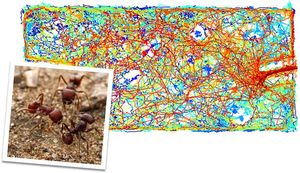
Ants Call it the ant version of Facebook. A new study finds that, whereas most red harvester ants share information with a small number of nestmates, a few convey news to a wide network of others. The results help explain how ant colonies quickly respond to predators and natural disasters. Red harvester ants (Pogonomyrmex barbatus) are native to the deserts in the American Southwest and live in large colonies of several thousand individuals. Most social interactions occur in the colony's entrance chamber. At first light, patroller ants emerge from the colony to ensure that the surrounding area is free from predators and natural hazards. If most of the patroller ants return, they signal forager ants that it's safe to gather seeds, their primary food.

Like all ants, red harvester ants use chemical signals to send information. The ants secrete small molecules on their exoskeletons, and their nestmates rub the exoskeletons with their antennae—the ant equivalent of “Hi, how are you?”—to read these signals. The particular combination of chemicals on an ant's exoskeleton can provide information on what task an ant performs (patroller versus forager), where it has been, and what food it has found. Researchers at Stanford University in Palo Alto, California, measured information exchange in red harvester ants by counting the number of antennae meet and greets each ant experienced in a mock entrance chamber in the lab. The scientists videotaped the entire scene and then used a sophisticated computer program to identify each ant and count how many interactions it had during the experiment (see video). The researchers measured 4628 interactions during a trial with red harvester ants from each of two different colonies.

More here.

The Praxis of the Egyptian Revolution

Mona El-Ghobashy at the Middle East Research and Information Project:

ScreenHunter_12 Apr. 13 12.15 If there was ever to be a popular uprising against autocratic rule, it should not have come in Egypt. The regime of President Husni Mubarak was the quintessential case of durable authoritarianism. “Our assessment is that the Egyptian government is stable and is looking for ways to respond to the legitimate needs and interests of the Egyptian people,” said Secretary of State Hillary Clinton on January 25, 2011. [1] With these words, Clinton gave voice to a common understanding of Egypt under Mubarak. Government officials, pundits and academics, foreign and domestic, thought the regime was resilient — not because it used brute force or Orwellian propaganda, but because it had shrewdly constructed a simulacrum of politics. Parties, elections and civic associations were allowed but carefully controlled, providing space for just enough participatory politics to keep people busy without threatening regime dominance.

Mubarak’s own party was a cohesive machine, organizing intramural competition among elites. The media was relatively free, giving vent to popular frustrations. And even the wave of protest that began to swell in 2000 was interpreted as another index of the regime’s skill in managing, rather than suppressing, dissent. Fundamentally, Egypt’s rulers were smart authoritarians who had their house in order. Yet they were toppled by an 18-day popular revolt.

Three main explanations have emerged to make sense of this conundrum: technology, Tunisia and tribulation.

More here.

Bombs, Bullets & Burqas

Daisy Rockwell in The Sunday Guardian:

ScreenHunter_11 Apr. 13 12.04 Last summer, at the local farmers' market, I was surprised and pleased to see a stand advertising “Pakistani Food.” Who would expect such an offering in a small New England town? But when I approached the stand I found that none of the food, a series of fried, stuffed turnover-like snacks called 'mantus,' seemed all that Pakistani. I struck up a conversation with the man behind the counter. His English was poor. I tried Urdu. His Urdu seemed poorer. I was confused. He was confused. Finally, I asked, in English, very slowly, “You're not Pakistani, are you?” He acknowledged that he was not. He indicated he was Persian, but said he was not from Iran. Finally I ventured that he might be from Afghanistan, and he agreed, but hedged his response by mentioning that he had lived for some time in Pakistan. He seemed convinced that advertising his food as Pakistani was a smarter business move than associating it with Afghanistan. This summer the booth has been a fixture in the market again, but now the banner reads “Afghan-Pak Foods.”

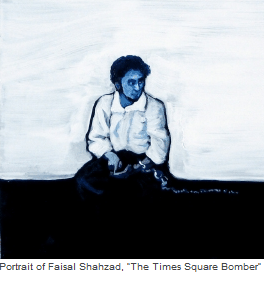
Thanks to such characters in the ever-expanding cast of the Global War on Terror as through Faisal Shahzad, the loftily nicknamed 'Times Square Bomber' (can you really be called a 'bomber' when your bomb didn't go off?), an awareness of Pakistan has suddenly burst into the American popular imagination. Our previous total lack of awareness of Pakistan in the United States has now been replaced with a perhaps more unfortunate awareness of militancy in Pakistan. Even the disastrous flooding of vast swaths of the country, characterised by UN Secretary General Ban Ki-moon as a 'slow-motion tsunami', has failed to make much of a dent in perceptions of the country. The chance that an increasingly xenophobic American populace will agree to buy stuffed savory snacks from Afghanistan over those from Pakistan have diminished greatly over the past year.

More here.

Elif Batuman

A conversation with Helen Stuhr-Rommereim in Full Stop:

Elifbatuman There aren’t many people who straddle the worlds of academia and journalism with as much ease and good humor as Elif Batuman. A Turkish-American writer, she recently gained fame chronicling her adventures as a PhD candidate in Comparative Literature at Stanford University in her first book, The Possessed: Adventures with Russian Books and the People Who Read Them. The book is a collection of essays about traveling, reading, academic conferences, relationship troubles, and the former Soviet Union. She continues to be a prolific writer of magazine pieces — her byline has popped up in the past year in the London Review of Books, the Paris Review, The New Yorker, n+1, and The New York Times, to name a few. I started keeping an eye out for her writing after I read The Possessed, which made me laugh out loud so often that I ended up having to read it aloud to whomever was around me. In Batuman’s hands it almost seems natural that a conference on Isaac Babel might leave you giggling and in tears.

Humor aside, it’s refreshing to have someone young, smart, and entertaining who is garnering attention for simply writing about how much she likes books. The Possessed concludes, “If I could start over today, I would choose literature again. If the answers exist in the world or in the universe, I still think that’s where we’re going to find them.” After finishing The Possessed, I was nearly convinced to jump into a PhD in literature, and I don’t imagine I’m the only one.

I was lucky enough to get to spend some time with Batuman at Koç University on the outskirts of Istanbul, where she is currently a writer-in-residence. We talked about her plans for her next book, her thoughts on contemporary fiction, and what exactly is so funny about academia.

What are you working on now?

I’m on contract for the first time with The New Yorker, rather than being a freelancer. It’s different because they help me come up with ideas, rather than me pitching and hustling. The last story I did for them was about football fan culture, which is not a story I would have come up with on my own. It was interesting to do something like that, kind of out of my comfort zone and also out of my interest zone.

More here.

Tuesday, April 12, 2011

My Years As Gaddafi’s Nurse

Oksana Balinskaya in Newsweek:

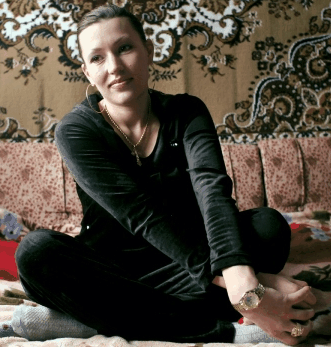
ScreenHunter_09 Apr. 13 11.16 I was just 21 when I went to work for Muammar Gaddafi. Like the other young women he hired as nurses, I had grown up in Ukraine. I didn’t speak a word of Arabic, didn’t even know the difference between Lebanon and Libya. But “Papik,” as we nicknamed him—it means “little father” in Russian—was always more than generous to us. I had everything I could dream of: a furnished two-bedroom apartment, a driver who appeared whenever I called. But my apartment was bugged, and my personal life was watched closely.

For the first three months I wasn’t allowed to go to the palace. I think Papik was afraid that his wife, Safia, would get jealous. But soon I began to attend to him regularly. The job of the nurses was to see that our employer stayed in great shape—in fact, he had the heart rate and blood pressure of a much younger man. We insisted that he wear gloves on visits to Chad and Mali to protect him against tropical diseases. We made sure that he took his daily walks around the paths of his residence, got his vaccinations, and had his blood pressure checked on time.

More here.

hitch reads the bible

Hitchens-220

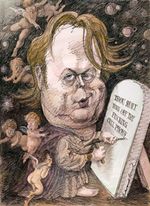
Four hundred years ago, just as William Shakespeare was reaching the height of his powers and showing the new scope and variety of the English language, and just as “England” itself was becoming more of a nation-state and less an offshore dependency of Europe, an extraordinary committee of clergymen and scholars completed the task of rendering the Old and New Testaments into English, and claimed that the result was the “Authorized” or “King James” version. This was a fairly conservative attempt to stabilize the Crown and the kingdom, heal the breach between competing English and Scottish Christian sects, and bind the majesty of the King to his devout people. “The powers that be,” it had Saint Paul saying in his Epistle to the Romans, “are ordained of God.” This and other phrasings, not all of them so authoritarian and conformist, continue to echo in our language: “When I was a child, I spake as a child”; “Eat, drink, and be merry”; “From strength to strength”; “Grind the faces of the poor”; “salt of the earth”; “Our Father, which art in heaven.” It’s near impossible to imagine our idiom and vernacular, let alone our liturgy, without them. Not many committees in history have come up with such crystalline prose.

more from Christopher Hitchens at Vanity Fair here.

The glory and the loneliness of Omar Sharif

24_sharif_02

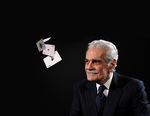
Omar Sharif represented Egypt in the 1964 Olympics for the game of contract bridge, according to one of the more benign rumors circulating about him on the internet. The secular trinity of Google, Google Books, and Wikipedia are uncharacteristically useless in confirming or denying the story, but the fact is, it just can’t be true, because bridge isn’t an Olympic sport. Bridge players have tried for decades to make it one, and in the late 1990s, the Olympic Committee recognized as it as one of two “mind sports,” along with chess. But the committee, which apparently finds curling perfectly tolerable viewing, has yet to be persuaded that the bridge is, in any conceivable sense, watchable. After considerable digging, I was able to trace the source of the rumor to a 1966 story in the Washington Post, which reported that Omar Sharif had captained the United Arab Republic’s bridge team for the World Bridge Olympiad of 1964. So much for the legacy media: there was indeed something called the World Bridge Olympiad, held every four years between 1960 and 2004, but the United Arab Republic — the short-lived union of Egypt and Syria — ceased to exist in 1961. Still, there is something apt about the bogus story. If anyone could have turned contract bridge into a spectator sport, it would have been the Omar Sharif of the swinging sixties. He was religiously devoted to the sport, occasionally refusing films if they interfered with his bridge-playing schedule. And he tried valiantly to bring attention to the game, even forming a barnstorming “Omar Sharif Bridge Circus,” a caravan of crack players who traveled the world playing tournaments and exhibition matches. Truly, there has never been a more beautiful, more glamorous bridge ambassador than Omar Sharif. The only way he might have given the Olympic Committee something to watch is if he had agreed to compete, like Olympians in the age of Pindar, naked.

more from Curtis Brown at Bidoun here.

war and literature

Civilwarlit__1302295964_3326

One April night in 1861, almost exactly 150 years ago, Walt Whitman decided to go to the opera. After watching a performance of Verdi, he walked into the New York air — and into a world that had changed completely. Paper boys were “rushing from side to side even more furiously than usual,” Whitman would later write, and he bought one of their extra editions and began reading it under the lamps of the Metropolitan Hotel. The previous day, Southern forces had fired on Fort Sumter. America’s Civil War had begun. Over the next four years, this war would become the most disruptive and transformative event in American history — something that was true in Whitman’s time and remains true in our own, as we begin marking its sesquicentennial this week. It’s no surprise that, in the intervening years, no other event has attracted more writers (or sold more books). But what is surprising is that the Civil War did not produce any great works of contemporary literature. This has puzzled critics and readers from the beginning. “Our war,” William Dean Howells wrote in 1867, “has laid upon our literature a charge under which it has hitherto staggered very lamely.”

more from Craig Fehrman at the Boston Globe here.

How To (and How Not To) Write Poetry

Advice for blocked writers and aspiring poets from a Nobel Prize winner’s newspaper column.

Wisława Szymborska at the website of the Poetry Foundation:

Wislawa-szymborska_36107 To Grazyna from Starachowice: “Let’s take the wings off and try writing on foot, shall we?”

To Mr. G. Kr. of Warsaw: “You need a new pen. The one you’re using makes a lot of mistakes. It must be foreign.”

To Pegasus [sic] from Niepolomice: “You ask in rhyme if life makes cents [sic]. My dictionary answers in the negative.”

To Mr. K.K. from Bytom: “You treat free verse as a free-for-all. But poetry (whatever we may say) is, was, and will always be a game. And as every child knows, all games have rules. So why do the grown-ups forget?”

To Puszka from Radom: “Even boredom should be described with gusto. How many things are happening on a day when nothing happens?”

To Boleslaw L-k. of Warsaw: “Your existential pains come a trifle too easily. We’ve had enough despair and gloomy depths. ‘Deep thoughts,’ dear Thomas says (Mann, of course, who else), ‘should make us smile.’ Reading your own poem ‘Ocean,’ we found ourselves floundering in a shallow pond. You should think of your life as a remarkable adventure that’s happened to you. That is our only advice at present.”

More here.

In the trenches at a molecular gastronomy mecca

From Salon:

Ferran Take an olive. Wring its pretty neck. Collect the juice, process it with algae-based gelifiers and calcium carbonate and — hey, presto! — the liquid turns into a tremulous globule of olive essence, beyond divine with your martini. It's subversive and witty, and Ferran Adria does equally outré, ravishing things to the likes of rabbit tongue, marinated fish liver, and prehistorically large cardoons, all in the service of flavor and slaying expectations, setting your hair on fire with his rarefied creations.

But all right already, enough ink has been spilled singing the praises of the avant-garde Spanish chef. What about those apprentices in the kitchen, asks Time magazine correspondent Lisa Abend, the ones actually making and plating much of the food served at the restaurant elBulli? Her book, “The Sorcerer's Apprentices,” spends a revealing, dexterously rendered six months in their company, this troop of unpaid kitchen disciples known as stagiaires, part of the feudal tradition whereby young cooks gain direction and purpose from a great mentor. They are an elect handful — Abend closely, sympathetically profiles a half-dozen of them — as lucky to get this apprenticeship as anyone else is to get a seat at elBulli, and thrilled with the opportunity, at least at first. “Like all great restaurants, elBulli's dazzle rests in large part on the willingness of the apprentices, in the name of education, to do the dreary work no one else wants to do.” Say, making 2,000 lentils a day out of clarified butter and sesame paste. That's right, lentils: typical Adria legerdemain.

More here.

Remembering Juliano Mer-Khamis

Ismail Khalidi and Jen Marlowe in The Nation:

Mer%20Khamis In 2006, the new Freedom Theatre in Jenin Refugee Camp held an art competition.

“Don’t just go for the tanks,” Juliano Mer-Khamis, the co-founder of the theater, told the children-artists. “Hope. Where is the hope?”

A 12-year-old girl named Wafaa painted a mother pulling her son out of the ruins of a demolished home. Juliano gently admonished the young student, reminding her that the painting should represent hope.

“But there’s this red flower,” the girl said, pointing to a splash of color next to the rubble. “There.”

“I almost cried,” Juliano recounted. “So…hope is there. We have to pour water, pour water, pour water. And that’s what we do here.”

That hope was badly shattered on Monday, April 4, when Juliano was shot dead by a masked gunman outside the Freedom Theatre.

Juliano, the child of a Jewish Israeli mother and Palestinian Christian father, both communists, co-founded the Freedom Theatre as an outgrowth of his 2004 documentary film, Arna’s Children. The film depicts the art and theater program that his mother, Arna, established for children in the Jenin Refugee Camp during the first intifada. Juliano returns to the camp after the massive Israeli invasion of 2002, during the second intifada, when large swaths of it were bulldozed by the Israeli army. He wants to know: what became of the children from his mother’s program? Nearly all of them, he discovers, are dead.

More here. The Jenin Freedom Theatre Today:

The day I met Abdul Sattar Edhi

Peter Oborne in The Telegraph:

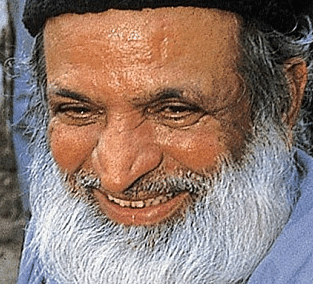
ScreenHunter_08 Apr. 12 13.37 He was born in 1928, when the British Empire was at its height, in Gujarat in what is now western India. But he and his family were forced to flee for their lives in 1947 when the division of India and creation of Pakistan inspired terrible communal tensions: millions were killed in mob violence and ethnic cleansing.

This was the moment Mr Edhi, finding himself penniless on the streets of Karachi, set out on his life's mission.

Just 20 years old, he volunteered to join a charity run by the Memons, the Islamic religious community to which his family belonged.

At first, Mr Edhi welcomed his duties; then he was appalled to discover that the charity's compassion was confined to Memons.

He confronted his employers, telling them that “humanitarian work loses its significance when you discriminate between the needy”.

So he set up a small medical centre of his own, sleeping on the cement bench outside his shop so that even those who came late at night could be served.

But he also had to face the enmity of the Memons, and became convinced they were capable of having him killed. For safety, and in search of knowledge, he set out on an overland journey to Europe, begging all the way.

One morning, he awoke on a bench at Rome railway station to discover his shoes had been stolen.

More here.