The family that plays together stays together?

From PhysOrg:

Thefamilytha “Get off the computer and go play outside.” So go the words heard in homes around the country as parents and children clash over the social benefits of video games. But parents needn’t worry so much, according to Dr. Cuihua (Cindy) Shen, an assistant professor of Emerging Media and Communication at UT Dallas. Her recent research article in the Communication Research journal argues that online games can actually bolster family communication. “Even though most people think that spending large amounts of time playing online games can be harmful to one's social life, if people play online games with their existing friends and family, game play could actually enhance their social experiences,” Shen said. “An online game thus becomes an additional venue, albeit virtual, for socialization.” Shen surveyed more than 5,000 gamers about how they use the Internet, their specific activities in the virtual world and their psychosocial well-being for the article, “Unpacking Time Online: Connecting Internet and Massively Multiplayer Online Game Use With Psychosocial Well-Being,” co-written by Dmitri Williams.

According to the study, online games engage 76 percent of all teens and 23 percent of all adults in the United States. Of these games, networked games known as massively multiplayer online games (MMOs) are growing in popularity. The content of these games is based largely on social interactions, which supports the argument that new technologies create social augmentation, as opposed to displacement: “Not only could the Internet enhance one’s everyday communication with family and friends locally and over a distance,” wrote Shen, “it could also enlarge one’s existing social network by bringing together people with shared interest and values in virtual communities.”

More here.

A Baltimore Sun photographer who took a buyout, started a blog, and changed the photography business forever

Steven I. Weiss in Slate:

ScreenHunter_02 Apr. 22 13.11 At first glance, David Hobby looks like just another casualty of the decline of print media: A longtime staff photographer for the Baltimore Sun, he was one of many employees who accepted a buyout in 2008 as part of broad staff reductions at the distressed newspaper.

Yet last month he embarked on a sold-out, cross-country tour that will visit 29 cities. Approximately $1 million in tickets have been sold for the privilege of hearing Hobby and famed magazine photographer Joe McNally speak about their craft. Hobby's blog, Strobist, on which he teaches amateurs the lighting techniques used by professionals, welcomed 2 million unique visitors last year. (The largest professional photography association has a membership 1 percent of that size.) Manufacturers have named lines of equipment after him, an unheard-of honor.

How Hobby went from being a workaday newspaper photographer to an internationally recognized guru is a story tied up with seismic changes in the photography profession. By teaching a horde of novices the skills necessary to shoot photographs of a quality that was until very recently only within the grasp of an elite few, Hobby has played a significant role in the transformation of the profession. In the last few years, the market rate for many types of professional photographs has dropped by as much as 99 percent.

More here.

Thursday, April 21, 2011

Pakistan’s transgender tribe of tax collectors

From CNN:

ScreenHunter_01 Apr. 22 10.32 Miss your tax deadline in the United States this weekend, and you might get a nasty letter at your door. In Karachi, Pakistan's largest city, you might get Riffee and the gang. They are “transgender” tax collectors — whose weapons include flamboyancy, surprise — and a little lipstick.

In a move that speaks volumes about the lengths to which Pakistan is going to tackle tax evasion, Karachi officials are using Riffee – who like many people in South Asia works under a single name – and her team as enforcers with a difference. They are sent to the businesses or houses of debtors. The aim — in this very conservative Muslim society — to embarrass tax debtors into paying up.

Riffee — like her tax-collector friends Sana and Kohan — is physically a man, but prefers to be called and dress as a woman. Their job is quite simple: each morning they turn up to work and get a list of missed payments. One by one, they make house-calls, causing trouble at each debtor's home or office, trying to get them to pay up. It's not clear how effective this tactic is, but officials insist they would not do it if it did not work.

“Their appearance causes great embarrassment amongst the people,” said Sajid Hussein Bhatti, the tax superintendent who gives Riffee her orders every morning.

More here.

HE HAD SHAMAN’S EYES

Article

“GOD, PLEASE FUCK MY MIND FOR GOOD!” Captain Beefheart shouted at the end of Doc at the Radar Station, his second-to-last album. It was 1980, and it was a dare to whatever version of God might be present to receive it: his audience, maybe; music itself. Or it was a dare to time—the fifteen years since he’d made his first record, or the thirty years to come. Can you shut me up? Can you scramble my rhythm and my words until they’re a labyrinth I’ll never escape? I’ll do it first! His first record—a single that was cut in 1965 in Los Angeles, a street sign away from Glendale, where he was born Don Glen Vliet in 1941—was a huge, devouring version of Bo Diddley’s 1956 “Diddy Wah Diddy.” Diddy-WAHHHHHH, the by now renamed Don Van Vliet proclaimed, his voice lowering into a rumble that all but broke the needle on the recording console: “Ain’t no town, ain’t no city—” That was a dare: Wherever I go, I’ll leave confusion, awe, fear, and freedom in my wake. From Safe as Milk in 1967 to the double dare of Trout Mask Replica two years later, from Lick My Decals Off, Baby in 1970 through to Ice Cream for Crow in 1982, he performed as a crackpot, spouting riddles made out of puns, sketching conspiracy theories as winking and Grimms-like as the paintings—often featuring wisps of animal-human composites at once threatening and playful—that would occupy his last three decades. Legends surrounded him, stopping just short of claims that he’d been raised by wolves: that he ruled the musicians in his Magic Band like a cult leader, giving all of them new names, as if they had had no identity before him and would have none after; that he could predict when the telephone would ring, or make it ring to match his prediction. Nothing was so scary as the sense of certainty that drove his music like a stagecoach driver flashing his whip.

more from Greil Marcus at Artforum here.

the literature of cursi

Puig_ftr

Manuel Puig occupies a curious place in Latin American literature. Chronologically, he should be a member of the Boom generation, but he’s rarely included in the usual catalog of Boom writers (Gabriel García Márquez, Mario Vargas Llosa, Carlos Fuentes). This is not because he was less prominent, though since the 1980s his reputation has faded a little. His novels—especially Kiss of the Spider Woman (1976)—were internationally acclaimed and widely read. He was a genuinely popular writer while at the same time a radical innovator, with a subversive take on sexual and domestic affairs. Kiss of the Spider Woman was notorious for its frank depiction of a love affair between two prisoners; Betrayed by Rita Hayworth (1968) and Heartbreak Tango (1969), his first two novels, are kitschy tributes to the Argentina of his youth; his third, The Buenos Aires Affair (1973), is a frothy, Freudian noir. From the perspective of some critics, the trouble with Puig wasn’t that he wrote about homosexuals and housewives. It was that he didn’t write about them seriously. His protagonists weren’t so much persecuted heroes or twisted victims (though they were that, too) as they were creatures of sentiment—and, often, figures of fun. What disqualified Puig (implicitly) as a member of the Boom was his lack of gravitas, both in fiction and in life. In a New York Times review of Suzanne Jill Levine’s highly entertaining and essential biography, Manuel Puig and the Spider Woman: His Life and Fictions (2000), Vargas Llosa writes disapprovingly about what he sees as Puig’s lack of dedication to the world of books: “Of all the writers I have known, the one who seemed least interested in literature was Manuel Puig (1932–90). He never talked about authors or books, and when a literary topic came up in conversation he would look bored and change the subject.” As Francisco Goldman points out in his excellent introduction to Heartbreak Tango, one of three Puig novels recently reissued by Dalkey Archive, this was unfair and ungenerous. Of all the writers of the Boom, Vargas Llosa might have been expected to understand and appreciate Puig, because he too has occasionally embraced what might be called the literature of cursi.

more from Natasha Wimmer at The Nation here.

flattened and standardized

The_Nobel_Prize_736230a

A novelist is not famous today unless internationally famous, not recognized unless recognized everywhere. Even the recognition extended to him in his home country is significantly increased if he is recognized abroad. The smaller the country he lives in, the less important his language on the international scene, the more this is the case. So if for the moment the phenomenon is only vaguely felt in Anglophile cultures, it is a formidable reality in countries like Holland or Italy. The inevitable result is that many writers, consciously or otherwise, have begun to think of their audience as international rather than national. One can get a sense of the mindset behind this development by considering the changing profile of translation on the one hand and international literary prizes on the other. If a writer is to be projected on to the world stage, his work must be translated into a number of languages. If a certain amount of promotional hype is to be generated around a book, then the publisher will make sure that these translations are commissioned and completed in a number of territories more or less simultaneously and prior to the publication of the book in its country of origin. In this way the novel can be launched worldwide, something that increases its profile in each separate territory. Translation thus becomes an all-important part of the initial promotion of a novel, which may well find fewer readers in its original language than in its many translations. Yet translators are becoming less rather than more visible. Few readers will be aware who translates their favourite foreign novelist, even though that person will have a huge influence on the tone and feel of every page.

more from Tim Parks at the TLS here.

What exactly is India’s Pakistan policy?

Anjum Altaf in The South Asian Idea:

India-pack What exactly is India’s Pakistan policy? For years (decades, really) I have puzzled this over without being able to discern anything coherent. True, I am not privy to the inner councils of the Indian establishment but backward induction from observed actions does not seem to suggest I am grossly mistaken.

The Pakistani establishment, by contrast, has a very clear India policy: keep the pot boiling, engineering an incident when needed; bleed by a thousand cuts with the bleeding outsourced to third parties; shore up domestic support by transforming education and information into indoctrination; and minimize public contact across borders to prevent any erosion of the mythology.

India’s policy, at best, could be characterized as a reactive tit-for-tat illustrated poignantly by the exchange of helpless fishermen released from time to time by both sides after having languished pointlessly in jails for years. Yes, there is back-channel diplomacy, the occasional handshake over cricket, and citizen vigils but these hardly count as policy.

The question remains: what explains this lack of policy? I suppose one could find a rationale of the mindless tit-for-tat until, say, the end of the 1980s, in the general perception of equivalence between two poor countries but for the fact that India had six times as many people. That, however, is no longer the case – the trajectories have diverged markedly since then with India aspiring to be key global player within the century and Pakistan floundering to save itself from itself.

More here.

Mind Games

From Orion:

Mind AS PARENTS, we can only do so much to protect our children from the brain-disrupting chemicals that lurk in every part of the Earth’s dynamic systems— its water cycles, air currents, and food chains. Faith and Elijah spend their days in a school full of equipment and furniture that no doubt contain brominated flame retardants (which, according to a 2010 study published by the National Institute of Environmental Health Sciences, is linked to lower scores on tests of mental development among children exposed in utero). They ride home on a diesel-powered bus. They fly around town on bicycles — or scooters or skateboards— to flute lessons, piano lessons, the public library, passing by pesticide-treated fields and lawns as they go. And when we lie together in the dark at the end of the day, I sometimes wonder how their brain architecture might have been — might still be — irreversibly altered, even if only slightly, by brain-damaging chemicals that are still allowed to be manufactured and sold, that are constantly pouring out of smokestacks and tailpipes, that are used as ingredients in everything from lipstick to gasoline. I sometimes think about these things when I watch one or the other of them erase a hole through a frustrating homework assignment and start over again.

So don’t give me any more shopping tips or lists of products to avoid. Don’t put neurotoxicants in my furniture and my food and then instruct me to keep my children from breathing or eating them. Instead, give me federal regulations that assess chemicals for their ability to alter brain development and function before they are allowed access to the marketplace. Give me a functioning developmental neurotoxicant screening program, with validated protocols. Give me chemical reform based on precautionary principles. Give me an agricultural system that doesn’t impair our children’s learning abilities or their futures. Give me an energy policy based on wind and sun. Because I can do the thinking and research associated with making the right school choice for my children. I can help them with multiplication tables and subject-verb agreement. I can pack healthy school lunches. But I can’t place myself between their bodies and the two-hundred-plus identified neurotoxicants that circulate freely through the environment we all inhabit.

More here.

Gut study divides people into three types

From Nature:

Gut Just as there are a few major blood types that divide up the world, so too, a study has found, there are just three types of gut-microbe populations. The result could help to pinpoint the causes of obesity and inflammatory bowel disease, and to personalize medicine. “Canada, in March. Ehrlich, a senior researcher on the paper published in Nature today1, is director of the Microbial Genetics Research Unit at the National Institute for Agricultural Research in Jouy-en-Josas, France, and part of a European consortium aiming to unpick links between gut microbes and disease. The finding of just three types of gut-microbe population was an unexpected result that fell out of the team's early analysis. The types aren't related to age, gender, nationality or diet. “What causes it? We don't know,” says Ehrlich.

One possible explanation, which the team is testing, is that a person's gut-microbe make-up is determined by his or her blood type. Alternatively, it might be determined by metabolism: there are three major chemical pathways by which people get rid of excess hydrogen gas created during food fermentation in the colon, and the gut type might be linked to those. Or, perhaps the first microbes a baby is exposed to as his or her immune system is developing determines the type. A person's gut type might help to determine whether people can eat all they like and stay slim, whether they will experience more gut pain than others when sick and how well they can metabolize a certain drug.

More here.

Ariel casts out Caliban

The concept of the 'killer-ape' offers a pessimistic reflection of humanity and its genesis, but the latest research shows that a primate species whose success is based on mutual aid and pleasure, not violence, is a better model for human origins.

Eric Michael Johnson in Times Higher Education:

THE_cover_210411 In 1607, after being held captive by the Portuguese in West Africa's Congo Basin for nearly 18 years, the English sailor Andrew Battell returned home with lurid tales of “ape monsters”. The larger of the two creatures Battell described, according to the edited volume later published by travel writer Samuel Purchas, Purchas His Pilgrimes, “is in all proportion like a man”, but “more like a giant in stature…and has a man's face, hollow-eyed, with long haire upon his browes”. These marauding beasts “goe many together, and kill many (villagers)…they are so strong, that ten men cannot hold one of them”. Battell's narrative, much of which was received second hand and sure to be highly imaginative, was nevertheless one of Western society's earliest introductions to our evolutionary cousins, the great apes.

Simia quam similis turpissima bestia nobis (“How similar the ape, this ugliest of beasts, is to ourselves”). What the Roman poet Ennius presented in the 2nd century BC was a refrain that could be heard repeatedly during the subsequent two millennia whenever Europeans encountered this being that so threatened the line separating human and animal. The common depiction of non-human primates in the West as representations of sin and the Devil, wickedness, frivolity, impulsivity and violence would ultimately say more about our own discomfort at being reminded of similar qualities in ourselves than their nature.

But it is the depiction of the ape as monster that is even more revealing.

More here.

Does Kate Middleton really want to marry into a family like this?

Christopher Hitchens in Slate:

110418_FW_willKateTN …I mean, the whole thing is just so painfully and absolutely vulgar. And, among the queen's many children and grandchildren, not by any means exceptional behavior either ….

This is why I laughed so loud when the Old Guard began snickering about the pedigree of young Ms. Middleton. Her parents, it appeared, were not quite out of the top drawer. The mother had been an air hostess or something with an unfashionable airline, and the family had been overheard using lethally wrong expressions, such as serviette for napkin, settee for sofa, and—I can barely bring myself to type the shameful letters—toilet for lavatory. Ah, so that's what constitutes vulgarity! People who would never dare risk a public criticism of the royal family, even in its daytime-soap incarnation, prefer to take a surreptitious revenge on a young woman of modest background. For shame.

Myself, I wish her well and also wish I could whisper to her: If you really love him, honey, get him out of there, and yourself, too. Many of us don't want or need another sacrificial lamb to water the dried bones and veins of a dessicated system. Do yourself a favor and save what you can: Leave the throne to the awful next incumbent that the hereditary principle has mandated for it.

More here.

Wednesday, April 20, 2011

Three Cups of BS

Alanna Shaikh in Foreign Policy:

ScreenHunter_05 Apr. 20 23.04 The world was shocked by a report on CBS's 60 Minutes this week that accused bestselling author and humanitarian Greg Mortenson of being a fraud. Not only were some of the stories from his book fabricated, 60 Minutes alleges, but the charity that Mortenson created to build schools in Pakistan and Afghanistan never built many of the facilities it has taken credit for. Mortenson's Three Cups of Tea didn't, as it claimed, bring education to rural Pakistan and Afghanistan. Its finances are a mess, and the charity does not even seem to have kept track of how many schools it built or how many students attended them.

While much of the uproar has been over the lies Mortenson peddled, I can't help wondering: Why, exactly, did we ever think that Mortenson's model for education, exemplified in his Central Asia Institute (CAI), was going to work? Its focus was on building schools — and that's it. Not a thought was spared for education quality, access, or sustainability. But building schools has never been the answer to improving education. If it were, then the millions of dollars poured into international education over the last half-century would have already solved Afghanistan's — and the rest of the world's — education deficit by now.

Over the last 50 years of studying international development, scholars have built a large body of research and theory on how to improve education in the developing world. None of it has recommended providing more school buildings, because according to decades of research, buildings aren't what matter. Teachers matter. Curriculum matters. Funding for education matters. Where classes actually take place? Not really.

The whole CAI model was wrong. But here's the truly awful thing: Looking back, it's clear that everyone knew that that CAI's approach didn't work. It was just that no one wanted to talk about it.

More here.

The Blog as Mask and Gravestone

6a00d83453bcda69e2014e6110cd8c970c-400wi Justin Erik Halldór Smith over at his blog:

In a fine introduction to a recent edition of The Anatomy of Melancholy (1621), William Gass writes that what he admires most about Robert Burton's life-work is “the width of the world that can be seen from one college window…; what a love of all can be felt by one who has lived it sitting in a chair.” Burton’s Anatomy, indeed, often gives the impression that its author set out to create a Gesamtkunstwerk, a total work of art whose aim was nothing less than to reproduce the world.

As with the Internet, the result is clumsy and chaotic, and Burton recognizes as much; and yet, in this way, both haphazard and cloistered, he manages to create, over the course of a life, a thousand-page mirror of the world:

I have confusedly tumbled over divers authors in our libraries, with small profit for want of art, order, memory, judgment. I never travelled but in map or card, in which my unconfined thoughts have freely expatiated, as having ever been especially delighted with the study of cosmography… A mere spectator of other men’s fortunes and adventures, and how they act their parts, which methinks are diversely presented unto me, as from a common theatre or scene.

Burton loved the world, though he knew it almost entirely through the books he kept in his cell. While at nearly the same moment in European history, Burton’s contemporaries, such as René Descartes, were denouncing ‘book learning’ as inauthentic, as an impediment to true knowledge, Burton reminds us, as Gass so well understands of his predecessor, that whether out in the world or locked in our cell, it is the human mind that is doing most of the work of experience anyway; a rich, full life may be led with only the most two-dimensional of stimuli to carry it along. The Anatomy of Melancholy is proof of this.

Today, too, the Internet can seem an impediment to many of what are thought to be our more authentic experiences. But it may also be facilitating the sort of experience we have always had, qua human beings, experience based in love, which can be had just as intensely in virtual form (letters from friends, books about nature, the Internet), as in ‘reality’ (seeing friends face-to-face, going camping).

The Bible Is Dead; Long Live the Bible

Photo_11595_landscape_large Timothy Beal in The Chronicle:

When it comes to the Bible, many feel there is a single right meaning—the one its divine author intended. “Well, what does the Bible say?” “The Bible is very clear about that.” This is part of the iconicity of the Bible in contemporary society, the idea of it as the one and only divinely authored and guaranteed book of answers, with one answer per question. No more, no less.

For many potential Bible readers, that expectation that the Bible is univocal is paralyzing. You notice what seem to be contradictions or tensions between different voices in the text. You can't find an obvious way to reconcile them. You figure that it must be your problem. You don't know how to read it correctly, or you're missing something. If the Bible is God's perfect, infallible Word, then any misunderstanding or ambiguity must be the result of our own depravity. So you either give up or let someone holier than thou tell you “what it really says.” I think that's tragic. You're letting someone else impoverish it for you, when in fact you have just brushed up against the rich polyvocality of biblical literature.

The Bible is anything but univocal about anything. It is a cacopho­ny of voices and perspectives, often in conflict with one another. In many ways, those dedicated to removing all potential biblical contradictions, to making the Bible entirely consistent with itself, are no different from irreligious debunkers of the Bible, Christianity, and religion in general. Many from both camps seem to believe that simply demonstrating that the Bible is full of inconsistencies and contradictions is enough to discredit any religious tradition that embraces it as Scripture.

Bible debunkers and Bible defenders are kindred spirits. They agree that the Bible is on trial.

Dangerous Arts

20opedimg-articleInline Salman Rushdie in the NYT:

The lives of artists are more fragile than their creations. The poet Ovid was exiled by Augustus to a little hell-hole on the Black Sea called Tomis, but his poetry has outlasted the Roman Empire. Osip Mandelstam died in a Stalinist work camp, but his poetry has outlived the Soviet Union. Federico García Lorca was killed by the thugs of Spain’s Generalissimo Francisco Franco, but his poetry has survived that tyrannical regime.

We can perhaps bet on art to win over tyrants. It is the world’s artists, particularly those courageous enough to stand up against authoritarianism, for whom we need to be concerned, and for whose safety we must fight.

Not all writers or artists seek or ably perform a public role, and those who do risk obloquy and derision, even in free societies. Susan Sontag, an outspoken commentator on the Bosnian conflict, was giggled at because she sometimes sounded as if she “owned” the subject of Sarajevo. Harold Pinter’s tirades against American foreign policy and his “Champagne socialism” were much derided. Günter Grass’s visibility as a public intellectual and scourge of Germany’s rulers led to a degree of schadenfreude when it came to light that he had concealed his brief service in the Waffen-SS as a conscript at the tail end of World War II. Gabriel García Márquez’s friendship with Fidel Castro, and Graham Greene’s chumminess with Panama’s Omar Torrijos, made them political targets.

When artists venture into politics the risks to reputation and integrity are ever-present.

Buster Keaton and the World of Objects

Geoff Nicholson in the debut issue of the Los Angeles Review of Books:
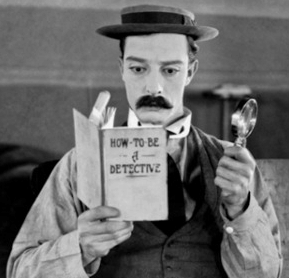
ScreenHunter_04 Apr. 20 16.02 Given the choice between a book and a baseball bat, there is no choice for Buster. He’ll take the bat every time. When he’s working on a movie sequence and they’ve run out of ideas, he yells, “Throw down your pencils, pick up the bats.” The crew sets up a baseball game. By the second or third inning, probably with a runner on base, Buster will throw his glove in the air, yell, “I got it!” and they can all get back to work. Must have been frustrating for the guy on third.

You know where you are with a baseball bat. It’s not that way with books. (It’s not that way with many things.) And sometimes, when it suits him, it isn’t even that way with baseball bats either. There are times when, for the sake of a laugh, or a charity game, or in the movie One Run Elmer, Keaton will put on a show with a bat made of plaster of Paris, or he’ll pack explosive in the tip so that it blows up on contact with the ball, but that’s OK: this is only appearance. It’s all part of the show, and he’s the one running it.

And that’s how it is with the rest of Buster’s universe. Things are clearly not to be trusted. The chair will collapse, the plank will hit you in the face, the gun will misfire, the car will die on the railroad tracks, the boat will sink, the balloon will escape gravity and take you with it. The only answer is to make sure those objects are in fact props. Once things are scripted, then everything’s all right, he’s in control, the objects will do his bidding. People less so.

More here.

Challenging the federal Defense of Marriage Act

Pamela S. Karlan in the Boston Review:

Karlan_36_3_rings It’s springtime, and marriage is in the air. Major constitutional battles about legal recognition for the marriage rights of same-sex couples are wending their way through the federal courts. Two couples are challenging California’s marriage restrictions; several other couples, in a series of lawsuits around the country, are challenging the federal government’s Defense of Marriage Act (DOMA) for denying federal benefits to couples validly married under state law in states such as Massachusetts (which issues marriage licenses to gay couples) and New York (which recognizes same-sex marriages performed elsewhere).

Along the way, supporters of marriage equality have commonly invoked the Supreme Court’s 1967 decision in the aptly captioned Loving v. Virginia. There, the Court held that Virginia’s criminalization of interracial marriage violated two provisions of the Fourteenth Amendment: the equal protection clause, because Virginia’s law could be explained only as the product of illegitimate racial prejudice, and the liberty element of the due process clause, because Virginia denied Mildred and Richard Loving “the freedom to marry” that “has long been recognized as one of the vital personal rights essential to the orderly pursuit of happiness by free men.” Restricting marriage to opposite-sex couples likewise relies on prejudiced, or empirically dubious, propositions about gay people and their families, and denies them a status that confers dignity and a bundle of tangible entitlements central to modern life.

But even as we embrace Loving and the rights of loving couples, we should remember that it takes much more than a celebrated judicial decision to realize constitutional values.

More here.

Wednesday Poem

Fruit, As It Is

She who paints
draws jackfruits
on the branches of the jackfruit tree
and on the roots
just as they are,
not fashioned as breasts on the female trunk

Not as split body parts
as openings and wounds
but
as if two minutes ago
Mother had
cut it in two with a knife
and laid it on the bare floor

Its skin, innards,
flesh, seeds,
the slippery seed-husks
none of them drawn separately

The body fully built in thorns
the burden a woman straightening herself bears.

The sticky stain
that refuses to be erased –
the seed that falls at the foot of the jackfruit tree
that rots and sprouts –
the smell that spreads all around –

Women who do not paint –
women with babies growing inside their bellies –
when they look,
they see fruits
for real,
stuck to the jackfruit tree trunk.

by Anita Thampi
from Azhakillathavayellam
Current Books, Thrissur, © 2010