
Category: Recommended Reading
Obama Secretly Sold Israel Bunker-Buster Bombs
Eli Lake in The Daily Beast:

In an exclusive story to be published Monday on growing military cooperation between the two allies, U.S. and Israeli officials tell Newsweek that the GBU-28 Hard Target Penetrators—potentially useful in any future military strike against Iranian nuclear sites—were delivered to Israel in 2009, just several months after Obama took office.
The military sale was arranged behind the scenes as Obama’s demands for Israel to stop building settlements in disputed territories were fraying political relations between the two countries in public.
The Israelis first requested the bunker busters in 2005, only to be rebuffed by the Bush administration. At the time, the Pentagon had frozen almost all U.S.-Israeli joint defense projects out of concern that Israel was transferring advanced military technology to China.
More here.
Sunday Poem
Mistaken Identity
I thought I saw my mother
in the lesbian bar,
with a salt gray crew cut, a nose stud
and a tattoo of a parrot on her arm.
She was sitting at a corner table,
leaning forward to ignite, on someone’s match,
one of those low-tar things she used to smoke,
and she looked happy to be alive again
after her long marriage
to other people’s needs,
her twenty-year stint as Sisyphus,
struggling to push
a blue Ford station wagon full of screaming kids
up a mountainside of groceries.
My friend Debra had brought me there
to educate me on the issue
of my own unnecessariness,
and I stood against the wall, trying to look
simultaneously nonviolent
and nonchalant, watching couples
slowdance in the female dark,
but feeling speechless, really,
as the first horse to meet the first
horseless carriage on a cobbled street.
That’s when I noticed Mom,
whispering into the delicate
seashell ear of a brunette,
running a fingertip along
the shoreline of a tank top,
as if death had taught her finally
not to question what she wanted
and not to hesitate
in reaching out and taking it.
I want to figure out everything
right now, before I die,
but I admit that in the dark
(where a whole life can be mistaken) cavern of that bar
it took me one, maybe two big minutes
to find my footing
and to aim my antiquated glance
over the shoulder of that woman
pretending not to be my mother,
as if I were looking for someone else.
by Tony Hoagland
from What Narcissism Means To Me
Graywolf Press, 2003
The potent sweep of English history
Simon Jenkins in The Telegraph:
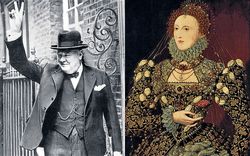
I cannot trust any political argument, from left or right, that is bereft of historical evidence. As we repeat the mistakes of the past – in Afghanistan, in relations with Europe, in banking policy – we should wince. Surely we are not going back to the Afghan wars, or to the Entente Cordiale, or to the South Sea Bubble? Or at least if we are going back to the bubble, let us recall that, after it burst, the First Minister dropped dead in parliament, the Chancellor of the Exchequer was sent to the Tower, and the mob demanded bankers be “tied up in sacks filled with snakes and tipped into the murky Thames”.
More here.
Roll over Einstein: Law of physics challenged
From PhysOrg:
One of the very pillars of physics and Einstein's theory of relativity – that nothing can go faster than the speed of light – was rocked Thursday by new findings from one of the world's foremost laboratories.
CERN reported that a neutrino beam fired from a particle accelerator near Geneva to a lab 454 miles (730 kilometers) away in Italy traveled 60 nanoseconds faster than the speed of light. Scientists calculated the margin of error at just 10 nanoseconds. (A nanosecond is one-billionth of a second.)
More here. (Note: Do watch the video)
Laksha Ganan
autumn wastes
the curse
Saturday, September 24, 2011
A Doyle Man
Michael Dirda in The Paris Review:
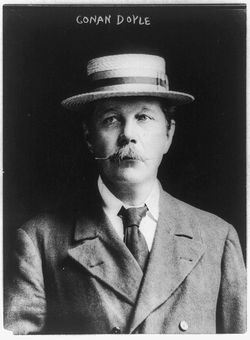
In Javier Marías’s charming volume of essays called Written Lives, the Spanish novelist retells a well-known story about the writer and his family. Sir Arthur was traveling by train through South Africa and “one of his grown-up sons commented on the ugliness of a woman who happened to walk down the corridor. He had barely had time to finish this sentence when he received a slap and saw, very close to his, the flushed face of his old father, who said very mildly: ‘Just remember that no woman is ugly.’ ” While no man is on oath for lapidary inscriptions, nearly every student of Conan Doyle agrees that as man, writer, and citizen he strove to live up to the knightly words etched on his tombstone: “Steel true, blade straight.”
More here.
The Post-Black Condition
From The New York Times:

What this malleability means, according to nearly all the 105 prominent African-Americans interviewed for this book, is a liberating pursuit of individuality. Black artists, like other professionals, now feel free to pursue any interest they like and are no longer burdened with the requirement to represent “the race.” Indeed, when they do explore black themes, as most still do, they feel at liberty to be irreverent and humorous. Thus Kara Walker, a typical post-black artist, unhesitatingly “mines modern visions of slavery for comedy without disrespecting slaves.” There are no sacred cows, not even the great civil rights leaders. The artist Rashid Johnson is typically candid in a way many older African-Americans are bound to find hurtful and ungrateful. According to Touré, some of Johnson’s work says, “These people are our history, so honor them, but also, these people are history, so let’s move on.” Ouch!
More here.
Saturday Poem
When the rich rain economic bombs upon ordinary folks, that just capitalism.
When ordinary folks point out the bombs, that's Class Warfare.
—Roshi Bob
A Reporter from New York Asks Edith Mae Chapman,
Age Nine, What Her Daddy Tells her about the Strike
We ain't to go in the company store, mooning
over peppermint sticks, shaming ourselves like a dog
begging under the table. They cut off our account
but we ain't no-account. We ain't to go to school
so's the company teacher can tell us we are.
We ain't going to meeting and bow our heads
for the company preacher, who claims it is the meek
will inherit the coal fields, instead of telling
how the mountains will crumble and rocks
rain down like fire upon the heads
of the operators, like it says in the Bible.
We ain't to talk to no dirtscum scabs
and we ain't to talk to God. My daddy
is very upset with the Lord.
by Diane Gilliam Fisher
from Kettle Bottom
publisher: Penguin Press, 2004
not just failure

With “American Dreamers: How the Left Changed a Nation,” Michael Kazin tackles a conventional wisdom so deeply believed that even those it disparages tend to accept it — namely, that the history of the American left, for all its drama and artistry, brilliance and passion, is one of failure. It is, in that telling, a story of causes unfulfilled, elections lost, unions busted, communes dispersed. Kazin emerges with a counterpoint, not so much of hidden victories as of grand and enduring achievement, often carried to fruition by moderates but envisioned by the left and propelled by its energy. It is, to say the least, a timely read.
more from Jim Newton at the LA Times here.
1493 was Year One
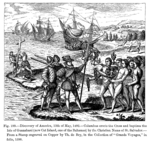
In hindsight, 1492 might have been a good point at which to reset the calendar. Traditionally, the year in which Columbus discovered America is seen as the moment Europe began to shape a New World. Today it looks more like the start of a process that has stitched the drifting continents back together: 1492 was the Year Zero of globalisation, and 1493 was Year One. It has been a thrilling and frequently catastrophic ride for humankind ever since, and science writer Charles C Mann’s excitement never flags as he tells his breathtaking story. His account enshrines Columbus as a founding father of globalisation, and recognises that its effects have been as much biological as economic. Here he borrows from the historian Alfred W Crosby, who in 1972 coined the phrase “Columbian Exchange” to describe the traffic of species between continents. The term is elegant, but the exchange was often anything but equitable. Europe sent malaria to the Americas; in return the Americas gave Europe a cure, the Andean cinchona bark from which quinine is derived.
more from Marek Kohn at the FT here.
the Orgasmatron

An alternative explanation for the temporary success of Reich, especially among American intellectuals both of the Marxisant stripe and of the do-it-yourself “organic community” sort, is that he was able to propose an essentially mechanical and “scientific” solution to a psychological problem, yet a mechanical solution that could be easily assembled and employed at home. Arriving in the United States in 1939 as one of the many dissident Freudians and heterodox Marxists to have escaped Hitler (and in his own case, also Stalin), Reich was quick to announce the invention of the “orgone energy accumulator.” This device or contraption took the form of a wooden cupboard lined with metal and insulated with steel wool. It was about the size of a telephone booth. In his movie “Sleeper,” Woody Allen satirically referred to the humble resulting structure as “the Orgasmatron”: a ridiculous name deftly annexed by Turner. But the real terms used by Reich to promote the cupboard of ecstasy — “orgastic potency”; “orgone energy” — were hardly less hyperbolic. Turner, an editor at Cabinet magazine, is clearly right to connect the Reich movement to the early stirrings of the postwar sexual revolution: a development that might have occurred naturally and that could well have been apolitical. However, a series of hysterically comic figures on the American right (and one or two rather sinister ones as well, like Senator Joseph McCarthy) claimed to see the figure of Alfred Kinsey, say, as a frontman for a wider conspiracy to sap American morals. It wasn’t long before agents from the F.B.I. and the Immigration and Naturalization Service were calling on Reich, either to ask him about subversive characters he might know, or about his own political past and affiliations. In a way, he made the perfect boogeyman for J. Edgar Hoover, who managed to amass a file of hundreds of pages on a man who must have seemed the perfect fusion of Red menace and sexual pervert.
more from Christopher Hitchens at the NYT here.
Want Evolutionary Change? Wait a Million Years.
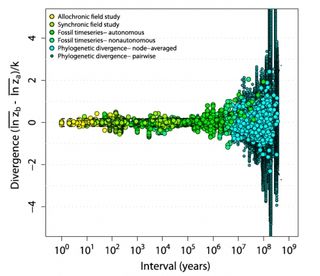
The question of the pattern of stasis (no change) versus gradualism (persistent and continuous change) in the fossil record continues. A new paper in the Proceedings of the National Academy of Sciences by Uyeda et al. comprises a huge survey and analysis of morphological change in animals (mammals, birds, squamate reptiles, and primates) over ten million years. The purpose was to determine whether change between species in one trait—body size—accumulates gradually with the passage of time since species diverged, or whether that change is more episodic. What they did was take a tremendous amount of data from three sources: current field studies of the rate of evolutionary change, fossil data showing change (again, this is all body size) through time, and estimates of rate of body-size divergence from living organisms whose divergence times can be estimated from molecular data.
Uyeda et al. then plotted the divergence in body size between related species (measured as proportional change, thus requiring a log scale) versus the divergence time. The graph below tells the tale: they see what they call a “blunderbuss” pattern, with not much change accumulating between species until they’ve diverged for about a million years, and then change occurring more rapidly and cumulatively after a million years.
Academic Publishers Make Murdoch Look Like a Socialist
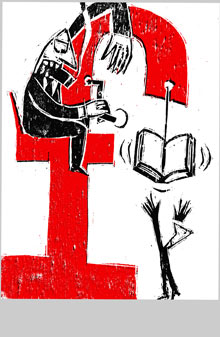
Murdoch pays his journalists and editors, and his companies generate much of the content they use. But the academic publishers get their articles, their peer reviewing (vetting by other researchers) and even much of their editing for free. The material they publish was commissioned and funded not by them but by us, through government research grants and academic stipends. But to see it, we must pay again, and through the nose.
The returns are astronomical: in the past financial year, for example, Elsevier's operating profit margin was 36% (£724m on revenues of £2bn). They result from a stranglehold on the market. Elsevier, Springer and Wiley, who have bought up many of their competitors, now publish 42% of journal articles.
More importantly, universities are locked into buying their products. Academic papers are published in only one place, and they have to be read by researchers trying to keep up with their subject. Demand is inelastic and competition non-existent, because different journals can't publish the same material. In many cases the publishers oblige the libraries to buy a large package of journals, whether or not they want them all. Perhaps it's not surprising that one of the biggest crooks ever to have preyed upon the people of this country – Robert Maxwell – made much of his money through academic publishing.
Troy Davis and Arguments Against the Death Penalty

By the time you read this, Troy Davis will probably have been executed for a crime he probably didn't commit. (Update: At 11:08pm, Wednesday, Dahlia Lithwick of Slate reported that the state of Georgia had executed Troy Davis.)
Amanda Marcotte of Pandagon argues that, from here on out, death penalty abolitionists should focus on procedural arguments against the death penalty, as opposed to simply asserting that the death penalty is wrong. To change minds on capital punishment, we should stress that the justice system is fallible, racist, and classist and that it's foolish to give such a system the power of life and death.
Amanda's probably right about how to sway undecided voters on this issue. But I don't think that procedural objections to the death penalty are actually the strongest arguments.
I think the risk of killing an innocent person is a good enough reason to scrap the whole concept of judicial executions, but that probably only seems persuasive to me because I have a strong aversion to the state executing anyone. If I thought that the death penalty was synonymous with justice, I'd wave those concerns away.
The vast majority of people who are executed did all the murdering, raping, and mutilating they were found guilty of. The justice system makes mistakes in sending people to jail, too. That's unfortunate, but it's a cost of doing business. The answer is to make the system fairer, not to embrace across-the-board prison abolitionism. You can't give someone back the years that were wrongly taken from them any more than you can bring the back to life from a wrongful execution. We can commute death sentences, of course. But surely, more innocent people have died in prison than have been wrongly executed.
When I ask myself why I'm really against the death penalty–not just what I think other people will find persuasive–my bottom line is this: The state should only kill when it's absolutely necessary.
The Skin Trade

WHAT DOES IT take to succeed in an intensely competitive, cutting-edge industry? You need to show ambition, clearly, while never exuding unbecoming eagerness. For the right kind of exposure, you may have to work for free—even go into debt. You need to be calculating with your acquaintances, but avoid close connections with possible competitors. Above all, you need to stay beholden to the unlikely dream of success and the rare moments of magic, building calluses and erecting blinders to the unpleasant and grueling realities.
Such self-steeling is required for a career in any number of creative fields: journalism, novel-writing, acting, design, singing, dancing. But the world in which such demands come into perhaps the sharpest relief is that of the fashion model. The modeling world, with increased intensity in recent decades, has become one of freakish and outsized expectations—professionally and physically. Look no further than the apex of the industry, the high-end catwalk model, for the starkest example: she is often a size 00, with a waist that compares to a seven-year-old girl’s. For all the beauty it regularly displays, there is something deeply twisted about this industry. In her new book, the former-model and current professor of sociology Ashley Mears untangles just how crazy the fashion industry can be.
The physical requirements for the high-end model, while upsetting and grotesque, are not exactly unfamiliar. As an agent half-joked to Mears at the outset of her teenage modeling career: “Anorexia is in this season.”
Friday, September 23, 2011
Has pop culture, uh, stopped?

Idea for a Saturday Night Live sketch: A group of ’80s post-punkers, famous for spiky guitar noise and grimacing intelligence, reunites to perform its most legendary album at a rock festival in 2011. The original lineup has not played a show together in 20 years. The bassist is now a college professor, the drummer owns a comic-book store, and so on. The charismatic lead singer, meanwhile, has become a surprise hit on the children’s circuit, peddling a groovified canon of kid-friendly sing-alongs to an audience of 6-year-olds. Of all the guys, he seems to have changed the most: in the dressing room he is uncharacteristically spritely, and keeps humming “Nellie the Elephant.” Also, is his voice … higher? It’s showtime, anyway, and the crowd roars—the silvering rock dudes, the love-handled ex-fanatics, the frowning young cognoscenti. But what’s the front man doing? His bandmates watch in horror as he bounces to the microphone, stares out wide-eyed, and yelps “Hey, everybody! Who else hates asparagus?!”
more from James Parker at The Atlantic here.
we strange children of Abraham

At a moment when some of the theoretical gestures being inspired by old, new, or futuristic political theologies have become ineffective, Paul Kahn’s Political Theology: Four New Chapters on the Concept of Sovereignty is a book of extraordinary significance. Or, perhaps I should say that I think it might be a book of extraordinary significance, inasmuch as it bears a potential to do something which has remained impossible, not only for Carl Schmitt, but also for some important contemporary critics of neo-liberal political economy. I want to reflect specifically about the way this impossibility might become possible, strangely, by way of a new migration of Abraham into the territory of philosophies of freedom and difference. Throughout, Kahn constructs a stage on which is presented a complex encounter between a decidedly American revolutionary heritage, a deeply European critique of liberalism, and a repeated and self-conscious reflection on Jewish traditions. In this encounter, each figure appears bathed in mutually illuminating light, a situation which is much more difficult to stage than one might think. Just for a start, it would have been impossible for Schmitt himself to conjure a similar forcefulness for his ruminations on intractable questions of freedom with these three actors. A sporadic anti-Judaism and anti-Americanism endemic not only to Schmitt’s writings in the ‘20s but also to the larger conversation about legality, freedom, and authenticity in which his work participated saw to that.
more from Ward Blanton at The Immanent Frame here.