Category: Recommended Reading
The Turnaround Men
The story of Tom Petters—a Minnesota scam artist who orchestrated a convoluted and gargantuan Ponzi scheme that grew to over $36 billion…
Mariah Blake in The New Republic:
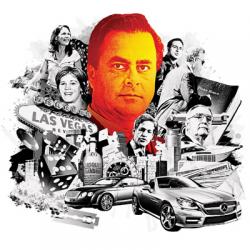
Then, suddenly, Petters’s Blackberry started ringing. At that moment, 1,700 miles away in the leafy suburb of Minnetonka, Minnesota, more than 50 government agents were swarming into the parking lot of Petters Company Incorporated (PCI). The agents entered the building, ordered everyone out, and began opening safes and rummaging through file drawers. Another team of agents descended on Petters’s mansion overlooking Lake Minnetonka, where they moved from room to room snapping photos and stuffing Petters’s belongings into cardboard boxes.
More here.
Wednesday Poem
Voltaire at Ferney
Perfectly happy now, he looked at his estate.
An exile making watches glanced up as he passed
And went on working; where a hospital was rising fast,
A joiner touched his cap; an agent came to tell
Some of the trees he'd planted were progressing well.
The white alps glittered. It was summer. He was very great.
Far off in Paris where his enemies
Whsipered that he was wicked, in an upright chair
A blind old woman longed for death and letters. He would write,
“Nothing is better than life.” But was it? Yes, the fight
Against the false and the unfair
Was always worth it. So was gardening. Civilize.
Cajoling, scolding, screaming, cleverest of them all,
He'd had the other children in a holy war
Against the infamous grown-ups; and, like a child, been sly
And humble, when there was occassion for
The two-faced answer or the plain protective lie,
But, patient like a peasant, waited for their fall.
And never doubted, like D'Alembert, he would win:
Only Pascal was a great enemy, the rest
Were rats already poisoned; there was much, though, to be done,
And only himself to count upon.
Dear Diderot was dull but did his best;
Rousseau, he'd always known, would blubber and give in.
Night fell and made him think of women: Lust
Was one of the great teachers; Pascal was a fool.
How Emilie had loved astronomy and bed;
Pimpette had loved him too, like scandal; he was glad.
He'd done his share of weeping for Jerusalem: As a rule,
It was the pleasure-haters who became unjust.
Yet, like a sentinel, he could not sleep. The night was full of wrong,
Earthquakes and executions: soon he would be dead,
And still all over Europe stood the horrible nurses
Itching to boil their children. Only his verses
Perhaps could stop them: He must go on working: Overhead,
The uncomplaining stars composed their lucid song.
W.H.Auden
How the Web Affects Memory
From Harvard Magazine:
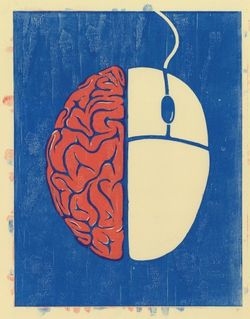
Wegner, the senior author of the study, believes the new findings show that the Internet has become part of a transactive memory source, a method by which our brains compartmentalize information. First hypothesized by Wegner in 1985, transactive memory exists in many forms, as when a husband relies on his wife to remember a relative’s birthday. “[It is] this whole network of memory where you don’t have to remember everything in the world yourself,” he says. “You just have to remember who knows it.” Now computers and technology as well are becoming virtual extensions of our memory. The idea validates habits already forming in our daily lives. Cell phones have become the primary location for phone numbers. GPS devices in cars remove the need to memorize directions. Wegner points out that we never have to stretch our memories too far to remember the name of an obscure movie actor or the capital of Kyrgyzstan—we just type our questions into Google. “We become part of the Internet in a way,” he says. “We become part of the system and we end up trusting it.”
More here.
How strange can space-time get?
From MSNBC:
You must get this question all the time: What sort of proof do you have that any of this stuff is true?
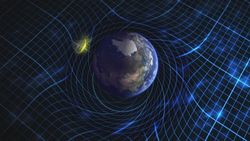
Brian Greene: Well, the first three episodes — focusing on space, time and quantum mechanics — are much more closely tied to observations and experiments that have already been done. Much of what we describe in those programs is firmly rooted in science that is now largely accepted, even though it's weird. The fourth program is different in that regard, because as the last program in the series, it is looking beyond what we currently know, and surveying the landscape of possibilities that may in the future become accepted science. But not yet.
More here.
Tuesday, November 1, 2011
shuffy on galle face green

They’re flying kites on Galle Face Green. The air is alive, twisting and fluttering against the blue in swatches of yellow and red and blue and flags. All along the mile of Green, children grasp their kite strings like umbilical cords to the sky, only just barely keeping hold of the ground beneath them. Families and lovers walk patiently through the tangle. A boy who has only been alive for a few years has gotten his kite into the clouds. The women are wearing gold-and-peach saris and t-shirts and white headscarves and sundresses and sandals and sneakers. The men wear pants with jerseys and sarongs with business shirts, heads covered and not. There are clusters of women in long black abayas and niqabs, which also flutter in the breeze, and clusters of bright balloons with feet underneath, that walk through the crowd, peddling themselves to passersby. Every outfit worn by the children is the perfect outfit for a game of cricket. Girls hold their fathers’ hands and boys roll around in patches of dirt where the grass has worn bald with play. The Galle Face Green is reported to be the most expansive place in the city, and though the Green itself is as bustling as the street, you can catch your breath there. It is, as was once written, Colombo City’s lung.
more from Stefany Anne Golberg at The Owls here. (PS we have 401 contributors to our little fundraiser. We have many many thousands of daily readers. Please, two minutes of your time and few bucks means we can keep doing what we do. Thanks.)
didion v kael

Here’s an anecdote from James Wolcott’s crackerjack new memoir of ink-stained ’70s New York, Lucking Out: Wolcott, then in his twenties and cutting his teeth at the Village Voice, tagged along with Pauline Kael for a drink at the townhouse of a top Newsweek editor. Kael was three decades older than Wolcott and miles above him then in the editorial food chain, but he wasn’t about to ask the most famous movie critic in America why she kept inviting him to screenings. (Whatta town.) The only prominent item on the enormous glass coffee table at the editor’s house was Joan Didion’s then-latest novel, A Book of Common Prayer (1977). Kael asked the host what he thought of it. “The editor reached for the novel, held it up as if it had healing properties, and pronounced: ‘It’s full of resonance.'” Wolcott adds: “I didn’t dare exchange glances with Pauline, for whom Didion was full of something, but it sure wasn’t resonance.”
more from Evan Hughes at The Awl here.
the politics of the poor
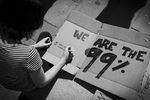
To some ears it will sound paradoxical or even dangerous for intellectuals to champion populism. Can there really be such a thing as an intellectual populism, an internationalist populism, and a populism of civil liberties? The record of some historical populisms would cast doubt on these possibilities. But the same possibilities are the moment’s necessities, and already they are being embodied by the Occupy movement. A people, in the populist sense, never includes everybody, and any decent American populism will have to guard the rights of the persons falling outside of its shifting self-definition; one task of the 99 percent, if it ever attains power, will be to ensure the protection of the 100 percent. The responsibilities of power remain, however, a long way off. The battle of the moment pits domination by corporate persons against an emergent democratic people. A movement is finding out who it is. That it couldn’t say at the start means only that it is learning, listening, thinking, growing. “This country has not fulfilled the reasonable expectations of mankind,” Emerson wrote in 1838, when the US was still a very young country. Maybe we’re not yet 100 percent too old.
more from Benjamin Kunkel and Charles Petersen at n+1 here.
Tuesday Poem
Crossing the Loch
Remember how we rowed toward the cottage
on the sickle-shaped bay,
that one night after the pub
loosed us through its swinging doors
and we pushed across the shingle
till water lipped the sides
as though the loch mouthed ‘boat’?
I forget who rowed. Our jokes hushed.
The oars’ splash, creak, and the spill
of the loch reached long into the night.
Out in the race I was scared:
the cold shawl of breeze,
and hunched hills; what the water held
of deadheads, ticking nuclear hulls.
Who rowed, and who kept their peace?
Who hauled salt-air and stars
deep into their lungs, were not reassured;
and who first noticed the loch’s
phosphorescence, so, like a twittering nest
washed from the rushes, an astonished
small boat of saints, we watched water shine
on our fingers and oars,
the magic dart of our bow wave?
It was surely foolhardy, such a broad loch, a tide,
but we live — and even have children
to women and men we had yet to meet
that night we set out, calling our own
the sky and salt-water, wounded hills
dark-starred by blaeberries, the glimmering anklets
we wore in the shallows
as we shipped oars and jumped,
to draw the boat safe, high at the cottage shore.
by Kathleen Jamie
From: Jizzen
Publisher: Picador, London, 1999
Eureka!: Inventors describe the moment they realised they’d created a hit
From The Independent:
Steve McCurry, photographer
The Afghan Girl
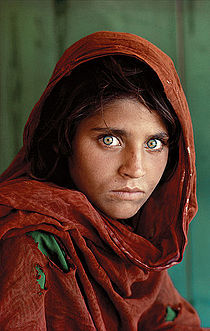
I was shooting with a tripod on Kodachrome 64, a transparency slide film, which is slow. I was worried if I approached the girl straight away she might say no, so I photographed a few of her friends first, trying to create a situation where she didn't want to be excluded. Nobody spoke English, so we used sign language to communicate. In this part of the world, classes are conducted on the floor; no tables or desks. You don't really direct people in that kind of situation, you just take what is offered. The girl was sitting on the ground. There was an amazing light coming into the tent behind her; I positioned my camera so that it fell on her face. I tried to stay calm and focused because I knew this was a special moment and that for a minute she'd be amused by the strange man with his strange equipment, and then she'd bore and wander off. There was so much motion in the classroom, kids screaming, dust; it wasn't this sort of still, profound moment when she revealed herself. I only had a chance to take a few exposures before she walked away. I could see the image in my mind, but I didn't know how it would have translated to film. I sent the film back to the States but I had more work to do here so I didn't see the results until a few weeks later. The magazine's photo editor and I edited the film down to two slides. I liked this picture, but he thought it was too haunting; he preferred one with her hand covering part of her face. We agreed to present both to the editor, who leapt to his feet and said: “This is our next cover!”. Sometimes you just know.
Afghan Girl first appeared on the cover of 'National Geographic' in June 1985 and was later the subject of a TV documentary, 'Search for the Afghan Girl'
More here.
A Tumor Is No Clearer in Hindsight
Denise Grady in The New York Times:
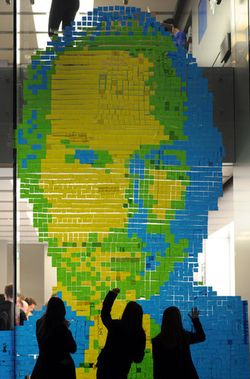
It might seem so, from the broad outlines of what he did in 2003 when a CT scan and other tests found a cancerous tumor in his pancreas. Doctors urged him to have an operation to remove the tumor, but Mr. Jobs put it off and instead tried a vegan diet, juices, herbs, acupuncture and other alternative remedies. Nine months later, the tumor had grown. Only then did he agree to surgery, during which his doctors found that the cancer had spread to his liver, according to the new biography by Walter Isaacson. Cancer eventually killed him. The sequence of events has given rise to news articles and blogs based on 20/20 hindsight, speculating that if only Mr. Jobs had had the surgery right away, doctors could have caught the cancer early, before it spread, and saved him. But there is no way in this life to know what might have been — not in politics, baseball, romance or the stock market, and certainly not in sickness and health. Mr. Jobs’s wish to avoid or delay surgery was not unusual. And given the type of tumor he had and the way it was found, his decision to wait may not have been as ill considered as it seems at first blush. His wife, Laurene Powell Jobs, declined requests for an interview and for permission to speak to Mr. Jobs’s doctors. But she did allow one of them to comment briefly: Dr. Dean Ornish, a friend of Mr. Jobs who is also a well-known advocate for using diet and lifestyle changes to treat and prevent heart disease.
Dr. Ornish said that when the diagnosis was first made, he advised Mr. Jobs to have the surgery. But in an e-mail message, he added: “Steve was a very thoughtful person. In deciding whether or not to have major surgery, and when, he spent a few months consulting with a number of physicians and scientists worldwide as well as his team of superb physicians. It was his decision to do this.
More here.
Please welcome Megavirus, the world’s most ginormous virus
Carl Zimmer in his excellent blog, The Loom:
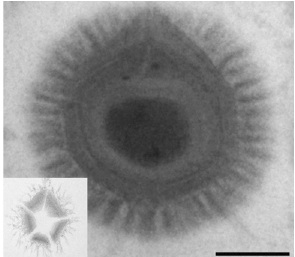
For years, they were hiding in plain sight. They were so big–about a hundred times bigger than typical viruses–that scientists mistook them for bacteria. But a close look revealed that they infected amoebae and built new copies of themselves, as all viruses do. And yet, as I point out in A Planet of Viruses, giant viruses certainly straddle the boundary between viruses and cellular life. Flu viruses may only have ten genes, but giant viruses may have 1,000 or more. When giant viruses invade a host cell, they don’t burst open like other viruses, so that their genes and proteins can disperse to do their different jobs. Instead, they assemble into a “virus factory” that sucks in building blocks and spits out large pieces of future giant viruses. Giant viruses even get infected with their own viruses. People often ask me if I think viruses are alive. If giant viruses aren’t alive, they sure are close.
Ever since giant viruses were first unveiled seven years ago, scientists have argued about the origins of these not-so-wee beasties. Many of their genes are different from those found in cellular life forms, or even other viruses. It’s possible that giant viruses amassed their enormous genetic armamentarium over billions of years, picking up genes from long-extinct host or swapping them with other viruses we have yet to find. Other scientists have suggested that giant viruses started out giant–or even bigger than they are today. Some have even argued that they represent a new domain of life, although others aren’t so sure.
More here.
A Sister’s Eulogy for Steve Jobs
Mona Simpson in the New York Times:
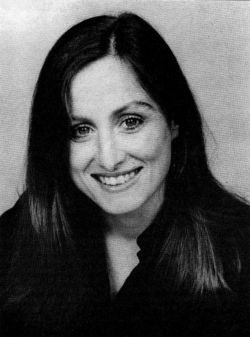
Even as a feminist, my whole life I’d been waiting for a man to love, who could love me. For decades, I’d thought that man would be my father. When I was 25, I met that man and he was my brother.
By then, I lived in New York, where I was trying to write my first novel. I had a job at a small magazine in an office the size of a closet, with three other aspiring writers. When one day a lawyer called me — me, the middle-class girl from California who hassled the boss to buy us health insurance — and said his client was rich and famous and was my long-lost brother, the young editors went wild. This was 1985 and we worked at a cutting-edge literary magazine, but I’d fallen into the plot of a Dickens novel and really, we all loved those best. The lawyer refused to tell me my brother’s name and my colleagues started a betting pool. The leading candidate: John Travolta. I secretly hoped for a literary descendant of Henry James — someone more talented than I, someone brilliant without even trying.
When I met Steve, he was a guy my age in jeans, Arab- or Jewish-looking and handsomer than Omar Sharif.
More here.
Edward W. Said — The Last Interview
Edward W. Said was born in Jerusalem 76 years ago today. He is much missed. Read a remembrance of Edward by Akeel Bilgrami here.
Click below to continue watching the rest of the interview:
Occupy Wall Street: What Would Kurt Vonnegut Say?
Charles J. Shields in Writing Kurt Vonnegut:
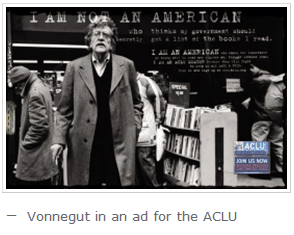
So would he have joined elder statesmen of protest and civil disobedience such as Pete Seeger and Arlo Guthie who went down to Zuccotti Park recently?
If he did, I suspect he would have felt some pangs of conscience. Because you see, Kurt was a fat cat himself. His life, his career, and his beliefs put him squarely in the moral paradox that most of us find ourselves in: we believe in the tenets of freedom, capitalism, and free enterprise… except when we don’t.
More here.
Monday, October 31, 2011
Perceptions

Sughra Raza. Fort Point puddle. 2010
Digital photograph.
Sunday, October 30, 2011
The Arab Intellectuals Who Didn’t Roar

IN mid-June, the Syrian poet known as Adonis, one of the Arab world’s most renowned literary figures, addressed an open letter to the Syrian president, Bashar al-Assad. The stage was set for one of those moments, familiar from revolutions past, in which an intellectual hero confronts an oppressive ruler and eloquently voices the grievances of a nation.
Instead, Adonis — who lives in exile in France — bitterly disappointed many Syrians. His letter offered some criticisms, but also denigrated the protest movement that had roiled the country since March, and failed even to acknowledge the brutal crackdown that had left hundreds of Syrians dead. In retrospect, the incident has come to illustrate the remarkable gulf between the Arab world’s established intellectuals — many of them, like Adonis, former radicals — and the largely anonymous young people who have led the protests of the Arab Spring.
More than 10 months after it started with the suicide of a Tunisian fruit vendor, the great wave of insurrection across the Arab world has toppled three autocrats and led last week in Tunisia to an election that many hailed as the dawn of a new era. It has not yielded any clear political or economic project, or any intellectual standard-bearers of the kind who shaped almost every modern revolution from 1776 onward. In those revolts, thinkers or ideologues — from Thomas Paine to Lenin to Mao to Vaclav Havel — helped provide a unifying vision or became symbols of a people’s aspirations.
The absence of such figures in the Arab Spring is partly a measure of the pressures Arab intellectuals have lived under in recent decades, trapped between brutal state repression on one side and stifling Islamic orthodoxy on the other. Many were co-opted by their governments (or Persian Gulf oil money) or forced into exile, where they lost touch with the lived reality of their societies. Those who remained have often applauded the revolts of the past year and even marched along with the crowds. But they have not led them, and often appeared stunned and confused by a movement they failed to predict.
Martha Graham’s Appalachian Spring
Pain is no more or no less profound than any other sensation
Lata Mani excerpted in the Wall Street Journal:
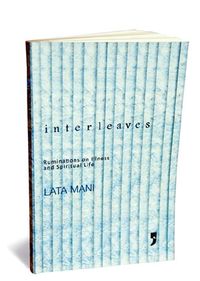
Pain throbs. Pain shreds. Pain darts. Pain weaves sly patterns across the length and breadth of the body. Pain stabs. Pain pulses. Pain plummets the body into a vortex unknown and at times fearful. Pain nags. Chronic pain drones repetitiously, monotonously, ad nauseam. Pain flays the surface of the skin, turning it almost translucent with frailty. Pain makes one so weak that the whole world is experienced through its omnipresent filter. Pain drains everything into its core. Pain can be focused as the point of a pinhead or as dispersed as one’s consciousness and, if suffered long enough, the pinpoint can seem to grow and swallow one’s entire physical being. Pain can be as hard as steel or as soft as a ripe pear. Pain shudders. Pain shivers.
More here.
Neuroscience and Justice
From Edge:
MICHAEL GAZZANIGA is a Neuroscientist; Professor of Psychology & Director, SAGE Center for the Study of Mind, University of California, Santa Barbara. His books include Human; The Ethical Brain; and Who's In Charge: Free Will and the Science of the Brain (forthcoming, November 11th).