Facing down my eighth-grade tormentor

Steve Almond in Salon:

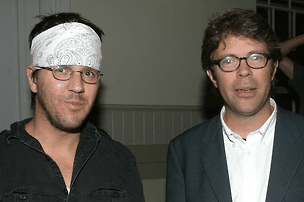
ScreenHunter_01 Sep. 28 11.26 So, like I said, I wanted to talk about this brief, intense period of time when — and I realize this is a memory, so it's totally subjective — but it felt like you really hated me.

Really?

Yeah. It was mostly in this metal shop class we took together.

I definitely remember taking that metal shop class in eighth grade. And I was thinking about it, since you sent that original email, and I do remember being in a relationship with someone where I was the bully or the dominant, because I remember feeling that. But I never would have put two and two together and thought it was you.

I had this sense of being totally frozen out. And it was clear, or it seemed clear to me, that you were calling the shots. You were the alpha of that group.

It's funny you would say that, because this was around the time that Billy Dempsey entered the picture —

Yeah, I remember Billy coming up to me at the lockers, I think you were there for this, and threatening to kick my ass.

I don't remember that, but it wouldn't surprise me. The thing is, we had this very tortured relationship where I spent the entire time trying to prove myself to him. Billy was athletically more gifted than me and he was fearless and willing to get into fights with anybody, whereas I always saw myself as an egghead nerd. So it's quite possible, I could easily see, if there was an opportunity for me to prove to Billy that I was his equal in terms of being the macho guy I would have grabbed at it.

More here.

The Many Faces of Charles Dickens

From The Telegraph:

Dickens_main_2006044f ‘The history of the Victorian age will never be written,” Lytton Strachey announced at the start of his waspish clutch of biographical sketches Eminent Victorians, not because of what has fallen between the cracks of the historical record, but because “we know too much about it”. The same is true of Dickens’s life, which has often been treated as the pivot around which the Victorian age revolved. From the spelling mistake on his birth certificate, to the neatly folded notes he left for his children if they used bad language, every document has been filleted for facts, every stray anecdote transformed into a revealing flash of personality. As with Shakespeare, his only serious rival for the title of the nation’s favourite author, the books, articles and blogs about him have multiplied to the extent that nobody can possibly read them all. Attempting then to write about him is like trying to cut up a blue whale with a penknife.

That doesn’t stop us trying. Next week sees the publication of my new biography Becoming Dickens, in which I investigate how in the space of five years an unknown reporter became the most famous novelist in the world. Within a few days it will be joined by Claire Tomalin’s cradle-to-grave Charles Dickens: a Life and Lucinda Hawksley’s more compact Charles Dickens, and later by Simon Callow’s book on Dickens’s love of the theatre. They will be followed by several documentaries, glossy BBC adaptations of Great Expectations and The Mystery of Edwin Drood, and a film about his lengthy secret affair with the actress Ellen Ternan. In 2012, his bicentenary year, Dickens’s face will be everywhere, his presence inescapable.

More here.

The Simplest Health Solutions? It’s Complicated

Abigail Zuger in The New York Times:

Amed Take what must be the greatest cheap medical fix in all of history: the bar of soap. Soap never stops proving itself. As recently as 2005, a study from the slums of Karachi, Pakistan, showed that free bars of soap (and lessons in how to use them) cut rates of childhood killers like diarrhea and pneumonia by half. But you don’t find soap in American hospitals anymore, at least not in its classic solid rectangular form. A variety of expensive improvements have replaced it, all created in response to the various ways in which modern doctors and patients reflexively undermine good, inexpensive tools. First, we automatically capture these things for our own personal use: Bars of soap left in any public place are likely to disappear in short order. (That is why toilet paper rolls are generally locked into their little metal houses.) Second, we find fault with them. People will actually use the observation that bar soap is “dirty” as an excuse not to wash their hands. (Studies have shown that you will not pick up somebody else’s germs from a piece of soap, however dingy it may look.)

More here.

Regime Change Doesn’t Work

Ndf_36.5_regime_change Alexander Downes in Boston Review:

Beyond the question of whether it is wise for the United States to seek regime change in yet another country while it continues to clean up the mess from the last two, the Libya adventure begs a reconsideration of the wisdom of regime change in general. Focusing on consequences, I will steer clear of issues of legality and moral justification. Rather, I ask what the historical record tells us about the capacity of externally imposed regime change to bring peace, stability, and democracy to target countries. Is the bloody aftermath of regime change in Afghanistan and Iraq the exception or the rule? Does regime change work?

The short answer is: rarely. The reasons for consistent failure are straightforward. Regime change often produces violence because it inevitably privileges some individuals or groups and alienates others. Intervening forces seek to install their preferred leadership but usually have little knowledge of the politics of the target country or of the backlash their preference is likely to engender. Moreover, interveners often lack the will or commitment to remain indefinitely in the face of violent resistance, which encourages opponents to keep fighting. Regime change generally fails to promote democracy because installing pliable dictators is in the intervener’s interest and because many target states lack the necessary preconditions for democracy.

Gratitude and Forbearance: On Christopher Lasch

220px-Christopher_Lasch Norman Birnbaum reviews Eric Miller's Hope in a Scattering Time A Life of Christopher Lasch, in The Nation (photo from Wikimedia Commons):

Born in Omaha in 1932, the year Franklin Roosevelt was elected president, Christopher Lasch graduated from Harvard in 1954, during the Eisenhower era’s mood of anxious complacency, and from there went directly to Columbia to do graduate work in history. Lasch’s career as a historian began as it would end forty years later with his death, with a search for the moral resources for the next New Deal. Lasch rejected the liberal history of Arthur Schlesinger Jr.—whose legitimation of the cold war he disliked, and whose view of the permanence of the New Deal’s achievements he found naïve. He learned much of modern social science as well as European political and social thought, and took psychoanalysis and theology seriously. He became one of the nation’s most prominent intellectuals, but he increasingly doubted the capacity of his colleagues to guide their fellow citizens. His first book, The American Liberals and the Russian Revolution, a critique of liberalism’s early capitulation to imperialism, sold a few hundred copies when it appeared in 1962. His next book was published three years later. Called The New Radicalism in America, 1889–1963: The Intellectual as a Social Type, it depicted intellectuals’ sometimes unintended subservience to power, and it made him famous. Lasch regarded his success in part as a burden, and throughout his life he would insist on the importance of his ties to family, friends, colleagues and students.

David Spiegelhalter on Statistics and Risk

Stat Over at Five Books:

Let’s have a look. First up is The Drunkard’s Walk by Leonard Mlodinow, which looks at how the mathematical laws of randomness affect our lives.

This is a general introduction to the history of probability and the way it comes into everyday life. It intersperses the historical development with modern applications, and looks at finance, sport, gambling, lotteries and coincidences.

It starts off with quotes from Cicero feeling that people were being misled by thinking that the gods influenced the throw of a die. Then it carries on through the early development of probability in the 16th century with [Italian Renaissance mathematician Gerolamo] Cardano. He threw two dice and looked at the distribution of the sum of the two faces. There was an incredibly popular game called Hazard where you threw two dice and betted on what the total would be. Amazingly, people had been gambling for centuries and had never realised you could do maths on gambling. Probability – which used to be known by the wonderful term “the doctrine of chances” – grew out of this.

the devil’s advocate

ID_PI_GOLBE_BIERC_FT_001

Cynicism, for Bierce, was not just an attitude; it was his life force. It’s ironic then that The Devil’s Dictionary is seen today primarily as a delightful little book of irreverent (if now anachronistic) witticisms. This is entirely Bierce’s fault. In life and in art, Bierce made it his prerogative to present himself as a Class A misanthropic know-it-all. Much of the real sensitivity and even anguish that produced The Devil’s Dictionary is obscured by an intentional ironic distance. By the time The Devil’s Dictionary was published, Bierce was 69. He had made a career as a curmudgeon, a writer with a big personality who always kept distance between himself and his public. He was famous for his motto “nothing matters” and was known as “Bitter Bierce.” Even his popular short stories, based on his experiences of the Civil War (see the classic “An Occurrence at Owl Creek Bridge”) were never autobiographical, never meant to bring readers closer to the man. He publicly attacked friends, employers, and of course, other writers. (Bierce had a literary run-in with Oscar Wilde once after the latter declared satire to be “as sterile as it is shameful, and as impotent as it is insolent.” Bierce responded in print with a torrent of insults, calling Wilde “a gawky gowk,” a “dunghill he-hen.” and the “littlest and looniest of a brotherhood of simpletons” who had “the divine effrontery to link his name with those of Swindburne, Rosetti and Morris.”) How could someone who addressed his book to “those…enlightened souls who prefer dry wines to sweet, sense to sentiment, wit to humor and clean English to slang” be taken all that seriously, especially by 21st-century readers? Today, The Devil’s Dictionary comes off as smart but smug. Who was Ambrose Bierce to pronounce such judgments on humanity?

more from Stefany Anne Golberg at The Smart Set here.

the pre-pre-raphaelite

C6f94546-e5b9-11e0-8e99-00144feabdc0

Most of what we associate with Victorian art is condensed into this picture: story-telling, social nuance, naturalism down to the last detail (“all the red-headed boys in Finchley” took turns sitting for the tousled ginger-haired child, for example, who appears as a mere fragment), humour (the cabbages dangling from the boat’s edge) balancing sentimentality, with the whole animated by vivid, piercing colour – the woman’s brilliant bonnet ribbon, fuchsia, crimson, mauve, magenta, fluttering across the picture; the deep maroon skeins of the deck rope – set against the grey wintry light and swell of a dull green sea. For the first time since this painting left Brown’s studio in 1855 it is shown here alongside a delicious preparatory oil sketch that reveals significant differences: the faces are finely featured, delicate as ivory and porcelain, rather than weather-beaten; textural details – an elaborate green and red embroidered shawl rather than the plain grey, for example – give a sumptuous surface sheen redolent of a Flemish miniature.

more from Jackie Wullschlager at the FT here.

Tuesday Poem

Postscript

And some time make the time to drive out west
Into County Clare, along the Flaggy Shore,
In September or October, when the wind
And the light are working off each other
So that the ocean on one side is wild
With foam and glitter, and inland among stones
The surface of a slate-grey lake is lit
By the earthed lightning of a flock of swans,
Their feathers roughed and ruffling, white on white,
Their fully grown headstrong-looking heads
Tucked or cresting or busy underwater.
Useless to think you'll park and capture it
More thoroughly. You are neither here nor there,
A hurry through which known and strange things pass
As big soft buffetings come at the car sideways
And catch the heart off guard and blow it open.

by Seamus Heaney
from The Spirit Level
publisher:Farrar, Straus and Giroux, 1996

paint speaking up for itself

Schwartz_12_101311_jpg_470x452_q85

Hals was an unusual artist in that, especially in the first half of his career, he was able to paint, with little or no coyness, people grinning, or being plain happy. The relative scarcity in the history of painting of people giggling or looking like they have just said or heard something tickling indicates how hard it must be for a painter to bring off such a thing. Hals’s images of laughter and mirth come across as being the underpinning of his approach. It is as if his work is based on a philosophical position, and he is saying, “We are alive, so how can we not be cheerful?” Far from all his people are effervescent. He was hardly a painter propounding a thesis. As Seymour Slive, our foremost authority on the artist, has suggested, Hals seems to have taken the key to each of his pictures from the nature of his encounter with the sitter. (Slive’s writings on Hals have the same warmth, directness, energy, and clarity that rise from the paintings.) The experience of the 1989 retrospective, which was largely Slive’s work and which can almost be recaptured in its catalog, where the reproductions are large and good, is that we are encountering a storehouse of subtle moods and expressions.

more from Sanford Schwartz at the NYRB here.

Monday, September 26, 2011

Sunday, September 25, 2011

Crediting Poetry: Nobel Lecture by Seamus Heaney

From the Nobel winners' site:

Arts-graphics-2007_1181158a When I first encountered the name of the city of Stockholm, I little thought that I would ever visit it, never mind end up being welcomed to it as a guest of the Swedish Academy and the Nobel Foundation. At the time I am thinking of, such an outcome was not just beyond expectation: it was simply beyond conception. In the nineteen forties, when I was the eldest child of an ever-growing family in rural Co. Derry, we crowded together in the three rooms of a traditional thatched farmstead and lived a kind of den-life which was more or less emotionally and intellectually proofed against the outside world. It was an intimate, physical, creaturely existence in which the night sounds of the horse in the stable beyond one bedroom wall mingled with the sounds of adult conversation from the kitchen beyond the other. We took in everything that was going on, of course – rain in the trees, mice on the ceiling, a steam train rumbling along the railway line one field back from the house – but we took it in as if we were in the doze of hibernation. Ahistorical, pre-sexual, in suspension between the archaic and the modern, we were as susceptible and impressionable as the drinking water that stood in a bucket in our scullery: every time a passing train made the earth shake, the surface of that water used to ripple delicately, concentrically, and in utter silence.

But it was not only the earth that shook for us: the air around and above us was alive and signalling too. When a wind stirred in the beeches, it also stirred an aerial wire attached to the topmost branch of the chestnut tree. Down it swept, in through a hole bored in the corner of the kitchen window, right on into the innards of our wireless set where a little pandemonium of burbles and squeaks would suddenly give way to the voice of a BBC newsreader speaking out of the unexpected like a deus ex machina. And that voice too we could hear in our bedroom, transmitting from beyond and behind the voices of the adults in the kitchen; just as we could often hear, behind and beyond every voice, the frantic, piercing signalling of morse code.

More here.

INTERVIEW WITH GIANNI VATTIMO AND SANTIAGO ZABALA, AUTHORS OF HERMENEUTIC COMMUNISM: FROM HEIDEGGER TO MARX

From Columbia University Press:

Question: Let’s talk about the structure of the book. Among the first things that come to mind looking at the table of contents is the balance among the two parts, four chapters, and twelve sections. Also, although all sections are the same length, chapters 2 and 4 contain many more notes than the other two chapters. Why is this?

61Ru7PWavKL GV: The last systematic book I wrote was Il soggetto e la maschera [The Subject and the Mask] (1974). There are various reasons why I stopped taking so much care in explicating my thesis though balanced order and style: perhaps for the same reasons as Derrida, Rorty, and so many other postmetaphysical philosophers, that is, the end of grand narratives, truth, and ideology? I’m glad Santiago persuaded me to follow this structure because it certainly helps the reader, who, in this case, we hope will be not only philosophical but also political.

SV: Those chapters contain many more notes because we needed to justify with documents, articles, and other information some of our theses, for example, how Obama has increased military spending or Chávez has forced the oil industry to finance free health care for the poorest citizens of Venezuela. But if these chapters had to have more notes it’s also because they are the “ontic” sections of the book; that is, while chapters 1 and 3 are philosophical or ontological, chapters 2 and 4 are ontic or political. I’m not saying they could be read independently, but they correspond to each other. While part 1, “Framed Democracy,” is really a deconstruction of the “winners’ history,” that is, of the conservative realist positions of John Searle, Robert Kagan, and Francis Fukuyama, part 2, “Hermeneutic Communism,” outlines (through the work of Jacques Derrida, Richard Rorty, and others) how the “anarchic vein of hermeneutics” points toward a weakened communism.

More here.

Obama Secretly Sold Israel Bunker-Buster Bombs

Eli Lake in The Daily Beast:

1316752791452 While publicly pressuring Israel to make deeper concessions to the Palestinians, President Obama has secretly authorized significant new aid to the Israeli military that includes the sale of 55 deep-penetrating bombs known as bunker busters, Newsweek has learned.

In an exclusive story to be published Monday on growing military cooperation between the two allies, U.S. and Israeli officials tell Newsweek that the GBU-28 Hard Target Penetrators—potentially useful in any future military strike against Iranian nuclear sites—were delivered to Israel in 2009, just several months after Obama took office.

The military sale was arranged behind the scenes as Obama’s demands for Israel to stop building settlements in disputed territories were fraying political relations between the two countries in public.

The Israelis first requested the bunker busters in 2005, only to be rebuffed by the Bush administration. At the time, the Pentagon had frozen almost all U.S.-Israeli joint defense projects out of concern that Israel was transferring advanced military technology to China.

More here.

Sunday Poem

Mistaken Identity

I thought I saw my mother
in the lesbian bar,
with a salt gray crew cut, a nose stud
and a tattoo of a parrot on her arm.
She was sitting at a corner table,
leaning forward to ignite, on someone’s match,
one of those low-tar things she used to smoke,

and she looked happy to be alive again
after her long marriage
to other people’s needs,
her twenty-year stint as Sisyphus,
struggling to push
a blue Ford station wagon full of screaming kids
up a mountainside of groceries.

My friend Debra had brought me there
to educate me on the issue
of my own unnecessariness,
and I stood against the wall, trying to look
simultaneously nonviolent

and nonchalant, watching couples
slowdance in the female dark,
but feeling speechless, really,
as the first horse to meet the first
horseless carriage on a cobbled street.

That’s when I noticed Mom,
whispering into the delicate
seashell ear of a brunette,
running a fingertip along
the shoreline of a tank top,

as if death had taught her finally
not to question what she wanted
and not to hesitate
in reaching out and taking it.

I want to figure out everything
right now, before I die,
but I admit that in the dark
(where a whole life can be mistaken) cavern of that bar
it took me one, maybe two big minutes

to find my footing
and to aim my antiquated glance
over the shoulder of that woman
pretending not to be my mother,
as if I were looking for someone else.

by Tony Hoagland
from What Narcissism Means To Me
Graywolf Press, 2003

The potent sweep of English history

Simon Jenkins in The Telegraph:

Churchill-elizabet_2005875b I have come to regard England as the most remarkable country in European history. While its relations with its neighbours, especially Celtic ones, have often been appalling, its ability to assimilate newcomers, reform its politics, care for its citizens and be a liberal beacon to the world, is astonishing. Its “game-changing” individuals – Elizabeth, Cromwell, Walpole, Gladstone, Lloyd George, Churchill, Thatcher – far outnumber its villains. The trouble with most history books is that they are either aimed at children and too naive, or at other historians and are too long. As a journalist, I have set out to tell England’s story as a brisk narrative to be read in an afternoon. It is intended to supply a context for the bromides of politicians and commentators, and a setting for the fragmentary histories offered in films and television series. It is a background, sometimes I hope a corrective, to the wisdom peddled by lawyers, economists, diplomats and generals.

I cannot trust any political argument, from left or right, that is bereft of historical evidence. As we repeat the mistakes of the past – in Afghanistan, in relations with Europe, in banking policy – we should wince. Surely we are not going back to the Afghan wars, or to the Entente Cordiale, or to the South Sea Bubble? Or at least if we are going back to the bubble, let us recall that, after it burst, the First Minister dropped dead in parliament, the Chancellor of the Exchequer was sent to the Tower, and the mob demanded bankers be “tied up in sacks filled with snakes and tipped into the murky Thames”.

More here.

Roll over Einstein: Law of physics challenged

From PhysOrg:

One of the very pillars of physics and Einstein's theory of relativity – that nothing can go faster than the speed of light – was rocked Thursday by new findings from one of the world's foremost laboratories.

Rollovereins European researchers said they clocked an oddball type of subatomic particle called a neutrino going faster than the 186,282 miles per second that has long been considered the cosmic speed limit. The claim was met with skepticism, with one outside physicist calling it the equivalent of saying you have a flying carpet. In fact, the researchers themselves are not ready to proclaim a discovery and are asking other physicists to independently try to verify their findings. “The feeling that most people have is this can't be right, this can't be real,” said James Gillies, a spokesman for the European Organization for Nuclear Research, or CERN, which provided the particle accelerator that sent neutrinos on their breakneck 454-mile trip underground from Geneva to Italy. Going faster than light is something that is just not supposed to happen according to Einstein's 1905 special theory of relativity – the one made famous by the equation E equals mc2. But no one is rushing out to rewrite the science books just yet. It is “a revolutionary discovery if confirmed,” said Indiana University theoretical physicist Alan Kostelecky, who has worked on this concept for a quarter of a century. Stephen Parke, who is head theoretician at the Fermilab near Chicago and was not part of the research, said: “It's a shock. It's going to cause us problems, no doubt about that – if it's true.”

CERN reported that a neutrino beam fired from a particle accelerator near Geneva to a lab 454 miles (730 kilometers) away in Italy traveled 60 nanoseconds faster than the speed of light. Scientists calculated the margin of error at just 10 nanoseconds. (A nanosecond is one-billionth of a second.)

More here. (Note: Do watch the video)