Why Israel can’t be a ‘Jewish State’

Sari Nusseibeh in Al Jazeera:

201192615635147734_20 The Israeli government's current mantra is that the Palestinians must recognise a “Jewish State”. Of course, the Palestinians have clearly and repeatedly recognised the State of Israel as such in the 1993 Oslo Accords (which were based on an Israeli promise to establish a Palestinian state within five years – a promise now shattered) and many times since. Recently, however, Israeli leaders have dramatically and unilaterally moved the goal-posts and are now clamouring that Palestinians must recognise Israel as a “Jewish State”.

In 1946, the Anglo-American Committee of Inquiry concluded that the demand for a “Jewish State” was not part of the obligations of the Balfour Declaration or the British Mandate. Even in the First Zionist Congress in Basel in 1897, when Zionists sought to “establish a home for the Jewish people”, there was no reference of a “Jewish State”. The Zionist Organisation preferred at first to use the description “Jewish homeland” or “Jewish Commonwealth”. Many pioneering Zionist leaders, such as Judah Magnes and Martin Buber also avoided the clear and explicit term “Jewish State” for their project of a homeland for Jews, and preferred instead the concept of a democratic bi-national state.

More here.

Wilson Greatbatch, Inventor of Implantable Pacemaker, Dies at 92

Barnaby Feder in the New York Times:

ScreenHunter_03 Oct. 02 21.16 Wilson Greatbatch, a professed “humble tinkerer” who, working in his barn in 1958, designed the first practical implantable pacemaker, a device that has preserved millions of lives, died on Tuesday at his home in Williamsville, N.Y. He was 92.

His death was confirmed by his daughter, Anne Maciariello.

Mr. Greatbatch patented more than 325 inventions, notably a long-life lithium battery used in a wide range of medical implants. He created tools used in AIDS research and a solar-powered canoe, which he took on a 160-mile voyage on the Finger Lakes in New York to celebrate his 72nd birthday.

In later years, he invested time and money in developing fuels from plants and supporting work at the University of Wisconsin in Madison on helium-based fusion reaction for power generation.

He also visited with thousands of schoolchildren to talk about invention, and when his eyesight became too poor for him to read in 2006, he continued to review papers by graduate engineering students on topics that interested him by having his secretary read them aloud.

“I’m beginning to think I may not change the world, but I’m still trying,” Mr. Greatbatch said in a telephone interview in 2007.

He was best known for his pacemaker breakthrough, an example of Pasteur’s observation that “chance favors the prepared mind.”

Mr. Greatbatch’s crucial insight came in 1956, when he was an assistant professor in electrical engineering at the University of Buffalo.

More here.

Cruel America

Jonathan Schell in The Nation:

Ron-paul-debate At the GOP debate on the 12th, there was another public expression of enthusiasm for loss of life in Texas. CNN’s Wolf Blitzer asked Texas Congressman Ron Paul, who favors repeal of President Obama’s health plan, what medical response he would recommend if a young man who had decided not to buy health insurance were to go into a coma.

Paul answered, “That’s what freedom is all about: taking your own risks.” He seemed to be saying that if the young man died, that was his problem.

There were cheers from the crowd.

Blitzer pressed on: “But Congressman, are you saying that society should just let him die?” Someone in the audience shouted, “Yeah!” And the crowd roared in approval.

A characteristic that these exchanges have in common is cruelty. Cruelty is a close cousin to injustice, yet it is different. Injustice and its opposite, justice—perhaps the most commonly used standards for judging the health of the body politic—are political criteria par excellence, and apply above all to systems and their institutions. Cruelty and its opposites, kindness, compassion and decency, are more personal. They are apolitical qualities that nevertheless have political consequences. A country’s sense of decency stands outside and above its politics, checking and setting limits on abuses. An unjust society must reform its laws and institutions. A cruel society must reform itself.

More here.

Can we please stop the nonsense and give Philip Roth a Nobel Prize?

Michael Bourne's open letter to the Swedish academy, in The Millions:

ScreenHunter_02 Oct. 02 20.25 Esteemed Members of the Swedish Academy:

Can we please stop the nonsense and give Philip Roth a Nobel Prize for Literature before he dies?

For your consideration, I present to you the Library of America edition of The American Trilogy, out just this week. The coincidence, I grant you, is a touch unseemly. One can’t help wondering if the board of the LOA chose this week to publish its handsome $40 omnibus edition of Roth’s three best-known late novels in the hope that you, the esteemed members of the Swedish Academy, would award him the Nobel Prize in Stockholm next week, allowing the LOA to bring in enough cash to float yet another edition of Henry James’s Desk Doodles. But don’t let that sway you. Just consider the work.

The opening of American Pastoral, the first book of the trilogy, with its effortless conjuring of the age of American innocence during the Second World War, is enough by itself to warrant at least a Nobel nomination. The book begins with an extended reverie about “steep-jawed…blue-eyed blond” Seymour Levov, star athlete of Newark’s tight-knit Jewish community, and a Jew who excels at all the things Jews of that era aren’t supposed to be good at: playing ball, being glamorous, loving themselves. By being “a boy as close to a goy as we were going to get,” Seymour Levov, nicknamed the Swede, offers his neighbors, only “a generation removed from the city’s old Prince Street ghetto,” a home-grown avatar in the fight against Hitler’s fascists in Europe.

Yet in the eyes of the novel’s narrator, Roth’s alter ego, novelist Nathan Zuckerman, the Swede is a plaster saint, a bland, blond cipher. The Swede goes on to inherit the family’s Newark glove-making factory; marry a shiksa goddess, Dawn Dwyer, Miss New Jersey of 1949; and buy an old stone house in an upper-crust Gentile suburb.

More here.

Kashmir’s Mass Graves

Basharat Peer in Foreign Policy:

Kashmir_0 The grim story starts more than two decades ago, in 1989, when a separatist insurgency blossomed in Kashmir. India had gradually eroded any sense of Muslim-majority Kashmir's autonomy, rigging elections and arresting and torturing opposition political activists. Gun battles between the separatist guerrillas and the Indian troops were routine; land mines and hand grenades exploded every other day in crowded markets, on empty roads. Fear dominated the streets and nobody stepped out after dusk. By 1996, according to conservative official estimates, around 15,000 had been killed — a number that has since risen to 70,000. India's military, paramilitary, and police forces deployed in massive numbers to pacify the rebellious province, and tens of thousands of Kashmiri civilians were taken into custody. Thousands never returned. Human Rights Watch, Amnesty International, and several Indian rights groups have repeatedly urged the Indian government to investigate the disappearances in Kashmir, but the government and the Army consistently argued that the missing weren't dead: They had crossed over to Pakistan to train as militants.

More here.

he could leap through time

65092036

They called him the Dog Wonder, the Mastermind Dog, America’s Greatest Movie Dog. He was listed in the Los Angeles phone book, made more money than his human costars and actually came unnervingly close to winning the first Academy Award for actor. He was Rin Tin Tin and, as Susan Orlean puts it, “He was something you could dream about. He could leap twelve feet, and he could leap through time.” “Rin Tin Tin: The Life and the Legend” is New Yorker writer Orlean’s first original work since the celebrated “The Orchid Thief,” and like that book, it’s a story of magnificent obsession. Nearly a decade in the making, combining worldwide research with personal connection, it offers the kind of satisfactions you only get when an impeccable writer gets hold of one heck of a story. Rin Tin Tin (Rinty to his intimates) was not the first dog on film; that honor went to 1905’s “Rescued by Rover.” He wasn’t even the first Hollywood dog star. That would be Strongheart, who was promoted as “More Human Than Human.” But Rin Tin Tin was bigger than them all, and he had a story so unlikely it would have made a movie in itself.

more from Kenneth Turan at the LA Times here.

foster and the starchitects

Efbfe3be-eb85-11e0-a576-00144feab49a

I like this title. It suggests the uncovering of a huge conspiracy, a moneymaking axis on a par with the military-industrial complex or the newer, more sinister military-entertainment complex (which sees the confluence of shoot-’em-up computer gaming and training soldiers to kill without compunction). Unfortunately – because, surely, we all love conspiracy theories – it is nothing of the kind. Instead it is a collection of essays, some very good, some less so, on the state of contemporary architecture and contemporary – particularly minimal – art. Hal Foster, a US art critic and author who writes for the London Review of Books, purports to reveal an alliance of the corporate and the cultural in an increasingly globalised world of contemporary visual culture. He backs this up by pointing to the ubiquity of big-name artists in homogenous new museums designed by an elite group of “starchitects”. It is an intriguing proposition and one, you would think, that could be bitingly critical. But Foster feels, perhaps, too much affection for his protagonists.

more from Edwin Heathcote at the FT here.

adams on mahler

02ADAMS-articleInline

Idealistic, fantastic, grotesque, violent, tender, sarcastic, confrontational, confessional, the symphonies of Gustav Mahler (1860-1911) are among the most profoundly autobiographical of all composed music. “I have written into them, in my own blood, everything that I have experienced and endured,” he confided to a friend after finishing the Second Symphony. For all its professional, emotional and physical crises, Mahler’s life was exemplary for an artist who, no matter how loud the outside world might pound on the walls of his concentration, vigilantly maintained an unobstructed direct line to his creative self, keeping it uncorrupted and unblocked to the end. He was the living embodiment of “the world as will and idea.” The composer Hans Pfitzner said Mahler was “one of the most strong-willed men I have known.” Romain Rolland, novelist and creator of the fictional genius composer Jean-­Christophe, saw in the “extraordinarily high-strung” Mahler “something of the schoolmaster and something of the clergyman,” with a “long, clean-shaven face, hair tousled over a pointed skull and receding from a high forehead, eyes constantly blinking behind his glasses, a strong nose, a large mouth with narrow lips, sunken cheeks, and an ascetic, ironic and desolate air.”

more from John Adams at the NYT here.

Saturday, October 1, 2011

Saturday Poem

Gas Tank Sonnets

1 hour out of Byron Bay
and no dreams for three days
when the snakes in the engine
hatched a mutiny

the radiator hose was the first to go

a roadside heart-attack,
meatball surgery with a swiss-army knife
and almost hijacked by hitchers

the days and days of service station pies
finally ripped through my spare tyre
and cocktails of on-edge nerves did their work

while all the time
across the hills, the Pacific
looking good enough to eat

feelings of withdrawal
leaving
Byron Bay and the muse,
for the likes of Brisbane-town
and this want of becoming a writer
tongue dragging along the bitumen
regurgitating yesterday's gravel,
the mind aflush
with gas tank sonnets

by Samuel Wagan Watson
from Smoke Encrypted Whispers
University of Queensland Press, 2005

Friday, September 30, 2011

Obama’s Palestinian Veto: Let’s Be Honest

Henry Siegman in the New York Review of Books:

ScreenHunter_01 Sep. 30 22.59 Over the past few days, much has been written about the Palestinian bid for UN recognition of its statehood and Washington’s opposition to it. But the real importance of last week’s events at the UN does not lie with the US response itself, but with the effect that response has had on the international community. For now, the Palestinian bid must be reviewed by a special UN committee, a process that will take weeks or months, thus postponing any immediate reckoning with the veto threatened by the Obama Administration. But for the first time, there is a broad recognition of the emptiness of the American claim that the US is uniquely qualified to bring the Israel-Palestine conflict to an end, and awareness that it may instead be the main obstacle to peace.

This recognition marks a dramatic shift from only two years ago. In his speech in Cairo in June 2009, Obama seemed to announce a new American commitment to fairness, international law, and a two-state solution when he proclaimed that:

the Palestinian people—Muslims and Christians—have suffered in pursuit of a homeland. For more than 60 years they’ve endured the pain of dislocation. Many wait in refugee camps in the West Bank, Gaza, and neighboring lands for a life of peace and security that they have never been able to lead. They endure the daily humiliations—large and small—that come with occupation. So let there be no doubt: The situation for the Palestinian people is intolerable. And America will not turn our backs on the legitimate Palestinian aspiration for dignity, opportunity, and a state of their own.

In his speech at the UN General Assembly last week, however, Obama reserved his compassion for those responsible for the Palestinians’ misery. “Let’s be honest,” he said. “Israel is surrounded by neighbors that have waged repeated wars against it,” and Israeli citizens have been killed by suicide bombers on their buses. “These are facts, they can not be denied,” he said. As noted by The New York Times’s Ethan Bronner, the speech could have been written by an Israeli government official: “It said nothing about Israeli settlements, the 1967 lines, occupation, or Palestinian suffering, focusing instead on Israeli defense needs.”

More here.

Personal Best: Top athletes and singers have coaches. Should you?

Atul Gawande in The New Yorker:

Atul After eight years, I’ve performed more than two thousand operations. Three-quarters have involved my specialty, endocrine surgery—surgery for endocrine organs such as the thyroid, the parathyroid, and the adrenal glands. The rest have involved everything from simple biopsies to colon cancer. For my specialized cases, I’ve come to know most of the serious difficulties that could arise, and have worked out solutions. For the others, I’ve gained confidence in my ability to handle a wide range of situations, and to improvise when necessary. As I went along, I compared my results against national data, and I began beating the averages. My rates of complications moved steadily lower and lower. And then, a couple of years ago, they didn’t. It started to seem that the only direction things could go from here was the wrong one.

Maybe this is what happens when you turn forty-five. Surgery is, at least, a relatively late-peaking career. It’s not like mathematics or baseball or pop music, where your best work is often behind you by the time you’re thirty. Jobs that involve the complexities of people or nature seem to take the longest to master: the average age at which S. & P. 500 chief executive officers are hired is fifty-two, and the age of maximum productivity for geologists, one study estimated, is around fifty-four. Surgeons apparently fall somewhere between the extremes, requiring both physical stamina and the judgment that comes with experience. Apparently, I’d arrived at that middle point. It wouldn’t have been the first time I’d hit a plateau. I grew up in Ohio, and when I was in high school I hoped to become a serious tennis player. But I peaked at seventeen. That was the year that Danny Trevas and I climbed to the top tier for doubles in the Ohio Valley. I qualified to play singles in a couple of national tournaments, only to be smothered in the first round both times. The kids at that level were playing a different game than I was. At Stanford, where I went to college, the tennis team ranked No. 1 in the nation, and I had no chance of being picked. That meant spending the past twenty-five years trying to slow the steady decline of my game.

More here.

The Marriage Plot

From Guardian:

Eugenides-The-Marriage-Pl-007 The first thing we know about Madeleine Hanna is her library. “To start with, look at all the books,” Jeffrey Eugenides suggests of his heroine, and proceeds with a tracking shot of her shelves: “A lot of Dickens, a smidgen of Trollope, along with good helpings of Austen, George Eliot and the redoubtable Brontë sisters… the Colette novels she read on the sly… the first edition of Couples, belonging to her mother, which Madeleine had surreptitiously dipped into back in sixth grade…” Madeleine Hanna is an English major at Ivy League Brown University in 1982. Her thesis is concerned with “the marriage plot” as it existed in the 19th-century novel and the way, with marriage having lost its gravitas in her era of quickie divorces and prenups, the novel itself has been diminished. Much as Madeleine may believe this thesis as a critic, however, as a 20-year-old woman there is much about her life that seems Victorian. She is, cliche of cliches, caught in a love triangle herself, torn between two fellow undergraduates: the charismatic and depressive Leonard Bankhead on the one hand and the studious and spiritual Mitchell Grammaticus on the other. Her heart shouts Leonard (most of the time); her head and her Waspish parents murmur Mitchell.

As well as locating the style of Madeleine's dilemma, Eugenides's opening tracking shot of those library shelves is also a nudge to the reader: this is the territory we are in. And here is the challenge he sets himself: to breathe new life into the redundant marriage plot; to create a properly absorbing love triangle, not only as pastiche or irony, but as something as full of life as those books on Madeleine's shelf. In the 400-odd pages that follow he mostly succeeds in this aspiration, both knowingly and brilliantly. This is Eugenides's third novel. It is 18 years since the precocious and perfectly formed The Virgin Suicides marked him out as a writer who would always be required reading. In between times, the fabulous family saga Middlesex, which, along the way, told of the unlikely coming of age of a hermaphrodite in Michigan, became a huge bestseller and Pulitzer prize-winner, without ever seeming entirely coherent.

More here.

A Eulogy for Carl Oglesby

Oglebyss

In 1965, when Carl Oglesby threw himself into the New Left—“the movement” was the more intimate term, meaning life-force, energy, motion—he was a 30-year-old paterfamilias with a wife and three small children, living in a nice little Ann Arbor house on (he relished the memory) Sunnyside Street, making a solid living as a technical editor-writer for a military-industrial think-tank called Bendix. He golfed, drove a snappy little sports car, wrote plays, and smoked good dope—a damn fine life for the son of an Akron rubber worker and the grandson of a coal miner. He’d been a champion debater in high school and at Kent State University, and for a time an actor. Pretty much an autodidact, he was reading Cold War revisionist scholarship in an effort to figure out why America, the only country on earth he could ever have hailed from, was burning up peasants on the other side of the world. At high velocity, as people did then, he “went through changes.” One minute he was writing against the Vietnam war for a Democratic congressional candidate (who refused to deliver the speech); the next, he was writing it up for the University of Michigan literary magazine; the next, he was turning it into a pamphlet for Students for a Democratic Society, which was organizing a national demonstration against the war but didn’t yet have any antiwar “literature” on offer.

more from Todd Gitlin at TNR here.

the Western Desert art movement

129810-110930-john-mawurndjul

SINCE the first triumphs of the Western Desert art movement, which had its origins in remote Papunya 40 years ago this month, a shining dream has haunted the Australian indigenous art market: the dream of international acceptance and global cultural prestige. Those first, mysterious boards with their elusive symbols painted by the desert men; the grand topographic panels of the mid-1980s; the wild, jagged colour fields poured out in the far western sand-dune communities in recent years: how is it they charm Australian audiences so easily and dominate private collections and state galleries in this country, yet fail to win such concerted admiration in the wider world? Aboriginal art promoters and enthusiasts, Australian and foreign, have tried repeatedly in the past two decades to overcome the indifference of the fickle, shifting contemporary culture establishment and stage breakthrough shows that would put the indigenous tradition on the map: regularly, a landmark exhibition is held, word spreads, then ebbs away, and all the optimism dies.

more from Nicolas Rothwell at The Australian here.

A walk through the Egyptian Museum in Cairo with licensed tour guide Ahmed Mohammed, at the rate of 150 Egyptian pounds per hour

Museum2

Really. I heard there are police interrogation chambers in the basement. No, those are next door. But four days after the revolution they found one tourist walking around down there, he was looking to find more Tutankhamun exhibit. I heard this from security police. After the revolution, we took a lot of time to repair ourselves. I don’t know if it is right to tell you this kind of information — tourists are going to think Egypt is not safe. Anyway, when Tutankhamun was alive, he slept in this bed. Very uncomfortable, very narrow. You know, when I was working here with a Russian tour group, when I told this woman that this is Tutankhamun’s bed, she asked me a very strange question: “Where is his wife?” I have nothing to tell her! I wanted to make a joke. I tell her, “Maybe under the bed.” She told me, “No, no, not like that. I mean, the bed is so narrow, they must have only done 67.” I asked her, “What?” She said, “You know, 67, they do it all over the world, especially in Russia.” I say, “How old am I? I’m thirty years old, I don’t understand what this means, 67.” For thirty minutes, she explains it to me. I’ve been married for nine years, I’ve never done 67. No joking! Tutankhamun and his wife — first love story. She was his half-sister — first love story. They found two sarcophagus, side by side. And here’s his toilet, made of papyrus.

more from Bidoun here.

The Reluctant Luddite

Dirk Olin in Dartmouth Alumni Magazine:

ScreenHunter_07 Sep. 30 11.08 Carr’s biography makes sense in hindsight. Game player, English major, punk—he is now a journalist and leading iconoclast of the information age. He has written three books, with the most recent, The Shallows: What the Internet Is Doing to Our Brains, arguing that online overuse is infecting society with collective attention deficit disorder. The book earned Carr the title of Pulitzer finalist earlier this year.

That thesis “came out of a personal realization,” Carr says. “I came to the conclusion that my brain had been reprogrammed due to my use of the Internet. I just didn’t have the concentration I used to have. And not just with books. I was getting antsy even reading a longish magazine piece.”

But isn’t that what happens as one approaches middle age?

“That was my initial thought,” says Carr. “But a lot of studies show that attention spans for things like reading can increase as you get older. No, I think the Net has retrained me so that I expect to consume information rapidly, jumping around and clicking on links and checking e-mail, even when I’m in the middle of reading something else.”

The point of departure for his current work was formulated as a question—“Is Google Making Us Stupid?”—that headlined his article in The Atlantic in 2008 and led to his Pulitzer-nominated tome. The Shallows offers calm, collected provocation. Slate called the book “Silent Spring for the literary mind.”

More here.

The Neuroscience of Beauty

Steven Brown and Xiaoqing Gao in Scientific American:

ScreenHunter_06 Sep. 30 11.02 The notion of “the aesthetic” is a concept from the philosophy of art of the 18th century according to which the perception of beauty occurs by means of a special process distinct from the appraisal of ordinary objects. Hence, our appreciation of a sublime painting is presumed to be cognitively distinct from our appreciation of, say, an apple. The field of “neuroaesthetics” has adopted this distinction between art and non-art objects by seeking to identify brain areas that specifically mediate the aesthetic appreciation of artworks.

However, studies from neuroscience and evolutionary biology challenge this separation of art from non-art. Human neuroimaging studies have convincingly shown that the brain areas involved in aesthetic responses to artworks overlap with those that mediate the appraisal of objects of evolutionary importance, such as the desirability of foods or the attractiveness of potential mates. Hence, it is unlikely that there are brain systems specific to the appreciation of artworks; instead there are general aesthetic systems that determine how appealing an object is, be that a piece of cake or a piece of music.

We set out to understand which parts of the brain are involved in aesthetic appraisal.

More here.

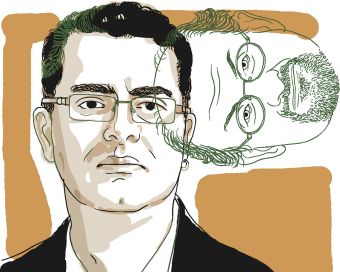
Is Das Racist’s Himanshu Suri for real?

Vivek Menezes in The Caravan:

The first time Das Racist ever performed ‘Michael Jackson’, the first single from their much-anticipated debut album Relax, was at Columbia University’s Bacchanal Spring Concert on 30 April earlier this year. The picturesque, grassy quadrangle in the centre of campus was packed with thousands of students and walk-in concertgoers from thegrittier neighbourhoods beyond the university’s walls, and the Brooklyn-based trio was notching another step on their improbable journey toward rap credibility: opening up for the west coast rap legend Snoop Dogg.

I was standing stagefront when Das Racist’s Himanshu Suri (aka ‘Heems’) announced the song; a distinct hush of anticipation fell over the crowd. Within moments, the band exploded across the stage, frenetically yelling the song’s catchphrase into their mics: “Michael Jackson! One Million Dollars! You feel me? Holler!” Just one scant minute later, the audience had taken up the refrain, and the callback spread all the way to the back of the crowd, hundreds of yards from where I stood—a few thousand people hollering, and I was doing the same.

But before they had even begun to captivate the audience with their music, and make us dance uncontrollably at their feet, Das Racist had first made sure to ruffle the feathers of the elite crowd that stood before them, filling the air with palpably awkward and uncertain murmurs. “This is the most collegiate shit I ever seen,” Heems said when he had first walked onto the stage. With an expression that made it seem as if he was smelling something putrid, he continued: “You look like a Tommy Hilfiger ad.” He proceeded to greet the Ivy Leaguers with a “shout-out” to Queens College and Stony Brook University, both decidedly public institutions. The audience was thoroughly confused, and it only got worse.

More here.

In Prenzlauer Berg

Justin E. H. Smith in his blog:

ScreenHunter_04 Sep. 30 10.28 Among the grimmer thoughts one has to contend with on any visit to Berlin is this: that one could very well be staying not only in the logistical nerve center of the Final Solution, but in the very building, and perhaps in the very same room, in which a Holocaust victim once lived. This possibility rose to 50%, in fact, when I was in Berlin a few days ago, and stayed in a six-unit building which housed, according to the commemorative plaques paved into the sidewalk outside, three separate Jewish couples who did not see the end of the war.

These plaques ensure that no visit to Berlin will ever be too fun. They are also the most decent, and most properly scaled, Holocaust memorials I've seen, anywhere, just the opposite of the misfired maze near the Brandenburger Tor (which induces, paradoxically, a sense of fun one knows one isn't supposed to be having), and a universe away from the grandiose theoretical statement of Libeskind's Jewish Museum. The plaques pull you away from the abstraction of large numbers and into the scene of what must have happened right there, in that building, the scene of individual lives unravelling.

More here.