
Category: Recommended Reading
Machine Morality and Human Responsibility
Charles T. Rubin in The New Atlantis:

Before R.U.R., artificially created anthropoids, like Frankenstein’s monster or modern versions of the Jewish legend of the golem, might have acted destructively on a small scale; but Čapek seems to have been the first to see robots as an extension of the Industrial Revolution, and hence to grant them a reach capable of global transformation. Though his robots are closer to what we now might call androids, only a pedant would refuse Čapek honors as the father of the robot apocalypse.
Today, some futurists are attempting to take seriously the question of how to avoid a robot apocalypse. They believe that artificial intelligence (AI) and autonomous robots will play an ever-increasing role as servants of humanity. In the near term, robots will care for the ill and aged, while AI will monitor our streets for traffic and crime. In the far term, robots will become responsible for optimizing and controlling the flows of money, energy, goods, and services, for conceiving of and carrying out new technological innovations, for strategizing and planning military defenses, and so forth — in short, for taking over the most challenging and difficult areas of human affairs.
More here.
Thursday, January 26, 2012
The Art of Mastering Many Tongues
Peter Constantine in the New York Times Book Review:

How is it, Erard asks, that certain people are able to accumulate what for the average person is a daunting number of languages? What are the secrets of polyglots who can master 6, 26, 96 languages? What are their quirks and attitudes? Are their brains wired differently from ours?
Erard, a journalist who writes frequently on language and whose previous book was “Um . . . : Slips, Stumbles, and Verbal Blunders, and What They Mean,” begins by visiting Bologna, Italy, the hometown of one of history’s most distinguished polyglots, the 19th-century cardinal Giuseppe Mezzofanti. The cardinal is said to have known 45, 50, 58 or even more languages, depending on whom you ask. Victorian travelers who met him at ecclesiastical banquets reported that he affably conversed in all directions with foreign visitors in languages ranging from French, German and Arabic to Algonquin and “Californian.” (Lord Byron, who challenged the cardinal to a multilingual contest of profanities, was not only summarily defeated but walked away from the contest having learned a number of new Cockney gibes.)
More here.
9/11 as art

THE GAMBIT OF THIS EXHIBITION about 9/11, which includes sixty-nine works by forty-two artists, is deceptively simple: to eschew any images of the attacks and any made in response to them. (As if to prove the rule, there is one exception, a 2003 proposal by Ellsworth Kelly to reconfigure Ground Zero as a giant trapezoidal park of bright green grass.) Instead, MoMA PS1 curator Peter Eleey writes in his brochure, “this exhibition considers the ways in which 9/11 has altered how we see and experience the world in its wake.” This is a strong thesis—one that asks to be taken seriously. As for the ban on images of 9/11, Eleey regards the attacks as an intervention in spectacle that was a spectacle in its own right: 9/11 “was made to be used,” he argues, with the Bush administration no less than Al Qaeda in mind. “Why would I want to repeat such transgression?” His catalogue essay begins with an epigraph from Wittgenstein—“A picture held us captive”—and his purported aim is to release us from this captivity, to despectacularize 9/11, a little. To this end, Eleey exhibited only work, created independently of the attacks, that, as stated in the brochure, “transcend[s] the specificities of its epoch, form, or content to uncannily address the present.” That art can resonate across time and place is a familiar notion, but often it concerns the retroactive effect of present practices on past ones, as in accounts of literary revision offered by T. S. Eliot in “Tradition and the Individual Talent” (1919) and Harold Bloom in The Anxiety of Influence (1973). Here the question is pitched differently: Might historical works foreshadow contemporary events and be changed by this unexpected connection?
more from Hal Foster at Artforum here.
in darkness

Agnieszka Holland is a half-Jewish director, born in Warsaw several years after the Second World War, who has had a varied and illustrious film career. She was assistant director on her mentor Andrzej Wajda’s Danton (1983), and directed films of her own in Poland, like the grim, political A Lonely Woman (1981). After 1981 most of her films, such as Olivier, Olivier (1992) and Washington Square (1997), were made elsewhere in Europe and in the United States. In recent years, she has directed episodes of David Simon’s two striking HBO series, The Wire and Treme. Holland, whose paternal grandparents were killed in the Warsaw ghetto and whose Catholic mother served in the Polish underground and helped save Jewish families, is probably best known for her Holocaust films: the psychologically penetrating Angry Harvest (1985), which received an Academy Award nomination for Best Foreign Language Film, and Europa Europa (1990), her best known and critically acclaimed film. Holland has said that both Jewish and Gentile sensibilities exist within her. Consequently, all three of her Holocaust films deal with the complex relationship of victimized Jews to Gentiles in worlds—German, Polish, and Ukrainian—that either initiated or collaborated in the destruction of the Jews.
more from Leonard Quart at Dissent here.
none of your fiddly french sauces
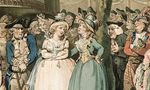
Vauxhall pleasure gardens, on the south bank of the Thames, entertained Londoners and visitors to London for 200 years. From 1729, under the management of Jonathan Tyers, property developer, impresario, patron of the arts, the gardens grew into an extraordinary business, a cradle of modern painting and architecture, and a music venue vital to the careers of Thomas Arne and George Frideric Handel: the Music for the Royal Fireworks was first played here, in a rehearsal attended by up to 12,000 paying customers. A pioneer of mass entertainment, Tyers had to become also a pioneer of mass catering, of outdoor lighting, of advertising, and of all the logistics involved in running one of the most complex and profitable business ventures of the eighteenth century in Britain. In this extraordinary work of historical reconstruction, David Coke and Alan Borg have collected a vast array of information about the gardens and somehow managed to arrange it into a compelling narrative. The book is almost too heavy to pick up, almost impossible to put down. The illustrations, some 300 in all, are sumptuous: not merely inert accompaniments to the story, they are read with a wonderfully careful attention to what they can tell us about the way, year by year, decade by decade, the gardens were changed, in search of the blend of continuity and novelty that was the secret of Tyers’s success in the glory years of Vauxhall.
more from John Barrell at the TLS here.
Thursday Poem
“His soul swooned slowly as he heard the snow falling faintly through the universe and faintly falling, like the descent of their last end, upon all the living and the dead.” —James Joyce, The Dead
Snow and Love
.
On this day of burning heat, I’m waiting for snow.
I’ve been waiting for it always.
When I was a boy, I read Notes from the House of the Dead
and saw snow falling on Siberian steppes
and on the tattered coat of Fyodor Dostoevsky.
I love snow because it doesn’t separate day from night
or distance heaven from the sufferings of earth.
It unites what’s separate:
the footsteps of those condemned to darkened ice
and sighs of love vanishing in the air.
One has to have a fine-tuned ear
to hear the music of falling snow, something almost silent
like the touch of an angel’s wing, assuming there are angels,
or the dying breath of a bird.
One shouldn’t wait for snow the way one waits for love.
They are different things. It’s enough to open our eyes to see the snow
falling on a deserted field. And it falls on us, cold white snow
that doesn’t burn like the flame of love.
To see love our eyes do not suffice,
nor our ears, nor our mouth, nor even our hearts
that beat in the dark with the same sound
as snow falling on the steppes
and on the roofs of darkened hovels
and on the tattered coat of Fyodor Dostoevsky.
To see love, nothing suffices. Both winter cold and searing heat
keep it from us, from our open arms
and our tormented hearts.
Faithful to my childhood, I prefer to see snow
that unites heaven and earth, night and day,
rather than be a helpless prey to love,
love that is neither white nor pure nor cold as snow.
.
by Lêdo Ivo
© Translation: 2010, Alexis Levitin
publisher: PIW, 2010
Dark Matter, Dark Energy, and the Race to Discover the Rest of Reality
Jonathan L. Feng in American Scientist:
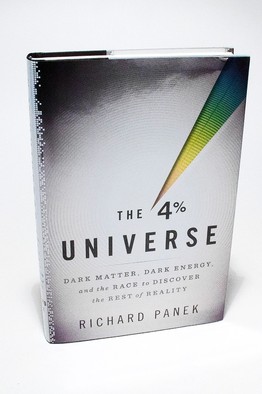
In The 4% Universe, Richard Panek has done something similar, not with business executives, but with physicists and astronomers who are confronting some of the biggest questions in science today. Want to hear a codiscoverer of dark matter say what she truly thinks of her legendary mentor? Want to be a fly on the wall as scientific history is shaped by the backroom dealings of a good-old-boy network? Want to read the e-mails scientists send as they jockey for position in the Nobel Prize queue? Scientists usually share such information only with their closest colleagues, but it’s all in Panek’s book, and it’s placed in enough historical and scientific context to be both intelligible and riveting.
More here.
Richard Dawkins at the Jaipur Literarture Festival
French children are a cut above our own
From The Telegraph:
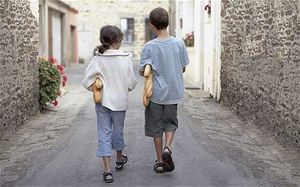
…“Children are an important part of the family, but family life doesn’t revolve round them,” points out Druckerman. “In America and Britain, there’s a belief that having children must entail self- sacrifice and that we must push them to succeed. The French are more patient and allow their children far more freedom. You never see French mothers hovering anxiously round their children in a park.” French women don’t dedicate themselves selflessly to motherhood. French fathers aren’t enslaved at weekends, driving children to activities. And babies are seldom breast-fed for long – the emphasis instead being on the mother’s sex life returning to normal as soon as possible.
More here.
Pakistan the Unreal
Aatish Taseer in Foreign Policy:
My relationship to the country has always been a complicated one. My father was Pakistani, but I had grown up away from him in New Delhi with my mother and had known neither him nor his country until the age of 21, when I first went to Lahore to seek him out. That time of great personal upheaval coincided with my first wish to be a writer, and knowing next to nothing about the mechanics of fiction but seduced by its glamour, I sat down to write a novel about the experience.
It was an abysmal failure, a baggy black hole of a book. I tried to calm my well-founded fears about it by taking comfort in the urgency and relevance of the real-world circumstances that had inspired the novel. But no outside reality, no matter how compelling, can rescue a work of fiction that doesn't work on its own terms. A writer needs distance if he is to create an autonomous fictional world in which the complexities of lived experience are distilled; he cannot still be in the throes of the experience he is writing about.
More here.
Facebook’s roots go way, way back
From MSNBC:

Another co-author of the study, UCSD's James Fowler, said the results suggest that the structure of today's social networks go back to a time before the invention of agriculture, tens of thousands of years ago. For decades, social scientists have puzzled over the origins of cooperative and altruistic behavior that benefits the group at the expense of the individual. That seems to run counter to a basic “tooth and claw” view of evolution, in which each individual fights for survival, or at least the survival of its gene pool. One of the leading hypotheses is that a system to reward cooperation and punish non-cooperators (“free riders”) grew out of a sense of genetic kinship between related individuals. But how far back did such a system arise?
More here.
Wednesday, January 25, 2012
The Caging of America
Adam Gopnik in The New Yorker:

The accelerating rate of incarceration over the past few decades is just as startling as the number of people jailed: in 1980, there were about two hundred and twenty people incarcerated for every hundred thousand Americans; by 2010, the number had more than tripled, to seven hundred and thirty-one. No other country even approaches that. In the past two decades, the money that states spend on prisons has risen at six times the rate of spending on higher education. Ours is, bottom to top, a “carceral state,” in the flat verdict of Conrad Black, the former conservative press lord and newly minted reformer, who right now finds himself imprisoned in Florida, thereby adding a new twist to an old joke: A conservative is a liberal who’s been mugged; a liberal is a conservative who’s been indicted; and a passionate prison reformer is a conservative who’s in one.
More here.
Timothy Snyder on Dissent
From The Browser:
How do you define dissent? What sets it apart from simple anger?

So it has to offer both a precise target and a precise alternative. And what of more vague dissent against circumstances that aren’t politically well defined, for instance the Occupy movement?
I’m forced here to make a distinction between dissent and dissidence. Of course, dissent can simply be an object noun. Clearly the Occupiers are dissenting, although it’s not entirely clear either what they’re dissenting from or what their alternative is. And I think those two go together – you can’t have an alternative unless you know precisely what you’re dissenting from. Whereas the Eastern European dissidents who I’m talking about here did, in general, stand for precise alternatives. It was insufficient for them just to say, “I’m standing apart”.
Although in the case of Václav Havel all he was really doing was to say, “We have the right to stand apart”. That was required in an awful lot of argumentation given the communist society that was around him. Dissidents recognise that you’re all on the same school bench but you have to sit somewhere else on that school bench, saying something different.
More here.
Twitter Feed of A Lawbreaker
Amitava Kumar in the New York Times:
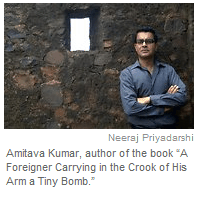
Just landed at Newark. Before leaving saw on TV at Delhi airport that complaints have been filed against us in Jaipur and elsewhere. #JLF
I was not a protester at Tahrir; I only read from a banned book. #JLF
Friends in media, forgive me for my silence. It was on legal advice. Also, I don’t trust you. #JLF
I had to leave India to be safe. A realization filled with surpassing loss. #JLF
But did I need to leave India to be brave? The truth was that I was afraid. #JLF
As in countless films, when the man pleads with his killer, “I have small children.” #JLF
First moment of fear: Hindi TV reporter pushing camera in my face to ask, “Are you not guilty of provoking religious violence?” #JLF
More here.
powers of ten

The film Powers of Ten was first made as a trial version in 1968, and then remade and released in 1977 in the familiar form that has been so widely disseminated in both film and printed formats. Produced by the Eames Office, the Los Angeles-based firm founded by the husband-and-wife design team, the 1977 version was one of the couple’s final films.4 In the postwar era of US corporate expansion and ascendancy, the Eameses established relationships with some of the key companies of the time. The development of their practice across the period parallels the larger transformation of a modern economy, based on the production of material objects, to a postmodern or informational economy, based on the production of signs. From their early designs for office and consumer objects—such as their famous chairs—they moved increasingly into exhibition and media productions for clients such as IBM, an early commission being The Information Machine, a film produced for the 1958 Brussels world’s fair. While work for corporate clients destined for the international exhibitions of the Cold War period was inevitably situated in an arena of national representation and geopolitical contest, the Eameses were at the same time receiving major commissions explicitly driven by such imperatives. Most notable of these was the film installation Glimpses of the USA, produced the year after the Brussels exposition for the 1959 American National Exhibition in Moscow, coordinated by the United States Information Agency (USIA). This event has been described as “the first cultural exchange between the two countries since the Bolshevik Revolution” and was the site of the infamous “kitchen debate” between (then vice-president) Richard Nixon and Nikita Khrushchev, itself an object lesson in the highly symbolic role that technological consumer products played in the period.5 The Eameses’ presentation used simultaneous projection onto seven large screens that hung in the main exhibition pavilion, a geodesic dome designed by Buckminster Fuller.
more from Mark Dorrian at Cabinet here.
welcome to belarus

One of my earliest memories is riding a Belarus tractor. My grandmother was the mayor of a small village in Communist Bulgaria and, being her favorite grandchild, I seemed to wield enormous power over all municipal employees. To be on good terms with me was a smart career move. Whenever there was road work in and around the village, I was there, riding the paving machine, the dump trucks, and the roller, hungrily breathing in the tar fumes and squealing with joy. When summer came around and the hills of the Danubian Plain turned into a sea of wheat, I was given a privileged spot on a combine harvester. The heat was dreadful and my lungs got congested by dust, but I liked it anyway. My favorite ride, though, was the tractor. It was a blue machine with large rear wheels and the loudest engine in the world. The driver, uncle Mitko, had a bushy moustache, like Stalin’s, and always wore the same dirty cotton wife-beater. He was a good friend of my grandmother’s and every afternoon he would stop by our house after finishing work at the collective farm. With mayoral permission he would lift me up into the cab and place me on the seat next to him. I could smell the alcohol on his breath, along with the headier mix of diesel, sweat, and earth. I loved that smell. I loved the levers and buttons and dashboard instruments, the steering wheel that looked enormous even in uncle Mitko’s enormous hands. “Welcome to Belarus,” he’d say every time with a mystifying smile, the way I had seen Stalin smile at little children in the old picture books in my grandmother’s library.
more from Dimiter Kenarov at VQR here.
Salman Rushdie goes on offensive
Jason Burke in The Guardian:

However, in an interview with the local NDTV network, the 64-year-old author reserved his harshest words for the “Muslim groups that were so unscrupulous, and whose idea of free speech is that they are the only ones entitled to it”.
“[If] Anyone else, who they disagree with, wishes to open his mouth, they will try and stop that mouth,” Rushdie said.
“That’s what we call tyranny. It’s much worse than censorship because it comes with the threat of violence.”
The interview followed the last-minute cancellation of Rushdie’s speech to thousands waiting at the Diggi Palace, a heritage hotel in the centre of Jaipur.
British writer and historian William Dalrymple, one of the festival’s directors, said the decision had been taken by the owners of the venue.
“The police commissioner told us there would be violence in the venue and a riot outside where thousands were gathering if we continued,” Dalrymple said.
More here.
See the whole video here.
the most excitingly vocal and ruggedly combative of American critics

“Everyone is entitled to his own nostalgia,” wrote the Vanity Fair critic James Wolcott in a review of George W.S. Trow’s polemical memoir, My Pilgrim’s Progress. But entitled on what terms? Wolcott is easily displeased by writing concerned with golden ages, slipping standards and vanished values. Trow was accused of wearing his “doldrums” about the dumb present as a badge of integrity; Gail Pool was found guilty of “moping” in Faint Praise, her monograph about the decline of American book reviewing; the nostalgia in Frank Rich’s memoir Ghost Light had come “too early.” Yet despite his tendency to touch on, or brush past, such particularities, Wolcott’s beef really lies with the nostalgic impulse itself. “Sugarcoating the past is unworthy of someone with Trow’s brilliance,” he decided. “Where these books don’t take you,” he wrote in the final line of a piece about Harvard memoirs, “is beyond nostalgia.” How much space do Wolcott’s proscriptions leave for his own trip down memory lane, Lucking Out: My Life Getting Down and Semi-Dirty in Seventies New York? Even less than it seems. Not only has he taken a bat to the genre but others have beaten him to his subject. Greenwich Village of the 1950s, Wolcott once noted, “has been fictionally satirized by Dawn Powell and Wallace Markfield, replayed like a nostalgic newsreel in Dan Wakefield’s New York in the ’50s, reduced to a cigarette flicker in Herbert Gold’s Bohemia: Where Art, Angst, Love and Strong Coffee Meet, restaged like a Strindberg play in Leonard Michaels’s Sylvia.” New York City in the 1970s has been getting similar treatment recently. “You could have an apartment all to yourself for less than $150 a month,” wrote Luc Sante in 2003 about the Lower East Side in his essay “My Lost City.” “We needed to raise four hundred fifty dollars, a month’s rent and a month’s deposit,” Patti Smith recalled of life with Robert Mapplethorpe in her recent memoir, Just Kids.
more from Leo Robson at The Nation here.
Mitt’s 1040s
From The New Yorker:

Let’s be clear: Romney did nothing wrong. As he said in last night’s debate, he and his wife paid the U.S. government what they owed, and not a penny more. Like many very wealthy people, they appear to have employed a small army of financial advisers and a perfectly reputable accounting firm, PricewaterhouseCoopers, to minimize their tax exposure using a range of methods. Over the years, these methods have included setting up tax-sheltered retirement vehicles, establishing family trusts, making offshore investments, and exploiting one particular tax break that Romney was entitled to use by dint of his employment at Bain Capital. By now, you’ve probably seen the headlines about the returns. In 2010 and 2011, Romney and his wife made $42.6 million, almost all of it in the form of income from their various investments, which is taxed at a rate of fifteen per cent. In those two years, the Romneys paid the federal government $6.2 million. Confirming what Mitt said in New Hampshire last week, their effective tax rate in 2011 will be 15.4 per cent. In 2010, they did a bit better, at 13.9 per cent.
More here.