The Symbolism Survey

From The Paris Review:

LetterIn 1963, a sixteen-year-old San Diego high school student named Bruce McAllister sent a four-question mimeographed survey to 150 well-known authors of literary, commercial, and science fiction. Did they consciously plant symbols in their work? he asked. Who noticed symbols appearing from their subconscious, and who saw them arrive in their text, unbidden, created in the minds of their readers? When this happened, did the authors mind?

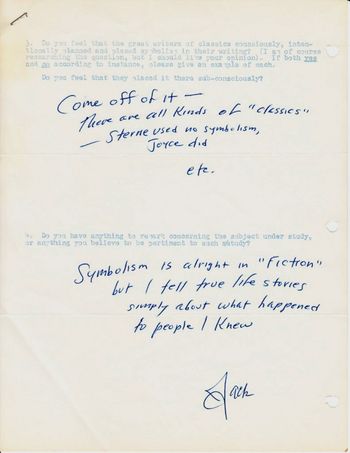
…The answers to the questionnaire were as varied as the writers themselves. Did Isaac Asimov plant symbolism in his work? “Consciously? Heavens, no! Unconsciously? How can one avoid it?” Iris Murdoch sagely advises that “there is much more symbolism in ordinary life than some critics seem to realize.” Ayn Rand wins the prize for concision; addressing McAllister’s example of symbolism in The Scarlet Letter, she wrote, “This is not a definition, it is not true—and, therefore, your questions do not make sense.” Kerouac is a close second; he writes, “Symbolism is alright in ‘Fiction’ but I tell true life stories simply about what happened to people I know.” The apologies Bruce received from secretaries—including those of John Steinbeck, Muriel Spark, and Ian Fleming—explaining that they were traveling and unable to respond were longer than that.

More here.

Astronomers Find Biggest Black Holes Yet

Dennis Overbye in The New York Times:

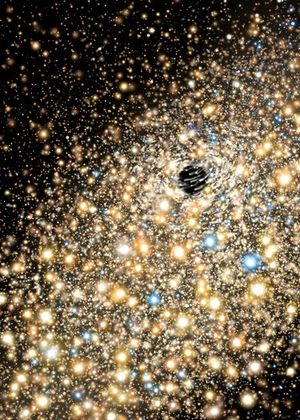
HOLES-REFER-popupDon’t get too close. Astronomers are reporting that they have taken the measure of the biggest, baddest black holes yet found in the universe, abyssal yawns 10 times the size of our solar system into which billions of Suns have vanished like a guilty thought. Such holes, they say, might be the gravitational cornerstones of galaxies and clues to the fates of violent quasars, the almost supernaturally powerful explosions in the hearts of young galaxies that dominated the early years of the universe. One of these newly surveyed monsters, which weighs as much as 21 billion Suns, is in an egg-shaped swirl of stars known as NGC 4889, the brightest galaxy in a sprawling cloud of thousands of galaxies about 336 million light-years away in the Coma constellation.

The other black hole, a graveyard for the equivalent of 9.7 billion Suns, more or less, lurks in the center of NGC 3842, a galaxy that anchors another cluster known as Abell 1367, about 331 million light-years away in Leo. “These are the most massive reliably measured black holes ever,” Nicholas J. McConnell, a graduate student at the University of California, Berkeley, said in an e-mail, referring to the new observations. These results are more than just cool and record-setting. Observations with the Hubble Space Telescope over the years have shown that such monster black holes seem to inhabit the centers of all galaxies — the bigger the galaxy, the bigger the black hole. Researchers said the new work could shed light on the role these black holes play in the formation and evolution of galaxies.

More here.

Choosing Egypt’s Future

Yasmine El Rashidi in the New York Review of Books:

ScreenHunter_09 Dec. 06 13.19Few people I know in Cairo got much sleep last Sunday night. The voting stations were set to open at 8AM the following morning, and everyone was concerned that the day would be marred by the increasingly lethal violence we have witnessed in recent weeks. “I’m going to go as early as possible, before it gets crowded or anything bad happens,” my mother had told me. It seemed everyone had thought the same—by the time I reached my neighborhood voting station at 7:15AM Monday, it was already packed—there were at least 2,000 people there. A friend called me from her own voting station about 40 minutes away as I arrived, saying she couldn’t even see the end of the line.

For much of the past ten months, you could gauge the direction Egypt was moving in by seeing what was happening in Tahrir Square. Ever since serving as the epicenter of the revolution, it has been the place where the different post-Mubarak factions—the Islamists, unemployed youth, trade unions, liberal and secular parties, even government workers and the police—have staged rallies or aired their grievances. If Tahrir was calm, things were generally considered to be improving; if it was occupied, or worse—the site of confrontation with thugs or the military—it meant the country was in trouble.

This week, however, as we started voting in the country’s first parliamentary elections since the fall of Mubarak, that center of gravity seemed to have shifted. The square was once again occupied by activists protesting the recent violence at the hands of riot and military police, and they had announced they were boycotting the vote, on the grounds that it would legitimize the rule of the Military Council that they sought to remove. But by Monday morning, the “boycotters” were a muffled minority numbering only a few hundred people. Everywhere else, throughout Cairo and across the country, voters came out by the tens of thousands, often enduring hours-long lines to cast their ballots.

More here.

Kepler 22-b: Earth-like planet confirmed

From the BBC:

ScreenHunter_08 Dec. 06 13.12Astronomers have confirmed the existence of an Earth-like planet in the “habitable zone” around a star not unlike our own.

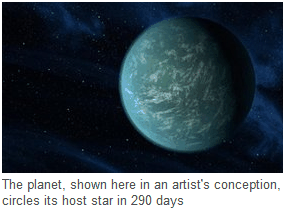
The planet, Kepler 22-b, lies about 600 light-years away and is about 2.4 times the size of Earth, and has a temperature of about 22C.

It is the closest confirmed planet yet to one like ours – an “Earth 2.0”.

However, the team does not yet know if Kepler 22-b is made mostly of rock, gas or liquid.

During the conference at which the result was announced, the Kepler team also said that it had spotted some 1,094 new candidate planets – nearly doubling the telescope's haul of potential far-flung worlds.

Kepler 22-b was one of 54 exoplanet candidates in habitable zones reported by the Kepler team in February, and is just the first to be formally confirmed using other telescopes.

More here.

Art and the Limits of Neuroscience

Alva Noë in the New York Times:

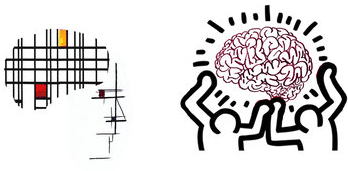
ScreenHunter_07 Dec. 06 13.08What is art? What does art reveal about human nature? The trend these days is to approach such questions in the key of neuroscience.

“Neuroaesthetics” is a term that has been coined to refer to the project of studying art using the methods of neuroscience. It would be fair to say that neuroaesthetics has become a hot field. It is not unusual for leading scientists and distinguished theorists of art to collaborate on papers that find their way into top scientific journals.

Semir Zeki, a neuroscientist at University College London, likes to say that art is governed by the laws of the brain. It is brains, he says, that see art and it is brains that make art. Champions of the new brain-based approach to art sometimes think of themselves as fighting a battle with scholars in the humanities who may lack the courage (in the words of the art historian John Onians) to acknowledge the ways in which biology constrains cultural activity. Strikingly, it hasn’t been much of a battle. Students of culture, like so many of us, seem all too glad to join in the general enthusiasm for neural approaches to just about everything.

What is striking about neuroaesthetics is not so much the fact that it has failed to produce interesting or surprising results about art, but rather the fact that no one — not the scientists, and not the artists and art historians — seem to have minded, or even noticed. What stands in the way of success in this new field is, first, the fact that neuroscience has yet to frame anything like an adequate biological or “naturalistic” account of human experience — of thought, perception, or consciousness.

More here.

What children’s drawings would look like if painted realistically

Rian van der Merwe in Elezea:

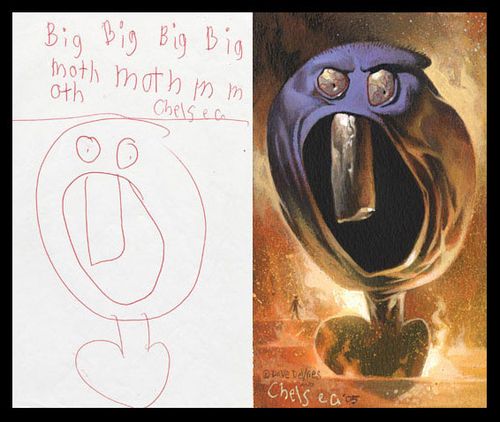
Monsters3

The Monster Engine is one of those projects that make me love the Internet for its ability to expose amazing creative talent to a worldwide audience. Illustrator Dave DeVries started with a simple question: What would a child’s drawing look like if it were painted realistically? In his own words:

It began at the Jersey Shore in 1998, where my niece Jessica often filled my sketchbook with doodles. While I stared at them, I wondered if color, texture and shading could be applied for a 3D effect. As a painter, I made cartoons look three dimensional every day for the likes of Marvel and DC comics, so why couldn’t I apply those same techniques to a kid’s drawing? That was it… no research, no years of toil, just the curiosity of seeing Jessica’s drawings come to life.

The Monster Engine is the 48-page outcome from that curiosity, and it looks wonderful. He describes the process as follows:

I project a child’s drawing with an opaque projector, faithfully tracing each line. Applying a combination of logic and instinct, I then paint the image as realistically as I can.

More here.

“Only Connect…:” Super Sad True Love Story and the Semiotics of Palo Alto

Ea_sstlsAbby Kluchin over at Rethinking Religion:

I put off writing about Gary Shteyngart’s conversation with McKenzie Wark about technology, religion, and literature—well, mostly because I had to write a conference paper. And then I went to San Francisco for the conference and I put it off again, because I took a side trip to Facebook HQ in Palo Alto—metonymically, at least, the epicenter of everything that Shteyngart’s latest novel Super Sad True Love Story laments—and I had to reconsider my reaction both to the book and the conversation.

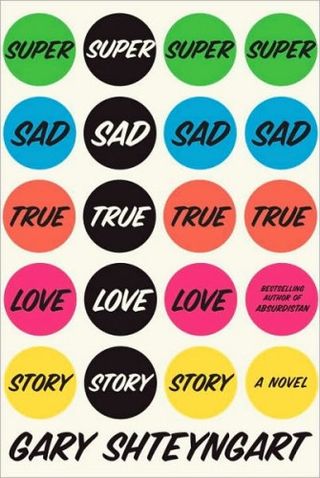
As Ujala Sehgal and Sephora Markson Hartz have already noted on this blog, Shteyngart spoke eloquently at the talk about his encounter with books as the only religious experience available to him. He didn’t hammer home the solid, satisfying ‘object’-ness of a book as opposed to an e-reader, as opponents of such technologies frequently do, including Super Sad’s protagonist, Lenny Abramov—“the last reader on earth!”—who delights in his wall of real books in a not-too-distant future in which such “bound, printed, nonstreaming Media artifacts” bring down one’s “PERSONALITY rankings” and are primarily known for their repulsive smell. Rather, he remarked that a physical book is a ‘rudimentary technology.’ You can’t, he observed, use a book to order other things; it has only one function. There is something about this rudimentary technology that in the hands of an undistracted person (should we be able to locate one) can give rise to an encounter that enlarges the parameters of ordinary selfhood, that creates a space in which something can occur, something can arrive.

In person, Shteyngart didn’t seem ready just yet to mourn the death of the possibility of this encounter, although Super Sad is certainly, among other things, an elegy for its vanishing. The question that Shteyngart, deliberately fiddling with what he called his ‘iTelephone,’ asked is, should he, as a writer (and, I sensed, equally as a reader), stick to his guns about the importance of this encounter with this singular rudimentary technology, or should he adapt? Super Sad suggests in its very form and its engagement with social media, albeit primarily in the mode of blistering critique, that Shteyngart will adapt, though, certainly, he will not go gentle into that buzzing digital night. But the conversation, as well as the audience, was filled with nostalgia. Shteyngart didn’t bring up E.M. Forster, but I thought repeatedly, as he spoke, of Forster’s famous, poignant plea from Howard’s End: “Only connect . . .” And then I went to Palo Alto.

Monday, December 5, 2011

3 Quarks Daily 2011 Politics & Social Science Prize: Vote Here

Dear Reader,

Thanks very much for participating in our contest. For details of the prize you can look at the announcement here, and to read the nominated posts you can go here for a complete list with links.

If you are new to 3 Quarks Daily, we welcome you and invite you to look around the site after you vote. Learn more about who we are and what we do here, and do check out the full site here. Bookmark us and come back regularly, or sign up for the RSS feed. If you have a blog or website, and like what you see here, we would very much appreciate being added to your blogroll. Please don’t forget!

Results of the voting round (the top twenty most voted for posts) will be posted on the main page on December 11, 2011. Winners of the contest will be announced on or around December 19, 2011.

Now go ahead and submit your vote below!

PLEASE BE AWARE: We have multiple ways of detecting fraud such as multiple votes being cast by the same person. We will disqualify anyone attempting to cheat.

Cheers,

Abbas

The Nominees for the 2011 3QD Prize in Politics and Social Science Are:

Alphabetical list of blog names followed by the blog post title:

(Please report any problems with links in the comments section below.)

For prize details, click here.

And after looking around, click here to vote.

  1. 3 Quarks Daily: Indians Abroad: A Story from Trinidad
  2. 3 Quarks Daily: Pakistan: The Narratives Come Home to Roost
  3. 3 Quarks Daily: The Immensity Of Killing Bin Laden vs. The Banality Of Language
  4. 3 Quarks Daily: The Pao of Love
  5. 3 Quarks Daily: There’s Something about the Teeth of Tyrants
  6. Abandoned Footnotes: A Simple Model of Cults of Personality
  7. Accidental Blogger: The mideast uprisings: a lesson for strong men, mad men and counterfactual historians
  8. Andy Worthington: Mocking the Law, Judges Rule that Evidence Is Not Necessary to Hold Insignificant Guantánamo Prisoners for the Rest of Their Lives
  9. Asian Security Blog: I finally played “Homefront”
  10. Barry Pump’s Blog: Union Membership and Welfare Spending
  11. Blinktopia: Ain’t Capitalism Grand?
  12. Brendan Nyhan: Forecasting 2012: How much does ideology matter?
  13. Brian Thill: On the Early Iconography of Certain of the 2012 Presidential Campaign Logos, Considered Alphabetically
  14. Corey Robin: Revolutionaries of the Right: The Deep Roots of Conservative Radicalism
  15. Crikey: Could Australia’s record on arms control harm UN Security Council bid?
  16. Crikey: Theorising Darwin: US may stockpile and transit cluster munitions
  17. Crooked Timber: Sex, hope, and rock and roll
  18. David B. Sparks: Isarithmic History of the Two-Party Vote
  19. Ezra Klein’s Wonkblog: Could this time have been different?
  20. Guernica: The Iron Lady
  21. Heathen Scripture: Joyce, Katter, Devine: Last bastion against the Gaypocalypse
  22. HLD6: Christian Persecution Complex
  23. Hopeless but not serious: Pokémon gets political
  24. Jadaliyya: Palestine in Scare Quotes: From the NYT Grammar Book
  25. Jadaliyya: The Marriage of Sexism and Islamophobia; Re-Making the News on Egypt
  26. Jeremy Scahill: DoD Investigating Nine Cases of “Terrorism-Related Acts” by US Military and Contractors?
  27. Muhammad Cohen: Overheard at Ali’s Diner on Arab Street
  28. Naked Capitalism: On the Invention of Money
  29. Occupy | Decolonize | Liberate: Flathead: Occupy Thomas Friedman
  30. Pandaemonium: Rethinking the Idea of “Christian Europe”
  31. Peter Frase: Anti-Star Trek: A Theory of Posterity
  32. PH2.1: Polarization?
  33. Platykurtosity: The Economics of Sex, Revisited
  34. Progressive Geographies: The Killings of Troy Davis
  35. RantAWeek: Here Comes Monti’s Army
  36. Sagartron: Psychotropic drugs anyone?
  37. Scholar as Citizen: Who’s Really Behind Recent Republican Legislation in Wisconsin and Elsewhere? (Hint: It Didn’t Start Here)
  38. Shunya’s Notes: Decolonizing My Mind
  39. Tang Dynasty Times: The Persian Prince Pirooz
  40. The Awl: The Livestream Ended: How I Got Off My Computer And Onto The Street At Occupy Oakland
  41. The Buck Stops Here: Charter Schools and Averages
  42. The Monkey Cage: It’s a Bird! It’s a Plane! It’s…. Technocratic Government!
  43. The Philosopher’s Beard: Democracy is not a truth machine
  44. The Primate Diaries: Freedom to Riot: On the Evolution of Collective Violence
  45. The Sociological Eye: The Inflation of Bullying: From Fagging to Cyber-effervescent Scapegoating
  46. Thought News: Barack Obama, Abraham Lincoln, Reinhold Niebuhr, and Creativity
  47. TripleCrisis: Paradigms Lost? Cowboys and Indians in the Battle over Economic Ideas
  48. U.S. Intellectual History: Going beyond the “Racial Protocol”
  49. U.S. Intellectual History: Great Books Liberalism
  50. U.S. Intellectual History: Leo Strauss, Common Sense, and American Conservatism 
  51. U.S. Intellectual History: War and the “We”
  52. U.S. Intellectual History: “When the Zulus Produce a Tolstoy We Will Read Him”: Charles Taylor and the Politics of Recognition
  53. Voteview Blog: S.& P. Downgrade and the Polarization of the American Political System
  54. Voteview Blog: The Ideological Makeup of the “Super Committee”
  55. Vox Mentis: Democracy vs Republic – Essential differences & Speculations on Future Politics of the world
  56. Zunguzungu: “The Grass Is Closed”: What I Have Learned About Power from the Police, Chancellor Birgeneau, and Occupy Cal

The Bhagavad Gita Revisited – Part 1

By Namit Arora

(Why the Bhagavad Gita is an overrated text with a deplorable morality at its core. This is part one of a two-part critique. Part 1 is the appetizer with the Gita’s historical and literary context. Part 2 is the main course with the textual critique.)
KarnaDeathIn mid-first millennium BCE, a great spiritual awakening was underway in areas around the middle Ganga. People were moving away from the old Vedic religion—which revolved around rituals, animal sacrifices, and nature gods—to more abstract, inner-directed, and contemplative ideas. They now asked about the nature of the self and consciousness, thought and perception. They asked if virtue and vice were absolute or mere social conventions. Personal spiritual quests, aided by meditation and renunciation of material gain, had slowly gathered pace. From this churn arose new ideas like karma and dharma, non-dualism, and the unity of an individual’s soul (atman) with the universal soul (Brahman)—all pivotal ideas in Brahmanical Hinduism.

Some of these innovations in thought soon made their way into the texts we now know as the Upanishads, setting them qualitatively apart from the earlier Vedas. All of this occurred in the context of great sociopolitical and economic changes, marked by the rise of cities, trade and commerce, social mobility, public debates, new institutions of state, and even some early republics. This was also the world of the Buddha, Mahavira, and Carvaka.

The Great War of Yore

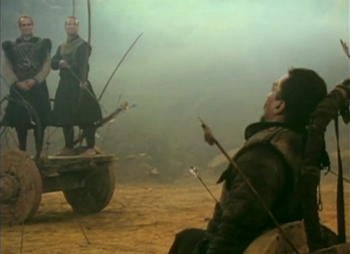
By this time, versions of a Mahabharata story had been circulating for centuries. Perhaps inspired by a war that took place c. 950 BCE around modern Delhi (the date is tentative), the story, through oral transmission, took on a life of its own. In The Hindus: An Alternative History (2009), Wendy Doniger writes that the earliest bards who told the Mahabharata story came from a caste of charioteers, who served as drivers, confidantes, and bodyguards to the Kshatriya warrior-castes. While on military campaigns, they recited stories around campfires. (No wonder God is a charioteer in the epic! Even Karna is raised by a charioteer.) In later ages and in times of peace, many bards took their performance art to lay audiences in villages and folk festivals. The story also came to be recited during royal sacrifices, where the Brahmins gradually took over its delivery and evolution, eventually writing it down in Sanskrit. Its “final form” dates from 300 BCE-300 CE and ranges from 75K to 100K verses, seven to ten times the Iliad and the Odyssey combined. (Read an outline of the story here.)

Read more »

Sunday, December 4, 2011

Top 100 Global Thinkers

From Foreign Policy:

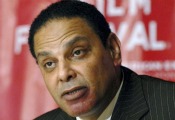
1. ALAA AL ASWANY: For channeling Arab malaise and Arab Renewal. Novelist/Egypt:

Aswany_0All revolutionaries want their stories told to the world, and no one has conveyed the hopes and dreams of Egyptians more vividly than Alaa Al Aswany. The dentist turned author rose to fame with his 2002 novel, The Yacoubian Building, which charted Egypt's cultural upheaval and gradual dilapidation since throwing off its colonial shackles. Aswany used his prominence to help found the Kefaya political movement, which first articulated the demands that would energize the youth in Tahrir Square: an end to corruption, a rejection of hereditary rule, and the establishment of a true democratic culture. For his political activism, Aswany was blacklisted by Egypt's state-owned publishing houses, and security officials harassed the owner of the cafe where he met with young writers.

How times change. Aswany was a fixture in Tahrir Square during Egypt's uprising — he was almost killed three times, he said, during the running battles between demonstrators and pro-Mubarak thugs. And he has tried to keep the revolution's spirit alive since, pressing the country's ruling military junta to remove the vestiges of Hosni Mubarak's regime and assailing Egypt's Islamists for their willingness to sacrifice the movement's principles for a taste of power. In the process, Aswany has given voice to a people silenced for too long. “Revolution is like a love story,” he said in February. “When you are in love, you become a much better person. And when you are in revolution, you become a much better person.”

More here.

A Page in the Life with Vikram Seth

From The Telegraph:

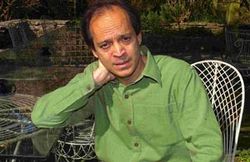
Vikram-sethWhether Jeffrey Archer sought permission from the shade of Rupert Brooke before he moved into The Old Vicarage, Grantchester, I don’t know. But when Vikram Seth decided to buy the Old Rectory in Bemerton, Salisbury, he had a word with one of its previous owners, the poet and Anglican priest George Herbert, who died in the house in 1633. “I had a little colloquy with him as to whether I should buy it… I imagined Herbert saying, ‘Oh yeah, go ahead’. I think basically I was granting myself permission.” Seth, puckish and urbane, is showing me around his house’s beautiful if molehill-pocked garden adjoining the River Nadder, and describing the Heath Robinson-like process for making jam from the fruit of the medlar tree that Herbert planted here. He recalls how he first came here on a rainy day with his then-partner, the violinist Philippe Honoré; he wanted to look around the place where some of his favourite poems were written, so pretended to be interested in buying it.

“I’m not a country type, I’ve lived in cities most of my life. But within five or 10 minutes of being here, I felt there was something really drawing me towards it. Obviously not the price tag.” A stained-glass window in the tiny church across the road seemed like a good omen: it depicts Herbert holding a violin. He shows me the bridge in the garden on which he slipped and fell that day. “I thought, well, that is very unpropitious, and then I thought wasn’t there the example of William the Conqueror who stumbled and fell when he first landed, and said this showed his attachment to the soil? So I thought I’d interpret it according to my own devices.” The house and garden have inspired some of the libretti Seth has written for various musical collaborations with Honoré and the composer Alec Roth. Some of these crisp, glittering texts, collected in The Rivered Earth, follow Herbert’s metrical forms.

More here.

Sunday Poem

Utopia

Island where all becomes clear.
Solid ground beneath your feet.
The only roads are those that offer access.
Bushes bend beneath the weight of proofs.
The Tree of Valid Supposition grows here
with branches disentangled since time immemorial.
The Tree of Understanding, dazzlingly straight and simple,
sprouts by the spring called Now I Get It.
The thicker the woods, the vaster the vista:
the Valley of Obviously.
If any doubts arise, the wind dispels them instantly.
Echoes stir unsummoned
and eagerly explain all the secrets of the worlds.
On the right a cave where Meaning lies.
On the left the Lake of Deep Conviction.
Truth breaks from the bottom and bobs to the surface.
Unshakable Confidence towers over the valley.
Its peak offers an excellent view of the Essence of Things.
For all its charms, the island is uninhabited,
and the faint footprints scattered on its beaches
turn without exception to the sea.
As if all you can do here is leave
and plunge, never to return, into the depths.
Into unfathomable life.

by Wislawa Szymborska
from A Large Number
translation by S. Baranczak & C. Cavanagh

The Bomb Buried In Obamacare Explodes Today-Hallelujah!

Rick Ungar in Forbes:

218x300I have long argued that the impact of the Affordable Care Act is not nearly as big of a deal as opponents would have you believe. At the end of the day, the law is – in the main – little more than a successful effort to put an end to some of the more egregious health insurer abuses while creating an environment that should bring more Americans into programs that will give them at least some of the health care coverage they need.

There is, however, one notable exception – and it’s one that should have a long lasting and powerful impact on the future of health care in our country.

That would be the provision of the law, called the medical loss ratio, that requires health insurance companies to spend 80% of the consumers’ premium dollars they collect—85% for large group insurers—on actual medical care rather than overhead, marketing expenses and profit. Failure on the part of insurers to meet this requirement will result in the insurers having to send their customers a rebate check representing the amount in which they underspend on actual medical care.

This is the true ‘bomb’ contained in Obamacare and the one item that will have more impact on the future of how medical care is paid for in this country than anything we’ve seen in quite some time.

More here. [Thanks to Asad Raza.]

Siri Doesn’t Know About Your Lady Stuff

129202541.jpg.CROP.rectangle3-largeAmanda Marcotte in Slate:

The programmers behind Siri seem to be a bunch of gleefully juvenile dudes who took the time to teach Siri corny jokes, marijuana know-how and sci-fi references, along with teaching it about serious problems that can affect both men and women, such as suicidal thoughts. And even though they really like the idea of sex with women, they seem to have not thought much about the work that women have to put into being sexually accessible. Just as with the mind-boggling name fail of the iPad, the problem seems to be that there simply aren't enough women working in innovative, customer-driven technology services, and the ones who do have to adopt a bro-like attitude that makes them nearly as forgetful of the concerns of ordinary women as the men are.

I don't have Siri on my phone, but my boyfriend does, and like pretty much all dorks left alone with Siri for five minutes, we've had our fun playing with it. It was also pretty stupid when I asked it for a vasectomy. Just as with the phrase “birth control”, it had no ability to look past the actual name of clinics, so instead of producing the names of local urologists, it gave me a couple of seedy-sounding places with the word “vasectomy” right in their name. But I still can't see this as some kind of egalitarian fail on the reproductive health front; even though vasectomies are performed on men, they are done to protect women from pregnancy. Again, it just seems that some of the most basic, everyday health concerns of women hadn't registered as important with Siri's programmers. When I used some common slang terms for oral sex performed on women with it, Siri seemed to think I was in the the mood for a hamburger or on the market to buy a cat (and shame on Siri for sending me to a pet store instead of a local animal shelter!). It had zero problem knowing what I meant when I referenced fellatio.