sullivan and the essay

111219_r21697_p233

At present, the American magazine essay, both the long feature piece and the critical essay, is flourishing, in unlikely circumstances. Despite the slightly tedious nostalgia for the world of the New York intellectuals and the patient outlets of nineteen-fifties high journalism, I doubt that Edmund Wilson or Alfred Kazin would rightfully find much to complain about. New and new-ish journals such as McSweeney’s, n+1, The Point, and The Common have found their way; older magazines have been optimistically refurbished, or just optimistically survive anyway. There are plenty of reasons for this. One is that magazines, big and small, are taking over some of the cultural and literary ground vacated by newspapers in their seemingly unstoppable evaporation. Another is that the contemporary essay has for some time now been gaining energy as an escape from, or rival to, the perceived conservatism of much mainstream fiction.

more from James Wood at The New Yorker here.
Women’s Response to Alcohol

From Scientific American:

AlcoholAlcohol abuse does its neurological damage more quickly in women than in men, new research suggests. The finding adds to a growing body of evidence that is prompting researchers to consider whether the time is ripe for single-gender treatment programs for alcohol-dependent women and men.

Over the past few decades scientists have observed a narrowing of the gender gap in alcohol dependence. In the 1980s the ratio of male to female alcohol dependence stood at roughly five males for every female, according to figures compiled by Shelly Greenfield, a professor of psychiatry at Harvard Medical School. By 2002 the “dependence difference” had dropped to about 2.5 men for every woman. But although the gender gap in dependence may be closing, differences in the ways men and women respond to alcohol are emerging. Writing in the January 2012 issue of Alcoholism: Clinical and Experimental Research, principal investigator Claudia Fahlke from the Department of Psychology at the University of Gothenburg in Sweden and her colleagues found that alcohol's ability to reduce serotonin neurotransmission, was “telescoped” in alcoholic women compared with their male counterparts. In other words, although the alcohol-dependent men and women in the study differed substantially in their mean duration of excessive drinking—four years for the women and 14 years for the men—both sexes showed similar patterns of reduced serotonin activity compared with controls. The researchers gauged serotonergic neurotransmission by measuring its response to citalopram, a drug that stalls serotonin molecules in the synaptic gap (as measured by the hormone prolactin's response to citalopram. This pattern of reduced serotonergic neurotransmission matters, because some of the alcohol-induced abnormalities were found in brain regions involved in judgment, self-control and emotional regulation.

More here.

An Eye for Genius: The Collections of Gertrude and Leo Stein

From Smithsonian:

Gertrude-Stein-631With its acid colors and slapdash brush strokes, the painting still jolts the eye. The face, blotched in mauve and yellow, is highlighted with thick lines of lime green; the background is a rough patchwork of pastel tints. And the hat! With its high blue brim and round protuberances of pink, lavender and green, the hat is a phosphorescent landscape by itself, improbably perched on the head of a haughty woman whose downturned mouth and bored eyes seem to be expressing disdain at your astonishment. If the picture startles even after a century has passed, imagine the reaction when Henri Matisse’s Woman with a Hat was first exhibited in 1905. One outraged critic ridiculed the room at the Grand Palais in Paris, where it reigned alongside the violently hued canvases of like-minded painters, as the lair of fauves, or wild animals. The insult, eventually losing its sting, stuck to the group, which also included André Derain and Maurice de Vlaminck. The Fauves were the most controversial artists in Paris, and of all their paintings, Woman with a Hat was the most notorious.

So when the picture was later hung in the Parisian apartment of Leo and Gertrude Stein, a brother and sister from California, it made their home a destination. “The artists wanted to keep seeing that picture, and the Steins opened it up to anyone who wanted to see it,” says Janet Bishop, curator of painting and sculpture at the San Francisco Museum of Modern Art, which organized “The Steins Collect,” an exhibition of many pieces the Steins held. The exhibition goes on view at the Metropolitan Museum of Art in New York City from February 28 to June 3. (An unrelated exhibition, “Seeing Gertrude Stein: Five Stories,” about her life and work, remains at the Smithsonian National Portrait Gallery until January 22.)

More here.

Wednesday Poem

Quilts

—for Sally Sellers

Like a fading piece of cloth
I am a failure

No longer do I cover tables filled with food and laughter
My seams are frayed my hems falling my strength no longer able
To hold the hot and cold

I wish for those first days
When just woven I could keep water
From seeping through
Repelled stains with the tightness of my weave
Dazzled the sunlight with my
Reflection

I grow old though pleased with my memories
The tasks I can no longer complete
Are balanced by the love of the tasks gone past

I offer no apology only
this plea:

When I am frayed and strained and drizzle at the end
Please someone cut a square and put me in a quilt
That I might keep some child warm

And some old person with no one else to talk to
Will hear my whispers

And cuddle
near

by Nikki Giovanni

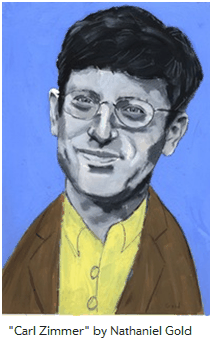
Interview with Carl Zimmer on the Art of Science Writing

Eric Michael Johnson in his blog The Primate Diaries at Scientific American:

Johnson: When you were first developing your voice as a writer, who were some of your most important influences? I know you were particularly fond of Melville and Faulkner as an undergrad at Yale. What did studying literature offer for developing your own style compared to the work of other science writers?

ScreenHunter_08 Dec. 21 10.49Zimmer: At the time I was reading Melville, Faulkner, or Mark Twain, I had vague ideas about writing fiction. That was my initial impetus for reading them. Gradually I realized that I was actually more interested in the natural world. It was at that point I began to appreciate really good science writing. I was reading people like Jonathan Weiner, John McPhee, or David Quammen, writers who could construct a sentence that left you breathless. But it was very important for me to have had that different experience in reading beforehand. It taught me how important it is to tell a story when you’re writing as well as all the different ways you can tell that story. These are elements you can bring into science writing to great effect.

The fact is there is a lot of science writing in great literature. I’m a big fan of Moby Dick, for example. Melville’s novel is probably a quarter to a third science writing. It’s the story of an obsessed captain going after a whale interspersed with long passages about marine biology, paleontology, even consciousness. It’s all science. But he writes about it in a style that can be quite humbling. When you read it you see how beautiful someone can make these descriptions of the natural world. I’ve always been frustrated with the flatness of a lot of science writing. I think that science writers should try to aim high rather than going for a lot of these clichés you often see both in magazines and in books.

More here.

Eating animals is healthful, environmentally appropriate, and ethical

Nicolette Hahn Niman in The Atlantic:

ScreenHunter_07 Dec. 21 10.36As Americans gather around holiday tables this year, many of us will be setting places for vegetarians and vegans. In some families, diverse diets co-exist peacefully. In others, well … maybe there's a health-obsessed uncle who relishes warning that “Meat will kill you!” Or an idealistic college student, eager to regale her complacent elders with grim details of the cruelty and environmental damage wrought by factory farms. Or omnivores who resent the suggestion that they should worry — or feel guilty — about eating meat.

The three of us can relate to both sides of such discussions. Though reared by omnivorous families, as young adults we each came to the conclusion that meat was to blame for health problems, environmental destruction, and cruelty to animals. Collectively, we have lived 52 years vegan or vegetarian. Yet we no longer think that vegetarianism is the answer to these ills. Now — as a rancher, a hunter, and a butcher — we firmly believe foods from animals can be healthful, environmentally appropriate, and ethical.

More here.

Tuesday, December 20, 2011

A 3QD Reader-Driven Poll of Readers

Inspired by Andrew Sullivan's use of Urtak's reader-driven poll, I thought I'd start one here on 3QD, just to know a little more about our readers, and to help readers know a little more about each other. If you want to add a question, feel free. You will have to create a Urtak account or sign in via facebook or twitter. Have fun. (UPDATE: If you don't want to go through the hassle of signing up in order to pose a question to your fellow readers, just pose it in the comments and I will add it to the widget, provided it's a reasonable question.)

3QD readers ask and answer questions

I Knew Christopher Hitchens Better Than You

Hitchens-460x307A friend comments, “[I]n the past 72 hours we've gone from obsequy to backlash to satire.” Neal Pollack in Salon:

University, as you know, is the only time in one’s life when anything really worthwhile happens. I met Hitch there. The first time I saw him, he had a bird on each arm and a woman by his side. She beamed as he read aloud passages from “Homage to Catalonia.” He looked up.

“Who the hell are you?” he said.

“I’m your housemate,” I said.

“Are you in favor of the war in Vietnam?”

“Of course not.”

Hitch put down the book and took a swig of cheap Scotch.

“Good,” he said. “Because I refuse to fraternize with men who are afraid to be intellectual heroes.”

In the annals of history, only Orwell, Voltaire and maybe a half-dozen other guys could match’s Hitch ideological bravery and breadth of political knowledge. In 1977, after I’d returned to his graces by aiding him in a plot to assassinate Henry Kissinger’s character, Hitch and I visited Borges’ library in Buenos Aires. At the time, Hitch was working for the KGB while pretending to work for the BBC, and I was working for the Mossad while pretending to work for Burger King. But our many identities were merely covers for our lives as political writers at low-paying magazines.

Image of unknown woman beaten by Egypt’s military echoes around world

Ahdaf Soueif in The Guardian:

ScreenHunter_06 Dec. 20 16.20The woman is young, and slim, and fair. She lies on her back surrounded by four soldiers, two of whom are dragging her by the arms raised above her head. She's unresisting – maybe she's fainted; we can't tell because we can't see her face. She's wearing blue jeans and trainers. But her top half is bare: we can see her torso, her tummy, her blue bra, her bare delicate arms. Surrounding this top half, forming a kind of black halo around it, is the abaya, the robe she was wearing that has been ripped off and that tells us that she was wearing a hijab.

Six years ago, when popular protests started to hit the streets of Egypt as Hosni Mubarak's gang worked at rigging the 2005 parliamentary elections, the regime hit back – not just with the traditional Central Security conscripts – but with an innovation: militias of strong, trained, thugs. They beat up men, but they grabbed women, tore their clothes off and beat them, groping them at the same time. The idea was to insinuate that females who took part in street protests wanted to be groped.

Women developed deterrent techniques: layers of light clothing, no buttons, drawstring pants double-knotted – and carried right on protesting. Many of the smaller civil initiatives that grew into the protest movement: “We See You”, “Against Corruption”, “The Streets are Ours” were women-led.

But, a symbiotic relationship springs up between behaviours. Mubarak and Omar Suleiman turn Egypt into the US's favourite location for the torture of “terror suspects” and torture becomes endemic in police stations. The regime's thugs molest women as a form of political bullying – and harassment of women in the streets rises to epidemic levels.

More here.

Eating less keeps the brain young

From PhysOrg:

BrainA team of Italian researchers at the Catholic University of Sacred Heart in Rome have discovered that this molecule, called CREB1, is triggered by “caloric restriction” (low caloric diet) in the brain of mice. They found that CREB1 activates many genes linked to longevity and to the proper functioning of the brain. This work was led by Giovambattista Pani, researcher at the Institute of General Pathology, Faculty of Medicine at the Catholic University of Sacred Heart in Rome, directed by Professor Achille Cittadini, in collaboration with Professor Claudio Grassi of the Institute of Human Physiology. The research appears this week in the Proceedings of the National Academy of Sciences (PNAS). “Our hope is to find a way to activate CREB1, for example through new drugs, so to keep the brain young without the need of a strict diet,” Dr Pani said.

Caloric restriction means the animals can only eat up to 70 percent of the food they consume normally, and is a known experimental way to extend life, as seen in many experimental models. Typically, caloric-restricted mice do not become obese and don't develop diabetes; moreover they show greater cognitive performance and memory, are less aggressive. Furthermore they do not develop, if not much later, Alzheimer's disease and with less severe symptoms than in overfed animals.

More here.

the fountain of youth

Lucas_Cranach_d._Ä._00714

Ten or twelve years ago, when I was visiting Berlin, Stan Persky took me to see Cranach the Elder’s painting of the Fountain of Youth at the Gemäldegalerie. It is a medium-sized canvas that depicts, in excruciating detail, a rectangular swimming pool seen in perspective full of happily cavorting men and women. Old people are arriving from the left in carts and wheelbarrows; youths emerge naked from the other side where a series of red tents await them, like those bathing-machines of which Lewis Carroll’s Snark was so inordinately fond. The Cranach painting led Stan and me into a discussion on whether we would like to extend the time of our lives, if such a thing were possible. I said that the foreseeable end did not frighten or worry me; on the contrary, I liked the idea of living with a conclusion in mind, and compared an immortal life to an endless book which, however charming, would end up seeming tiresome. Stan, however, argued that living on, perhaps forever (provided he were free of sickness and infirmities), would be an excellent thing. Life, he said, was so enjoyable that he never wanted it to end.

more from Alberto Manguel at Threepenny Review here.

Genes Play Major Role in Primate Social Behavior

Nicholas Wade in The New York Times:

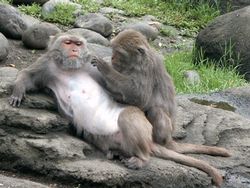
PrimThe scientists, at the University of Oxford in England, looked at the evolutionary family tree of 217 primate species whose social organization is known. Their findings, published in the journal Nature, challenge some of the leading theories of social behavior, including:

¶ That social structure is shaped by environment — for instance, a species whose food is widely dispersed may need to live in large groups.

¶ That complex societies evolve step by step from simple ones.

¶ And the so-called social brain hypothesis: that intelligence and brain volume increase with group size because individuals must manage more social relationships.

By contrast, the new survey emphasizes the major role of genetics in shaping sociality. Being rooted in genetics, social structure is hard to change, and a species has to operate with whatever social structure it inherits. If social behavior were mostly shaped by ecology, then related species living in different environments should display a variety of social structures. But the Oxford biologists — Susanne Shultz, Christopher Opie and Quentin Atkinson — found the opposite was true: Primate species tended to have the same social structure as their close relatives, regardless of how and where they live.

More here.

Tuesday Poem

“It's when your head's turned inattentively,
just slightly, in belief that inattention comes
to swallow you whole.” —Alain Bischford

Talith

We sleep beneath your grandfather’s talith
Fine lamb’s wool striped black and white
A giant barcode to be scanned by God
The pelt of a fabulous beast.

Little tent, portable temple
It survived Dutch looters and Dublin landlords
To shelter in this Irish night even me
Uncircumcised, and all too often, unwashed.

Your father pinned it to his study wall
A flag without a shield. Eternity’s quilt,
Your grandfather didn’t think he’d need it
When he took the train in Amsterdam.

“And what,” he mocked your father,
“are they going to murder us all?”

by Michael O’Loughlin
from In This Life
publisher: New Island, Dublin, 2011

create new money…

Money_closeup-e1322060471529

Just after the election of 2008, the Nobel laureate liberal economist Paul Krugman made a prophecy: we will not restore prosperity, he warned in The New York Review of Books, “unless we are willing to think clearly about our problems and to follow those thoughts wherever they lead.” But as Krugman’s thoughts drifted back to the maxims of John Maynard Keynes—maxims he called “more relevant than ever”—our thoughts could be turning to the older and in some respects wiser innovations of President Lincoln and the Republican Congress during the Civil War. Here’s the gist of it: using the monetary methods of Lincoln, updated to employ the inflation-fighting tools of the Federal Reserve, we could pay for a faster recovery and a great many worthy projects without higher taxes, without more national debt, and believe it or not, without inflation. How? By letting Congress exercise a little-known power that is used (very quietly indeed) by the Federal Reserve: the power to create new money.

more from Richard Striner at The American Scholar here.

art and the social

The_long_nineties_1

Mocked and ridiculed, the 1980s met a pitiful end at the hands of a generation of artists who considered a market-friendly, object-based art their ideological nemesis, and punished it summarily for its false richness. This is an exaggeration, of course, but ask around in my (Northern European) corner of the world, and I would guess that many of those who were working back then will confirm this picture of a generational showdown. By contrast, faded and forgotten as they may be, ‘the long nineties’ remain unsubverted.1 The symbolic revival of Félix Gonzáles-Torres at the 2011 Istanbul Biennial, for instance, echoed his status as a guiding star of curating and art theory of that decade. However, during the last five years, as the historicization of the ’90s gains momentum, the jury has gradually reconvened. The case being weighed is that of art’s relationship to the social.

more from Lars Bang Larsen at Frieze here.

Hedy Lamarr’s World War II Adventure

John Adams in the New York Times Book Review:

ScreenHunter_04 Dec. 20 10.58That a glamorous movie star whose day job involved hours of makeup calls and dress fittings would spend her off hours designing sophisticated weapons systems is one of the great curiosities of Hollywood history. Lamarr, however, not only possessed a head for abstract spatial relationships, but she also had been in her former life a fly on the wall during meetings and technical discussions between her ­munitions-manufacturer husband and his clients, some of them Nazi officials. Disturbed by news reports of innocents killed at sea by U-boats, she was determined to help defeat the German attacks. And Ant­heil, arguably the most mechanically inclined of all composers, having long before mastered the byzantine mechanisms of pneumatic piano rolls, retained a special genius for “out of the box” problem ­solving.

Over several years the composer and the movie star spent countless hours together drafting and redrafting designs, not only for the torpedo system but also for a “proximity fuse” antiaircraft shell. In reality, their patent was an early version of today’s smart bombs. The device as they made it employed a constantly roving radio signal to guide the torpedo toward its target. Because the signal kept “hopping” from one frequency to another, it would be impossible for the enemy to lock onto. To solve the problems of synchronizing receiver and transmitter, Ant­heil proposed a tiny structure inspired by the workings of a piano roll. This was a feat that years later would be used in everything from cellphone and Bluetooth technology to GPS instruments.

More here.

Hayat Sindi’s career as a scientist began with a fib

…and that’s a good thing. Now the Saudi innovator is doing work that could save millions of lives in the developing world—and launching her own Mideast foundation.

Abigail Pesta in The Daily Beast:

ScreenHunter_02 Dec. 20 10.47Sindi, who dresses in a traditional headscarf but also in trendy heels, relishes the details of making her own way in science. It started with a fib to her family after her first year of college in Saudi Arabia.

Keen to continue her studies abroad, she told her father some good news: She had been accepted at a prestigious university in London. Her traditional Muslim father said it would tarnish the family name for a young woman to live overseas alone. “He told me, ‘Over my dead body,’” Sindi recalls. Still, she persuaded him, and off she went to England.

The truth is, she hadn’t been accepted at any university. When she landed in London as a teenager in 1991, she says, she spoke only Arabic, no English. “My first night there, I went to a youth hostel,” she says. “I was in an attic room. I panicked. I looked at my plane tickets—my father had bought a return ticket. I thought, I’ll go home tomorrow.” Instead she went to an Islamic cultural center and got a translator to help her meet with college officials. “They told me, ‘You’re crazy,’” she says. “I was naive. I thought they would just let me in.”

After a year spent cramming on English and studying to pass the “A-levels,” the U.K.’s college-admission courses, she got herself in to King’s College, where she graduated in 1995 with a degree in pharmacology. She went on to get a Ph.D. in biotechnology from Cambridge in 2001. She says her family didn’t learn about her lie until years later, when they were surprised to hear her mention it in a speech.

More here. [Thanks to Sughra Raza.]