
Category: Recommended Reading
sub-continental christmas
the bishop’s wife
What Love Looks Like
From Orion Magazine:
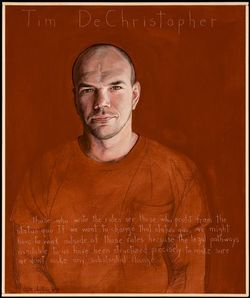
On March 2, 2011, Tim DeChristopher was found guilty on two felony charges for violation of the Federal Onshore Oil and Gas Leasing Reform Act and for making false statements. He refused to entertain any type of plea bargain. On July 26, 2011, he was sentenced to two years in a federal prison with a $10,000 fine, followed by three years of supervised probation. Minutes before receiving his sentence, Tim DeChristopher delivered an impassioned speech from the courtroom floor. At the end of the speech, he turned toward Judge Dee Benson, who presided over his trial, looked him in the eye, and said, “This is what love looks like.” Minutes later, he was placed in handcuffs and briskly taken away.
More here.
The accidental universe: Science’s crisis of faith
Alan P. Lightman in Harper's:

It is perhaps impossible to say how far apart the different universes may be, or whether they exist simultaneously in time. Some may have stars and galaxies like ours. Some may not. Some may be finite in size. Some may be infinite. Physicists call the totality of universes the “multiverse.” Alan Guth, a pioneer in cosmological thought, says that “the multiple-universe idea severely limits our hopes to understand the world from fundamental principles.” And the philosophical ethos of science is torn from its roots. As put to me recently by Nobel Prize–winning physicist Steven Weinberg, a man as careful in his words as in his mathematical calculations, “We now find ourselves at a historic fork in the road we travel to understand the laws of nature. If the multiverse idea is correct, the style of fundamental physics will be radically changed.”
More here.
Saturday, December 24, 2011
Forced Merriment: The True Spirit of Christmas

[T]he thing about the annual culture war that would probably most surprise those who want to “keep the Christ in Christmas” is this: The original Puritan Protestants regarded the whole enterprise as blasphemous. Under the rule of Oliver Cromwell in England, Christmas festivities were banned outright. The same was true in some of the early Pilgrim settlements in North America.
Last year I read a recent interview with the priest of one of the oldest Roman Catholic churches in New York, located downtown and near Wall Street. Taking a stand in favor of Imam Rauf's “Ground Zero” project, he pointed to some parish records showing hostile picketing of his church in the 18th century. The pious protestors had been voicing their suspicion that a profane and Popish ceremonial of “Christ Mass” was being conducted within.
Now, that was a time when Americans took their religion seriously. But we know enough about Puritans to suspect that what they really disliked was the idea of a holiday where people would imbibe strong drink and generally make merry. (Scottish Presbyterians did not relax their hostility to Yuletide celebrations until well into the 20th century.) And the word “Yule” must be significant here as well, since pagans of all sorts have been roistering at the winter solstice ever since records were kept, and Christians have been faced with the choice of either trying to beat them or join them.
Kenneth Arrow on Economics and Inequality
Kenneth Arrow in the Boston Review:

Since the middle 1980s, this tendency has been reversed. In the United States, median family income (adjusted for size) has remained virtually constant since 1995, while per capita income has risen at about 2 percent per annum. The difference in income between college graduates and those with only high school degrees increased at a rapid rate, even during the period before 1990 when per capita income grew very slowly. Further, the proportion of the college-age population enrolled in college, which had been rising rapidly, stopped increasing and has remained the same for thirty years.
Clearly, the bulk of the gains from increased productivity went to a small group of upper-income recipients. Indeed, closer study has shown that the bulk of the increase went to the top 1 percent of income recipients and much of that to those in the top .1 percent.
More here.
Christmas History
Did you know that Santa Claus was a 4th century bishop in what is now Turkey? That Puritans tried to outlaw Christmas? Or Tiny Tim was originally Little Fred?
An interview with Bruce Forbes in The Browser:

There are several surprises that people encounter when they start to learn about Christmas. One is that Jesus probably wasn’t born on the 25th, because we don’t know when his birthday was. Secondly, it’s a surprise for many people that the early Christians did not celebrate Christmas. It took 300 years or so before there was an annual Christian celebration.
And Christmas originated as a pagan festival long before that, right?
When one studies the history one sees that there were, especially in Europe, many mid-winter festivals that existed prior to Jesus even walking the earth. Then Christians decided to start a birthday celebration, and intentionally set it in the middle of pre-existing mid-winter festivals. So right from the very beginning, the Christmas tradition has always been a mixture of a winter party and a Christian celebration. The struggle of how we balance those two is nothing new.
More here.
a sad, strange figure
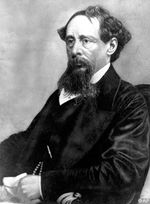
The bicentenary of the birth of Charles Dickens falls in February next year. A procession of volumes to mark this anniversary has already begun, inviting us to ask why this verbally extravagant and often melodramatic novelist has exerted such a hold over the imagination of readers. Dickens is a cardinal representative of the age in which he lived. His writings shape our perception of Victorian London; even his detractor Walter Bagehot conceded that in his evocation of London life he was “like a special correspondent for posterity”. And his characters – from Scrooge and the Artful Dodger to Mr Micawber and Uriah Heep – have become avatars of Englishness. The word “Dickensian” calls to mind not so much the man or the characters he created as the world those characters inhabit: on the one hand a scene of red-nosed comedy and zany good cheer, yet on the other a grimy, impoverished society full of abused children, wrangling lawyers, sadistic teachers and watchful effigies.
more from Henry Hitchings at the FT here.
the book

A number of the great works of Western literature address themselves very directly to questions that arise within Christianity. They answer to the same impulse to put flesh on Scripture and doctrine, to test them by means of dramatic imagination, that is visible in the old paintings of the Annunciation or the road to Damascus. How is the violence and corruption of a beloved city to be understood as part of an eternal cosmic order? What would be the consequences for the story of the expulsion from Eden, if the fall were understood as divine providence? What if Job’s challenge to God’s justice had not been overawed and silenced by the wild glory of creation? How would a society within (always) notional Christendom respond to the presence of a truly innocent and guileless man? Dante created his great image of divine intent, justice and grace as the architecture of time and being. Milton explored the ancient, and Calvinist, teaching that the first sin was a felix culpa, a fortunate fall, and providential because it prepared the way for the world’s ultimate reconciliation to God. So his Satan is glorious, and the hell prepared for his minions is strikingly tolerable. What to say about Melville? He transferred the great poem at the end of Job into the world of experience, and set against it a man who can only maintain the pride of his humanity until this world overwhelms him. His God, rejoicing in his catalog of the splendidly fierce and untamable, might ask, “Hast thou seen my servant Ahab?” And then there is Dostoyevsky’s “idiot” Prince Myshkin, who disrupts and antagonizes by telling the truth and meaning no harm, the Christ who says, “Blessed is he who takes no offense at me.”
more from Marilynne Robinson at the NY Times here.
tolstoy and his essential russianness
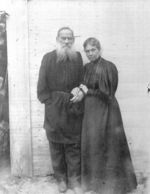
Count Lev Tolstoy is one of those writers who was as fascinating and complex as his novels and stories. A man so awful and quarrelsome to those around him, especially his long-suffering wife, was nonetheless able to produce masterpieces of serene introspection and humane insights. How could Tolstoy, a loner, a quintessential outsider all his life, understand and evoke the glittering social whirl and intricacies of fashionable salons? How could someone so masculine through and through somehow plumb sympathetically in his fiction the female psyche, which seemed, in real life, to perplex him at times beyond endurance? In short, he is a dream subject for a literary biographer. But with such richness comes the inevitable difficulty of writing about a man whose life was so messy and destructive, so tormented and tormenting to those around him, and reconciling all this mayhem with the lapidary literary products of his head and heart. The good news is that in “Tolstoy: A Russian Life” British Russophile Rosamund Bartlett, author of a fine biography of Anton Chekhov, has managed to reconcile the contrarieties and produce a marvelously judicious, insightful study.
more from Martin Rubin at the LA Times here.
Tim Minchin: Woody Allen Jesus
How commercial success has propelled hip-hop’s superstars into America’s business elite
Ed Crooks in the Financial Times:

Country music, the only other contender, showcases a different set of equally American values: community, tradition, compassion, patriotism, resilience, faith. But it is principally a domestic phenomenon, largely ignored overseas. Hip-hop, meaning rap music and its associated culture, is both a global force and a central feature of the face America presents to the world. In Russia, for example, Vladislav Surkov, the powerful aide to prime minister Vladimir Putin, keeps on his desk a picture of Tupac Shakur, the Californian rapper murdered in 1996 who has become a global icon of non-specific militancy.
Artistically, rap is often said to be in decline. Aficionados talk wistfully about a golden age, typically dated from about the mid-1980s to the mid-1990s, and now forgotten by today’s performers. Commercially, too, the music has slipped back from its peak around the turn of the millennium, with steadily declining sales through the second half of the 2000s. In 2010, though, hip-hop record sales made a comeback, and this year rappers provided eight of the 31 US chart-topping albums.
More here.
All you need is love
—John Lennon
Love is all there is,
it makes the world go round
— Bob Dylan
Without love nothing makes sense
—Roshi Bob
The Base of all Metaphysics
And now gentlemen,
A word I give to remain in your memories and minds,
As base and finale too for all metaphysics.
(So to the students the old professor,
At the close of his crowded course.)
Having studied the new and antique, the Greek and Germanic systems,
Kant having studied and stated, Fichte and Schelling and Hegel,
Stated the lore of Plato, and Socrates greater than Plato,
And greater than Socrates sought and stated, Christ divine having
studied long,
I see reminiscent to-day those Greek and Germanic systems,
See the philosophies all, Christian churches and tenets see,
Yet underneath Socrates clearly see, and underneath Christ the divine I see,
The dear love of man for his comrade, the attraction of friend to friend,
Of the well-married husband and wife, of children and parents,
Of city for city and land for land.
by Walt Whitman
from Leaves of Grass
Five-letter Word for Magic
From Harvard Magazine:

Public participation is crucial in Kwong’s act. “A successful and engaging performance comes from performing for a sophisticated and savvy audience,” he notes. “The smarter the audience, the more fun it is, I think. I can start to stump them and give them more interesting clues.” As people solve his challenges, he fills the grid with their answers, riffing cleverly off the audience responses as he goes along and occasionally blocking out black squares in classic crossword style. When he’s completed the collaborative puzzle, he reveals the identity of the hidden card—miraculously embedded within the newly made crossword. Although Kwong’s beginnings in magic stem from simple sleight-of-hand tricks he learned as a kid from books and a magic set he received as a gift, the evolution of his conjuring skills to include crossword construction is a career milestone. “In the 25 years I’ve been a magician, I’ve never before invented my own brand-new trick,” he admits. Though a long-time magic aficionado, he didn’t become interested in professional magic until freshman year, when he attended a performance by Ricky Jay, who “gave an absolutely scintillating talk” on the history of magic. Kwong later wrote his history honors thesis on Oriental magicians and their impersonators: “I was captivated by stories of these magicians at the turn of the twentieth century, what’s commonly known as the Golden Age of Magic.” His love for magic extended outside the classroom as well. At one Arts First celebration, he reports, he performed Houdini’s “Metamorphosis” illusion before then Harvard president Larry Summers and taught Summers how to produce a bouquet of flowers from his sleeve.
More here.
Why We Lie
From The New York Times:
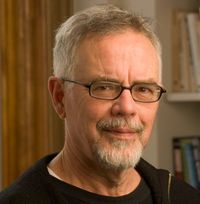
The most influential thinker there, arguably, was a scruffily bearded fellow, wearing sunglasses and a knitted cap, who never gave a talk. He lurked around the margins of the conference; at one point I spotted him puffing a joint outside a meeting hall. This, at any rate, is how I remember Robert Trivers, although as he points out in “The Folly of Fools,” memory often tricks us. He also confesses to being a pothead, so I’m pretty sure my recollection is accurate. As a Harvard graduate student in the 1970s, Trivers wrote a handful of papers showing how our genes’ relentless drive to self-replicate underpins even our most apparently magnanimous impulses. According to his theory of reciprocal altruism, we occasionally act kindly toward strangers because our ancestors — over time and in the aggregate — received a quid pro quo benefit from acts of generosity. In other papers, Trivers proposed that families roil with conflict because parents share no genes with each other and only half of their genes with children, who unless they are identical twins also have divergent genetic interests. These concepts were popularized by others, notably Edward O. Wilson in “Sociobiology,” Dawkins in “The Selfish Gene” and Pinker in “How the Mind Works.” All have credited Trivers, whom Pinker has called “an underappreciated genius, and one of history’s greatest thinkers in the analysis of behavior and emotion.” If Trivers is not better known, that may be because he has struggled with bipolar disorder since his youth. He is also, by his own admission, an irascible anti-authoritarian, whose sharp tongue often gets him into trouble. He left Harvard in the late 1970s, eventually ending up at Rutgers. He also has a home in Jamaica. No doubt tired of seeing others crank out well-received elaborations of his work, Trivers has finally produced a popularization of his own. His topic is deceit, with which by his own admission he has wrestled — on a personal as well as professional level — throughout his adult life. Trivers’s scope is vast, ranging from the fibs parents and children tell to manipulate one another to the “false historical narratives” political leaders foist on their citizens and the rest of the world.
More here.
Friday, December 23, 2011
Pakistan’s Hamid Mir publicizes a death threat
Sadly, for the second year in a row, Pakistan has been rated the most dangerous country in the world for journalists. Bob Dietz at the Committee to Protect Journalists:

There is an additional sense of urgency in this case: Umar Cheema, The News reporter who was abducted and beaten in 2010, and who is no stranger to threats himself, told me in an email: “The reason for taking the latest threat [to Mir] seriously is that I have faced the trouble in same manner, so we suspect the same mastermind.”
CPJ has written a lot about threats in Pakistan, and their debilitating effect. At this moment CPJ's Journalists Assistance program is working with a few other Pakistani journalists who are under threat for specific reporting, but I do not have their permission to publicize the details of their cases.
While the threat to Mir appears to be from supporters of the military/security establishment, if not officials within the government itself, threats to journalists come from everywhere. Pakistani reporters are targeted by all sides to the country's conflicts — religious militants, political factions fighting turf battles in violent cities like Karachi, competing secessionist groups in Baluchistan, and all the militarily active parties along the border with Afghanistan, as well as drug runners and gun dealers.
More here.
We Like Lists Because We Don’t Want to Die: An Interview with Umberto Eco

SPIEGEL: Mr. Eco, you are considered one of the world's great scholars, and now you are opening an exhibition at the Louvre, one of the world's most important museums. The subjects of your exhibition sound a little commonplace, though: the essential nature of lists, poets who list things in their works and painters who accumulate things in their paintings. Why did you choose these subjects?
Umberto Eco: The list is the origin of culture. It's part of the history of art and literature. What does culture want? To make infinity comprehensible. It also wants to create order — not always, but often. And how, as a human being, does one face infinity? How does one attempt to grasp the incomprehensible? Through lists, through catalogs, through collections in museums and through encyclopedias and dictionaries. There is an allure to enumerating how many women Don Giovanni slept with: It was 2,063, at least according to Mozart's librettist, Lorenzo da Ponte. We also have completely practical lists — the shopping list, the will, the menu — that are also cultural achievements in their own right.
SPIEGEL: Should the cultured person be understood as a custodian looking to impose order on places where chaos prevails?
Eco: The list doesn't destroy culture; it creates it. Wherever you look in cultural history, you will find lists. In fact, there is a dizzying array: lists of saints, armies and medicinal plants, or of treasures and book titles. Think of the nature collections of the 16th century. My novels, by the way, are full of lists.
Let Them Eat Kulfi: France Escapes to Fantasy India
While the Russians bizarrely seem to think banning the Bhagavad Gita and freedom of conscience with it is actually sensible, the French by contrast appear to be entering a new phase of India-fetish. Mira Kamdar over at the NYT's India Ink:
The French have found a way to cope with the unrelenting bad economic news in Europe: escape to India. Not the real India but a fantasy land far removed from the realities of sinking currencies and credit-rating downgrades.
Paris metro stations are papered with huge posters for “Rani,” this year’s Christmas-season television special about the improbable adventures of a dispossessed marquise in 18th-century France and India. While, for a much more elite public, the house of Chanel unveiled on Dec. 6 to 200 handpicked guests, including Frieda Pinto and Sonam Kapoor, its Paris-Bombay collection at a sumptuous durbar in the Grand Palais.
The title “Rani” is helpfully translated for the French public as “the Hindi word for the raja’s wife.” The raja, who makes the French renegade Jolanne de Valcourt his wife, is played by Hrithik Roshan, the only name Indian actor in the series. The lead role is played by French actress Mylène Jampanoi who was married in real-life to Indian model and actor Milind Sonam.
Friday Poem
Cleis
Sleep, darling
I have a small
daughter called
Cleis, who is
like a golden
flower
I wouldn't
take all Croesus'
kingdom with love
thrown in, for her
—
Don't ask me what to wear
I have no embroidered
headband from Sardis to
give you, Cleis, such as
I wore
and my mother
always said that in her
day a purple ribbon
looped in the hair was thought
to be high style indeed
but we were dark:
a girl
whose hair is yellower than
torchlight should wear no
headdress but fresh flowers
by Sappho
translation by Mary Barnard
Source: gopher://gopher.OCF.Berkeley.EDU:70/
00/Library/Poetry/Sappho/sappho.Cleis