All About PIPA and SOPA, the Bills That Want to Censor Your Internet

From Lifehacker:

The Stop Online Piracy Act (SOPA) and the Protect IP Act (PIPA) are two bills that sound like they have a mildly positive aim but, in reality, have serious potential to negatively change the internet as we know it. While the Obama administration has come out against SOPA, effectively shelving it indefinitely, the very similar PIPA bill is still alive and well. Both SOPA and PIPA put power in the hands of the entertainment industry to censor sites that allegedly “engage in, enable or facilitate” copyright infringement. This language is vague enough to target sites you use every day, like Facebook and Google, making these bills a serious problem. Here's what you need to know about the bills and what you can do about them.

The idea behind these bills sounds reasonable. They came about in order to try and snuff out piracy online, as the entertainment industry is obviously not excited that many people are downloading their products without payment or permission. The issue is, however, that it doesn't really matter whether you're in support of piracy, against it, or just don't care. The methods are ineffective. Here's what they are and why they're problematic.

More here.

Save the Internet!

1744_youtube lockdown_1_460x230For those outside the US, as well an within, a petition from citizens of the world, over at Avaaz:

For years, the US has condemned countries like China and Iran for their clampdown on Internet use. But now, the impact of these new censorship laws could be far worse — effectively blocking sites to every Internet user across the globe.

Last year, a similar Internet censorship bill was killed before reaching the US Senate floor, but it's now back in a different form. Copyright laws already exist and are enforced by courts. But this new law goes much further — granting the US government and big corporations enormous powers to force service providers and search engines to block websites based just on allegations of violations — without a trial or being found guilty of any crime!

Free speech advocates have already raised the alarm, and some key senators are trying to gather enough support to stop this dangerous bill. We have no time to lose. Let's stand with them to ensure that American lawmakers preserve the right to a free and open Internet as an essential way for people around the world to exchange ideas, share communication and work collectively to build the world we want. Sign the petition to stop censorship, and save the Internet as we know it.

Sign the petition!

Protesting SOPA: How to Make Your Voice Heard

Sopa-megaphone-4f1631a-intro-thumb-640xauto-29481Jon Brodkin in Ars Technica:

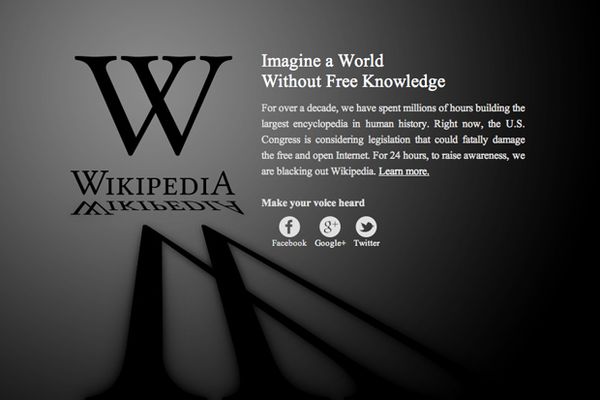
As Ars readers know, Wikipedia, reddit, Craiglist, and others are blacking out their sites today in protest of the Stop Online Piracy Act (SOPA) and Protect IP Act (PIPA), antipiracy bills that protestors believe would give far too much power to rightsholders at the expense of the Internet as a whole.

Members of Congress are already backpedaling on some of the provisions in SOPA and PIPA, and Rep. Darrell Issa (R-CA) said Tuesday that he expects to have more co-sponsors for his alternative (and much saner) OPEN Act “than SOPA has in the House.”

SOPA opponents say it is critical to block the bill now, because if it is turned into law, website owners will be at risk of having payments blocked, or forced into lengthy and expensive litigation even if they're not trying to enable piracy or profit from it.

“Scribd could not have come into existence in a world governed by SOPA,” said Scribd co-founder Jared Friedman during a conference call yesterday. Alexis Ohanian, co-founder of reddit (which shares a parent company with Ars Technica), said much the same thing about Internet entrepreneurs. “I'd hate to be the Congressperson who has to go back to his or her district and say, 'You know what, maybe this is not the industry for you. Maybe you can try your luck in Canada.'”

Video hosting site Veoh found out the hard way what litigation can do to an Internet business, even when the law is on your side. Veoh was “litigated to death” before being finally cleared in a lawsuit filed against the site by Universal Music Group. “The lawsuit dramatically impacted our company,” said founder Dmitry Shapiro. “It cost us millions of dollars to litigate. It took up a tremendous amount of executives' time. More importantly, it dramatically demotivated our 120 employees who were constantly concerned about what this meant and what would happen to them and their families.”

It’s INTERNETAGEDDON!

Wikipedia-anti-sopa-blackout-1

While 3QD is not blacking out our content (we believe it is better for us to stay on and bring attention to the problem), we are in full support of the anti-SOPA strikes and protests happening all over the internet today.

Ezra Klein in the Washington Post:

As an example of political mobilization —and a new form of political mobilization at that — the anti-SOPA campaign is likely to enter the organizing textbooks. Saul Alinsky could never have seen this coming. As an example of the power and prevalence that these Web sites have in our lives, the anti-SOPA blackouts are a bit unsettling. SOPA might be a particularly noxious piece of legislation, but the future will bring bills that Internet giants don’t like, yet might actually be good for consumers. Will they be able to resist mobilizing against those, too? Still, as an example of the creativity that shines across the Internet, the anti-SOPA protests are, well, sort of awesome. Here are five of the best:

1) Wired.com, where the homepage is redacted, at least until you mouse over the content;

2) Wikipedia.com, where you get to see the article you want for a flash, but are quickly pushed to an ominous, black page with an explanation of the protest and a tool for contacting your representative;

3) Greenpeace.org, where the Internet has gone dark and your mouse acts as a spotlight;

4) Mashable.com, where the front page looks almost normal, but the content is all about SOPA, including ‘This is the Internet After SOPA [PICS]”;

5) Google.com, where they’ve blacked-out the Google logo in a way that sustains the site’s basic functionality—so they’re not misusing their power too much— but makes their point very, very clear.

More here. And here is a good primer on the issues. And please see the post before this one and sign the anti-SOPA petition there.

Tell Congress: Don’t censor the Web

Takeaction

From Google:

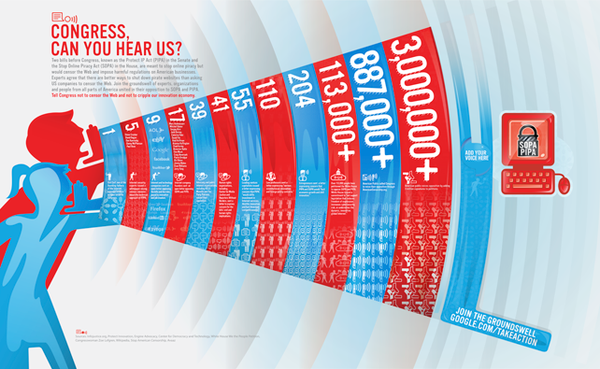
Two bills before Congress, known as the Protect IP Act (PIPA) in the Senate and the Stop Online Piracy Act (SOPA) in the House, would censor the Web and impose harmful regulations on American business. Millions of Internet users and entrepreneurs already oppose SOPA and PIPA.

Millions of Americans oppose SOPA and PIPA because these bills would censor the Internet and slow economic growth in the U.S.

The Senate will begin voting on January 24th. Please let them know how you feel. Sign this petition urging Congress to vote NO on PIPA and SOPA before it is too late.

Go here now to sign the petition. Read more about SOPA and PIPA here.

Tuesday, January 17, 2012

World’s largest Qur’an unveiled in Afghanistan

From The Guardian:

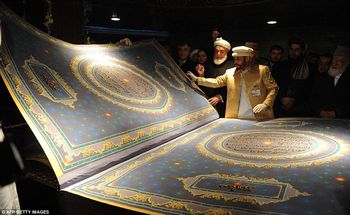
QuranA calligrapher worked for five years to create the world's biggest Qur'an in a bid to show the world that Afghanistan's rich cultural heritage and traditions have been damaged but not destroyed by 30 years of war, it has been revealed. The lavish book, with pages measuring 2.28 metres by 1.55 metres, has been certified as the world's largest by the Afghan ministry of Haj and religious affairs, according to the Kabul cultural centre that houses it. The previous claim to the title was for a copy unveiled last year in Russia's Tatarstan region. The Afghan Qur'an weighs 500kg and its 218 pages of cloth and paper, bound inside an embossed leather cover made from the skins of 21 goats, cost over £300,000 to create.

Mohammad Sabir Khedri, the master calligrapher behind the project, worked with nine students on a design that combines gold script with millions of tiny colourful dots, forming highly symbolic decorations around the giant pages. “I wanted to use as many tasteful colours as possible to make this holy book look beautiful,” he said, standing beside his enormous creation in a room built specially to house it. Khedri not only created the masterpiece, he managed to keep it a secret for over two years. It was finished in 2009, but the binding and room to house it were not ready until the start of 2012, when it was finally unveiled. The Qur'an is housed in a cultural centre originally founded in the 1980s, and once home to 50,000 books, a medical centre, and schools for Afghan crafts such as carpet weaving.

More here.

Say hello to intelligent pills

From Nature:

Pill_3390Newspapers in the United Kingdom have jumped on the news that patients will soon be able to purchase ‘intelligent pills’ containing sensors to monitor their medication use. Nature looks at what these pills can do. Proteus Biomedical, a company based in Redwood City, California, announced on 13 January that it would be launching a “digital health product” in the United Kingdom in collaboration with the pharmacy chain Lloydspharmacy. This product, called Helius, will include “sensor-enabled tablets” to monitor patients' medication use. Compliance with doctors’ instructions has been identified as a problem area in medicine, especially when patients are prescribed multiple drugs that may need to be taken at different times.

For the system, Proteus has designed sensors called ‘ingestible event markers’, which can be taken with pills or incorporated directly into medicines as part of the manufacturing process. In this system, the sensors will be embedded in a placebo to be taken alongside a medicine. Lloydspharmacy hopes to make the system, which will be marketed to people with chronic conditions, available from September. They are activated by stomach acid and are powered much like 'potato batteries', in which two different metals generate a current when inserted into the vegetable. Each sensor contains a tiny amount of copper and magnesium, says Thompson. “If you swallow one of these devices, you are the potato that creates a voltage, and we use that to power the device that creates the signal”. The digital signal, he adds, cannot be detected except by a device that attaches to the patient’s skin, much like a bandage. This device also monitors heart rate, respiration and temperature, showing how the patient responds to the medication. These data can then be relayed to a patient’s mobile telephone and shared with whomever the patient chooses.

More here.

Muhammad Ali at 70: What he meant, what he means

67438531Happy Birthday Muhammad Ali! Dave Zirin over at the LA Times [h/t: Farooq Ahmed] (also see Abbas's post on ali from a few years ago):

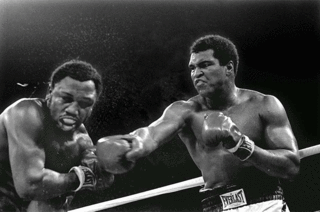
Muhammad Ali turned 70 on Tuesday, and the three-time heavyweight champion who doubled as the most famous draft resistor in U.S. history remains larger than life in the American mind, despite being ravaged by Parkinson's disease. Two years ago, on a visit to Louisville, Ky., I was reminded why.

In a cab on the way to the Muhammad Ali Center downtown, I saw that my driver had a Vietnam Veterans of America patch on display by his license. I asked him about his experience in Southeast Asia, and he started talking a mile a minute about his time “in country,” how his “happiest days” were being a sniper in Vietnam. He even said: “You might not know this, being from Washington, D.C., but the most dangerous animal to hunt is man.” He then described the task in detail. He wanted to make sure I left his cab fully aware of his pride, patriotism and unwavering belief in the duty of going to war when country called.

I didn't engage the driver in a debate about Vietnam or U.S. imperialism, but given my reason for being in Louisville, I couldn't resist one question. I asked: “What do you think about Muhammad Ali? He opposed the war in Vietnam. He called it an illegal war aimed at increasing oppression throughout the globe.

“Now you're in a city where there is a Muhammad Ali Street and you're taking me to the Muhammad Ali Center. Does that bother you?”

Without skipping a beat, my cabdriver said, “Well, you have to love Ali.”

The Straits of America

Pa3227c_thumb3Nouriel Roubini in Project Syndicate:

Macroeconomic indicators for the United States have been better than expected for the last few months. Job creation has picked up. Indicators for manufacturing and services have improved moderately. Even the housing industry has shown some signs of life. And consumption growth has been relatively resilient.

But, despite the favorable data, US economic growth will remain weak and below trend throughout 2012. Why is all the recent economic good news not to be believed?

First, US consumers remain income-challenged, wealth-challenged, and debt-constrained. Disposable income has been growing modestly – despite real-wage stagnation – mostly as a result of tax cuts and transfer payments. This is not sustainable: eventually, transfer payments will have to be reduced and taxes raised to reduce the fiscal deficit. Recent consumption data are already weakening relative to a couple of months ago, marked by holiday retail sales that were merely passable.

At the same time, US job growth is still too mediocre to make a dent in the overall unemployment rate and on labor income. The US needs to create at least 150,000 jobs per month on a consistent basis just to stabilize the unemployment rate. More than 40% of the unemployed are now long-term unemployed, which reduces their chances of ever regaining a decent job. Indeed, firms are still trying to find ways to slash labor costs.

Rising income inequality will also constrain consumption growth, as income shares shift from those with a higher marginal propensity to spend (workers and the less wealthy) to those with a higher marginal propensity to save (corporate firms and wealthy households).

Of Writers & Reading

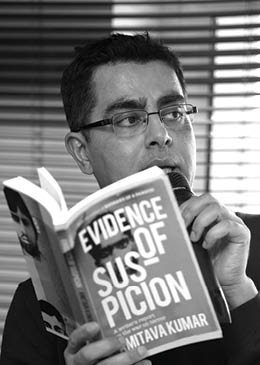
Of_weiters-260_1326546241Some of India’s best writers discuss books that have moved them, in the Sunday Guardian. Amitava Kumar:

When I was younger books were fetish objects. They sat in a small group on a bare shelf or a window sill, depending on whether I was at home or staying in my room at the college hostel. Now, with more money, I'm able to acquire the books more easily, and they have lost their ancient magic as objects. Now, they are treasured as friends. Or, more likely, as guilty reminders of money wasted — because I hardly have the time to read one-tenth of the books I buy. While I'm on the subject, may I also confess to the guilt of seeing the piles of unread magazines growing higher in my study? The New Yorker, Granta, Caravan, The New York Review of Books, Himal, London Review of Books…the piles grow bigger till it is time to take them for recycling. In the case of each of those publications, some of the articles get read but that's only because I have encountered them online. Someone has posted a link on Facebook, or they've been mentioned on a blog, or sparked a controversy on Twitter. This is a new truth of reading: your taste is determined by the conversations on the Net.

It is difficult to narrow down to four or five what I treasure in this room where I'm sitting writing this. Books are like people: you value those who you can turn to in times of need. V.S. Naipaul's A House for Mr Biswas is a monumental work, and his Enigma of Arrival is a profound, stylistic achievement, but the book of his that I value most is Finding the Center. In that book I read, as a young student in Delhi, Naipaul's “Prologue to an Autobiography,” and it offered me a way to imagine a writer's life. I've often turned back to it to find the road back to my own beginnings.

I think of each book that I have written as a tribute to the writers who have taught me vital lessons; there are too many list, perhaps, but here are four milestones on the road I have travelled: John Berger's A Seventh Man, Hanif Kureishi's The Buddha of Suburbia, Urvashi Butalia's The Other Side of Silence, and J.M. Coetzee's Disgrace.

A Former Model Delves into the Industry

Mears 1 0115Alyssa Giacobbe profiles 3QD friend Ashley Mears in the Boston Globe (photo by Laura Barisonzi Photography):

Ashley Mears grew up in the suburbs of Atlanta and got her first copy of Vogue, she recalls, at age 13. Two years later, after entering a model-search contest held at her local mall, she landed representation with an Atlanta booking agency and began picking up odd modeling jobs after school – catalog shoots and mall fashion shows. It was mostly for fun. Her more dependable after-school earnings came from her job at a movie theater, where she was paid minimum wage and got free popcorn.

And yet she kept modeling – something of a hustle already in those early days – for years, motivated by the promise of an eventual big payoff. Later, she spent hours of her limited free time as a sociology student at the University of Georgia driving to Atlanta for fittings and department store gigs, prepping for shoots, and waiting on call for jobs that could happen at a moment’s notice, all for annual earnings of around $5,000, less than she might have earned at a conventional campus job. It didn’t bother her at the time. “I thought I was going to be a huge success and I’d travel the world and it would be very glamorous,” she says. And for a while it was: During summer breaks, Mears traveled to Osaka, Japan, and Milan, Italy. And she spent about six months after graduation working in Asia, pulling in approximately $50,000 in 2002 – slightly more than the typical recent college grad at the time earned in a full year and far more than her peers working in New York (models, she says, often go to Asia to “cash out”). By the time she was 23, though, – over the hill for a model still trying to make the big time – she had packed up her portfolio and gone to graduate school to pursue a PhD in sociology.

The Chimpanzee and the Whale

Guilty-planetJennifer Jacquet over at her Scientific American blog Guilty Planet:

[A] Nature commentary, titled “A market approach to saving the whales,” begins with how whaling has doubled since the early 1990s, despite the International Whaling Commission’s (IWC) moratorium on whaling. The authors go on to propose how a whale conservation market might save some of the 2000 whales destined for slaughter this year – never bothering to note plenty of work in economics, at this point painfully popular, on how putting a price tag on behavior most people see as negative (e.g., picking your children up late from daycare) can actually exacerbate, not temper, a trend (e.g., more parents arrive late because the market has now undermined the norm and the financial penalty is less burdensome than guilt or shame). In the case of whaling, an international price tag, which the authors argue would allow conservationists to buy the lives of whales, would create a clear incentive in favor of whaling and undermine the norm (a norm that Sea Shepherd is using its multi-million dollar media-driven campaigns to cultivate and spread — a hard-to-quantify but valuable addition to the 350 Sea-Shepherd-saved minke whales that the authors report).

This is economics at its most naïve – the same Milton Friedman number crunching that might try to justify markets for child labor, organs, or adoption.

But worry not. This idea operates on the premise of a ‘cap and trade’ system. It would not be an open market; some bright guys would regulate how many whales could be taken each year – a job that that sounds suspiciously like the current role of the IWC, which, as the authors note, is still arguing, thanks mostly to Japan, over the numbers. So much for an improvement on the current situation, and so much for the free market.

Test Tube Yeast Evolve Multicellularity

Sarah Fecht in Scientific American:

Test-tube-yeast-evolve_1The transition from single-celled to multicellular organisms was one of the most significant developments in the history of life on Earth. Without it, all living things would still be microscopic and simple; there would be no such thing as a plant or a brain or a human. How exactly multicellularity arose is still a mystery, but a new study, published January 16 in Proceedings of the National Academy of Sciences, found that it may have been quicker and easier than many scientists expected.

“This is a significant paper that addresses one of the most fundamental questions in evolutionary and developmental biology,” says Rick Grosberg, an evolutionary biologist at the University of California at Davis, who was not involved with the research.

Since evolution acts on individual cells, it pays off for a cell to be selfish. By hogging resources and hindering neighbors, a cell can increase the odds that more of its own genes get passed into the next generation. This logic is one of the reasons it has been challenging to imagine how multicellularity arose; it requires the subjugation of self-interest in favor of the group’s survival.

More here.

Barbarism In Cultured Soil: Rushdie’s Great Pakistani Novel

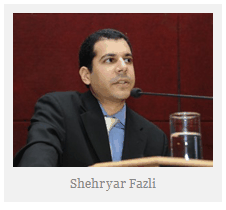
Shehryar Fazli at The India Site:

ScreenHunter_12 Jan. 17 17.47Salman Rushdie’s third novel, Shame, which will turn thirty next year, may have an unenviable legacy. Squeezed between its author’s two most famous books – and two of the most famous books of the 1980s – Midnight’s Children and The Satanic Verses, it is seldom given its due in discussions either of the author’s body of work, or of the direction of Pakistani fiction. Yet, even with the recent ‘boom’ in Pakistan’s literature, it remains the most ambitious English-language novel about that country, yet to be surpassed in terms of scope, inventiveness and humor.

But first, a word about my own copy of this novel. It’s a 1984 Picador edition, with the Urdu word for shame, ‘sharam’, written as if by hand with Tippex in Arabic script above the English title. I say ‘my’ copy, but it in fact belonged to my father, who bought it in the 1980s at a secondhand bookstore in Islamabad. What’s peculiar about this is that General Zia-ul-Haq’s military government had banned Shame in Pakistan, a decision that attracted more attention to the book than the dictatorship intended, and induced several Western capitals to ship copies to Islamabad through the diplomatic bag for their envoys to read. Once done, these people would sell their copies to one of the many used bookstores in the capital.

More here.

Iran’s Bomb and Pakistan

Pervez Hoodbhoy in The Express Tribune:

ScreenHunter_11 Jan. 17 17.34In my opinion, Iran’s quest for the bomb does it — and the world — no service. The world needs less nukes, not more. Yet, given the regime’s obstinate insistence, there appear to be only two possible outcomes. Continuing on its present path, Iran will likely become the world’s 10th nuclear state over the next few years. Bad as this would be, it would not be terrible. In all likelihood Iran would then moderate its dangerous rhetoric and, like other existing global nuclear rivalries, this one too could be managed.

On the other hand, an Israeli attack — whether aided or not by the US — would be truly terrible. The Middle East would become a permanent war zone. The third Gulf War would surely devastate Iran. But today it is in a position to inflict much greater damage on the US than were Iraq or Libya. The US would plunge into an economic crisis the likes of which it has not seen before. The last bits of its post-withdrawal strategy from Afghanistan would be shredded to pieces.

More here.

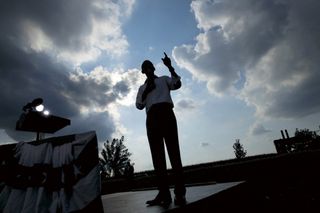
How Obama’s Long Game Will Outsmart His Critics

1326569046385Andrew Sullivan defends Obama in the Daily Beast:

A president in the last year of his first term will always get attacked mercilessly by his partisan opponents, and also, often, by the feistier members of his base. And when unemployment is at remarkably high levels, and with the national debt setting records, the criticism will—and should be—even fiercer. But this time, with this president, something different has happened. It’s not that I don’t understand the critiques of Barack Obama from the enraged right and the demoralized left. It’s that I don’t even recognize their description of Obama’s first term in any way. The attacks from both the right and the left on the man and his policies aren’t out of bounds. They’re simply—empirically—wrong.

A caveat: I write this as an unabashed supporter of Obama from early 2007 on. I did so not as a liberal, but as a conservative-minded independent appalled by the Bush administration’s record of war, debt, spending, and torture. I did not expect, or want, a messiah. I have one already, thank you very much. And there have been many times when I have disagreed with decisions Obama has made—to drop the Bowles-Simpson debt commission, to ignore the war crimes of the recent past, and to launch a war in Libya without Congress’s sanction, to cite three. But given the enormity of what he inherited, and given what he explicitly promised, it remains simply a fact that Obama has delivered in a way that the unhinged right and purist left have yet to understand or absorb. Their short-term outbursts have missed Obama’s long game—and why his reelection remains, in my view, as essential for this country’s future as his original election in 2008.