Tiny amounts of alcohol dramatically extend a worm’s life, but why?

From PhysOrg:

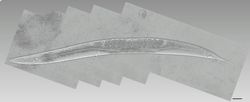
CelegansMinuscule amounts of ethanol, the type of alcohol found in alcoholic beverages, can more than double the life span of a tiny worm known as Caenorhabditis elegans, which is used frequently as a model in aging studies, UCLA biochemists report. The scientists said they find their discovery difficult to explain. “This finding floored us — it's shocking,” said Steven Clarke, a UCLA professor of chemistry and biochemistry and the senior author of the study, published Jan. 18 in the online journal PLoS ONE, a publication of the Public Library of Science. In humans, alcohol consumption is generally harmful, Clarke said, and if the worms are given much higher concentrations of ethanol, they experience harmful neurological effects and die, other research has shown. “We used far lower levels, where it may be beneficial,” said Clarke, who studies the biochemistry of aging. The worms, which grow from an egg to an adult in just a few days, are found throughout the world in soil, where they eat bacteria. Clarke's research team — Paola Castro, Shilpi Khare and Brian Young — studied thousands of these worms during the first hours of their lives, while they were still in a larval stage. The worms normally live for about 15 days and can survive with nothing to eat for roughly 10 to 12 days.

“Our finding is that tiny amounts of ethanol can make them survive 20 to 40 days,” Clarke said. Initially, Clarke's laboratory intended to test the effect of cholesterol on the worms. “Cholesterol is crucial for humans,” Clarke said. “We need it in our membranes, but it can be dangerous in our bloodstream.” The scientists fed the worms cholesterol, and the worms lived longer, apparently due to the cholesterol. They had dissolved the cholesterol in ethanol, often used as a solvent, which they diluted 1,000-fold. “It's just a solvent, but it turns out the solvent was having the longevity effect,” Clarke said. “The cholesterol did nothing. We found that not only does ethanol work at a 1-to-1,000 dilution, it works at a 1-to-20,000 dilution. That tiny bit shouldn't have made any difference, but it turns out it can be so beneficial.”

How little ethanol is that?

More here.

Friday Poem

Searching for the Dharma
.
You've traveled up ten thousand steps in search of the Dharma.
So many long days in the archives, copying, copying.
The gravity of the Tang and the profundity of the Sung
make heavy baggage.
Here! I've picked you a bunch of wildflowers.
Their meaning is the same
but they're much easier to carry.
.
by Xu Yun
from Empty Cloud: The Autobiography of the Chinese Zen Master
Trans. Charles Luck, ed. by Richard Hunn

A Revolution On The Page: Finding Identity In Poetry

Roya Hakakian at NPR:

9780385086011_customMy encounter with America, from the moment we drove away from the airport and I saw layer after layer of bridge and road piled vast and high, had dwarfed me through and though. The currency of everything I knew or had was of no value in the American bazaar. Everything here was bigger, better or, as displayed on every shampoo bottle, at least 20 percent more.

Except, and this was my sole consolation, for the treasury of poetry I carried in my head. Persian literature with its ancient tradition of verse was how I cured homesickness and soothed the melancholic byproducts of displacement.

When feelings of insecurity or inadequacy arose, I fought them, knowing that America, however great, could not match my country's peerless poetry.

Rumi, Omar Khayyam, Hafez were no longer simply writers but the pillars of my reconfigured identity. And when has identity ever been reconfigured without a note of superiority? No verse in this towering new land could outdo the love, passion, devotion and yearning, the beauty in the ones I knew.

I'd rested in that certainty when a poem by Theodore Roethke unsettled me. It was called “My Papa's Waltz.”

More here.

Conversations With America’s Funeral Directors

Max Rivlin-Nadler in The Awl:

ScreenHunter_15 Jan. 20 10.30Walking into McCormick Place, Chicago’s half-hangar, half-labyrinth convention center, I looked at the schedule to find that I had just missed “Canadians Do Cremation Right.” The 130th National Funeral Directors Conference, was underway; held each year in a different city, the conference brings together funeral directors from across the country for three days of presentations, trade talk, awards and camaraderie. After shaking off my initial disappointment at having missed the Canadian talk, I scanned the remaining workshops. After passing on “Marketing Your Cemetery: Connecting With Your Community” and “Managing Mass Fatality Situations,” I circled “The Difference Is In The Details,” an embalming workshop.

The small film company I sometimes work for was planning a feature on new trends in funerals, and I had flown out for the weekend to try to meet some of the younger, hipper funeral directors at the conference. One of these was Ryan, a round man with a wide smile and an impeccable hair-part, whose car, he told me, has a bumper sticker that says “Let's Put The 'Fun' Back In Funeral.” He started his career as a funeral director, but had since moved into the lucrative field of “death care industry” consultation, where he works with funeral directors on ways to expand their businesses. In one of our conversations he tells me, “The worst thing I’ve heard a funeral director say is ‘we’ve always done it this way.’” Later, I tell him my plan to attend that evening's “Funeral Directors Under 40: A Night on the Town” event. Without missing a beat, he lowered his voice and said, “Funeral directors are notoriously heavy drinkers. There will definitely be some hook-ups.”

The funeral industry is in the midst of a transition of titanic proportions. America is secularizing at a rapid pace, with almost 25% of the country describing itself as un-church. Americans, embracing a less religious view of the afterlife, are now asking for a “spiritual” funeral instead of a religious one. And cremation numbers are up. Way up.

More here.

The alternative to the slow boat of democracy in Pakistan is failure

Before a democratic government can stabilise, the middle classes, schooled in the Pakistan Military Academy narrative, start aching for another saviour on horseback, but none exists.

Omar Ali in The Hindu:

20TH_OPED_2_897769eIn the current crisis in Pakistan, there has been some comment over what might work better for the country's development — a “democratic” model or an “authoritarian” one. These categories may be misleading. Generalised arguments about “authoritarian regimes” and “democracies” hide far too many details under the hijab. There is vigorous debate about the shortcomings (real and imagined) of modern capitalist democracy and there is no reason to think that it is the final system under which mankind will live forever. But in the last 100 years, most absolute or dictatorial regimes have all either broken down, or seen capitalist development and evolved into some sort of democracy. The question then is not about democracy versus authoritarianism. It is about whether an “under-developed” state, such as Pakistan, can “develop” as a capitalist democracy without going through a fascist phase.

At least in Pakistan, the answer is clear. It either stabilises as a democracy, or it violently fails. There is no third choice.

More here.

Thursday, January 19, 2012

For a Moment of Statemanship

9407.rushdieManu Joseph in Open the Magazine (photo from Getty):

William Dalrymple, the Scotland-born writer and a director of the Jaipur Literature Festival, who is sometimes in medieval robes, has for long insisted that he is Indian at heart. But when he announces that the probability of an event occurring is one hundred per cent, it is not clear if he is being fatalistic the Indian way or if it is the swagger of the White man’s confidence in cause-and-effect, or if it is just that he knows something that others don’t. Last Friday, when I asked him if Salman Rushdie would be visiting the Jaipur festival, Dalrymple said, “Even if there is the threat of a nuclear explosion, Salman will come to Jaipur.”

The events of the past few days, which have cast a shadow over Rushdie’s visit, suggest that in this great republic the threat of a nuclear explosion is not as serious as the imagination of wounded religious sentiments, especially in the time of crucial elections. After an Islamic cleric objected to the visit of Rushdie because the writer has not apologised for Satanic Verses, and several Muslim groups joined the noise, with one of them even offering a prize of Rs 1 lakh to the lucky person who would fling a shoe at the writer, the Indian government has not told the nation what its position is. At least some Muslim organisations have had the will to strongly condemn those who have threatened violence against Rushdie, a grace the government is yet to show. Instead, the home ministry has conveyed, “law and order is a state subject”. And the Congress Chief Minister of Rajasthan, Ashok Gehlot, in turn, has very clearly said that he cannot promise safe passage for Rushdie because “a section of people” is offended.

What if Every Electron in the Universe Was all the Same Exact Particle?

1d132ed1b2d3d0cede06f144b143c44eAlasdair Wilkins in io9 (image by Tonis Pan):

There's an idea that suggests all the universe's electrons are actually one particle forever traveling backwards and forwards in time. It's a simple, elegant idea that solves some of physics's biggest mysteries. There's only one tiny problem. It's complete nonsense.

This is the story of that bizarre thought experiment and John Archibald Wheeler, the brilliant, largely unsung physicist who came up with it.

Like so much of the quantum world, electrons are strange. What's worse, they're all strange in exactly the same way. Every electron is identical to every other electron. They all have the same mass, the same electric charge, and the same spin. (For more on what these terms mean, check out our field guides here and here.) Electrons are just one of the indistinguishable particles – other examples include photons, neutrinos, protons, neutrons, and indeed most of the subatomic particles.

This isn't a trivial point, either. Not only is it impossible to tell electrons apart based on their physical properties, it's essentially impossible to tell them apart at all. This is because determining specific electrons by their position would require measuring their trajectories with exact precision, and the laws of quantum mechanics forbid this. Between measurements, electrons in the quantum world are probabilistic, defined by wave functions that give the odds of finding that particle in any given position. When the wave functions of multiple electrons overlap, it becomes officially impossible to determine which of the electrons was the one that was originally measured.

What Happened Before the Big Bang? The New Philosophy of Cosmology

Maudlin_615An interview with Tim Maudlin in The Atlantic (photo by Ross Anderson):

Your group has identified the central goal of the philosophy of cosmology to be the pursuit of outstanding conceptual problems at the foundations of cosmology. As you see it, what are the most striking of those problems?

Maudlin: So, I guess I would divide that into two classes. There are foundational problems and interpretational problems in physics, generally –say, in quantum theory, or in space-time theory, or in trying to come up with a quantum theory of gravity– that people will worry about even if they're not doing what you would call the philosophy of cosmology. But sometimes those problems manifest themselves in striking ways when you look at them on a cosmological scale. So some of this is just a different window on what we would think of as foundational problems in physics, generally.

Then there are problems that are fairly specific to cosmology. Standard cosmology, or what was considered standard cosmology twenty years ago, led people to the conclude that the universe that we see around us began in a big bang, or put another way, in some very hot, very dense state. And if you think about the characteristics of that state, in order to explain the evolution of the universe, that state had to be a very low entropy state, and there's a line of thought that says that anything that is very low entropy is in some sense very improbable or unlikely. And if you carry that line of thought forward, you then say “Well gee, you're telling me the universe began in some extremely unlikely or improbable state” and you wonder is there any explanation for that. Is there any principle that you can use to account for the big bang state?

Snakes and Ladders

Snakes-and-ladders-167x223Amartya Sen in the FT:

High quality global journalism requires investment. Please share this article with others using the link below, do not cut & paste the article. See our Ts&Cs and Copyright Policy for more detail. Email [email protected] to buy additional rights.

Like many board games that were developed in India, of which chess is perhaps the most important and famous, the game of “snakes and ladders” too emerged in this country a long time ago. With its balancing of snakes that pull you down and ladders that take you up, this game has been used again and again as a metaphor for life, telling us about our fortunes and misfortunes, and going further, about the consequences of good deeds and bad actions. Good decisions yield handsome rewards – taking us rapidly up a ladder – and bad moves yield severe penalties – making us suffer a precipitate decline through the mouth of a long snake, all the way down to its distant tail.

Britain too found in this board game from their colony a good way of expressing their traditional ethical tales, illustrating, for example, the simple moralistic world of what was called “Virtue Rewarded and Vice Punished” – a game that became very popular in early 19th century. The English version used the graphic illustrations of the snakes and ladders to depict traditional English moral tales that made this old Indian game popular first in England and then in the British-dominated global world of the nineteenth century. The Indian names – from Sanskrit, Hindi, Urdu and other subcontinental languages – for the qualities that respectively yielded rewards and punishment were replaced in the English version into the names of classical English virtues such as penitence, pity, obedience and self-denial yielding ascent up the ladders, while time-honoured vices of depravity, cruelty, dandyness made one slip rapidly down through the body of a snake.

The diagnosis of virtues and vices is, of course, adaptable, and the richness of the analogy of snakes and ladders can be put to use today in discussing modern problems as well – even the contemporary challenges of economic and social policies. We can well ask: what are the nasty snakes we face today in thinking about economic policies in our troubled world, and what helpful ladders we should try to climb up in moving an economy and society forward – in a world full of opportunities as well as serious dangers. The distinctions are quite important for the emerging economies which are trying to decide where to emerge. We do not want to emanate from the bottom end of snakes, and would rather emerge at the top of elevating ladders. How can we do this?

grass on wolf

AP0203210117_jpg_470x483_q85

Christa Wolf belonged to the generation in which I also count myself. We were stamped by National Socialism and the late—too late—realization of all the crimes committed by Germans in the span of just twelve years. Ever since, the act of writing has demanded interpreting the traces that remain. One of Christa Wolf’s books, Patterns of Childhood, responds to that imperative, exposing her successive immersions in brown-shirted dictatorship and the doctrines of Stalinism. False paths credulously followed, stirrings of doubt and resistance to authoritarian constraints and beyond that, the recognition of one’s own participation in a system that was crushing the utopian ideals of Socialism—those are hallmarks of the five-decades of writing that established Wolf’s reputation, a journey that leads book by book from The Divided Sky (1963) to her final work, Stadt der Engel (“City of Angels,” 2010); and the books remain. To pick one out: “What Remains” is the title of a story published in June 1990 by Aufbau Verlag in the East and Luchterhand Verlag in the West. Even before it was available to East and West German readers, some West German journalists—the sort who assumed they were history’s victors and the hour of reckoning was at hand—ignored the embargo and struck. Christa Wolf, the celebrated author who had been much-praised for her resistance, the 1980 recipient of the Büchner Prize, Germany’s most prestigeous literary award, who was mobbed by enthusiastic students two years later as she delivered her Frankfurt Lectures on Poetics, Christa Wolf, whose voice had been heard in both Germanies, was now—the Wall hardly having fallen—subjected to an unending barrage of words.

more from Günter Grass at the NYRB here.

Joseph Roth in letters

ID_PI_GOLBE_ROTH_AP_001

Among the 457 letters in Joseph Roth: A Life in Letters, there is not one love letter. This may not surprise fans of the writer — author of The Radetzky March, The Emperor’s Tomb, and Job, among others — who may know Joseph Roth as a vagabond and misanthrope whose occupation as a journalist had him traveling from one European country to the next, living in rented rooms, wearing threadbare clothes, without a bank account, mostly alone, too miserable for romance, the consummate Wandering Jew. But even Roth the World War I soldier left no love letters, no tender requests to, perhaps, a girl he left behind in the crumbling Hapsburg Empire, asking for solace or maybe a photo. Nor did he write any romantic epistles to the lovers with whom he found companionship and comfort in his final years. There are a handful letters from Roth’s pre-war younger days, but they are all written to his cousins in Lemberg. They are letters of encouragement, advice, pontifications, the kind of letters one writes in youth that are more an affirmation of one’s self-understanding: “I am a sworn enemy to etiquette,” he wrote to his cousin Resia (which, in any case, was not true) and “…just like in Goethe’s Faust, which, alas and alack, you haven’t read.” “Who ever would have guessed it: all of nineteen!” he wrote to his younger cousin Paula when he was 22. “But then nineteen years are like a piece of fluff on the scales of eternity. And it’s in eternity that we live. From eternity, in eternity, for eternity. Yes, for eternity as well.”

more from Stefany Anne Golberg at The Smart Set here.

more than greed

Dollarbill

A new species of book has emerged to tell us about the financial panic and subsequent economic calamity that have befallen the United States (and much of the rest of the world). Some books zero in on a particularly dramatic episode like the spine-tingling final hours leading up to the decision to let Lehman Brothers go under. Others recount the rise or fall of some venerable banking house such as Goldman Sachs or Merrill Lynch and treat these commercial ups and downs as if they were the sagas of grand empires come and gone. Biographical variants gives us the inside dope on titans of finance, invariably men of obsidian hearts and egomaniacal will, undone by their global ambition. Yet another sub-species of this genre, of which Jeff Madrick’s Age of Greed is an example, tries to combine story-telling and profiles of the rich and infamous with a survey and analysis of the whole sorry landscape of financial wilding and how its debaucheries came to be. Melodrama and moral drama supply the oxygen for this new literature. So we have books called Age of Greed, The Greed Merchants, The Big Con, Zombie Capitalism, The Great American Stick-Up, Bad Money, The End of Wall Street, The Banksters, Griftopia. Most of these books share a story line about what happened. An excess of greed nurtured in the highest precincts of the country’s financial establishment and ignored, deliberately or negligently, by those public authorities charged with monitoring and reining in these out-sized appetites, led inexorably to the near terminal breakdown, whose after-shocks reverberate to this day.

more from Steve Fraser at Dissent here.

What was J.D. Salinger working on?

From Salon:

Salinger_final-460x307When it came to his work, J.D. Salinger was the ultimate control freak. He strove for absolute perfection in his writing and sought complete power over its presentation. He ordered his photo be removed from the dust jacket of “The Catcher in the Rye,” fought with numerous publishers over his book’s content and presentation, and his disdain for editing was legendary. When a copy editor at the New Yorker dared to remove a single comma from one of his stories, Salinger snapped. “There was hell to pay,” recalled William Maxwell, and the comma was quickly reinstated. Recently uncovered letters demonstrate how the author repeatedly refused any film adaptation of his classic novel. He felt no actor could properly fill the role of Holden Caulfield, although he quipped to Ernest Hemingway that he might be persuaded to play the part himself. In a way, Salinger is still exerting similar control over our ability to define his legacy two years after his death on Jan. 27, 2010 – and he is using his writings to maintain that control. The difficulty in defining Salinger’s legacy stems from his decades of seclusion after his last publication in 1965 and the stubborn hope of millions that he continued to write for the next 45 years.

What have we learned about those years since Salinger’s death?

More here.

Dirty Dancing

From Scientific American:

Dung-beetle-dance_1As a dung beetle rolls its planet of poop along the ground it periodically stops, climbs onto the ball and does a little dance. Why? It's probably getting its bearings. A series of experiments published in the January 18 issue of PLoS ONE shows that the beetles are much more likely to perform their dance when they wander off course or encounter an obstacle. Until now, no one had any idea what a jitterbugging dung beetle was up to. Emily Baird of Lund University in Sweden and her colleagues study how animals with tiny brains—such as bees and beetles—perform complex mental tasks, like navigating the world. The dung beetle intrigues Baird because it manages to roll its dung ball in a perfectly straight line, even though it pushes the ball with its back legs, its head pointed at the ground in the opposite direction. If the six-legged Sisyphus can't see where it's going, how does it stay on its course?

Every now and then, a dung beetle stops rolling, mounts its ball and pirouettes. Baird noticed that dung beetles do not dance as often in the lab, where they roll around on flat surfaces, as they do in the field, where the terrain is rough and rocks and clumps of grass often obstruct the beetles' paths. She guessed that by climbing onto a ball of dung four or five times its height, a beetle gets a pretty good vantage point from which to correct any navigational mistakes.

More here.

A study of 250 million Facebook users reveals the Web isn’t as polarized as we thought

Farhad Manjoo in Slate:

ScreenHunter_14 Jan. 19 10.40Bakshy’s study involves a simple experiment. Normally, when one of your friends shares a link on Facebook, the site uses an algorithm known as EdgeRank to determine whether or not the link is displayed in your feed. In Bakshy’s experiment, conducted over seven weeks in the late summer of 2010, a small fraction of such shared links were randomly censored—that is, if a friend shared a link that EdgeRank determined you should see, it was sometimes not displayed in your feed. Randomly blocking links allowed Bakshy to create two different populations on Facebook. In one group, someone would see a link posted by a friend and decide to either share or ignore it. People in the second group would not receive the link—but if they’d seen it somewhere else beyond Facebook, these people might decide to share that same link of their own accord.

By comparing the two groups, Bakshy could answer some important questions about how we navigate news online. Are people more likely to share information because their friends pass it along? And if we are more likely to share stories we see others post, what kinds of friends get us to reshare more often—close friends, or people we don’t interact with very often? Finally, the experiment allowed Bakshy to see how “novel information”—that is, information that you wouldn’t have shared if you hadn’t seen it on Facebook—travels through the network. This is important to our understanding of echo chambers. If an algorithm like EdgeRank favors information that you’d have seen anyway, it would make Facebook an echo chamber of your own beliefs. But if EdgeRank pushes novel information through the network, Facebook becomes a beneficial source of news rather than just a reflection of your own small world.

More here.

SOPA / PIPA support collapses in congress after day of web blackouts and strikes

Jonathan Weisman in the New York Times:

ScreenHunter_13 Jan. 19 10.33“I think it is an important moment in the Capitol,” said Representative Zoe Lofgren, Democrat of California and an important opponent of the legislation. “Too often, legislation is about competing business interests. This is way beyond that. This is individual citizens rising up.”

It appeared by Wednesday evening that Congress would follow Bank of America, Netflix and Verizon as the latest institution to change course in the face of a netizen revolt.

Legislation that just weeks ago had overwhelming bipartisan support and had provoked little scrutiny generated a grass-roots coalition on the left and the right. Wikipedia made its English-language content unavailable, replaced with a warning: “Right now, the U.S. Congress is considering legislation that could fatally damage the free and open Internet.” Visitors to Reddit found the site offline in protest. Google’s home page was scarred by a black swatch that covered the search engine’s label.

Phone calls and e-mail messages poured in to Congressional offices against the Stop Online Piracy Act in the House and the Protect I.P. Act in the Senate. One by one, prominent backers of the bills dropped off.

More here.

Wednesday, January 18, 2012