
Category: Recommended Reading
sonnet 110
Saturday, May 19, 2012
Poetry on the Brink: Reinventing the Lyric
Marjorie Perloff in the Boston Review:

More here.
Notes from Iceland
Justin Erik Halldór Smith in his blog:

This basalt island, really only a side-effect of the volcanic eruptions of only one segment of the vast Mid-Atlantic Range (which also includes something called the 'Charlie Gibbs Fracture Zone', where by contrast I hope never to find myself): this island, I say, is not all that far from the Faeroes, which are in turn a short hop to the Hebrides, and from there another shorter one to mainland Scotland. In the other direction, there is really only a channel, and not open ocean, separating Iceland from Greenland, and again a smaller one separating Greenland from Baffin, and Baffin from Labrador.
A series of small hops then, brings one from Europe to North America, and even in the absence of archaeological evidence it is not hard to understand why, when Jacques Cartier sailed up the St. Lawrence in the 1530s, local Iroquois ran out to greet the ship with furs in hand, ready, to all appearances, to resume a well established trade.
More here.
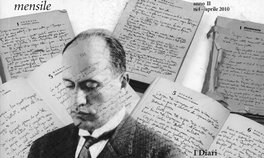
Mussolini’s diaries and the “treasure of Dongo”
John Gooch in the Times Literary Supplement:
More here.
How Neuroscientists and Magicians Are Conjuring Brain Insights
Mariette DiChristina in Scientific American:

Why are scientists working with sleight-of-hand artists? Their tricks, honed through the decades, have revealed that people respond to certain situations in specific ways. Like detectives looking for new leads to solve a mystery, scientists can mine magicians’ knowledge for ideas to test in the lab. And for the magicians, understanding principles about the brain—that is, why a trick works the way it does—can suggest new ways to advance their art as they develop new tricks or improve existing ones. (The article, “What Can Magicians Teach Us about the Brain?”, provides some more background and a November 2008 Nature Reviews Neuroscience paper coauthored by neuroscientists and magicians.)
More here.
The Demonic Trilling
Edward Mendelson in the New York Review of Books:
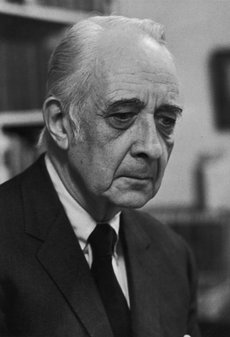
For Adam Kirsch, in Why Trilling Matters, Trilling’s authority still survives as a source of courage: “In the last twenty years, when writers have lamented the decay of literature’s confidence and authority, they have often turned, as if by instinct, to Trilling as the emblem of those lost virtues.” Kirsch’s central insight, however, is that Trilling wrote with an artist’s authority, not a teacher’s:
Trilling’s authority…is itself a literary achievement—not a privilege of cultural office or a domineering assertion of erudition and intellect, but an expression of sensibility, the record of an individual mind engaged with the world and with texts.
Trilling’s constant theme, he adds, was “the conflict between the artist’s will and the demands of justice.”
More here.
X-JET
How Reliable Are the Social Sciences?
Gary Gutting in the New York Times:
Public policy debates often involve appeals to results of work in social sciences like economics and sociology. For example, in his State of the Union address this year, President Obama cited a recent high-profile study to support his emphasis on evaluating teachers by their students’ test scores. The study purportedly shows that students with teachers who raise their standardized test scores are “more likely to attend college, earn higher salaries, live in better neighborhoods and save more for retirement.”
How much authority should we give to such work in our policy decisions? The question is important because media reports often seem to assume that any result presented as “scientific” has a claim to our serious attention. But this is hardly a reasonable view. There is considerable distance between, say, the confidence we should place in astronomers’ calculations of eclipses and a small marketing study suggesting that consumers prefer laundry soap in blue boxes.
A rational assessment of a scientific result must first take account of the broader context of the particular science involved. Where does the result lie on the continuum from preliminary studies, designed to suggest further directions of research, to maximally supported conclusions of the science? In physics, for example, there is the difference between early calculations positing the Higgs boson and what we hope will soon be the final experimental proof that it actually exists.
More here.
A portrait of the artist as a brooding young woman…
From The Independent:

Not so. Riley's lifestyle seems starkly at odds with her dust-jacket achievements. Over the five years it has taken to write Opposed Positions, Riley says she has had severe problems rubbing two pennies together. There have been unnerving moments of penury, wondering where the next subsistence cheque will be coming from. The cheques eventually came in the shape of tax credits, or literary grants, or summer school work, but it was far from the charmed life we imagine for our up-and-coming literary stars.
More here.
Point of Return
From The New York Times:
“Whose house is this?”
The first four words of Toni Morrison’s new book greet — or assail — us before the story even begins. They’re from the epigraph, which quotes a song cycle written by the author some 20 years ago and therefore, it seems safe to say, not originally intended for this book, but an indication, perhaps, of how long its themes have been haunting her. And “haunting” is a fitting word for the lyric itself, in which a speaker professes to lack both recognition of and accountability for the strange, shadowy, dissembling domicile in which he finds himself. The atmosphere of alienation makes the song’s final line even more uncanny: “Say, tell me, why does its lock fit my key?”
Thus the stage is set for “Home”: on the basis of its publisher’s description a novel, on the basis of its length a novella, and on the basis of its stripped-down, symbol-laden plot something of an allegory. It tells the story of Frank Money, a 24-year-old Korean War veteran, as he embarks on a reluctant journey home. But where — and what — is home? Frank is already back from the fighting when we meet him, a year after being discharged from an integrated Army into a segregated homeland. Since then, he has wandered the streets of Seattle, “not totally homeless, but close.” He has gambled his Army pay and lost it, worked odd jobs and lost them, lived with a girlfriend and lost her, and all the while struggled, none too successfully, against the prospect of losing his mind.
More here.
Saturday Poem
Always
I am not jealous
of what came before me.
Come with a man
on your shoulders,
come with a hundred men in your hair,
come with a thousand men between your breasts and your feet,
come like a river
full of drowned men
which flows down to the wild sea,
to the eternal surf, to Time!
Bring them all
to where I am waiting for you;
we shall always be alone,
we shall always be you and I
alone on earth,
to start our life!
by Pablo Neruda
Friday, May 18, 2012
Mother Natures: On Elisabeth Badinter

The Good Mother ideal is examined by the French feminist Elisabeth Badinter in her latest book, The Conflict: How Modern Motherhood Undermines the Status of Women. Badinter, a 68-year-old mother of three grown children, is utterly uninterested in writing about the personal experience of mothering. Last year she was voted “the most influential intellectual” in France, and she seems never to have wallowed in maternal guilt, choosing to dissect it instead with chilly precision.
In 1980 she wrote L’Amour en plus, a history of mother love, in which she described how maternal “selfishness and indifference” were the norm until Rousseau and the Romantics put the “reign of the child king” at the center of European family life. The book opens with some startling police statistics from 1780. Out of 21,000 infants born in Paris that year, more than 19,000 were dispatched to wet nurses in the countryside, where—if they were lucky enough to survive the treacherous journey—they would be tightly swaddled and left to stew in their excrement for hours; hung up on a nail by their swaddling bands to keep them out of reach of barnyard animals; and fed a diet of pap when the wet nurse had trouble with her milk supply. More than half of those children died before the age of 2.
Historians have commonly argued that such displays of maternal indifference were due to the crushing levels of infant mortality in the eighteenth century: a mother would stop herself from becoming too attached to an infant who might die. Badinter, however, takes her cue from medical historians such as Edward Shorter and reverses the lines of causality: “It was not so much because children died like flies that mothers showed so little interest in them,” she writes in L’Amour en plus, “but rather because the mothers showed so little interest that the children died in such great numbers.” The 10 percent of children who stayed at home to be breast-fed by their mothers or by live-in wet nurses were about twice as likely to live. To believe that high mortality rates were the cause rather than the result of maternal indifference is, for Badinter, a sentimental fantasy that “prevents us from condemning” mothers and keeps our mythology of mother love heart-warming and pristine.
Such sang-froid wends its way through The Conflict, which includes the same ghastly statistics, but here Badinter brings them up at the end, after devoting most of the book to denouncing what she calls “ecological motherhood,” which is essentially the attachment parenting promoted by Dr. Sears: breast-feeding, cloth diapering, co-sleeping. “Eco-biological prejudices” and “the vilification of chemicals” have “put motherhood squarely back at the heart of women’s lives” by making childcare an all-consuming activity that only a mother can do.
Essentialism

I've reached a crossroads in my research and in the questions I'm now starting to ask. Part of that was driven by some insight and realization about the direction I was taking, and part of it was also driven by changes in economic circumstances. Notably, the reduction in funding in this country has impacted upon my field quite dramatically (behavioral sciences). The way that that has impacted is that there's far less money to fund research, so the competition to get funding has become very acute. Now we have to justify with a view to application. In the past you could just go off on a flight of fancy studying the things that were of intrinsic interest.
But now we have to steer our grant applications towards potential application, and certainly we have to write a substantial proportion of the proposal to deal with impact, public engagement. And that's across the board. As I said, if this had been five, ten years ago, there would have been some resistance to that, but increasingly now the research councils feel that we, as a public body funded by taxation, need to be called to account in terms of what we're doing with the money, the taxpayers' money.
This has led me to start thinking more about what I do in terms of its tangible application in the real world? That's the external influences that have been shaping the sorts of questions I'm starting to ask now.
There's been a growing awareness that there have been a lot of problems with the way that psychological research has been going on in the past, very much lab-based type of work. There has been a general issue in the experimental method, what you typically do is you hone in on a question, and you try to refine that question by removing all the extraneous variables to try and make it as clean as possible. But then that does raise the question, to what extent? And does what you eventually find actually have real relevance or validity to the external world? Because in many senses, the complexity of the external world might be part of the problem that the brain is trying to solve.
How Economists have Misunderstood Inequality
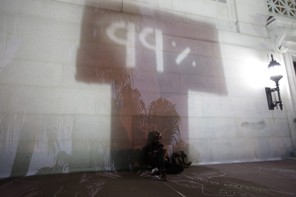
Brad Plumer: You bring together a lot of new data on inequality in the book across a variety of countries, from the United States to Europe to China to Latin America. What’s different about what your book discovers?
James Galbraith: One thing we found is that there are common global patterns in economic inequality across different countries that appear to be very strongly related to major events affecting the world economy as a whole. The most important have been changes in financial regimes and changes in systems of financial governance. It made a big difference when the Bretton Woods system ended in 1971. The debt crisis of the 1980s made a big difference. The debt crisis of the 1980s made a big difference. It made a big difference in 2000 when the NASDAQ crashed and interest rates were reduced These things all had global repercussions, and they affected inequality around the entire world in different ways.
BP: And this isn’t how many economists have looked at inequality, correct?
JG: No. The most unconventional thing in this book is about how inequality relates to macroeconomic performance and financial factors. The discussion of inequality tends to be heavily dominated by a marketplace perspective that stresses individual-level characteristics like the demand for skill. Economists have always classified this as a microeconomic problem. … But when something’s happening at the same time around the world, in different countries that are widely separated, that’s a macro issue. There was a global movement toward higher inequality as a result of the financial stresses that the world is under.
What Makes Countries Rich or Poor?
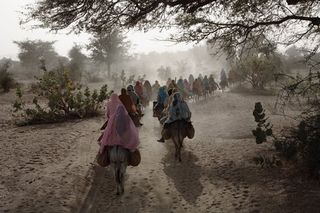
There is no doubt that good institutions are important in determining a country’s wealth. But why have some countries ended up with good institutions, while others haven’t? The most important factor behind their emergence is the historical duration of centralized government. Until the rise of the world’s first states, beginning around 3400 BC, all human societies were bands or tribes or chiefdoms, without any of the complex economic institutions of governments. A long history of government doesn’t guarantee good institutions but at least permits them; a short history makes them very unlikely. One can’t just suddenly introduce government institutions and expect people to adopt them and to unlearn their long history of tribal organization.
That cruel reality underlies the tragedy of modern nations, such as Papua New Guinea, whose societies were until recently tribal. Oil and mining companies there pay royalties intended for local landowners through village leaders, but the leaders often keep the royalties for themselves. That’s because they have internalized their society’s practice by which clan leaders pursue their personal interests and their own clan’s interests, rather than representing everyone’s interests.
The various durations of government around the world are linked to the various durations and productivities of farming that was the prerequisite for the rise of governments. For example, Europe began to acquire highly productive agriculture 9,000 years ago and state government by at least 4,000 years ago, but subequatorial Africa acquired less productive agriculture only between 2,000 and 1,800 years ago and state government even more recently. Those historical differences prove to have huge effects on the modern distribution of wealth.
A Nobelist’s Novel Museum
Ron Gluckman in the Wall Street Journal:
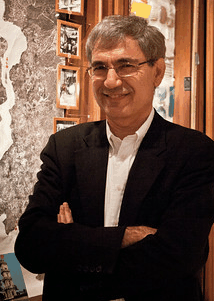
Yet the Museum of Innocence is also a genuine institution and, after more than a decade of planning, a huge triumph for Mr. Pamuk. The author not only curated the displays but collected all the items, grouped in 83 numbered panels, one for each chapter of his 2008 book, “The Museum of Innocence.”
That novel focused on the protagonist, Kemal, who, much like Mr. Pamuk, scavenged similar items for the fictitious museum of the book's title. In the real museum there is a potpourri of whimsical displays—a skull with a fly on the side, a ceramic heart noticeably broken, ceramic sheep in front of an old Turkish movie poster—alongside banks of photographs of old Turkish celebrities, antique watches, rows of toy dogs. Some describe it as a spectacular example of self-indulgence, but a cheerful Mr. Pamuk termed it a showcase of ordinary life in Istanbul. He seemed elated to play out the grand riddle—what came first, book or museum?
“I conceived both the novel and the museum together,” he insisted during a private tour a few days after the museum's April 28 opening. Reaction to the long-delayed museum was largely positive, and a general sense of relief swept Istanbul. Even die-hard fans had wondered if it would ever open.
More here.
Religious and Sacred Imperatives in Human Conflict
Scott Atran and Jeremy Ginges in Science (registration required):
Abstract:
Religion, in promoting outlandish beliefs and costly rituals, increases ingroup trust but also may increase mistrust and conflict with outgroups. Moralizing gods emerged over the last few millennia, enabling large-scale cooperation, and sociopolitical conquest even without war. Whether for cooperation or conflict, sacred values, like devotion to God or a collective cause, signal group identity and operate as moral imperatives that inspire nonrational exertions independent of likely outcomes. In conflict situations, otherwise mundane sociopolitical preferences may become sacred values, acquiring immunity to material incentives. Sacred values sustain intractable conflicts that defy “business-like” negotiation, but also provide surprising opportunities for resolution.
Read full paper here.
The Mathematician’s Obesity Fallacy
Michael Moyer in Scientific American:

This kind of outsider’s perspective can be invaluable when attacking a problem as difficult and entrenched as the epidemic of obesity in the U.S. Chow relates the story of starting work at the institute—a division of the National Institutes of Health—and finding a mathematical model created by a colleague that could predict “how body composition changed in response to what you ate.” The problem, as Chow describes it, was that the model was complicated: “hundreds of equations,” he told the Times. “[We] began working together to boil it down to one simple equation. That’s what applied mathematicians do.”
And what did Chow’s simple model reveal about the nature and causes of obesity? Basically, that we eat too much. “The model shows that increase in food more than explains the increase in weight.” Food in, fat out. Simple enough to be captured in a single equation.
Unfortunately Chow’s outsider’s perspective on the obesity crisis isn’t really an outsider’s perspective at all: it is the physicist’s perspective.
More here.