National Medal of Arts: Rita Dove

From The Root:

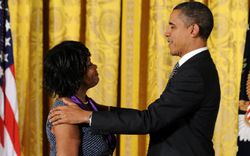
DovePoet and author Dove smiles at President Obama as she receives the 2011 National Medal of Arts in the East Wing of the White House on Feb. 13, 2012.

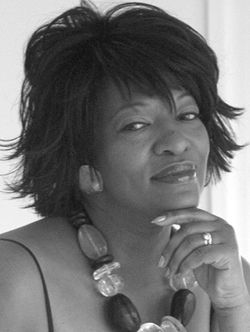
In 1993 Rita Dove was appointed Poet Laureate of the United States and Consultant in Poetry at the Library of Congress, making her the youngest person — and the first African-American — to receive this highest official honor in American letters. She held the position for two years. In 1999 she was reappointed Special Consultant in Poetry for 1999/2000, the Library of Congress's bicentennial year, and in 2004 Virginia governor Mark Warner appointed her as Poet Laureate of the Commonwealth of Virginia, a two year position. Rita Dove was born in Akron, Ohio in 1952 as the daughter of the first Black research chemist who, in the 1950s, broke the race Ritabarrier in the tire industry. In 1970 she was invited to the White House as a Presidential Scholar, one of the hundred most outstanding high school graduates in the United States that year, before attending Miami University in Oxford, Ohio as a National Achievement Scholar. She graduated summa cum laude (as well as Phi Beta Kappa and Phi Kappa Phi) with a degree in English in 1973, followed by two semesters as a Fulbright scholar at Universität Tübingen in Germany. She then joined the University of Iowa Writers' Workshop, where she earned her Master of Fine Arts degree in 1977. In 1976 she met the German writer Fred Viebahn, who was a Fulbright fellow in the University of Iowa's International Writing Program that year; they married in 1979, and their daughter Aviva Chantal Tamu Dove-Viebahn was born in 1983. Appearances in magazines and anthologies had already won national acclaim for Rita Dove when she published her first poetry collection, The Yellow House on the Corner, with Carnegie-Mellon University Press in 1980. It was followed by Museum (1983) and Thomas and Beulah (1986), both also from Carnegie-Mellon. Thomas and Beulah, a collection of interrelated poems loosely based on her grandparents' life, earned her the 1987 Pulitzer Prize, making her the second African American poet (after Gwendolyn Brooks in 1950) to receive this prestigious award.

More here. (Note: In honor of African American History Month, we will be linking to at least one related post throughout February. The 2012 theme is Black Women in American Culture and History).

From Pig to Plate: A taste of things to come?

From Nature:

Researchers are sure that they can put lab-grown meat on the menu — if they can just get cultured muscle cells to bulk up.

MeatMark Post has never been tempted to taste the 'fake' pork that he grows in his lab. As far as he knows, the only person who has swallowed a strip of the pale, limp muscle tissue is a Russian TV journalist who visited the lab this year to film its work. “He just took it with tweezers out of the culture dish and stuffed it in his mouth before I could say anything,” says Post. “He said it was chewy and tasteless.” Post, who works at the Eindhoven University of Technology in the Netherlands, is at the leading edge of efforts to make in vitro meat by growing animal muscle cells in a dish. His ultimate goal is to help rid the world of the wasteful production of farm animals for food by helping to develop life-like steaks. In the near term, he hopes to make a single palatable sausage of ground pork, showcased next to the living pig that donated its starter cells — if he can secure funds for his research. Post started out as a tissue engineer interested in turning stem cells into human muscle for use in reconstructive surgery, but switched to meat a few years ago. “I realized this could have much greater impact than any of the medical work I'd been doing over 20 years — in terms of environmental benefits, health benefits, benefits against world starvation,” he says. Largely because of the inefficiency of growing crops to feed livestock, a vegetarian diet requires only 35% as much water and 40% as much energy as that of a meat-eater1. Future 'in-vitrotarians' should be able to claim similar savings.

More here.

He always thought the roof was about to cave in

Georges_Simenon_(1963)_without_hat_by_Erling_Mandelmann

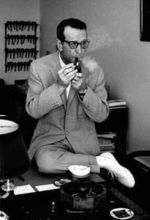
The Belgian writer Georges Simenon was the creator of Jules Maigret, one of the greatest of all fictional detectives: the anti-Holmes, the stout “mender of destinies” who fuels himself with copious amounts of beer and calvados and gets to the bottom of things, not through deductive process, but by intuition and his compassionate feeling for the outer reaches of human behavior. Most literary detectives embody their creator’s fantasy; Maigret is especially unusual in that the jumping-off point seems to be Simenon asking himself not, what would I be like if I were clever or tough, but, more intriguingly, what would I be like if I were a good man? Simenon certainly didn’t see himself as a good man. He once made the outrageous claim that in his life he slept with 10,000 women (or was it 20,000?), most of them prostitutes. And he was just as prolific on the page. In fact, he’s remembered chiefly for the swiftness of his output; he reckoned he could crank out a first draft in eleven days or so, and once agreed to write a book in public, in a glass booth. Simenon was a relentless self-mythologizer, but a pitiless self-analyzer too, from which emerged the invaluable second strand of his output, the so-called romans durs, or “hard novels.” Most of these deal with more or less the same predicament: a character, usually a man, is caught in a trap of his own devising and then pushed to the limit. The best of the romans durs feel raw and electric, because Simenon, despite all his worldly experience and his enormous wealth, never stopped seeing his own life in such anxious terms. He always thought the roof was about to cave in.

more from at the LA Review of Books here.

to frack or not to frack

Mckibben_1-030812_jpg_470x419_q85

In one sense, the analysts who forecast that “peak oil”—i.e., the point at which the rate of global petroleum extraction will begin to decline—would be reached over the last few years were correct. The planet is running short of the easy stuff, where you stick a drill in the ground and crude comes bubbling to the surface. The great oil fields of Saudi Arabia and Mexico have begun to dwindle; one result has been a rising price for energy. We could, as a civilization, have taken that dwindling supply and rising price as a signal to convert to sun, wind, and other noncarbon forms of energy—it would have made eminent sense, most of all because it would have aided in the fight against global warming, the most difficult challenge the planet faces. Instead, we’ve taken it as a signal to scour the world for more hydrocarbons. And it turns out that they’re there—vast quantities of coal and oil and gas, buried deep or trapped in tight rock formations or mixed with other minerals. Getting at them requires ripping apart the earth: for instance, by heating up the ground so that the oil in the tar sands formation of Canada can flow to the surface. Or by tearing holes in the crust a mile beneath the surface of the sea, as BP was doing in the Gulf of Mexico when the Deepwater Horizon well exploded. Or by literally removing mountaintops to get at coal, as has become commonplace across the southern Appalachians.

more from Bill McKibben at the NYRB here.

a strange brew

120227_r21865_p465

On December 16, 2007, on the two-hundred-and-thirty-fourth anniversary of the Boston Tea Party, Ron Paul, congressman and Presidential candidate, presided over a nationwide fund-raiser. This was a new tea party, with a new slogan: “Liberty is brewing.” In Boston, hundreds of Paul’s supporters marched to Faneuil Hall. Paul himself appeared in Freeport, Texas, where organizers had prepared barrels for him to dump into the Brazos River. One barrel read “United Nations”; another read “I.R.S.” The campaign raised more than six million dollars in one day, which was a record, and the event prefigured the protests that became common as the Tea Party movement coalesced, in 2009. The movement, with its focus on economic liberty and small government, sometimes seemed like a continuation of Paul’s campaign for the Republican nomination, during which he won a great deal of attention and a modest number of votes. It’s not much of a stretch to call him the “Godfather of the Tea Party,” as his campaign literature does, quoting Fox News. Ron Paul was ahead of his time. Paul is running for President again this year, in a field that many Republicans find disappointing. And yet, while Paul is doing better, state by state, than he did in 2008, he has conspicuously failed to establish himself as this year’s Tea Party candidate. Polls have shown that voters who support the Tea Party are actually less likely to support Paul—some have gone for Newt Gingrich, whose denunciations of Obama are pithier, or for Rick Santorum, who is more forthright in his defense of “traditional American values.” In South Carolina, where Paul received thirteen per cent of the vote, behind Gingrich, Mitt Romney, and Santorum, he did his best among voters opposed to the Tea Party. The Ron Paul movement has grown, but the events of recent years—the rise of the Tea Party, the fights over corporate bailouts, the messy passage of Obama’s health-care reform bill—have done surprisingly little to raise Paul’s standing among Republicans.

more from Kelefa Sanneh at The New Yorker here.

Tuesday, February 21, 2012

Salman Rushdie and Me

Amitava Kumar in the Chronicle of Higher Education:

Photo_18585_carouselThe organizers of the Jaipur Literature Festival were asked to hand over to the police the videotape of a reading from a novel last month. The tape will show the writer Hari Kunzru and me reading from Salman Rushdie's The Satanic Verses, a book banned in India since its publication in 1988. We were protesting Rushdie's absence from the festival. He had been forced to withdraw after extremist Muslim groups expressed displeasure, and, more urgently, when intelligence reports revealed that hired assassins from Mumbai were on their way to kill the writer. (Those reports were later revealed to be fiction. Cops as magical realists.)

On the tape, the police will have seen that, during our reading, I told the audience that just before the start of the protests in Tahrir Square last year, the Google executive-turned-cyber-activist Wael Ghonim had entered Egypt with a message ready on his computer. It said, “I am now being arrested at Cairo airport.” All he needed to do was press Send.

I joked that perhaps Hari ought to do something similar. Within minutes of my saying this, the festival's producer arrived and asked me to stop reading. I didn't. When the reading was over and we came out, a bank of television cameras was trained on us. A Hindi reporter asked me, “Aren't you guilty of provoking religious violence?” And then, a little later, the police were there, informing us that we had broken the law.

I was staggered at the speed at which all of this happened.

More here.

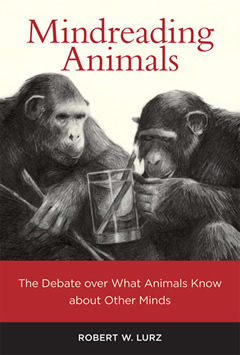
The Debate over What Animals Know about Other Minds

Colin Allen in American Scientist:

Mind-reading-animalsDoes your dog know what you are thinking? Can a chimpanzee understand what another sees? In the three and a half decades since David Premack and Guy Woodruff first asked whether chimpanzees have a “theory of mind,” a considerable empirical and philosophical literature has sprung up around what has come to be called “mind reading” in animals. Theory of mind, as Premack and Woodruff defined it, is the ability to attribute perceptual and cognitive states to others. This is not about telepathy, but about whether any animals besides humans have the capacity to attribute such states to others. Numerous experimental tests and other observations have been offered in favor of animal mind reading, and although many scientists are skeptical, others assert that humans are not the only species capable of representing what others do and don’t perceive and know.

Robert Lurz, a philosopher at Brooklyn College, CUNY, surveys the experiments at the heart of the debate and finds that not one of them solves what he calls “the logical problem” in animal mind-reading research. The logical problem is that for any mind-reading hypothesis, it seems possible to construct a complementary “behavior-reading” hypothesis that makes exactly the same predictions but is assumed to be less cognitively demanding. The basic point is that whatever mind reading is, it is not magic, and thus depends on ordinary, perceivable cues—but these same cues are then available as a basis for expectations about actions that an animal might take without making any mental attribution. If you see me gazing at a piece of cake with a certain look on my face, you may infer that I’m thinking about eating it, or you might instead directly form some expectations about my cake-directed behavior without imagining what I might be thinking about it.

More here.

Tuesday Poem

Ode to the Medieval Poets

Chaucer, Langland, Douglas, Dunbar, with all your
brother Anons, how on earth did you ever manage,
without anaesthetics or plumbing,
in daily peril from witches, warlocks,

lepers, The Holy Office, foreign mercenaries
burning as they came, to write so cheerfully,
with no grimaces of self-pathos?
Long-winded you could be but not vulgar,

bawdy but not grubby, your raucous flytings
sheer high-spirited fun, whereas our makers,
beset by every creature comfort,
immune, they believe, to all superstitions,

even at their best are so often morose or
kinky, petrified by their gorgon egos.
We all ask, but I doubt if anyone
can really say why all age-groups should find our

Age quite so repulsive. Without its heartless
engines, though, you could not tenant my book-shelves,
on hand to delect my ear and chuckle
my sad flesh: I would gladly just now be

turning out verses to applaud a thundery
jovial June when the judas-tree is in blossom,
but am forbidden by the knowledge
that you would have wrought them so much better.

by W.H.Auden
(who I believe would be 107 years old today)

Becoming Condoleezza Rice

From USA Today:

Condix-largePALO ALTO, Calif. — This can't be the right place.You would expect the home of Condoleezza Rice— the most successful African-American woman in the history of the executive branch — to be festooned with mementos from her tenure under two Bush presidencies, which culminated in her role as secretary of State.Perhaps some photos with world leaders. Ornate gifts from political counterparts. Lavish furnishings.Nope. Instead, the decidedly generic condo reserved for Stanford University faculty is filled with antiques that belonged to Rice's parents, sports memorabilia and a prominent photograph of her with … cellist Yo-Yo Ma. The only sign of George W. Bush is found on a hockey-puck-size Lucite disc, which is inscribed with a 9/11-era quote from the 43rd president.But make no mistake: There is no distancing going on. Rice is as proud of her record as ever.”I look back on those eight years fondly,” she says, dressed in black, sitting in a small den decorated with NFL helmets and framed shots of her with golfers Ernie Els and Phil Mickelson.”I'm glad I got to serve in a time of tremendous consequence,” says Rice, 55. “We did some things well. Some things not so well. But I'm a big believer that history has a long arc. We'll have final determination on things we did long after I'm gone. And that's fine.”A change in direction Rice set out to dissect her political life in a book, but that was put on hold when she opted to first pay tribute to the people who truly shaped her, Birmingham, Ala., educators John and Angelena Rice. The result is Extraordinary, Ordinary People: A Memoir of Family.

More here. (Note: In honor of African American History Month, we will be linking to at least one related post throughout February. The 2012 theme is Black Women in American Culture and History).

There’s More to Nothing Than We Knew

Dennis Overbye in The New York Times:

CosmosWhy is there something, rather than nothing at all?

It is, perhaps, the mystery of last resort. Scientists may be at least theoretically able to trace every last galaxy back to a bump in the Big Bang, to complete the entire quantum roll call of particles and forces. But the question of why there was a Big Bang or any quantum particles at all was presumed to lie safely out of scientific bounds, in the realms of philosophy or religion. Now even that assumption is no longer safe, as exemplified by a new book by the cosmologist Lawrence M. Krauss. In it he joins a chorus of physicists and cosmologists who have been pushing into sacred ground, proclaiming more and more loudly in the last few years that science can explain how something — namely our star-spangled cosmos — could be born from, if not nothing, something very close to it. God, they argue, is not part of the equation. The book, “A Universe From Nothing,” is a best seller and follows recent popular tomes like “God Is Not Great,” by the late Christopher Hitchens; “The God Delusion,” by Richard Dawkins; and “The Grand Design,” by the British cosmologist Stephen Hawking (with Leonard Mlodinow), which generated headlines two years ago with its assertion that physicists do not need God to account for the universe.

More here.

as always, Hartley gets the short end of the stick

Samuel Taylor Coleridge170x145

Hartley Coleridge began life with limitless promise—“all my child might be”—and ended it universally viewed as a failure. He is remembered not for his poems or his essays, though he wrote some fine ones, but for two things and two things only: he was the son of Samuel Taylor Coleridge, and he was a disappointment. He has been called a misfit, a dreamer, a sinner, a castaway, a wayward child, a hobgoblin, a flibbertigibbet, a waif, a weird, a pariah, a prodigal, a picturesque ruin, a sensitive plant, an exquisite machine with insufficient steam, the oddest of God’s creatures, and, most frequently—by his father, his mother, his brother, and his sister; by William Wordsworth, Dorothy Wordsworth, and Thomas Carlyle; and by countless others over the years—“Poor Hartley.” I will not call him Poor Hartley. Relieved of the adjective that has followed him around like a cringing cur for nearly two centuries, he will be, simply, Hartley. (Although the “David” referred to in his father’s letter—an homage to David Hartley, the eighteenth-century metaphysical philosopher—faded away before baptism, Hartley was still stuck with one great man for his first name and another for his last.) And that raises the question of what I should call his father, he of the abscessed buttocks and the great poems. “Coleridge” not only grants him sole proprietorship of a last name that belongs just as rightfully to his son but also makes the father sound like an adult and the son—forever—like a child. For the sake of parity, I should call him “Samuel.” However, he detested that name, considering it “the worst combination of which vowels and consonants are susceptible.” He signed his poems with a variety of pseudonyms, from Aphilos to Zagri. His most celebrated alias was Silas Tomkyn Comberbache, the name under which he enlisted in the dragoons and with whom he shared a set of initials: STC. Since that is how he referred to himself in his notebooks, sometimes in Greek, I will call our ill-starred pair Hartley and STC—with the rueful realization that, as always, Hartley gets the short end of the stick.

more from Anne Fadiman at Lapham’s Quarterly here.

breaking the drouth

Wendell_berry

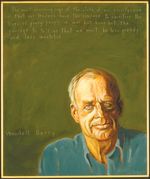
Early in my childhood, when the adult world and sometimes my own experience easily assumed the bright timelessness of myth, I overheard my father’s friend Charlie Hardy telling about the drouth of 1908. I liked hearing the grownups talk, and when I wanted to I could be quiet. By being more or less unnoticeable, I heard a lot. Some of the adult conversations I listened to ended with a question: “How long have you been here, Andy?” Charlie Hardy, anyhow, grew up on a rough little farm on Bird’s Branch. Charlie, as he said, “came up hard,” though that phrase, by now, has lost much of the meaning it still would have had in the early 1940s. At the time of Charlie’s boyhood, except for the railroad and the little packets that still carried passengers and freight up and down the river, there were no machines in the country around Port William, no electricity, no “modern conveniences” or not many. Now, when electricity, indoor plumbing, and many personal machines have become normal, people generally assume that a hundred years ago life was “hard” for almost everybody, though few still have the experience needed for a just comparison. It is perhaps impossible for a person living unhappily with a flush toilet to imagine a person living happily without one.

more from Wendell Berry at Threepenny Review here.

the problem with pennies

The_End_of_Money_Wolman-e1329336629234

Pennies, nickels, and dimes can barely be described as money anymore. Legally they are, sure, but they don’t exactly circulate. A store of value? Practically nil. Medium of exchange? Only if you have a boatload of them, which won’t exactly endear you to whomever you’re transacting with. A unit of account? Technically, but I don’t know anyone who uses the hundredths place in his mental accounting. Marketing types will be quick to tell you that consumers treat $2.99 differently from $3.00, but that’s because of the hypnotic power of the left digit. No one cares about the right one anymore. It’s no wonder then that people so willingly pay the usurious 8.9 percent fee to use one of Coinstar’s 20,000 kiosks to convert unwieldy jarfuls of metal into paper money. In the United States, the question of killing at least the penny and nickel surfaces whenever the price of metals spikes. A few years ago, the cost of making a penny peaked at 1.8 cents per cent, and nine cents for a nickel. The penny has since come down; nickels are still at about six cents apiece, while each of the new dollar coins costs an impressive thirty-four cents. “The current situation is unprecedented,” the director of the U.S. Mint told Congress in the summer of 2010. “Compared to their face values, never before in our nation’s history has the government spent as much money to mint and issue coins.” Never before has the United States faced such “spiraling” costs to issued coinage—more, in fact, than the coins’ legal tender value. “This problem is needlessly wasting hundreds of millions of dollars.”

more from David Wolman at The Awl here.

Half Human

Joseph_roth_013112_620pxAdam Kirsch in Tablet Magazine:

The rediscovery of Joseph Roth has been one of the happiest literary developments of the last 10 years—perhaps the first time that the word “happy” could be used in the same sentence as Roth’s name. Roth, born in the town of Brody in Austrian Galicia in 1894, was one of the best-known journalists in 1920s Germany, a master of the impressionistic personal essay known as the feuilleton. With the 1932 publication of The Radetzky March, his novel about the decline of the Austro-Hungarian Empire, he joined the first rank of fiction writers as well.

Within a year, however, the Nazis took power in Germany, making it impossible for Roth, or any German Jewish writer, to live and work in the country. Roth spent the next five years living hand-to-mouth in France, cranking out short novels at a terrific pace in an increasingly hopeless attempt to support himself. He died in 1939, a victim of alcoholism and of history, at the age of just 45—though to judge by photographs of his booze-ravaged face, he already looked like an elderly man. As it turned out, this premature death came just in time, for if Roth had still been living in France after the German conquest in 1940, he would surely have been sent to a concentration camp.

Several of Roth’s books were published in the United States in the 1920s and ’30s, but after his death his reputation nearly vanished here.

Bridging the Analytic-Continental Divide

0219Stone-blog480Gary Gutting in the NYT's Opinionator:

Many philosophers at leading American departments are specialists in metaphysics: the study of the most general aspects of reality such as being and time. The major work of one of the most prominent philosophers of the 20th century, Martin Heidegger, is “Being and Time,” a profound study of these two topics. Nonetheless, hardly any of these American metaphysicians have paid serious attention to Heidegger’s book.

The standard explanation for this oddity is that the metaphysicians are analytic philosophers, whereas Heidegger is a continental philosopher. Although the two sorts of philosophers seldom read one another’s work, when they do, the results can be ugly. A famous debate between Jacques Derrida (continental) and John Searle (analytic) ended with Searle denouncing Derrida’s “obscurantism” and Derrida mocking Searle’s “superficiality.”

The distinction between analytic and continental philosophers seems odd, first of all, because it contrasts a geographical characterization (philosophy done on the European continent, particularly Germany and France) with a methodological one (philosophy done by analyzing concepts). It’s like, as Bernard Williams pointed out, dividing cars into four-wheel-drive and made-in-Japan. It becomes even odder when we realize that some of the founders of analytic philosophy (like Frege and Carnap) were Europeans, that many of the leading centers of “continental” philosophy are at American universities, and that many “analytic” philosophers have no interest in analyzing concepts.

Eric Schliesser over at New APPS has a response [h/t: Ben Wolfson]:

Gary Gutting is one of the most important and interesting intermediaries between continental philosophy and mainstream analytic philosophy. So, he is always worth taking seriously, but I am afraid that his recent New York Times Opinionator is marred by some self-serving rhetoric that prevents illumination on some very important philosophic issues. Against standard blog-rhetoric (where we normally land heaviest punches first), my criticism below will increase in severity and philosophic significance.

First, Gutting writes: “There is…a continuing demand for analytic expositions of major continental figures. It’s obvious why there is no corresponding market for, say, expositions of Quine, Rawls or Kripke in the idioms of Heidegger, Derrida or Deleuze.” In context, Gutting implies that the obvious answer is that Quine, Rawls, and Kripke write so clearly that no such exposition would be needed–they are accessible without intermediation. Now, after a recent reading group on Word & Object (with Dutch folk who are very good philosophers of science, but who had not been exposed to a standard Anglo undergraduate curriculum), I know for a fact this is not true of Quine, who — while being a beautiful and humorous stylist — is extremely opaque writer to people not steeped in his dialectic with Carnap (and lack of knowledge of set-theory). [Is there anybody that really thinks the argument of Two Dogmas is clear?]

Monday, February 20, 2012

Gish Jen to Judge 3rd Annual 3QD Arts & Literature Prize

UPDATE 3/19/12: The winners have been announced here.

UPDATE 3/8/12: The finalists have been announced here.

UPDATE 3/7/12: The semifinalists have been announced here.

UPDATE 2/29/12: Voting round now open. Click here to see full list of nominees and vote.

Dear Readers, Writers, Bloggers,

Gish-JenWe are very honored and pleased to announce that Gish Jen has agreed to be the final judge for our 3rd annual prize for the best blog and online writing in the category of arts and literature. (Details of the inaugural prize, judged by Robert Pinsky, can be found here, and more about last year's prize, judged by Laila Lalami can be found here.)

Gish Jen is a novelist. Her first novel, Typical American, was a finalist for the National Book Critics' Circle award, and her second novel, Mona in the Promised Land, was listed as one of the ten best books of the year by the Los Angeles Times. Her latest novel, World and Town, won the 2011 Massachusetts Book Prize and has been nominated for the 2012 International IMPAC Dublin Literary Award. Her short work has appeared in numerous periodicals including The New Yorker, the Atlantic, the Paris Review, Daedalus, the New Republic, and The New York Times. She has also been included in dozens of textbooks and anthologies, including several Best American Short Stories collections, including The Best American Short Stories of the Century, edited by John Updike. The recipient of grants from the Guggenheim Foundation, the Radcliffe Institute for Advanced Study and the National Endowment for the Arts, she also received a Lannan Literary Award for Fiction in 1999, and a $250,000 Strauss Living Award from The American Academy of Arts and Letters in 2003.

Jen has been featured in a PBS American Masters program on the American Novel and was named a fellow of the American Academy of Arts and Sciences in 2009. She is slated to deliver the Massey Lectures in American Civilization at Harvard University in the spring of 2012. Her website is www.gishjen.com.

As usual, this is the way it will work: the nominating period is now open, and will end at 11:59 pm EST on February 28, 2012. There will then be a round of voting by our readers which will narrow down the entries to the top twenty semi-finalists. After this, we will take these top twenty voted-for nominees, and the four main editors of 3 Quarks Daily (Abbas Raza, Robin Varghese, Morgan Meis, and Azra Raza) will select six finalists from these, plus they may also add up to three wildcard entries of their own choosing. The three winners will be chosen from these by Gish Jen.

The first place award, called the “Top Quark,” will include a cash prize of one thousand dollars; the second place prize, the “Strange Quark,” will include a cash prize of three hundred dollars; and the third place winner will get the honor of winning the “Charm Quark,” along with a two hundred dollar prize.

(Welcome to those coming here for the first time. Learn more about who we are and what we do here, and do check out the full site here. Bookmark us and come back regularly, or sign up for the RSS feed.)

Details:
PrizeArtsAnnounce2012The winners of this prize will be announced on March 19, 2012. Here's the schedule:

February 20, 2012:

  • The nominations are opened. Please nominate your favorite blog entry by placing the URL for the blog post (the permalink) in the comments section of this post. You may also add a brief comment describing the entry and saying why you think it should win. (Do NOT nominate a whole blog, just one individual blog post.)
  • We will accept poems and fiction, as well as book or art reviews, criticism, and other types of writing about arts or literature.
  • Blog posts longer than 4,000 words are strongly discouraged, but we might make an exception if there is something truly extraordinary.
  • Each person can only nominate one blog post.
  • Entries must be in English.
  • The editors of 3QD reserve the right to reject entries that we feel are not appropriate.
  • The blog entry may not be more than a year old. In other words, it must have been written after February 19, 2011.
  • You may also nominate your own entry from your own or a group blog (and we encourage you to).
  • Guest columnists at 3 Quarks Daily are also eligible to be nominated, and may also nominate themselves if they wish.
  • Nominations are limited to the first 200 entries.
  • Prize money must be claimed within a month of the announcement of winners.

February 28, 2012

  • The nominating process will end at 11:59 PM (NYC time) of this date.
  • The public voting will be opened soon afterwards.

March 6, 2012

  • Public voting ends at 11:59 PM (NYC time).

March 19, 2012

  • The winners are announced.

One Final and Important Request

If you have a blog or website, please help us spread the word about our prizes by linking to this post. Otherwise, post a link on your Facebook profile, Tweet it, or just email your friends and tell them about it! I really look forward to reading some very good material, and think this should be a lot of fun for all of us.

Best of luck and thanks for your attention!

Yours,

Abbas

What does it sound like?

by Jen Paton

Damasceneroom

I remember material history seemed boring to me as an undergraduate. I could care less about some colonial lady’s crockery or her misshapen stony bead games. The only objects of interest were those allegedly imbued with “cultural import” – religious icons, certain paintings, particular grand spaces that made me wonder what it must have been like to be there. I was suffering, badly, from an over-reliance on words and pictures.

We see history through such words and pictures, sometimes video, often through blockbuster films or Ken Burns-effected photographs on television documentaries – the latter an effect that lends a sense of importance to an image that you can’t quite pinpoint nor fully buy into (especially now that you can do it yourself with iPhoto). But we live life with five senses, after all. People of the past felt, smelled, and heard things too. Perhaps this is why, where it seems one might get away with it, you can always catch people of today trying to touch the buffed Greek statuary or glowering Egyptian gods at the British Museum.

At the Met’s new, enveloping, Galleries for the Art of the Arab Lands, Turkey, Iran, Central Asia and Later South Asia, surrounded by astounding and challenging visual beauty, I couldn’t touch much of the past, but there is a nice moment where I could hear a bit of it, when I scuttled across a large gallery full of rugs to stumble into the Damascus room from 1707. With the splashes of a fountain, you can imagine a bit of what someone’s life of the senses was like, here, then.

Read more »

Sunday, February 19, 2012

Anthony Shadid: House of Stone

Anthony Shadid was a New York Times correspondent in the Middle East who died last week. This essay is adapted from his forthcoming memoir, “House of Stone.”

Anthony Shadid in the New York Times:

ScreenHunter_07 Feb. 19 21.56The America that drew my family was 7,000 miles from where they started, in old Marjayoun, in what is now Lebanon.

My aunts and uncles, grandparents and great-grandparents, were part of a century-long wave of migration that occurred as the Ottoman Empire crumbled, then fell, around the time of World War I. In the hinterland of what was then part of Greater Syria, the war marked years of violent anarchy that made bloodshed casual. Disease was rife. So was famine. Hundreds of thousands starved in Lebanon, Syria, Palestine and beyond. My family’s region was not spared. A survey of 182 villages in the area showed that a fourth of the homes withered into wartime ruin, and more than a third of the people who had inhabited them had died.

This horrific decade and its aftermath provoked villagers — including my family — to abandon their homes for locations ranging from South America to West Africa to Australia, as well as a few neighborhoods in Oklahoma City and Wichita, Kan.

More here.