the Starry Messenger

Galileo_Portrait_ftr

A right thumb, a finger, a tooth. These were the contents of a reliquary acquired several years ago by a collector at an auction in Florence. Little did he know that for centuries the remains had been objects of profane devotion. Last seen in 1905, they had been sliced from the corpse of Galileo, along with another finger and a vertebra, during his highly publicized reburial in the Basilica of Santa Croce in 1737 almost 100 years after his death, and preserved in a slender case fashioned of glass and wood and crowned with a carved bust of the scientist. The reliquary’s new owner consulted Galileo experts about his find, and after the authenticity of its contents had been verified he donated it to the Museo Galileo, which is tucked behind the Uffizi in a quiet piazza overlooking the River Arno. (A dentist asked by the museum to examine the tooth concluded that Galileo suffered from gastric acid reflux and ground his teeth in his sleep.) The rediscovered reliquary is displayed adjacent to a smaller one containing Galileo’s other finger, a prized museum possession since 1927. Nearby are several artifacts of Galileo’s scientific genius: a telescope presented to the Medici and the broken objective lens of the original device with which Galileo sighted Jupiter’s four satellites in 1610.

more from Paula Findlen at The Nation here.

religion and the public sphere

Power-of-Religion-200x300

“We develop in multi-cultural and multi-religious societies. To say this is to state the obvious. There is no religiously homogeneous society.” Akeel Bilgrami has invited commentary on his recent working paper about the nature and relevance of secularism in which he advances a central thesis that begins with the conditional phrase, “Should we be living in a religiously plural society.” In this post, I offer a response to his thesis convinced, like Cardinal Jean-Louis Tauran, author of the quotation with which I began, that there is no such thing as a modern religious monoculture. As president of the Pontifical Council for Interreligious Dialogue, the apparatus of the Catholic Church established after Vatican II to serve as the site of engagement with the followers of other religious traditions, Jean-Louis Tauran has something of a professional commitment to pluralism as an ontological category. Tauran gave his 2008 speech on the necessity of cultivating channels of interreligious dialogue at a time when the stock of interreligious dialogue was clearly on the rise. Controversies like those sparked by the Jyllands-Posten cartoons of 2005 and Pope Benedict XVI’s September 2006 lecture on faith and reason, which offended many Muslims by seeming to endorse misleading criticism of Islam, led to a surge in post-9/11 interfaith initiatives. In response to the misunderstandings that informed the Pope’s lecture, 138 global Muslim leaders published “A Common Word Between Us and You” in October 2007, an open letter calling for a common ground of understanding and peace between Muslims and Christians, a period that also saw the launch of Tony Blair’s Faith Foundation and Cardinal Tauran’s initiatives to train clergy for interreligious dialogue in a pluralist world, both in 2008. Global modernity, it is clear, neither presages the necessary rise of a homogeneous consumer culture nor an inevitable decline in the vitality and variety of religious engagement.

more from Justin Neuman at The Immanent Frame here.

west toward home

Article00

IN HER NOVELS AND in her nonfiction essays, Marilynne Robinson’s questions are always roughly the same: Who are we, and where did we come from? The first is a matter of metaphysics, the second of history. At least since the publication of her first collection of essays, The Death of Adam (1998), Robinson has been making it her business to remind us that these questions are not yet settled. We may be descended from apes, but that does not mean that we are essentially apelike. “It has been usual for at least a century and a half to think of human beings as primates,” she writes in her latest collection, When I Was a Child I Read Books, only to add, “I suppress the impulse to say ‘mere primates,’ since I suspect the other members of our great order are undervalued by us in the course of devaluing ourselves.” This is a characteristic Robinson turn—admit the dehumanizing point of your opponent, only to show how deep our humanity goes. When I Was a Child, by far Robinson’s most political work to date, turns her old questions to the problems now directly confronting us. The book is a defense of what she considers the grand traditions of American democracy—generosity, hope, and a radical openness to new experience—waged against a society that seems to believe itself in irreversible decline. At the same time, Robinson registers a profound note of disappointment at feeling, “on the darkest nights, and sometimes in the clear light of day, that we are now losing the ethos that has sustained what is most to be valued in our civilization.”

more from Charles Petersen at Bookforum here.

Thursday, February 23, 2012

Keeping Up with the Republican Primaries

Justin E. H. Smith in his own blog:

ScreenHunter_15 Feb. 23 15.46I got all teary-eyed around November, 2008, just like every other non-australopithecine American. But unlike most of my co-evolved concitoyens I was not a sucker. I was delighted that we would now have a rational and evidently morally decent person, rather than a cretinous one, volunteering to take on a role that is for structural reasons morally compromising. But I did not think for a second that this was the dawning of some sort of new era. That would be to misunderstand what a president is.

We have what in places like Turkey is lucidly described as a 'deep state' (though in Turkey it's principally the army that is had in mind, while for us it's a more composite beast). The deep state limits drastically what elected officals can do. It is the permanent structure that endures behind the constant electoral spectacle, and it ought to be the only thing of interest to political analysts. Do I blame Obama for the continuation of the Iraq War, the non-closure of Guantánamo, etc.? Just a little bit more than I blame his tailor. For Obama is, as they say, a suit, and many, many people conspire to maintain him as the presentable image of American power. I am incapable of conjuring any commiseration with the conventional liberals who believe disappointment in Obama the person is an appropriate reaction to his record as president.

However little Obama interests me, the current clamoring of the Republican candidates is of an altogether different order of uninterestingness.

More here.

Preliminary Historical Observations on the Arab Revolutions of 2011

Rashid Khalidi in Critical Inquiry:

1_123125_2073765_2180614_2203618_081103_fw_khaliditnWhat so far distinguishes the revolutionary upsurge that we have been watching across the Arab world from its many predecessors? One of the apparent distinctions is that in Tunisia, Egypt, Bahrain and several other countries, it has so far been largely peaceful: “Silmiyya, silmiyya” the crowds in Tahrir chanted. But so were many of the great Arab risings of the past. These included many episodes in Egypt and Iraq’s long struggles to end British military occupation, and those of Syria, Lebanon, Morocco and Tunisia to end that of France, not to speak of the first Palestinian intifada against Israeli occupation from 1987-1991. While tactics of non-violence were broadly employed in the recent uprisings in Egypt and elsewhere, this is by no means the first time that Arab uprisings have been largely non-violent, or at least unarmed.

It has also been said that what distinguishes these revolutions from earlier ones in the Arab world and elsewhere in the Middle East is that they are focused on democracy and constitutional change. It is true that these have been among their most central demands. But this is not entirely unprecedented. There was sustained constitutional effervescence in Tunisia and Egypt in the late 1870’s until the British and French occupations of those countries in 1881 and 1882. Similar debates led to the establishment of a constitution in the Ottoman Empire in 1876 that lasted with interruptions until 1918. All the successor states to the Ottoman Empire were deeply influenced by this chequered constitutional experiment. In 1906, Iran established a constitutional regime, albeit one that was repeatedly eclipsed. In the inter-war period and afterwards, the semi-independent and independent countries in the Middle East were mainly governed by constitutional regimes.

More here.

Networks of the Brain

Terrence Sejnowski in American Scientist:

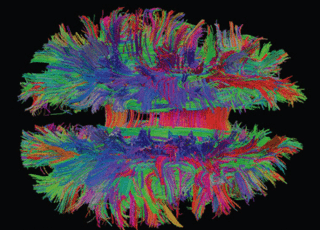
ScreenHunter_13 Feb. 23 14.45In 1993 Francis Crick and Edward Jones published an essay in Nature titled “Backwardness of human neuroanatomy.” They lamented our poor knowledge about the anatomy and connectivity of the human brain compared to that of the macaque monkey brain, especially for the visual system. “Clearly,” they wrote, “what is needed for a modern brain anatomy is the introduction of some radically new techniques.” Networks of the Brain, by Olaf Sporns, heralds a new era in neuroanatomy based on major advances in brain imaging and brain reconstruction that have been made since Crick and Jones’s commentary nearly 20 years ago. Sporns’s goal is to connect neuroscience with network science, the study of complex networks.

In the book’s early chapters, Sporns covers general principles of network science and offers background on the structure and dynamics of brain networks based on his research as well as that of many others, including some from my own laboratory. This prepares readers for the heart of the book, chapter 5, “Mapping Cells, Circuits, and Systems,” in which the author introduces modern imaging techniques.

More here.

Myrlie Evers-Williams

Myrlie-evers-williamsBorn in 1933, Myrlie Evers-Williams was the wife of murdered civil rights activist Medgar Evers. While fighting to bring his killer to justice, Evers-Williams also continued her husband's work with her book, For Us, The Living. She also wrote Watch Me Fly: What I Learned on the Way to Becoming the Woman I Was Meant to Be. Evers-Williams served as chair of the NAACP from 1995 to 1998.

From Root:

Surprised by the moral outrage expressed by some over the depiction of blacks in The Help, civil rights journalist and activist Myrlie Evers-Williams pens a moving letter at the Hollywood Reporter in defense of the award-winning film.

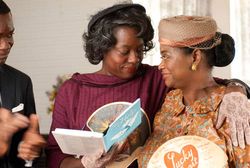
HelpMy mother was “the help.” And so was her mother. I’m telling you these things because they were courageous and they were not alone in their courage. Legions of black women like them — maids and waitresses and caretakers who fanned out across Vicksburg and Mississippi and the South to work in the homes and restaurants and hotels owned, operated and occupied by whites — practiced small measures of courage every day by facing constant violent threat and institutionalized racism instated by the very people they were charged with feeding, rearing and caring for their children. Theirs is an American story that is rarely told on any grand, meaningful scale — not one, at least, that defies stereotype and caricature. But recently, “The Help,” a film based on Kathryn Stockett’s bestselling book of the same name, became a cultural touchstone when two of its lead characters, both African-American maids in the then-staunchly segregated Mississippi, challenged viewers to walk their journey — to see, as lead protagonist, Abileen Clark, said, “what it felt like to be me.”

To me, The Help is this year’s most outstanding and socially relevant motion picture; Viola Davis’ quiet but powerful portrayal of Abileen made us all take notice of a historically invisible class of women and Abileen’s story, along with those of the other maids who rallied with her to tell it, remind us that when we speak, if only in a whisper, momentous things can happen.

More here. (Note: In honor of African American History Month, we will be linking to at least one related post throughout February. The 2012 theme is Black Women in American Culture and History).

What is the value of a green card?

From PhysOrg:

GreenJust what does it mean to get a green card? To some applicants, about $1,000 each month.

A recent study by a University of Nevada, Reno economist and a graduate student found that employer-sponsored workers in the United States on temporary visas who acquire their green cards and become permanent residents increase their annual incomes by about $11,860. They studied data from The New Immigrant Survey, a collaborative study of new legal immigrants funded in 2003 by the U.S. Immigration and Naturalization Service and other public and private partners. The study, “The Value of an Employment-Based Green Card,” by associate professor Sankar Mukhopadhyay and former graduate student David Oxborrow in the College of Business, was published this month in the journal, Demography. According to the U.S. Department of Homeland Security, from 1999 to 2008, about 1 million green cards were approved each year. The majority of these, 74 percent, were to those sponsored by family or with immediate relatives who are U.S. citizens. However, about 15 percent of those approved for green cards were classified as “employment-based applicants.” These workers are mostly highly educated and highly skilled with college degrees, here on work visas for up to six years. The average wait to obtain a green card, however, is six to 10 years. Of those workers here on this particular type of visa, about 56 percent end up being successful in obtaining their green cards.

More here.

The American Century Is Over—Good Riddance

Photo_18578_wide_large

From the jaded, not to say cynical, observer of international politics, the passing of the American Century elicits a more ambivalent response. I’d like to believe that the United States will accept the outcome gracefully. Rather than attempting to resurrect Luce’s expansive vision, I’d prefer to see American policy makers attend to the looming challenges of multipolarity. Averting the serial catastrophes that befell the planet starting just about 100 years ago, when the previous multipolar order began to implode, should keep them busy enough. But I suspect that’s not going to happen. The would-be masters of the universe orbiting around the likes of Romney and Obama won’t be content to play such a modest role. With the likes of Robert Kagan as their guide—”It’s a wonderful world order,” he writes in his new book, The World America Made (Knopf)—they will continue to peddle the fiction that with the right cast of characters running Washington, history will once again march to America’s drumbeat. Evidence to support such expectations is exceedingly scarce—taken a look at Iraq lately?—but no matter. Insiders and would-be insiders will insist that, right in their hip pocket, they’ve got the necessary strategy.

more from Andrew J. Bacevich at The Chronicle of Higher Education here.

the ongoing clash over Civil War memory

Kelman_249231h

A s birthday parties go, this one has been a bit of a downer so far. The American Civil War was 150 years old last year, but it went on for four years, so there’s still plenty of time for history buffs in period costumes to re-enact blood-soaked battles; actors to give President Lincoln’s and Frederick Douglass’s speeches, grafting new wings on to a bygone era’s soaring oratory; and writers to churn out volumes chronicling the history of the nation’s deadliest conflict. But, up to now, the reaction has remained oddly muted, suggesting that people in the United States, though apparently still obsessed with the Civil War, remain uncertain about how to remember this troubling event collectively: as triumph or tragedy, as rebirth or mass murder, or as something else again. Or maybe it’s just that Americans are notoriously suspicious of foreign languages, and just what kind of fancy word is sesquicentennial anyway? The problem of how to recall the conflict dates back to its immediate aftermath. With broken bodies still cooling in trenches outside Richmond, and ruined swathes of Georgia and South Carolina still smouldering in the wake of Sherman’s march, Confederate ideologues, having lost the war itself, embarked on a memory project designed to help them win the peace.

more from Ari Kelman at the TLS here.

petersburg

Tumblr_ldmuwcHLDz1qfuquoo1_500

In a chapter of his memoir, Speak, Memory, Nabokov tells of his nocturnal wanderings through St Petersburg. Real darkness and artificial light conspire to make foreign his surroundings. “Solitary street lamps were metamorphosed into sea creatures with prismatic spines”; “various architectural phantoms arose with silent suddenness”; “great, monolithic pillars of polished granite (polished by slaves, repolished by the moon, and rotating smoothly in the polished vacuum of the night) zoomed above us.” The whole scale is recalibrated, all perspective redrawn, but the young Nabokov laps it up, feeling “a cold thrill” and “Lilliputian awe” as he stops to contemplate “new colossal visions” rising up before him. He is thrown by these hall-of-mirrors distortions but not entirely surprised to be so—after all, he is in “the world’s most gaunt and enigmatic city.” This was 1915 and Nabokov was not the only writer to consider the city enigmatic. One year later, Andrei Bely’s Petersburg was published, a novel which possesses stranger, more fantastic distortions. The characters in Bely’s book are too flummoxed by the city and intoxicated by its swirling yellow mists to share Nabokov’s thrill. Their dazedness hardens into fear, and the reader is thrilled (and admittedly flummoxed, too) by the fecundity of surrealness on show and the sheer exceptionality of such a book coming from such a country at such a time. Nabokov himself approved, declaring Petersburg one of the greatest novels of the 20th-century.

more from Malcolm Forbes at The Quarterly Conversation here.

What the hell happened to Frances Farmer?

0401_linen_farmer

Frances Farmer was an actress in the 1930s and 1940s, Hollywood’s golden era. A goddess among other goddesses, a beautiful woman with a lower-register speaking voice (close your eyes, hear the plangent tones of a French horn). No less a goddess, either, for the relative brevity of her Hollywood career. Frances made only 15 feature films from 1935 to 1942—and a 16th, albeit trashy one, in 1957—appearing in the best of these with such luminaries as Cary Grant (The Toast of New York), Bing Crosby (Rhythm on the Range), Edward Arnold (Come and Get It and The Toast of New York), and Tyrone Powers (Son of Fury). But she was not just a figure of the ’30s and ’40s; she was one of the ’90s and ’00s, too. “Frances Farmer Will Have Her Revenge on Seattle” is the fifth song on Nirvana’s In Utero; particularly arresting is the line, “She’ll come back as fire and burn all the liars, leave a blanket of ash on the ground.” Full-bore vengeance on untold millions of Seattle innocents. That’s dramatic enough to make you wonder: What the hell happened to Frances Farmer?

more from Matt Evans at The Morning News here.

Wednesday, February 22, 2012

America’s last hope: A strong labor movement

Dorian Warren in Salon:

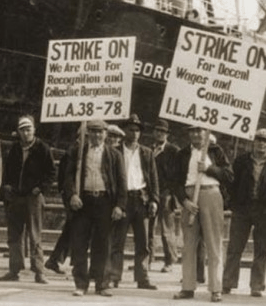
ScreenHunter_12 Feb. 22 16.54The fate of the labor movement is the fate of American democracy. Without a strong countervailing force like organized labor, corporations and wealthy elites advancing their own interests are able to exert undue influence over the political system, as we’ve seen in every major policy debate of recent years.

Yet the American labor movement is in crisis and is the weakest it’s been in 100 years. That truism has been a progressive mantra since the Clinton administration. However, union density has continued to decline from roughly 16 percent in 1995 to 11.8 percent of all workers and just 6.9 percent of workers in the private sector. Unionized workers in the public sector now make up the majority of the labor movement for the first time in history, which is precisely why — a la Wisconsin and 14 other states — they have been targeted by the right for all out destruction.

The urgency is striking. Instead of being fundamentally discredited, the oligarchs and plutocrats who crashed our economy are raking in record profits and acting even more aggressively to bury the American labor movement once and for all. Over the last year, several labor leaders have told me that they believe unions have only about five more years left if they don’t figure out some kind of breakthrough strategy.

The complete collapse of unions would have devastating consequences.

More here.

Adventures in Behavioral Neurology

V. S. Ramachandran at Edge.org:

ScreenHunter_11 Feb. 22 16.39One of the peculiar syndromes, which we have studied recently, is called apotemnophilia. It's in fact so uncommon that many neurologists and many psychiatrists have not heard of it. It's in a sense a converse of phantom limbs. In a phantom limb patient an arm is amputated but the patient continues to vividly feel the presence of that arm. We call it a phantom limb. In apotemnophilia you are dealing with a perfectly healthy, normal individual, not mentally disturbed in any way, not psychotic, not emotionally disturbed, often holding a job, and has a family.

We saw a patient recently who was a prominent dean of an engineering school and soon after he retired he came out and said he wants his left arm amputated above the elbow. Here's a perfectly normal guy who has been living a normal life in society interacting with people. He's never told anybody that he harbored this secret desire—intense desire—to have his arm amputated ever since early childhood, and he never came out and told people about it for fear that they might think he was crazy. He came to see us recently and we tried to figure out what was going on in his brain. And by the way, this disorder is not rare. There are websites devoted to it. About one-third of them go on to actually get it amputated. Not in this country because it's not legal, but they go to Mexico or somewhere else and get it amputated.

So here is something staring you in the face, an extraordinary syndrome, utterly mysterious, where a person wants his normal limb removed. Why does this happen? There are all kinds of crazy theories about it including Freudian theories. One theory asserts, for example, that it's an attention seeking behavior. This chap wants attention so he asks you to remove his arm. It doesn't make any sense. Why does he not want his nose removed or ear removed or something less drastic? Why an arm? It seems a little bit too drastic for seeking attention.

More here.

The Art of Distraction

Hanif Kureishi in the New York Times:

ScreenHunter_09 Feb. 22 16.00If you’re writing and you get stuck, and you then make tea, while waiting for the kettle to boil the chances are good ideas will occur to you. Seeing that a sentence has to have a particular shape can’t be forced; you have to wait for your own judgment to inform you, and it usually does, in time. Some interruptions are worth having if they create a space for something to work in the fertile unconscious. Indeed, some distractions are more than useful; they might be more like realizations and can be as informative and multilayered as dreams. They might be where the excitement is.

You could say that attention needs to be paid to intuition; that one can learn to attend to the hidden self, and there might be something there worth listening to. If the Ritalin boy prefers obedience to creativity, he may be sacrificing his best interests in a way that might infuriate him later. A flighty mind might be going somewhere.

I might have been depressed as a teenager, but I wasn’t beyond enjoying some beautiful distractions. Since my father had parked a large part of his library in my bedroom, when I was bored with studying I would pick up a volume and flip through it until I came upon something that interested me. I ended up finding, more or less randomly, fascinating things while supposedly doing something else. Similarly, while listening to the radio, I became aware of artists and musicians I’d otherwise never have heard of. I had at least learned that if I couldn’t accept education from anyone else, I might just have to feed myself.

More here.

Why Being Sleepy and Drunk Are Great for Creativity

Jonah Lehrer in Wired:

Here’s a brain teaser: Your task is to move a single line so that the false arithmetic statement below becomes true.

IV = III + III

Did you get it? In this case, the solution is rather obvious – you should move the first “I” to the right side of the “V,” so that the statement now reads: VI = III + III. Not surprisingly, the vast majority of people (92 percent) quickly solve this problem, as it requires a standard problem-solving approach in which only the answer is altered. What’s perhaps a bit more surprising is that nearly 90 percent of patients with brain damage to the prefrontal lobes — this leaves them with severe attentional deficits, unable to control their mental spotlight — are also able to find the answer.

Here’s a much more challenging equation to fix:

III = III + III

In this case, only 43 percent of normal subjects were able to solve the problem. Most stared at the Roman numerals for a few minutes and then surrendered. The patients who couldn’t pay attention, however, had an 82 percent success rate. What accounts for this bizarre result? Why does brain damage dramatically improve performance on a hard creative task? The explanation is rooted in the unexpected nature of the solution, which involves moving the vertical matchstick in the plus sign, transforming it into an equal sign. (The equation is now a simple tautology: III = III = III.) The reason this puzzle is so difficult, at least for people without brain damage, has to do with the standard constraints of math problems. Because we’re not used to thinking about the operator, most people quickly fix their attention on the roman numerals. But that’s a dead end. The patients with a severe cognitive deficit, in contrast, can’t restrict their search. They are forced by their brain injury to consider a much wider range of possible answers. And this is why they’re nearly twice as likely to have a breakthrough.

More here.