E.O. Wilson at NYTimes' The Stone:
More here.

E.O. Wilson at NYTimes' The Stone:
More here.
From The Independent:

“What I want is that these stories are arranged as a labyrinth with different points of entry,” says Ruiz Zafón.
More here. (Note: For Sara Preisler who introduced me to this magnificent story teller.)
Not Leaving the House
.
When Kai is born I quit going out  Hang around the kitchen – make cornbread Let nobody in. Mail is flat. Masa lies on her side, Kai sighs, Non washes and sweeps We sit and watch Masa nurse, and drink green tea.  Navajo turquoise beads over the bed A peacock tail feather at the head A badger pelt from Nagano-ken For a mattress; under the sheet; A pot of yogurt setting Under the blankets, at his feet.  Masa, Kai, And Non, our friend In the garden light reflected in Not leaving the house. From dawn till late at night making a new world of ourselves around this life.   by Gary Snyder
From The New York Times:
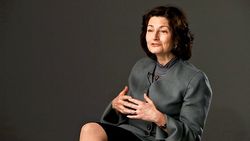
“It’s nuts,” said Dr. Linda P. Fried, an epidemiologist and geriatrician who is dean of the Mailman School of Public Health at Columbia University. “To assume defeat from what every one of us as individuals wants suggests we’re not asking the right questions.” Findings from the science of aging, Dr. Fried said, should “reframe our understanding of the benefits and costs of aging.” From her perch at Mailman, a position she has held for four years, Dr. Fried is pushing students, professors and a wider audience to ask the right questions and ponder the right policies for coping with an aging world population. Dr. Fried’s mandate is to lead a school that will give a new generation the tools to deal with global challenges to public health, including environmental degradation, climbing health care costs and the pressure of rapid urbanization. But she believes that research on aging and health changes “across the life course” are central to designing solutions to public health problems in the 21st century.
More here.
Jimmy Carter in the New York Times:
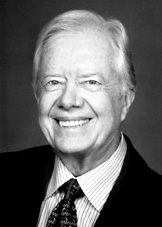
While the country has made mistakes in the past, the widespread abuse of human rights over the last decade has been a dramatic change from the past. With leadership from the United States, the Universal Declaration of Human Rights was adopted in 1948 as “the foundation of freedom, justice and peace in the world.” This was a bold and clear commitment that power would no longer serve as a cover to oppress or injure people, and it established equal rights of all people to life, liberty, security of person, equal protection of the law and freedom from torture, arbitrary detention or forced exile.
The declaration has been invoked by human rights activists and the international community to replace most of the world’s dictatorships with democracies and to promote the rule of law in domestic and global affairs. It is disturbing that, instead of strengthening these principles, our government’s counterterrorism policies are now clearly violating at least 10 of the declaration’s 30 articles, including the prohibition against “cruel, inhuman or degrading treatment or punishment.”
More here.
Peter Savodnik at Businessweek:

If war introduced fast-food joints to Kuwait City, peace made them a permanent fixture. Some 3,400 U.S. troops remained in Kuwait after the war, enforcing the no-fly zone over Iraq. McDonald’s (MCD) first opened in Kuwait in 1994, three years after the war ended. (In contrast, the U.S. withdrew its troops from Iraq late last year, and ongoing spurts of violence mean it’s unlikely that there will be a surge in U.S. restaurants there. In 2011, Pizza Hut, Cinnabon, and Burger King started closing locations in Iraq.)
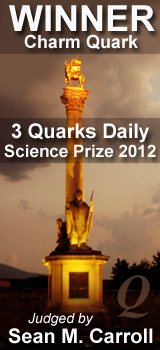
Sean Carroll has picked the three winners:
1. Top Quark, $1000: Aatish Bhatia, The crayola-fication of the world: How we gave colors names, and it messed with our brains
2. Strange Quark, $300: Cosma Shalizi, In Soviet Union, Optimization Problem Solves You
3. Charm Quark, $200: Holly Dunsworth, Forget bipedalism. What about babyism?
Here is what Sean had to say about them:
I want to thank Abbas and all the 3QD crew for inviting me to judge this year's Science Prize. I can't help but thinking that after having Richard Dawkins, Steven Pinker, and Lisa Randall judge the previous years, a certain phase transition has occurred; but I'm happy to be associated with such an amazing group.
Let me start by saying something obvious but nevertheless true: the entries this year were of extraordinarily high quality. Some excellent blog posts among the initial nominees didn't even make the final nine, and any one of the nine finalists would have been a worthy choice for number one. But I will resist the temptation to declare a nine-way tie.
There is no simple and objective standard for what makes a blog post “the best.” “Blog is software,” as Bora Zivkovic likes to remind us — blogging is a medium, not a genre. Successful blog posts can be one word or ten thousand; a personal reflection or a rigorous analysis; an original idea or an insightful commentary; a devastating take-down or an inspirational message. But within these flexible parameter, there are certain aspects of blogging that make it special, and I looked for posts that took advantage of those unique capabilities. I wanted to choose posts that would be hard to imagine finding in any other medium, but whose quality measured up to the best of journalism or science writing. One frustrating aspect of a contest like this is that the prize is given to posts, rather than to blogs — for many of the most successful blogs, their charm comes from the accumulated effect of reading many posts over a long period of time. But okay, enough with the throat-clearing.
Without further ado:
First place this year goes to Empirical Zeal, for “The crayola-fication of the world: How we gave colors names, and it messed with our brains.” With many different criteria in mind, this post by Aatish Bhatia stood out among the rest. It's just about the perfect use of a blog. For one thing, it looks gorgeous: all those colorful images, each of which actually serves a purpose. The writing is playful and clever; once you see the mantis shrimp telling you “DEAR MORTAL, YOUR RAINBOW IS PUNY,” you're not likely to forget it. And most of all, the science is fascinating and important. To a physicist, there is a continuum of colors; but to our eyes and brains, “rainbows have seams,” and that affects how we think about the world. A completely deserving winner. (And don't forget that there is a Part II.)
Second place goes to Three-Toed Sloth, for “In Soviet Union, Optimization Problem Solves You” (cross-posted at Crooked Timber.) Cosma Shalizi doesn't bother with colorful pictures; he even uses a slightly gray font on a white background, presumably because black on white would come off as too florid. But this is a creative and original essay that brings the theory of computational complexity to bear on the practical problem of managing a planned economy. (Conclusion: it can't be done.) The flexibility of blogs doesn't just mean the ability to post videos; it also means the freedom to explore ideas outside traditional disciplinary comfort zones. Not a light read, but a true contribution to intellectual discourse. The kind of post that nudges the rest of us to be better bloggers.
Third place goes to The Mermaid's Tale, for “Forget bipedalism. What about babyism?” In another great use of the medium, Holly Dunsworth takes creative advantage of the blog format to make important points both about science and about how science is done. How much can we learn about a species just by studying a few bones in its feet? Does a particular anatomical feature represent a crucial adaptation to circumstances, or is it just an ancestral remnant? Also: adorable pictures of baby monkeys, as well as real data with error bars. Everybody wins.
In very different ways, these three posts serve as proud examples of what blogging can be at its best — feel free to share them with any of your friends who still remain skeptical. Yet, I cannot help but cheat just a little bit by offering two “honorable mentions.” At The Primate Diaries, Eric Michael Johnson's “Freedom to Riot: On the Evolution of Collective Violence” is a polished and fascinating look at natural selection and the behavior of human crowds. And at Quantum Diaries, Flip Tanedo's “Helicity, Chirality, Mass, and the Higgs” is an original take on explaining an abstract but central point in modern quantum field theory. All of these posts — as well as the other finalists! — are impressive achievements. My hat's off.
Congratulations also from 3QD to the winners (remember, you must claim the money within one month from today–just send me an email). And feel free, in fact we encourage you, to leave your acceptance speech as a comment here! And thanks to everyone who participated. Many thanks also, of course, to Sean Carroll for doing the final judging and for his charmingly erudite judging essay.
The three prize logos at the top of this post were designed by Sughra Raza, me, and me. The photograph used in the strange quark logo was taken by Margit Oberrauch. I hope the winners will display them with pride on their own blogs!
Details about the prize here.
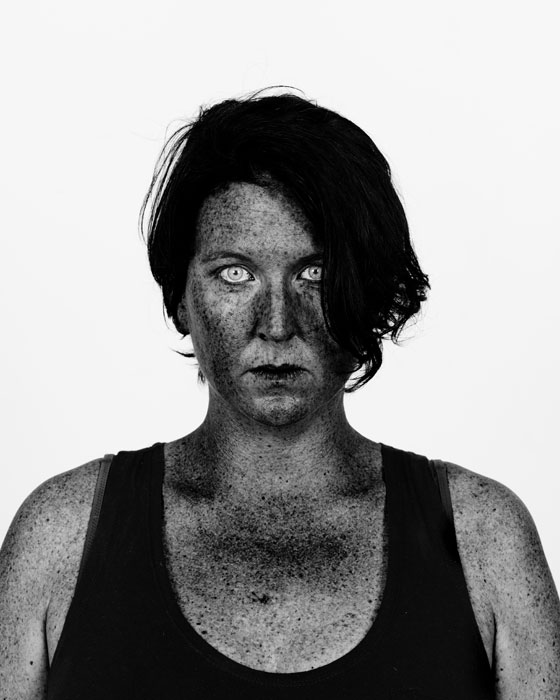
Pieter Hugo. Sarah Raymond, Capetown. From the series There's a Place in Hell for Me and My Friends, 2011.
” In this series … the subjects are simply the photographer and his friends, who represent an array of ethnicities but are not particularly atypical, abnormal or 'unusual' in a genetic sense. Instead they are rendered unusually, portrayed in a heightened monotone with their skin transformed into a range of exaggerated black spots and dark tones. As Hugo explains it, 'The process used in making these pictures involves turning digital colour images black and white, while keeping the colour channels active. In this manner one can manipulate the colour channels and emphasise certain colours within the grey scale. Melanin, the pigment responsible for skin colour, appears in two forms: pheomelanin (which appears as red), and eumelanin (which appears as a very dark, yellowish brown). In the case of these images, the red and yellow colour channels were darkened to a point where nearly all of their information was rendered as blacks and dark greys, and they were therefore brought to prominence.' Hence, within these photographs even the slightest pigmentation in light skin is converted into charcoal tones.”
(Extract from 'Beholder', Aaron Schuman's essay in Pieter Hugo's monograph (Munich: Prestel, 2012) accompanying his retrospective opening at the Fotomuseum den Haag in March 2012.) from here.
Michael Dirda in the Washington Post:
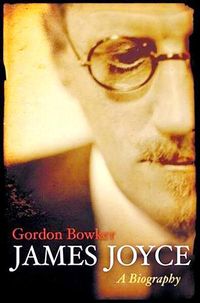
That, in a nutshell, is the action of “Ulysses” (1922), generally regarded as the greatest 20th-century novel in English. Of course, there’s a little more to the book than that, as generations of readers, critics, scholars and exegetes well know. Chapters loosely update episodes of Homer’s “Odyssey”; the language sings throughout; narrative conventions are ignored or revolutionized; literary and social taboos are violated (one scene takes place in an outhouse); and the whole book shifts constantly between interior monologue and outward events, between the starkest realism and the subtlest symbolism. “Ulysses” is arguably the most carefully wrought novel ever written — every word, down to its spelling, is there for an artistic reason.
More here.
Charles Choi in Discovery News:

“They had cities ordered into grids, with exquisite plumbing, which was not encountered again until the Romans,” Giosan told LiveScience. “They seem to have been a more democratic society than Mesopotamia and Egypt — no large structures were built for important personalitiess like kings or pharaohs.”
Like their contemporaries in Egypt and Mesopotamia, the Harappans, who were named after one of their largest cities, lived next to rivers.
“Until now, speculations abounded about the links between this mysterious ancient culture and its life-giving mighty rivers,” Giosan said.
Now Giosan and his colleagues have reconstructed the landscape of the plain and rivers where this long-forgotten civilization developed. Their findings now shed light on the enigmatic fate of this culture.
“Our research provides one of the clearest examples of climate change leading to the collapse of an entire civilization,” Giosan said.
More here.
Ellen Fanning in The Global Mail:
Here's a pop quiz for you. What is the adult population of North America?
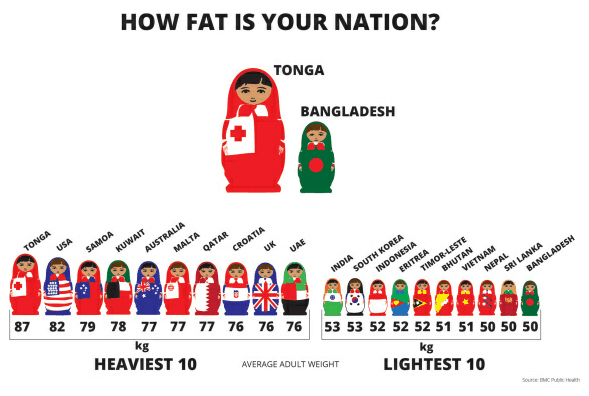
A few years ago, the official number was around 260 million. But the more accurate figure may be some 30 per cent higher — closer to 340 million. To be brutal, it's because so many of them are so fat.
London researchers have put the world's population on the scales and worked out that so many people are overweight or obese, they are effectively making the planet much more crowded.
Fred Branfman in Salon:
Our friendship was forged over concern for some of these “unpeople” when he visited Laos in February 1970. I had been living in a Lao village outside the capital city of Vientiane for three years at that point and spoke Laotian. But five months earlier I had been shocked to my core when I interviewed the first Lao refugees brought down to Vientiane from the Plain of Jars in northern Laos, which had been controlled by the communist Pathet Lao since 1964. I had discovered to my horror that U.S. executive branch leaders had been clandestinely bombing these peaceful villagers for five-and-a-half years, driving tens of thousands underground and into caves, where they had been forced to live like animals.
More here.
Brad Plumer in Wonkblog:
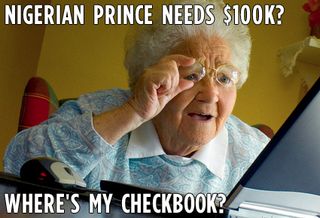
A fascinating new paper (pdf) from Microsoft researcher Cormac Herley actually tries to answer this question. He notes that 51 percent of all e-mail scams still originate from Nigeria, even though this is the most obvious scam known to mankind. And Corley argues (with math and graphs) that it’s not because scammers are stupid. Most of them are actually quite clever. Rather, they’re explicitly trying to weed out everyone but the most gullible respondents:
Our analysis suggests that is an advantage to the attacker, not a disadvantage. Since his attack has a low density of victims the Nigerian scammer has an over-riding need to reduce false positives. By sending an email that repels all but the most gullible the scammer gets the most promising marks to self-select, and tilts the true to false positive ratio in his favor.
Scamming people, after all, costs time and money. Herley notes that everyone who responds to a scamming ploy “requires a large amount of interaction.” The worst thing that can happen, from the scammer’s point of view, is that a savvy person starts responding and toying with the scammer.
More here.
Via Good:

More here.
From Harvard Magazine:
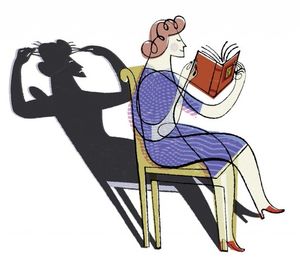
Of course, in a sense it worked out. Affectation of effortless perfection got me into Harvard.
More here.
Steven Pinker in Edge:
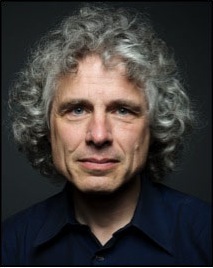
More here.
Branch Library
I wish I could find that skinny, long-beaked boy
who perched in the branches of the old branch library.
He spent the Sabbath flying between the wobbly stacks
and the flimsy wooden tables on the second floor,
pecking at nuts, nesting in broken spines, scratching
notes under his own corner patch of sky.
I’d give anything to find that birdy boy again
bursting out into the dusky blue afternoon
with his satchel of scrawls and scribbles,
radiating heat, singing with joy.
.
by Edward Hirsch
from The Living Fire: New and Selected Poems
publisher: Knopf, 2010
Via Newsweek:
Any parent knows there are few things 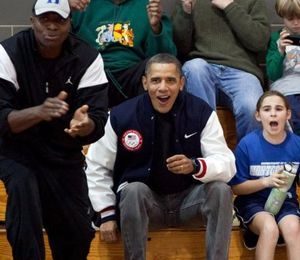
But it wasn’t so long ago that something like pursuing varsity sports was an unlikely dream for young women in America. Their teams often made do with second-rate facilities, hand-me-down uniforms, and next to no funding.
What changed? Well, 40 years ago, committed women from around the country, driven by everyone who said they couldn’t do something, worked with Congress to ban gender discrimination in our public schools. Title IX was the result of their efforts, and this week, we celebrated its 40th anniversary—40 years of ensuring equal education, in and out of the classroom, regardless of gender.