Sojourner Truth (1797-1883)

From shmoop.com:

Sojourner-truth-granger“I hope that Sojourner Truth would be proud to see me, a descendant of slaves, serving as the First Lady of the United States of America.”– First Lady Michelle Obama

Sojourner Truth is considered one of the great abolitionists, activists, speakers, and thinkers of all time. Born into slavery in 1797, she possessed a gift for public speaking and spoke fervently about abolishing slavery and about the need for women’s rights. After the Civil War, Sojourner Truth dedicated her time to helping former slaves transition to a life of freedom. Sojourner Truth fought tirelessly for the rights of African-Americans and women until the day she died in 1883. In April of 2009, Sojourner Truth became the first black woman to be honored with a bust in the United States Capital. First Lady Michelle Obama, Speaker Nancy Pelosi, and Senator Hillary Clinton were among those who spoke about Sojourner Truth at the bust’s unveiling.

More here. (Note: In honor of African American History Month, we will be linking to at least one related post throughout February. The 2012 theme is Black Women in American Culture and History).

Wednesday, February 1, 2012

Joseph Roth’s letters reveal a man stuck between the past and the present

Stefany Anne Golberg in The Smart Set:

ID_PI_GOLBE_ROTH_AP_001Among the 457 letters in Joseph Roth: A Life in Letters, there is not one love letter. This may not surprise fans of the writer — author of The Radetzky March, The Emperor’s Tomb, and Job, among others — who may know Joseph Roth as a vagabond and misanthrope whose occupation as a journalist had him traveling from one European country to the next, living in rented rooms, wearing threadbare clothes, without a bank account, mostly alone, too miserable for romance, the consummate Wandering Jew. But even Roth the World War I soldier left no love letters, no tender requests to, perhaps, a girl he left behind in the crumbling Hapsburg Empire, asking for solace or maybe a photo. Nor did he write any romantic epistles to the lovers with whom he found companionship and comfort in his final years. There are a handful letters from Roth's pre-war younger days, but they are all written to his cousins in Lemberg. They are letters of encouragement, advice, pontifications, the kind of letters one writes in youth that are more an affirmation of one’s self-understanding: “I am a sworn enemy to etiquette,” he wrote to his cousin Resia (which, in any case, was not true) and “…just like in Goethe’s Faust, which, alas and alack, you haven’t read.” “Who ever would have guessed it: all of nineteen!” he wrote to his younger cousin Paula when he was 22. “But then nineteen years are like a piece of fluff on the scales of eternity. And it’s in eternity that we live. From eternity, in eternity, for eternity. Yes, for eternity as well.”

More here.

Almost every physical trait in dogs is controlled by just a few genes

From NPR:

ScreenHunter_02 Feb. 02 11.30For years, scientists thought that dogs were just as genetically complicated as humans, Ratliff says. But that turned out not to be the case. Scientists at Cornell, UCLA, Stanford and the National Institutes of Health have been comparing dog DNA as part of a project called CanMap.

“They took a whole large collection of dogs, 900 dogs from, I think, 80 breeds,” Ratliff says. “And what they learned was that in these dogs, if you look at their physical traits, everything from their body size to their coat color to whether they have floppy ears, it's determined by a very small number of genes.”

It's actually human interference that's the cause of what Ratliff calls “Tinker-Toy genetics” in dogs. “The way that natural selection works, it usually works on very small changes,” he says. Sudden large changes can actually be harmful.

But breeders can introduce large changes in a dog relatively rapidly, by selecting the genes that have the strongest effects.

“If I want a tall dog, a large dog, then I end up selecting for this gene called IGF1, which has a very very strong effect on the size of a dog. And when you do that over a couple of hundred years, what happens is … it becomes the gene that controls body size.”

More here.

Why exercise is so good for people

From The Economist:

ScreenHunter_01 Feb. 02 11.24One sure giveaway of quack medicine is the claim that a product can treat any ailment. There are, sadly, no panaceas. But some things come close, and exercise is one of them. As doctors never tire of reminding people, exercise protects against a host of illnesses, from heart attacks and dementia to diabetes and infection.

How it does so, however, remains surprisingly mysterious. But a paper just published in Nature by Beth Levine of the University of Texas Southwestern Medical Centre and her colleagues sheds some light on the matter.

Dr Levine and her team were testing a theory that exercise works its magic, at least in part, by promoting autophagy. This process, whose name is derived from the Greek for “self-eating”, is a mechanism by which surplus, worn-out or malformed proteins and other cellular components are broken up for scrap and recycled.

To carry out the test, Dr Levine turned to those stalwarts of medical research, genetically modified mice. Her first batch of rodents were tweaked so that their autophagosomes—structures that form around components which have been marked for recycling—glowed green. After these mice had spent half an hour on a treadmill, she found that the number of autophagosomes in their muscles had increased, and it went on increasing until they had been running for 80 minutes.

To find out what, if anything, this exercise-boosted autophagy was doing for mice, the team engineered a second strain that was unable to respond this way.

More here.

Triumph of the City: How Our Greatest Invention Makes Us Richer, Smarter, Greener, Healthier, and Happier

Ivan Lett in Open Letters Monthly:

Triumphofthecity-e1314565536963City lights are romanticized just as they are demonized. Urban areas attract the majority of the world’s population, and in the United States, the percentage is approximately two-thirds. Some people feel that life in the grander metropolises—places like New York, London, Tokyo—is too much, too busy, too crowded. Still, as Edward Glaeser writes in Triumph of the City, “On a planet with vast amounts of space (all of humanity could fit in Texas—each of us with a personal townhouse), we choose cities”, and the subtitle promises high returns from this judicious choice.

I am no die-hard New Yorker, but I love the city where I live. In fact, I moved here for many of the reasons described in Glaeser’s book—access to artists, intellectuals, entertainment, and their interconnected cultural circles. Many friends from earlier phases in life preceded me in moving, so I had a ready-made social group when I arrived. And I use public transportation daily, including a work commute back and forth to New Haven, Connecticut, which is easily more than double the average 48-minutes spent on public transportation commutes, according to Glaeser’s research.

Why would I do such a thing to my schedule (let alone my wallet)? It is exactly as Glaeser describes: “Cities are the absence of physical space between people and companies. They are proximity, density, closeness. They enable us to work and play together, and their success depends on the demand for physical connection.”

More here.

Race, Religion and DNA

Barbara Spindel in the Barnes and Noble Review:

WANDERINGGENE_AFThe Wandering Gene and the Indian Princess: Race, Religion and DNA spans continents and millennia but takes place largely in Colorado's barren and impoverished San Luis Valley, which, author Jeff Wheelwright notes drily, is “not a place you would expect to find a flare-up of Jewish consciousness.” But the San Luis Valley is home to the Medinas, a large Hispano family of Spanish and Native American descent, and many of them have tested positive for the BRCA1.185delAG gene, the breast cancer mutation considered to be unambiguous evidence of Jewish ancestry.

The heart of Wheelwright's alternately fascinating and painful book is Shonnie Medina, who was diagnosed with aggressive breast cancer at age twenty-six and dead by twenty-eight. What fascinates is the author's account of how the Jewish marker first came to be and how it eventually showed up among the Catholics of the American Southwest. Scientists believe that the mutation, discovered in the mid-1990s, is 2,500 years old and that it entered the Israelite gene pool via a single founder. (Unlike recessive genes like those that cause the deadly Tay-Sachs, a rare genetic disease affecting Jews, this mutation acts alone, requiring only one parent to pass it down.) Wheelwright, a science journalist whose previous books were about the Exxon Valdez oil spill and illnesses afflicting Gulf War veterans, explains that in a bitter twist, some of the early Israelite strategies to survive in the face of oppression, including preserving “sacred separateness” and “blood purity,” led to genetic isolation and the concentration of the mutation.

More here.

Of Mobs and Muslims, the Rushdie Limit and Rushdie Capital

Rohit Chopra in Chapati Mystery about the furor after Salman Rushdie was prevented from speaking at the Jaipur Literature Festival:

Rushdie-350_011012084909III.
I did not attend the festival, but got a ringside view of the drama on the Internet. I grew sick of it at some point of time, but could not stop reading or reacting on Twitter. This was not just gratuitous rubbernecking if I may say so myself. What bothered me was the way in which the debate had been hijacked—not just by Rushdie’s detractors and critics but, equally, by his supporters—effectively prohibiting the expression of any nuanced political view beyond Rushdie-or-Deobandi. I could not help think. “You are either with us or you are with the enemy”. Where had I heard that before?

IV.
If Maulana Nomani of Deoband and his supporters were and are guilty of a revolting piety, then Rushdie’s supporters were and are surely guilty of sanctimony. For instance, in their unfair demand—not unlike a theological diktat—that all right-minded Muslims, Indians, Indian Muslims, lovers of literature, and lovers of free speech everywhere are obligated take up cudgels on behalf of Rushdie. And in their exaggerated claim that such an act will reverse decades of intolerance and make whole India’s compromised modernity and failed enlightenment.

V.
Because such a claim assumes that India is locked, in Dipesh Chakrabarty’s phrase, in the “waiting room of history,” til Sir Salman of South Bombay and his band of merry men and women usher it in to the clear future of liberal utopia, away from the darkness in which medieval Muslim hordes and Hindu obscurantists keep us. Because it plots a graph of Indian intolerance—Rushdie, Laine, Nasreen, Mistri, Ramanujan—that does not recognize the many ways in which Indians struggle everyday for their rights, including the right of freedom of expression and the right of freedom of religion.

More here.

Wednesday Poem

It's Me Speaking

Hello, customer service, it’s me speaking,
yes, how may I help you?
I’m sorry ma’am, I know you’ve waited a long time in the queue
no, I cannot transfer you to my supervisor,
ma’am, protocol talks here, contracts, performance reviews,
bonuses for outstanding human resources,
and on the first of the month a cheque that doesn’t quite cover
the roots of grey hair.
(Ma’am, can’t you hear your baby crying?)

It’s me, a human answering service, speaking to you
twenty-four hours a day seven days a week
we are here, crowded together underground
from sunrise till the soul expires
in a place they call open space, neon-lit,
windowless, with a loo in the corner, a supervisor who listens in
and fines me when I impolitely force
the same package of lies on each person,
ma’am, it doesn’t matter what you say,
(your baby won’t stop crying)
every person has a price and a lie that lights
the way down from above.
How may I help you?

by Yudit Shahar
from It's me talking
Publisher: Babel, Mishkal, Yediot Aharonot and Sifray Hemed,
Tel Aviv, 2009

Translation: 2012, Lauren Gordon

Voicegrams transform brain activity into words

From Nature:

WordsThe brain’s electrical activity can be decoded to reconstruct which words a person is hearing, researchers report today in PLoS Biology.

Brian Pasley, a neuroscientist at the University of California, Berkeley, and his colleagues recorded the brain activity of 15 people who were undergoing evaluation before unrelated neurosurgical procedures. The researchers placed electrodes on the surface of the superior temporal gyrus (STG), part of the brain's auditory system, to record the subjects’ neuronal activity in response to pre-recorded words and sentences. The STG is thought to participate in the intermediate stages of speech processing, such as the transformation of sounds into phonemes, or speech sounds, yet little is known about which specific features, such as syllable rate or volume fluctuations, it represents. “A major goal is to figure out how the human brain allows us to understand speech despite all the variability, such as a male or female voice, or fast or slow talkers,” says Pasley. “We build computational models that test hypotheses about how the brain accomplishes this feat, and then see if these models match the brain recordings.” To analyse the data from the electrode recordings, the researchers used an algorithm designed to extract key features of spoken words, such as the time period and volume changes between syllables. They then entered these data into a computational model to reconstruct 'voicegrams' showing how these features change over time for each word. They found that these voicegrams could reproduce the sounds the patients heard accurately enough for individual words to be recognized.

More here.

What’s The Theme of This Year’s African American History Month?

Note: In honor of African American History Month, we will be linking to at least one related post throughout February.

BlackAbout This Year’s Theme

This year's theme “Black Women in American Culture and History” honors African American women and the myriad of roles they played in the shaping of our nation. The theme, chosen by the Association for the Study of African American Life and History urges all Americans to study and reflect on the value of their contribution to the nation.

February is African American History Month

The Library of Congress, National Archives and Records Administration, National Endowment for the Humanities, National Gallery of Art, National Park Service, Smithsonian Institution and United States Holocaust Memorial Museum join in paying tribute to the generations of African Americans who struggled with adversity to achieve full citizenship in American society. As a Harvard-trained historian, Carter G. Woodson, like W. E. B. Du Bois before him, believed that truth could not be denied and that reason would prevail over prejudice. His hopes to raise awareness of African American's contributions to civilization was realized when he and the organization he founded, the Association for the Study of Negro Life and History (ASNLH), conceived and announced Negro History Week in 1925. The event was first celebrated during a week in February 1926 that encompassed the birthdays of both Abraham Lincoln and Frederick Douglass. The response was overwhelming: Black history clubs sprang up; teachers demanded materials to instruct their pupils; and progressive whites, not simply white scholars and philanthropists, stepped forward to endorse the effort. By the time of Woodson's death in 1950, Negro History Week had become a central part of African American life and substantial progress had been made in bringing more Americans to appreciate the celebration. At mid–century, mayors of cities nationwide issued proclamations noting Negro History Week. The Black Awakening of the 1960s dramatically expanded the consciousness of African Americans about the importance of black history, and the Civil Rights movement focused Americans of all color on the subject of the contributions of African Americans to our history and culture. The celebration was expanded to a month in 1976, the nation's bicentennial. President Gerald R. Ford urged Americans to “seize the opportunity to honor the too-often neglected accomplishments of black Americans in every area of endeavor throughout our history.” That year, fifty years after the first celebration, the association held the first African American History Month. By this time, the entire nation had come to recognize the importance of Black history in the drama of the American story. Since then each American president has issued African American History Month proclamations. And the association—now the Association for the Study of African American Life and History (ASALH)—continues to promote the study of Black history all year.

More here.

Tuesday, January 31, 2012

Jonathan Haidt Decodes the Tribal Psychology of Politics

Marc Parry in the Chronicle of Higher Education:

ScreenHunter_07 Feb. 01 10.59Haidt (pronounced like “height”) made his name arguing that intuition, not reason, drives moral judgments. People are more like lawyers building a case for their gut feelings than judges reasoning toward truth. He later theorized a series of innate moral foundations that evolution etched into our brains like the taste buds on our tongues—psychological bases that underlie both the individual-protecting qualities that liberals value, like care and fairness, as well as the group-binding virtues favored by conservatives, like loyalty and authority.

“He, over the last decade or so, has substantially changed how people think about moral psychology,” says Paul Bloom, a psychologist at Yale University.

Now Haidt wants to change how people think about the culture wars. He first plunged into political research out of frustration with John Kerry's failure to connect with voters in 2004. A partisan liberal, the University of Virginia professor hoped a better grasp of moral psychology could help Democrats sharpen their knives. But a funny thing happened. Haidt, now a visiting professor at New York University, emerged as a centrist who believes that “conservatives have a more accurate understanding of human nature than do liberals.”

In March, Haidt will publish The Righteous Mind: Why Good People Are Divided by Politics and Religion (Pantheon). By laying out the science of morality—how it binds people into “groupish righteousness” and blinds them to their own biases—he hopes to drain some vitriol from public debate and enable conversations across ideological divides.

More here.

A Box of Universe

Brian Hayes in American Scientist:

ScreenHunter_06 Feb. 01 10.53Isaac Newton’s universe was a cozy, tidy place. Gathered around the sun were six planets, a handful of moons and the occasional comet, all moving against a backdrop of stationary stars. Newton provided us with the mathematical tools needed to compute the motions of these bodies. Given initial positions and velocities, we can calculate the forces acting on each object, using Newton’s law of universal gravitation. From the forces we can determine accelerations, and then update the positions and velocities for the next round of calculations. This scheme of computation is known as the n-body method. Perhaps Newton himself could have put it to work if he had had suitable computing machinery.

Today we have the computers. On the other hand, our universe is far larger and more intricate than Newton’s. Now the solar system is merely a speck in a spiral galaxy of several hundred billion stars. Our galaxy drifts among billions of others, which form clusters and superclusters and a whole hierarchy of structures extending as far as the eye (and the telescope) can see. Those objects are getting farther away all the time because the universe is expanding, and moreover the expansion is accelerating. Strangest of all, the luminous matter of the galaxies—everything we see shining in the night sky—makes up less than one-half of 1 percent of what’s out there. Most of the universe is unseen and unidentified stuff known only as “dark matter” and “dark energy.”

Given this profound change in the nature and the scale of the known universe, I find it remarkable that computer simulations of cosmic evolution can still rely on n-body algorithms rooted in the principles of Newtonian mechanics.

More here.

Are we “born that way”? Do we choose to be gay? Who cares?

E. J. Graff in The American Prospect:

ScreenHunter_05 Feb. 01 10.43I'm one of fourteen Americans who has never watched an entire episode of “Sex and the City.” The high heels and extreme grooming, the squealing girl talk, the pursuit of men—booooring. Give me a rerun of The Wire any day.

So I had to be brought up to cultural speed when Cynthia Nixon, who played the show's sexy lawyer Miranda, made a little splash in The New York Times Magazine this past weekend by saying that, for her, being gay is a choice. Of course, the preferred LGBT movement line is that we were all “born this way”—and so her comments sent the Maoist portions of the LGBT thought police into an angry buzzing fury. Here's the relevant article, which is long because it is extremely thoughtful:

I gave a speech recently, an empowerment speech to a gay audience, and it included the line ‘I’ve been straight and I’ve been gay, and gay is better.’ And they tried to get me to change it, because they said it implies that homosexuality can be a choice. And for me, it is a choice. I understand that for many people it’s not, but for me it’s a choice, and you don’t get to define my gayness for me. A certain section of our community is very concerned that it not be seen as a choice, because if it’s a choice, then we could opt out. I say it doesn’t matter if we flew here or we swam here, it matters that we are here and we are one group and let us stop trying to make a litmus test for who is considered gay and who is not.” Her face was red and her arms were waving. “As you can tell,” she said, “I am very annoyed about this issue. Why can’t it be a choice? Why is that any less legitimate? It seems we’re just ceding this point to bigots who are demanding it, and I don’t think that they should define the terms of the debate. I also feel like people think I was walking around in a cloud and didn’t realize I was gay, which I find really offensive. I find it offensive to me, but I also find it offensive to all the men I’ve been out with.

I cannot tell you how much I adore Nixon for fully and wholeheartedly identifying as having chosen to be gay. (I love my bisexual friends for standing up for that despised identity, too, but Nixon is our topic today.)

More here.

On two accounts of the great Chinese famine

Xujun Eberlein in the Los Angeles Review of Books:

Tumblr_lyn4ni9W0g1qhwx0oIn July 2011, Frank Dikötter’s Mao’s Great Famine won the BBC’s Samuel Johnson Prize, one of Europe’s best known and most lucrative awards for a work of nonfiction. One of the judges, Brenda Maddox, explained to the Guardian why the book impressed her so much: “Why didn’t I know about this? We feel we know who the villains of the 20th century are — Stalin and Hitler. But here, fully 50 years after the event, is something we did not know about.”

That reaction highlights both the main contribution and main limitation of Dikötter’s book. Though there have been many books and articles published on the same subject — in English, Chinese, and I’m sure other languages — apparently Dikötter’s is the one that brought awareness to at least one more Westerner ignorant of the catastrophe. On the other hand, Dikötter’s attempt to draw parallels between the Mao-era famine that swept over the entirety of mainland China from 1959 to 1961 and killed tens of millions, the Holocaust, and the Soviet Gulag is, at best, an over-simplification that hinders understanding. To borrow what the discerning Asia scholar Ian Buruma once said on a different subject: “To distinguish between atrocities does not diminish the horror, but without clarity on these matters history recedes into myth and becomes a form of propaganda.”

More here.

Six Things That Are Dead, According to Harold Bloom

Austin Allen in Big Think:

Bloom2Celebrated literary critic Harold Bloom turns eighty-two this year and is still publishing and teaching. In his honor, I’ve compiled a list of six things he’s outlived.

1) The Western canon.

“Unfortunately, nothing will ever be the same because the art and passion of reading well and deeply, which was the foundation of our enterprise, depended on people who were fanatical readers when they were still small children.…The shadows lengthen in our evening land, and we approach the second millennium expecting further shadowing.” —“An Elegy for the Canon,” The Western Canon, 1994

“The battle is lost. These resentniks have destroyed the canon.” —New York Times interview, 1994

2) American education.

American education—even in elite universities—has become a scandal, in my opinion. It has committed suicide.” —TheBrowser.com interview, 2011

3) Art.

[On slam poetry] “It is the death of art.” —Paris Review interview, 2000

More here.

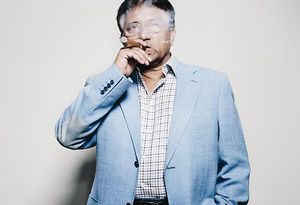
Pakistan’s rush for more bombs — why?

Pervez Hoodbhoy in the Express Tribune:

ScreenHunter_03 Jan. 31 16.52On January 24, UN Secretary-General Ban Ki-Moon vented his frustration at Pakistan’s determined opposition to a treaty that would limit fissile material production for use in nuclear weapons. For three years, Pakistan has single-handedly — and successfully — blocked the Conference on Disarmament (CD) in Geneva from discussing an effort that would reduce nuclear weapons globally. Consequently, within diplomatic circles, Pakistan has acquired the reputation of an outlier that opposes all efforts towards this end.

The opposition comes in the backdrop of news that Pakistan has the world’s fastest-growing nuclear arsenal. This claim — which still reverberates around the world — was first published in a Bulletin of Atomic Scientists report entitled “Pakistan’s nuclear forces — 2011”. The authors, Hans M Kristensen and Robert S Norris, say although the numbers of Pakistani warheads and delivery vehicles is a closely-held secret, yet “we estimate that Pakistan has a nuclear weapons stockpile of 90-110 nuclear warheads, an increase from the estimated 70-90 warheads in 2009”. They reckon that if the expansion continues, Pakistan’s stockpile could reach 150-200 in a few years. By this count, Pakistan’s arsenal may have already exceeded India’s, and will soon rival Britain’s.

The Bulletin report has not been denied by Pakistan. Its stockpile of highly enriched uranium is increased daily by thousands of centrifuges whirring away at the Kahuta Laboratory (and possibly elsewhere). This is augmented by plutonium producing reactors at Khushab; two are already at work and a third is undergoing trials. Google Earth photos show that a fourth one is under construction. The plutonium has no commercial purpose. Instead, the goal is to produce lighter but deadlier bombs to be fitted on to missile tips.

More here.

Tuesday Poem

Anahata

aside from faith,
as far as you know,
you will never have another heart.
better to grow the one you were born with.
fill it with blood & love. risk.
let the strange world sneak inside.
accept all of life in your chest.
death is the end of percussion.
breathe deeply, the music
will function. listen close.
freedom thaws in your ribcage.
dance with vehemence
to feel its fast-pumping.
tempt two lips to greet your throat
& take note: your racing pulse
will laugh & kiss back. god is strong
in the clock of your desire.
every tick, my friend, divine
confirmation: you are alive. beat. yes!
you are alive.

by Lenelle Moïse

The Orchid Olympics

From Smithsonian:

Orchid-Olympics-631Orchids may be the most diverse flower family in the world, with more than 25,000 species. (Their only competition comes from daisies.) The orchid family maintains such diversity in the wild in part because individual orchid species summon only specific pollinators; the flowers thus avoid mingling their genes with those of other nearby orchids that are visited by their own pollinators. But most of the 50,000 orchids from 5,000 varieties on display at the conference do not occur in the wild; they are hybrids, created by people who have cross-fertilized orchid species, often from far-flung lands. “The joy of breeding orchids is to see if you can combine two species in order to create something even more beautiful than either of the parents,” Martin Motes, a commercial grower from Florida and conference judge, said as visitors poured into the hall and crowded around the displays. He has been breeding orchids for 40 years, and many varieties of his 500 hybrids are named after his wife, Mary. “My wife thinks I am playing God! Well, man is given dominion over the beasts of the fields and orchids of the greenhouse, I guess,” he said. An orchid breeder begins with a vision—the color, shape, size, fragrance and longevity of the desired flower—and then searches for the ideal parents. “When we craft orchids for celebrities and delegates, we also consider their tastes, personalities and occupation, said Tim Yam, a senior researcher and orchid breeder at the Singapore Botanic Gardens. “For example, the orchid named for Princess Diana was white—the color of royalty—and very fragrant. But if it’s for a prime minister or president, we might choose a deeper color and majestic spray.”

More here.