Late
Late have I called &
late my
beloved
was blessing me
I was covering
my breasts with my arms
…………. “Those doves”
…………. you said
In the sun ………… I took my arms away
by Jean Valentine
from Barrow Street
Winter 2011-2012

Late
Late have I called &
late my
beloved
was blessing me
I was covering
my breasts with my arms
…………. “Those doves”
…………. you said
In the sun ………… I took my arms away
by Jean Valentine
from Barrow Street
Winter 2011-2012
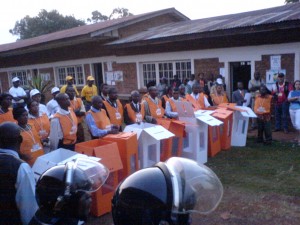
It’s difficult to make sense of the reactions of many Western governments and international actors to the disastrous elections in the Democratic Republic of the Congo (DRC) on November 28, 2011. Initial responses from the United States and the European Union were muted, and Belgium later congratulated President Joseph Kabila on his reelection. As the extent of fraud and lost votes have became clearer, some governments have come out with stronger criticisms of the elections. US Secretary Clinton was “deeply disappointed,” while EU High Representative Catherine Ashton echoed Clinton’s assessment and said that the EU would “re-evaluate” its cooperation.
Yet today, both Western responses to the elections and their policies are unclear and tending dangerously toward the status quo of the last five years. The US Government, according to some, is very divided on Congo, and its public representatives have recently provided cautious statements on the elections and their aftermath. Consumed by their own economic troubles, no member of the EU has the interest to take the lead on reconsidering Europe’s Congo policy, while the UN stabilization mission in the Congo (MONUSCO) wants to move on from the elections and renew its focus on civilian protection.
However, these signs of policy inertia could prove disastrous, since Western policies have so far done little to strengthen Congo’s governance, a key goal of many bilateral programs. While the Congo’s GDP growth for 2011 was just under seven percent, Congo dropped to last place in the UNDP’s latest Human Development Report, and its business environment, dominated by the corruption-laden mining industry, is considered one of the worst in the world. (It is telling of the personal nature of business in Congo, for instance, that the death of key Kabila-adviser Katumba Mwanke in a plane crash on 12 February has left foreign investors worried.) Above all, the 2011 presidential and legislative elections, which were an important indicator for the state of democratic governance in the country, were so compromised that the final results are called into question.

It was damp and cold as Anthony Shadid and I crossed in darkness over the barbed-wire fence that separated Turkey from Syria last month. We were also crossing from peace into war, into the bloodiest conflict of the Arab Spring, exploding just up the rocky and sparsely wooded mountain we had to climb once inside.
The smugglers waiting for us had horses, though we learned they were not for us. They were to carry ammunition and supplies to the Free Syrian Army. That is the armed opposition group, made up largely of defectors from President Bashar al-Assad’s brutal army, we had come to interview, photograph and try to understand.
The ammunition seemed evidence of the risk we were taking — a risk we did not shoulder lightly. Anthony, who passionately documented the eruptions in the Arab world from Iraq to Libya for The New York Times, felt it was essential that journalists get into Syria, where about 7,000 people have been killed, largely out of the world’s view. We had spent months planning to stay safe.
It turned out the real danger was not the weapons but possibly the horses. Anthony was allergic. He did not know how badly.
He had a terrible allergic attack that first night after we crossed over the barbed wire. He had another attack a week later, as horses led us out of Syria, just 45 minutes from safety. He died during that attack, at only 43, his wife and nearly 2-year-old son waiting for him in Turkey.
He did not write his articles from our eventful week of reporting and shooting pictures in Syria; his notes, taken obsessively, are barely decipherable. But he would have wanted a record of this final trip, some hint of the questions we sought to answer: Who were these fighters, and did they have any chance of beating the Syrian government? How were they armed and organized? Was the conflict, as in Iraq, worsening sectarian tensions? Just who supported whom?
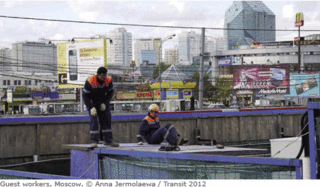
The debate on modernisation taking place in contemporary Russia at times puzzles western researchers, accustomed to a strict understanding of the term. Indeed, they may also consider Russia to be a country in which problems related to traditional industrialisation were resolved decades ago. Yet the issue of modernisation is very real and, in this short article, I will attempt to analyse it and ask whether it can be resolved in the immediately foreseeable future.
What does modernisation mean for contemporary Russia?
In my view, modernisation can be interpreted in two ways. On the one hand, it is understood as a purely economic and technological process, with the aim of achieving competitiveness at the global level. On the other hand, modernisation can refer to a development of social and political institutions that brings a given society closer to the ideal model represented by developed western democracies. The suggestiveness of the term can lead to inconsistencies in its use and it can be tempting to speak of modernisation, in the primary sense of the word, as industrialisation and, in a secondary sense, as liberalisation. It seems to me that this approach is mistaken: first, because in today's world economic modernisation cannot be reduced to industrialisation alone and, second, because a consolidation of institutions is not always a foundation for liberalism. For example, the contemporary Russian economy is far more “liberal” than the quasi-socialist economies of Europe. In this way we risk getting bogged down in the usual arguments about terminology that fail to lead to any real increase in knowledge.
I prefer to talk about modernisation as, essentially, an economic process that leads to a modern, self-regulating economy capable of stable self-development. At the same time, the building up of an economy requires a serious, consolidated effort from both society and the state, directed at dismantling previous economic structures, opening up the country to the outside world and re-orientating social consciousness from traditional values and ideals drawn from the past, towards the future. In this particular context, I would say that the criterion for the success of modernisation is the absence of any need for new modernisations.
The jacket of Geoff Dyer’s “Zona” describes it as “A Book About a Film About a Journey to a Room.” It is also a hall of mirrors in which the author watches himself watching (and remembers himself remembering) a movie that, according to his impressively detailed description, ends with a character looking at us, looking at her. At once audacious post-postmodernist memoir and après-DVD monograph, “Zona” considers Andrei Tarkovsky’s “Stalker” (1979), the last movie the great Russian director would make in his native land. Dyer, a novelist, critical polymath and regular contributor to the Book Review whose oeuvre includes book-length essays on jazz, photography and D. H. Lawrence, isn’t the first literary author to write a book about a single movie. Some years ago, Salman Rushdie initiated the British Film Institute’s Film Classics series with a slim volume on “The Wizard of Oz”; more recently, Jonathan Lethem wrote a book-length essay on John Carpenter’s sci-fi thriller “They Live.” But “The Wizard of Oz” is more culture myth than movie, and “They Live” is a disreputable genre flick that pokes fun at the Reagan era. “Stalker,” by contrast, is a doggedly ambitious masterpiece by a major filmmaker.
more from J. Hoberman at the NY Times here.
From Open Letters Monthly:

Against their painstakingly researched conclusions, Woolf’s commentaries seem—indeed, are—impressionistic, idiosyncratic, unsubstantiated. On what basis, with what justification, can she claim that Donne “excels most poets” in his “power of suddenly surprising and subjugating the reader”? What exactly does it mean to “subjugate the reader” anyway? Where are the quotations—where is the specific analysis of prosody and form, metaphor and imagery—to support that claim, or the claim that in “Extasie” “lines of pure poetry suddenly flow as if liquefied by a great heat”?
More here.
Natalie Wolchover in Yahoo! News:

The research, led by David Dunning, a psychologist at Cornell University, shows that incompetent people are inherently unable to judge the competence of other people, or the quality of those people's ideas. For example, if people lack expertise on tax reform, it is very difficult for them to identify the candidates who are actual experts. They simply lack the mental tools needed to make meaningful judgments.
As a result, no amount of information or facts about political candidates can override the inherent inability of many voters to accurately evaluate them. On top of that, “very smart ideas are going to be hard for people to adopt, because most people don’t have the sophistication to recognize how good an idea is,” Dunning told Life's Little Mysteries.
He and colleague Justin Kruger, formerly of Cornell and now of New York University, have demonstrated again and again that people are self-delusional when it comes to their own intellectual skills.
More here.
Marina Kamenev in The Atlantic:

Friends of Science in Medicine (FSM) already has 450 members. They include Ian Frazer, the inventor of the cervical cancer vaccine, and Sir Gustav Nossal, a renowned immunologist. Among their group, 50 are international and they too hope to snuff out what they refer to as modern-day quackery. The group has written a letter to all of Australia's university vice-chancellors asking them to: “Reverse the trend which sees government-funded tertiary institutions offering courses in the health care sciences that are not underpinned by convincing scientific evidence.”
The questionable courses include homeopathy, iridology, reflexology, Chinese herbal medicine, chiropractic, naturopathy, and aromatherapy, some of which are taught at 18 of 39 Australian universities. “A university is supposed to be a bastion of good science, but their reputation is let down by teaching something like homeopathy,” said John Dwyer, a founding member of FSM and emeritus professor of medicine at the University of New South Wales.
More here.
From The New York Times:
It’s not funny, I know, but it’s not the punch line, either. That comes when the two sociologists I have in mind — Katherine S. Newman of Johns Hopkins University, the author of “The Accordion Family,” and Eric Klinenberg of New York University, the author of “Going Solo” — conclude their fascinating studies with a nod each to the bartender. Except by then they’re no longer in a bar; they’re in Sweden. We’ll get to that. First let’s look at those so-called accordion families, which Newman evaluates both as a transnational phenomenon and in the nuanced particulars of individual households. Like Klinenberg, she devotes a good portion of her book to personal interviews, but where Klinenberg goes deep in his emphasis on the United States, Newman goes wide. At the extreme end of her analysis is a country like Italy, where 37 percent of 30-year-old men live with their parents, and have never lived anywhere else. Less striking but certainly notable is a parallel trend in the United States, where a higher proportion of adult children now live with parents than at any time since the 1950s. Newman states her thesis plainly: “Global competition is the most profound structural force affecting the residential location of young adults in the developed world (or the underdeveloped world, for that matter)” — but one is impressed by her refusal to turn thesis into dogma.
More here.
From Smithsonian:

…Some DARE words hint at long-lost social occasions. At a “waistline party,” mentioned in African-American circles, the price of admission corresponded to a reveler’s girth; at a “toe social,” a mid-20th- century term, women draped in sheets were picked as partners on the basis of their feet. (Presumably they then danced together uninhibitedly, or “fooped.”) We can hear echoes of how men and women spoke to, or about, each other. In the 1950s, a man from the Ozarks might say his pregnant wife was “teemin’” or “with squirrel”—but not if she was around to hear him.
Picture: Almost a whole page of the Dictionary of American Regional English is dedicated to “wampus,” a Southern term for a variety of real creatures, such as a wild horse, and imagined ones, such as swamp wampuses and whistling wampuses.
More here.
Toba 1
.
I have nothing to write about
My flesh is bared to the sun
My wife is beautiful
My children are healthy
Let me tell you the truth
I am not a poet
I just pretend to be one
I was created, and left here
Look, the sun cascades among the boulders
making the sea look darker
Other than this quiet at the height of the day
I have nothing I want to tell you about
even if you are bleeding in your country
Ah, this everlasting radiance!
by Shuntaro Tanikawa
from Tabi (Journey)
publisher: Kyuryudo, Tokyo, 1968
translation: Takako Lento, 2011
Original Japanese after the jump
Matthew Lasar in Ars Technica:

The fight against copyright maximalism has largely been negative. To offer something more positive, Public Knowledge (PK for short) has released an Internet Blueprint—six bills that the group says could “help make the internet a better place for everyone” and that “Congress could pass today.”
We're not expecting Congress to pass them today (or tomorrow), but they're at least an intriguing start point for debate. Here's a quick version each.
Shorten copyright terms
The current copyright protection time window is quite large: life of the creator plus a whopping 70 years (or 95 years total for corporate authorship). It's hard to believe that when the Republic was young, copyright lasted 14 years, renewable by another 14.
“Continually expanding the term of copyright comes at a cost,” the new Blueprint contends. “By giving an author a monopoly on an expression, it prevents other people from building on that expression to create new works.”
The Public Knowledge reform proposal isn't particularly radical, though—it would reduce most copyright terms to life of the author plus 50 years, or “a flat 50 years if the author was an employee.”
More here.
Marilynne Robinson in Guernica:

Of course we have not realized anything approaching this ideal. The meaning of it is much disputed—does it mean equality of opportunity or equality of outcome? Frankly, if we were to achieve either we might find that it resembled the other nearly enough to make the question moot. In any case, our failures, real and perceived, sometimes manifest as an anger with the project itself, and this distracts attention from the fact that we have made a very interesting experiment, full of implication, in putting aside traditional definitions and expectations and finding that when they are not supported culturally, which is to say artificially, they tend to fade away. We can learn from our own history that the nature of our species, and our nature as individuals, is an open question.
More here.
From MIT's Technology Review:
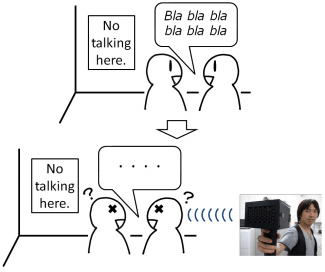
Kurihara and Tsukada have simply built a handheld device consisting of a microphone and a speaker that does just that: it records a person's voice and replays it to them with a delay of about 0.2 seconds. The microphone and speaker are directional so the device can be aimed at a speaker from a distance, like a gun.
In tests, Kurihara and Tsukada say their speech jamming gun works well: “The system can disturb remote people's speech without any physical discomfort.”
Their tests also identify some curious phenomena. They say the gun is more effective when the delay varies in time and more effective against speech that involves reading aloud than against spontaneous monologue. Sadly, they report that it has no effect on meaningless sound sequences such as “aaaaarghhh”.
More here.
Emily Colette Wilkinson in The Millions:

But this, perhaps, is changing. Thanks to the efforts of his son, Henry, Köhler’s work has made its way outside of Sweden for the first time. If you live in New York, you might have seen “Beyond the Words: The Author Portraits of Carl Köhler” at the Brooklyn Central Library this past winter and spring, or the write-up in The New York Times’ blog Paper Cuts. The show was also briefly at the Martin Luther King Jr. Library, in Washington, D.C., in July and August. Now, this exhibit is on its way to Canada: Its next stop is the Robarts Library at the University of Toronto (January-March 2010). After that, the show’s on to the University of British Columbia’s Irving K. Barber Learning Centre in Vancouver (April-June/July 2010). With any luck, these shows will not be the last.
While Köhler’s figure drawings from his time in Paris in the 1950′s are remarkable, as are his abstract figural paintings, it is what he called his “authorportraits,” his paintings of European and American writers, intellectuals, and popular artists that I am most taken with—as much for their content as for their formal diversity. These portraits comprise an astonishing variety of media and styles, a variety that reflects the variety of Köhler’s subjects, who included James Joyce, Günter Grass, Joyce Carol Oats, Michael Jackson, Simone de Beauvoir, and Fyodor Dostoyevsky, among many others.
More here. [Photo shows portrait of Franz Kafka.]
Bina Shah, H. M. Naqvi, Maniza Naqvi, and Mohammed Hanif:
From Guardian:

Equilibrium
Colombia-born Alejandro Gomez Stubbs, the designer of Equilibrium, says 'The concept was to design a piece that contrasted stylish modern design with playfulness and animation'
More here.
June 16
It's Bloomsday in Dublin
and wherever Ulysses works
as an advertizing man
with an unfaithful wife
as I sit here listening
to a lecture on Flannery
O'Conner, Frank O'Conner
and Frank, I think of going
to Dublin with you and buying
a toy wedding ring at
Woolworth's and the phrase
'mock funeral' comes
to me I don't know what it
means though I remember being
the groom at a mock wedding
with a girl named Ann in 1956
I was eight and so was she
and all the other children
were in the procession it was
the first hot night in June and
yes she said yes I will yes
by David Lehman
From New Scientist:

“The study is the first to show conclusively that fetal cells contained in the placenta assist in cardiac tissue repair,” says Jakub Tolar, director of stem-cell therapies at the University of Minnesota in Minneapolis.
More here. (Congratulations to dear friend Hina on her groundbreaking work.)