Saturday Poem

Where I come From

My father put me in my mother
but didn't pick me out.
I am my own quick woman.
What drew him to my mother?
Beating his drumsticks
he thought- why not?
And he gave her an umbrella.
Their marriage was like that.
She hid ironically in her apron.
Sometimes she cried into the biscuit dough.
When she wanted to make a point
she would sing a hymn or an old song.
He was loose-footed. He couldn't be counted on
until his pockets were empty.
When he was home the kettle drums,
the snare drum, the celeste,
the triangle throbbed.
While he changed their heads,
the drum skins soaked in the bathtub.
Collapsed and wrinkled, they floated
like huge used condoms.
.

by Ruth Stone
from New American Poets of the 90s
publisher David R. Godine, 1999

You Can Call Me Senator

From Harvard Magazine:

AlAlan Stuart Franken, now 60, was born in New York, but his father, seeking opportunity, moved his wife and their two sons to Minnesota when Al was young. Joe Franken was a printing salesman, yet Al attended Blake, generally acknowledged as the most exclusive private school in Minneapolis. How did that happen? There is no better question to ask Al Franken. In his Senate office, settled into the obligatory leather couch, he leaned forward and looked back. “My brother and I were Sputnik kids,” he began. “My parents told us, ‘You boys have to study math and science so we can beat the Soviets.’ I thought that was a lot of pressure to put on an 11- and a six-year-old, but my brother and I started playing math games in the living room.”

Franken turned out to be a whiz in science and math, and when his brother went off to MIT, the family began to look for a better secondary school for Al. As it happened, Blake was looking for kids just like him. “Blake was a school chartered for Protestants,” Franken said. “In the 1950s, it started to lose the ability to get enough kids into top colleges. They needed kids who would score well. And they said…‘JEWS!’” It was almost inevitable that Blake’s Jewish wrestler and honor student glided into Harvard, graduating cum laude in general studies. But his real field of concentration was comedy. In Minneapolis, he’d worked up an act—some improvisation, some sketch comedy—with his Blake classmate Tom Davis. By Franken’s senior year at Harvard, Davis was sleeping on his couch.

More here.

A History of the FBI

23456401818480-22101639

Each week, the FBI sends reporters an email of “top ten news stories” that it hopes will hit the headlines. The press releases usually highlight crooks nabbed, terrorism plots foiled and convictions notched up by the straight-shooting, gang-busting agents from the world’s most famous law enforcement agency. It’s doubtful any of the cases the FBI likes to publicize made it into Tim Weiner’s absorbing “Enemies: A History of the FBI.” It is a scathing indictment of the FBI as a secret intelligence service that has bent and broken the law for decades in the pursuit of Communists, terrorists and spies. Worse, in his view, the bureau was often grossly inept. As Thomas Kean, Republican chair of the9/11Commission, declared in 2004: “You have a record of an agency that’s failed, and it’s failed again and again and again.” Weiner eviscerates the FBI in a sweeping narrative that is all the more entertaining because it is so redolent with screw-ups and scandals.

more from Bob Drogin at the LA Times here.

Can’t Help Myself

From The New York Times:

BookHuman consciousness, that wonderful ability to reflect, ponder and choose, is our greatest evolutionary achievement. But it is possible to have too much of a good thing, and fortunately we also have the ability to operate on automatic pilot, performing complex behaviors without any conscious thought at all. One way this happens is with lots of practice. Tasks that seem impossibly complex at first, like learning how to play the guitar, speak a foreign language or operate a new DVD player, become second nature after we perform those actions many times (well, maybe not the DVD player). “If practice did not make perfect,” William James said, “nor habit economize the expense of nervous and muscular energy, he” (we, that is) “would therefore be in a sorry plight.”

But of course there is a dark side to habits, namely that we acquire bad ones, like smoking or overeating. I imagine that most people — save, perhaps, for a friend of mine who said, in reaction to a news story about the dangers of hyper­tension, “I’ve given up all of my vices; please don’t take away my salt!” — would love to find an easy way of breaking a bad habit or two. Charles Duhigg, an investigative reporter for The New York Times, has written an entertaining book to help us do just that, “The Power of Habit: Why We Do What We Do in Life and Business.” Duhigg has read hundreds of scientific papers and interviewed many of the scientists who wrote them, and relays interesting findings on habit formation and change from the fields of social psychology, clinical psychology and neuroscience. This is not a self-help book conveying one author’s homespun remedies, but a serious look at the science of habit formation and change.

More here.

does neuroscience deny free will?

8b6c8b5c-69a1-11e1-9618-00144feabdc0

I assume that right now, you are not following these words because there is a gun pointed at your head or you’ve been hypnotised. Until such time as a benign dictator makes reading the FT compulsory, it seems the most self-evident fact in the world that people who buy it do so of their own free will. Yet for centuries there have been those who have argued that “seems” is all there is to this feeling of freedom. Advances in neuroscience have given the free will deniers new impetus. The ace in the pack is the work of the late Benjamin Libet, which neuroscientist Sam Harris says in Free Will shows that “some moments before you are aware of what you will do next … your brain has already determined what you will do. You then become conscious of this ‘decision’ and believe that you are in the process of making it.” For the likes of Harris, evidence like this shows that the absence of free will is now scientific fact, not philosophical theory. But as other new books on the same issue show, it’s far more complicated than that.

more from Julian Baggini at the FT here.

house of stone

11COCKBURN-articleInline

Anthony Shadid, who died in February at the age of 43 while reporting the crisis in Syria, was one of the most intelligent, experienced and well-­informed journalists covering the Middle East. In his writing, he showed a depth of intellectual inquiry and a skepticism toward conventional wisdom matched by few other correspondents. In 2006, Shadid visited the abandoned house of his great-grandfather in Marja­youn, a largely Christian town in southern Lebanon that, after a century of wars, was battered and decayed, and was cut off from its natural hinterland by the Israeli and Syrian frontiers. A few months later he returned to find that the upper story of the house had been hit by a half-­exploded Israeli rocket. In a defiant gesture to show that the house, “whatever its condition, remained a home worth care,” he bought a small olive tree for $4 and planted it near the wrecked building.

more from Patrick Cockburn at the NY Times here.

Friday, March 9, 2012

The Funny World of Fashion and Terrorism

PhotoOver at The Economist, a Q & A with Alex Gilvarry, author of From the Memoirs of a Non-Enemy Combatant:

POLITICS and fashion are not mutually exclusive interests—a person might pledge to ProPublica only to enjoy a Style.com slideshow moments later. In literature, however, they tend to make strange bedfellows. So it’s with great pleasure that we read Alex Gilvarry’s funny debut novel, “From the Memoirs of a Non-Enemy Combatant”, which cleverly entwines these seemingly disparate fictional worlds.

All it takes is one error in judgment to sweep Boy Hernadez, a newly minted Filipino fashion designer, away from Bryant Park and into No Man's Land—Mr Gilvarry’s fictionalised Guantanamo. The book is a post-modern mash-up of Boy’s flamboyant confession, a reporter’s mocking footnotes and some false documents.

This book is a unique satire of the topsy-turvy times immediately following the September 11th attacks. Mr Gilvarry spoke to us about mid-aughts Manhattan, the post-9/11 novel and the hazards of certain proper nouns.

When did you begin writing the book?

I started the novel in 2006 when I was working as a production editor at Scholastic, a children's publisher in SoHo. On my lunch break I would see models going to and from their castings with their big portfolios—you couldn't miss them. I would see Marc Jacobs, because his studio is there. And I'd go to these fashion parties with my girlfriend for no real purpose. I was just observing. it was part of my world for a while, and I never knew what I’d do with it, but the people always fascinated me. I wrote after work, at night. I never knew I was going to write a novel. It started as a short story.

Making the Pill Available Over the Counter

I1qAI2fXPrJwVirginia Postrel in Bloomberg (via Andrew Sullivan):

Anyone — a local teenager, a traveling businessman, a married mother of four, an illegal immigrant, even a student at a Jesuit university — can walk into my neighborhood CVS any time, day or night, and, for less than $30, buy a 36-count “value pack” of Trojan condoms.

That’s enough to last most Americans at least three months, according to Kinsey Institute surveys. If you want more, you can buy out the store’s entire stock. There’s no limit, and you don’t need to see a doctor for permission and a prescription.

Contrary to widespread belief, there’s no good reason that oral contraceptives — a far more effective form of birth control — can’t be equally convenient.

True, making the pill available over the counter could reduce the amount of outrage and invective available for entertaining radio audiences, spurring political fundraising and otherwise amusing the American public. But the medical risks are quite low.

Partly because birth-control pills are available only by prescription, people tend to think they’re more dangerous and less well understood than they actually are. In fact, “more is known about the safety of oral contraceptives than has been known about any other drug in the history of medicine,” declared an editorial in the American Journal of Public Health back in 1993. That editorial accompanied an article arguing for over-the-counter sales.

Debating Ralph Fiennes’s Coriolanus

Col_posterOver at Ibishblog, Hussein Ibish and Artistic Director of The York Shakespeare Company Seth Duerr offer differing reads of Ralph Fiennes's adaptation of Coriolanus. First, Ibish:

Fiennes' meta-multimedia production captures this inability of Coriolanus to function effectively in the staged world of political theater and practiced artifice. The trial scene in which his banishment is confirmed rather than repealed is staged on a TV debate set, and as he leans forward to begin his opening speech urging reconciliation and his own forgiveness, “The honour'd gods Keep Rome in safety…,” Fiennes' Coriolanus is unable to control the feedback from his microphone, eliciting derisive laughter from the hostile audience. Time and again the media representations of his political and even military activities, and the mass media environment and technology with which he is so uncomfortable, mainly serve to undermine his ambitions and cast him in the worst possible light. They are in this adaptation aptly depicted as best suited to the demagogic manipulations of the tribunes, although the crafty old politician Menenius also seems appropriately adept at deploying them.

What is far less effective is the way in which so much of Coriolanus is lost in this adaptation.

Duerr:

Your initial statement that the film “has much to offer, especially if it can succeed in re-connecting parts of the public with an undeservedly neglected masterwork” is the main reason that the film is valuable. Despite my intense dislike of the script-cutting and the consequent one-dimensionality of the central performance, the very idea that we’re having a discourse about this play is spectacular. Only a small percentage of the global population is familiar with the play, and most people dismiss it as problematic.

It is the “problem plays” of Shakespeare that usually interest me the most. I do not choose to work on a play if I think it is a problem, as it is not my duty to “fix” them, merely to share great stories with an audience. As warning for the future, if you ever notice in the publicity/director notes for a production a description of the play as a “problem”, then save your time and money and don’t go. Otherwise, you will be in for an evening of the director’s condescension to the audience and devaluation of the playwright.

What’s at the Heart of Black Cool?

Air_Jordans_Spike_Lee-mj-400Hank Willis Thomas over at The Root:

The generation before me was defined by soul. Soul was a virtue born out of the spirituality of gospel, the pain of blues, and the progressive pride of being the standard-bearers of civil rights. They were stylish like Shaft, but noble like Martin. They sang on Sunday mornings, after “sangin'” on Saturday nights. They pressed their thrift store suits with so much starch that the bare-threaded knees were as stiff as if they'd just bought them new at Brooks Brothers. Almost everyone was poor, so there wasn't any shame in it.

Not my generation. We were defined by “cool,” an emotionally detached word that provokes a cold response to the world with a narrowly focused ambition for its ice, its bling, and its things. We heard stories of our parents and grandparents fighting for the right to be fully recognized Americans. We saw some folks from the neighborhood come up — way up. They became ballers, rappers, hustlers, actors — even a few doctors and lawyers. On TV we saw it happening right before our eyes: the Jeffersons, the Cosbys, Jesse Jackson running for president, and Michael Jackson, Michael Jordan, Magic Johnson, and Whitney Houston dominating the airwaves.

But the majority of us saw the dreams, passions, and hopes of our parents dashed by the regression of a Black community linked to the welfare system, project housing, rising unemployment, deteriorating education, addiction, and an increase in Black men in the penal system. Good Times and What's Happening!! were funny in the 1970s, but by the eighties they were in reruns and the joke seemed to be on us.

Something broke in the community spirit of my generation. “Easy credit rip-offs” and “scratchin' and survivin'”1 didn't add up to “good times” anymore, so we rejected soul and turned back to cool.

Knights in Shining Armour: Men who Rescue Sex Workers and Slaves

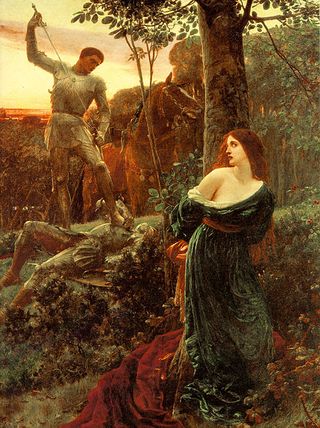
Dicksee-Chivalry-1885Laura Agustín over at Naked Anthropologist:

Men at the higher end of the evolutionary scale: That is how one man has described men who want to save sex slaves, seeking to differentiate themselves from less civilised, bad men – the ones that buy sex. In this idea, being a Good Man is achieved not by concern for world peace, equal opportunity, racism, the end of poverty or war but rather by concern for sex slaves.

Recently I published a sober academic review of a book that is not academic at all, Sex Trafficking: Inside the Business of Modern Slavery. Afterwards, I republished the review in Counterpunch, with a snappy introduction for the occasion…

The publisher of Counterpunch, Alexander Cockburn, has forwarded me a letter from the Frederick Douglass Family Foundation objecting to the piece, calling me a journalist, which I am not, and obviously not checking to see who I am before writing the letter. He also doesn’t seem to have read past that introductory paragraph to the review of the book, where he might have found real issues to think about.

In Laura Agustin’s cynical worldview, men who hold the opinion that prostituting women is wrong and endeavor to do something about it are, in fact, misguided crusaders in the tradition of Don Quixote lost in chivalric fantasy on a mortal quest to feed their own egos by saving damsels in distress. In her article, Not Inside the Business of Modern Slavery, Sex Trafficking, Agustin specifically targets two men amongst what she portrays as a growing parade of attention-seeking phony heroes (cue the paparazzi) – Nicholas Kristof and Siddharth Kara.

Unsettling as it is for Agustin to accept the presence of men at the higher end of the evolutionary scale, Kristof and Kara are helping to shed light on a culture of gender exploitation that has survived only because of spin and lies. Where the rest of us see two men of intelligence and compassion, Agustin sees ulterior motive. In my experience, ones own ill intent makes one suspicious of ill intent in others. What is Agustin’s motive in attacking those working hard to end the exploitation of women? More spin and lies I suspect.

Robert J. Benz
Founder & Executive Vice President
Frederick Douglass Family Foundation

A culture of gender exploitation has only survived because of spin and lies? What? No interest in poverty or cultures of gender inequality from this crusader! Cynicism is in the eye of the beholder, of course. Note that Benz clearly places his kind of man on the high end of evolution, in that overtly colonialistic move in which white men save brown women from brown men…

(Here is a debate on trafficking with Laura Agustin and Siddharth Kara, among others, over at the BBC. Also here is an intervew with Siddharth Kara over at Columbia University Press.)

How India Became America

INDIA-articleLargeAkash Kapur in the NYT:

ANOTHER brick has come down in the great wall separating India from the rest of the world. Recently, both Starbucks and Amazon announced that they would be entering the Indian market. Amazon has already started a comparison shopping site; Starbucks plans to open its first outlet this summer.

As one Indian newspaper put it, this could be “the final stamp of globalization.”

For me, though, the arrival of these two companies, so emblematic of American consumerism, and so emblematic, too, of the West Coast techie culture that has infiltrated India’s own booming technology sector, is a sign of something more distinctive. It signals the latest episode in India’s remarkable process of Americanization.

I grew up in rural India, the son of an Indian father and American mother. I spent many summers (and the occasional biting, shocking winter) in rural Minnesota. I always considered both countries home. In truth, though, the India and America of my youth were very far apart: cold war adversaries, America’s capitalist exuberance a sharp contrast to India’s austere socialism. For much of my life, my two homes were literally — but also culturally, socially and experientially — on opposite sides of the planet.

All that began changing in the early 1990s, when India liberalized its economy. Since then, I’ve watched India’s transformation with exhilaration, but occasionally, and increasingly, with some anxiety.

I left for boarding school in America in 1991. By the time I graduated from high school, two years later, Indian cities had filled with shopping malls and glass-paneled office buildings. In the countryside, thatch huts had given way to concrete homes, and cashew and mango plantations were being replaced by gated communities. In both city and country, a newly liberated population was indulging in a frenzy (some called it an orgy) of consumerism and self-expression.

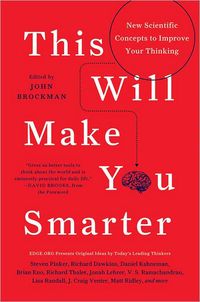
THIS WILL MAKE YOU SMARTER: New Scientific Concepts to Improve Your Thinking

From Edge:

BookAs you march through or dance around in this book, you'll see that some of the entries describe the patterns of the world. Nicholas Christakis is one of several of scholars to emphasize that many things in the world have properties not present in their parts. They cannot be understood simply by taking them apart; you have to observe the interactions of the whole. Stephon Alexander is one of two writers (appropriately) to emphasize the dualities found in the world. Just as an electron has both wave-like and particle-like properties, so many things can have two sets of characteristics simultaneously. Clay Shirky emphasizes that while we often imagine bell curves everywhere, in fact the phenomena of the world are often best described by the Pareto Principle. Things are often skewed radically toward the top of any distribution. Twenty percent of the employees in any company do most of the work, and the top 20 percent within that 20 percent do most of that group's work. As you read through the entries that seek to understand patterns in the world, you'll run across a few amazing facts. For example, I didn't know that twice as many people in India have access to cell phones as latrines. But most of the essays in the book are about metacognition. They consist of thinking about how we think. I was struck by Daniel Kahneman's essay on the Focusing Illusion, by Paul Saffo's essay on the Time Span Illusion, by John McWhorter's essay on Path Dependence, and Evgeny Morozov's essay on the Einstellung Effect, among many others. If you lead an organization, or have the sort of job that demands that you think about the world, these tools are like magic hammers. They will help you, now and through life, to see the world better, and to see your own biases more accurately.

But I do want to emphasize one final thing. These researchers are giving us tools for thinking. It sounds utilitarian and it is. But tucked in the nooks and crannies of this book there are insights about the intimate world, about the realms of emotion and spirit. There are insights about what sort of creatures we are. Some of these are not all that uplifting. Gloria Origgi writes about Kakonomics, our preference for low-quality outcomes. But Roger Highfield, Jonathan Haidt, and others write about the “snuggle for existence”: the fact that evolution is not only about competition, but profoundly about cooperation and even altruism. Haidt says wittily that we are the giraffes of altruism. There is something for the poetic side of your nature, as well as the prosaic.

More here.

grasping the H.D. situation

H-d

Written at the twilight high water of American modernism in the early Sixties, chapters scattered among obscure literary magazines like the limbs of Osiris, nearly published as a book by Black Sparrow in 1971, circulated incomplete among poets in samizdat photocopy from 1979, contracted for publication by University of California Press in 1986 and then banished for a quarter century into limbo (a delay which would have killed any other book of its kind, if there were one, but this one is wholly sui generis), Robert Duncan’s The H.D. Book, complete in print at last, now manifests the timeliness of its permanence. Centering on the work of Hilda Doolittle and her part in the invention of modernist poetry, it embraces an assay of modernist practice and tradition as well as a searching investigation of fundamental issues in poetics, with elements of literary autobiography and cultural history and salient reference to depth psychology, cultural anthropology, political economy, art history, philosophy, and religion.

more from Jim Powell at Threepenny Review here.

Errol Morris: The Thinking Man’s Detective

From Smithsonian:

Profile-Errol-Morris-631Born in suburban Long Island, Morris graduated from the University of Wisconsin. After a stint of cello study in France, he talked his way into the Princeton graduate philosophy seminar of Thomas Kuhn, an icon of postmodernism, the man who coined the term “paradigm shift.” It wasn’t exactly a meeting of the minds. In fact, it almost cracked Morris’ skull, which is what Kuhn seemed to be aiming to do at the climax of an argument when the esteemed philosopher threw an ashtray at Morris’ head.

“The Ashtray,” Morris’ five-part, 20,000-word account of that episode and their philosophical clash over the nature of truth, is a good introduction to the unique kind of writing he’s doing now. (Don’t miss the section on the obscure Greek philosopher of irrationalism, Hippasus of Metapontum, a digression worthy of Jorge Luis Borges.) After the ashtray incident, Morris eventually did two stints as a private eye. If there is one subtext to all of Morris’ subsequent films and writings, it is the private eye’s creed, the anti-postmodernist belief that “the truth is out there.” Truth may be elusive, it may even be unknowable, but that doesn’t mean, as postmodernists aver, that reality is just a matter of subjective perspectives, that one way of seeing things is just as good as another.

More here.

Canada exists for no natural reason

Thattime01

The grand view of history has traditionally offered two paths for the interpretation of events. The first imagines social trends rising up from below to sweep humanity along in their irrepressible, all-powerful waves. The other dreams of iconic figures who shape history through their own vision and will. In the case of the United States during the War of 1812, we find neither. Instead, a third way emerges: history dominated by stupidity and impulse. From the revolution to the present moment, hardly a single generation of Americans has passed without giving rise to a bona fide military genius. The Civil War alone produced half a dozen. To Canada’s good fortune, the post-revolution US Army was stacked with bunglers and officers past their prime. It might have taken Canada easily, if not for the miraculously systemic idiocy among the top brass.

more from Stephen Marche at The Walrus here.

what it means to be a human animal

Nadas

At the core of the novel, which Nadas took 18 years to write, are the major catastrophes and upheavals of the last century. They are the magma that is always present but usually not visible. The book tells of deportations, the closing of a camp at the end of the war and marauding prisoners; both wars appear as traumatic memories for a number of protagonists, and anti-Semitism is shown in all its colourations. The Holocaust itself is not an explicit subject of the novel; neither are the waves of Stalinist terror. Nadas portrays the monstrosity of the century through its people, through the traces and scars it has left on their psyches and bodies. No one is indestructible in this book. They betray themselves and others, fight and love each other, wear themselves out. Everyone is frayed, terrible, maimed by this epoch. “Parallel Stories” is primarily set in the region of Central Europe in the period between the two wars. The years 1938, 1945, the Hungarian uprising of 1956 and the fall of the Iron Curtain in 1989 are the focal dates. The novel is many things – also a product of scholarly research. While a fellow at the Wissenschaftskolleg in Berlin, Nadas combed through pertinent archives on the Third Reich to the point of exhaustion, but also examined those on architecture, criminology, fashion, those pertaining to any and all questions of this period in history. This is most noticeable in the brilliant and biographically grounded portrait of Otmar Freiherr von der Schuer, to name one of the most striking examples, who was the Director of the Institute for Hereditary Research in Berlin. The perfect German soldier, educated, disciplined, von der Schuer (in real life: Freiherr von Verschuer) had given orders for massacres in World War I and had gone through experiences that had destroyed his view of people and the world. But he never admits to this kind of “internal haemorrhaging”.

more from Joachim Sartorius at Sign and Sight here.

Friday Poem

My Moses

Big Jack and his walking stick
live on the ridge. Navajo
orphan kids dance for him,
bobcat urine’s in the weeds,
the shotgun barrel’s up his sleeve,
a Persian coin is on the wind.
The Chinese Mountains smell the moon
and arch their backs. I tell him, Jack,
there’s times I wish I was living in
canvas France, the old west,
a picture book, the Sea of
Tranquility, or even in
the den near the hot spring.
He says, kid, to hell with

phantom limbs; spring is a verb,
a wish is a wash, a walking stick
is a gottdam wing.

by Wendy Videlock
from Poetry, Vol. 192, No. 4, July/August
Publisher: Poetry, Chicago, 2008

Thursday, March 8, 2012

What is There to Celebrate Around the World on International Women’s Day?

Meira-Kumar-007Over at The Guardian's Comment is Free, “Women from 11 countries give their thoughts on achievements where they live.” Orzala Ashraf Nemat from Afghanistan:

Afghan women have nothing to celebrate, except the continuous courage, dedication and determination of activists who despite all the challenges and barriers still continue their struggle.

Celebration of International Women's Day in Afghanistan over the past 10 years have turned into a fancy project sponsored by donors who have never made an attempt to understand the complex nature of women's position in Afghan society. These events all involve long, boring speeches most often by men, so-called top leaders (and no one knows how they treat their female relative) about women's rights. Yet few practical steps are taken to challenge the deep roots of violence against women, absence or the drop off in numbers of older girls from schools; lack of female teachers, doctors, judges and police officers all over Afghanistan.

Mari Marcel Thekaekara from India:

Urban Indian women are in the public sphere like never before. In Bengaluru and Pune, thousands zoom around on motorbikes, scooters and in cars. In Tamil Nadu, where free bicycles were distributed to village schoolgirls, they sail along with demurely plaited hair, in their ankle-length skirts with the wind in their faces. In the south, women now work in garages, the army and police. They're doing jobs once considered unseemly: waitressing, night shifts in IT companies and call centres. This year Indian women ranked 30th, beating Italian and Japanese women, in the league table of corporate world board members.

In Maharashtra state, the courts ruled women no longer have to take their husband's surnames. And the supreme court controversially recognised live-in relationships.