
Category: Recommended Reading
jupiter
love songs in age
Saturday, March 17, 2012
Religion for Atheists

De Botton looks around and sees a secular society denuded of high spiritual aspiration and practical moral guidance. Centuries ago, religions gave people advice on how to live with others, how to tolerate other people’s faults, how to assuage anger, endure pain and deal with the petty corruptions of a commercial world. These days, he argues, teachers, artists and philosophers no longer even try to offer such practical wisdom. “We are fatefully in love with ambiguity, uncritical of the Modernist doctrine that great art should have no moral content or desire to change its audience,” he writes. Museums were once temples for the contemplation of the profound. Today, he says, they offer pallid cultural smorgasbords: “While exposing us to objects of genuine importance, they nevertheless seem incapable of adequately linking these to the needs of our souls.” Visitors “appear to want to be transformed by art,” de Botton observes, “but the lightning bolts they are waiting for seem never to strike. They resemble the disappointed participants in a failed séance.”
more from David Brooks at the NY Times here.
How the West Sparked the AIDS Epidemic

Genetic evidence strongly indicates that the AIDS pandemic originated in southeastern Cameroon sometime between 1880 and 1920, most likely when a hunter butchering a chimpanzee infected with simian immunodeficiency virus (SIV), the precursor of HIV, became infected through a cut on his body. That event had probably happened hundreds of times in the past, perhaps even more. But Halperin argues that European efforts to exploit Africa’s vast resources of rubber, ivory and other materials provided a unique push to the virus. Porters toting their loads of precious cargo carried it across the previously uncharted jungles, allowing it to spread much more widely than before. Steamships plying the region’s rivers and the newly developed railroads allowed the virus to travel much faster than had ever been possible. European exploitation thus allowed the virus to escape its natural habitat. But Africans themselves shared much of the blame for the virus taking root, Halperin argues. Cultural norms in the region allowed men to have several wives, as well as multiple sexual partners outside of marriage. Those concurrent sexual relationships provided the tinderbox that allowed the spark of HIV to take full flame. Repeated analyses have shown, the authors argue, that AIDS became epidemic only in regions where the number of each person’s sexual partners was high, either in African villages or in the gay enclaves of San Francisco and other western cities. The primary exception to that is its spread among drug abusers, who use contaminated needles to inject themselves.
more from Thomas H. Maugh II at the LA Times here.
american nightmare

Americans seem to want to read about national decline. The more dire the prediction, the more heated the prose, the more colourful the book title, the better. Conservative commentator Mark Steyn’s jeremiad After America: Get Ready for Armageddon made it to number four on the New York Times’s bestseller list. Peter D Kiernan’s Becoming China’s Bitch briefly topped the Amazon chart. On first inspection of Kiernan’s luridly titled work, I assumed it had bubbled up from the wilder fringes of talk-radio. But no, Kiernan was a senior partner at Goldman Sachs for many years. Reading his ravings, I can only conclude that something went badly awry with the bank’s famously rigorous recruitment processes. The book’s title might lead the reader to expect a provocative tract on US-Chinese relations. In fact, this is just one of a huge number of topics that the writer yokes together under the general theme of impending catastrophes that threaten America.
more from Gideon Rachman at the FT here.
Saturday Poem
Belly Dancer
Across the road the decorators have finished;
your flat has net curtains again
after all these weeks, and a ‘To Let’ sign.
I can only think of it as a tomb,
excavated, in the end, by
explorers in facemasks and protective spacesuits.
No papers, no bank account, no next of kin;
only a barricade against the landlord,
and the police at our doors, early, with questions.
What did we know? Not much: a Lebanese name,
a soft English voice; chats in the street
in your confiding phase; the dancing.
You sat behind me once at midnight Mass.
You were Orthodox, really; church
made you think of your mother, and cry.
From belly dancer to recluse, the years
and the stealthy ballooning of your outline,
kilo by kilo, abducted you.
Poor girl, I keep saying; poor girl –
no girl, but young enough to be my daughter.
I called at your building once, canvassing;
your face loomed in the hallway and, forgetting
whether or not we were social kissers,
I bounced my lips on it. It seemed we were not.
They’ve even replaced your window frames. I still
imagine a midden of flesh, and that smell
you read about in reports of earthquakes.
They say there was a heart beside your doorbell
upstairs. They say all sorts. They would –
who’s to argue? I don’t regret the kiss.
by Fleur Adcock
from Glass Wings
publisher Bloodaxe, Newcastle, 2013
Strange Justice
From New York Times:

Texas, like most states, has a long history of criminalizing sodomy. What makes it special, however, is its obsession with the issue, which led Lone Star lawmakers to repeatedly refine their statutes over time. In 1943, Texas added oral sex to a long list of prohibited offenses. Thirty years later, it passed a law containing the “Homosexual Conduct” provision, which banned both oral and anal sex, but only when performed “with another individual of the same sex.” As such, the new law expanded the sexual freedom of heterosexuals while doing just the opposite for homosexuals. Put bluntly, it was now legal in Texas to have sex with a farm animal, but not with someone of the same gender.
More here.
Brain imaging study finds evidence of basis for caregiving impulse
From PhysOrg:

“These adults have no children of their own. Yet images of a baby's face triggered what we think might be a deeply embedded response to reach out and care for that child,” said senior author Marc H. Bornstein, Ph.D., head of the Child and Family Research Section of the Eunice Kennedy Shriver National Institute of Child Health and Human Development, the NIH institute that collaborated on the study. While the researchers recorded participants' brain activity, the participants did not speak or move. Yet their brain activity was typical of patterns preceding such actions as picking up or talking to an infant, the researchers explained. The activity pattern could represent a biological impulse that governs adults' interactions with small children. From their study results, the researchers concluded that this pattern is specific to seeing human infants. The pattern did not appear when the participants looked at photos of adults or of animals—even baby animals.
More here.
Friday, March 16, 2012
Ruth Barcan Marcus, 1921-2012: The NYT Obituary

Ruth Barcan Marcus, a philosopher esteemed for her advances in logic, a traditionally male-dominated subset of a traditionally male-dominated field, died on Feb. 19 at her home in New Haven. She was 90.
Her death was announced by Yale University, from which she retired in 1992 as the Reuben Post Halleck professor of philosophy.
Because of its affinities with mathematics and the hard sciences — disciplines historically unwelcoming to women — logic had long been one of philosophy’s most swaggering strains. For a woman of Professor Marcus’s generation to elbow her way into the field, then dominated by titans like Willard Van Orman Quine, Rudolf Carnap and Kurt Gödel, was almost unheard of.
“The rest of philosophy became less male dominated, less macho, more quickly than logic,” Stephen Neale, distinguished professor of philosophy at the City University of New York Graduate Center, said in a telephone interview. “She was working in a field which was really run by these giants.”
The Faithful Hussar Scene from Kubrick’s Paths of Glory
We Unhappy Few: Alexander Cockburn Reflects on SDS 50 Years After the Port Huron Statement

The Students for a Democratic Society (SDS) held their first convention in the summer of 1962, in Port Huron in the American mid-West, an hour’s drive north of Detroit. They were the cutting edge of radical organising — in the battles against racial discrimination, particularly in the South, in the protests against the Vietnam war, and more generally in the aim of the young then to break the shackles of the cold war consensus that had paralysed independent thought and spread fear of McCarthyite purges through what remained of the organised left in America, in the labour movement, the churches and the universities.
SDS had been founded by Tom Hayden two years earlier. His initial manifesto was presented to the 1962 gathering, revised by committee and delivered as the Port Huron statement (1).
“We are people of this generation,” it began, “bred in at least modest comfort, housed now in universities, looking uncomfortably to the world we inherit. When we were kids the United States was the wealthiest and strongest country in the world: the only one with the atom bomb, the least scarred by modern war, an initiator of the United Nations that we thought would distribute Western influence throughout the world … As we grew, however, our comfort was penetrated by events too troubling to dismiss. First, the permeating and victimising fact of human degradation, symbolised by the Southern struggle against racial bigotry, compelled most of us from silence to activism. Second, the enclosing fact of the cold war, symbolised by the presence of the Bomb, brought awareness that we ourselves, and our friends, and millions of abstract ‘others’ we knew more directly because of our common peril, might die at any time.
“While these and other problems either directly oppressed us or rankled our consciences and became our own subjective concerns, we began to see complicated and disturbing paradoxes in our surrounding America … we began to sense that what we had originally seen as the American Golden Age was actually the decline of an era. Our work is guided by the sense that we may be the last generation in the experiment with living. But we are a minority — the vast majority of our people regard the temporary equilibriums of our society and world as eternally-functional parts.”
Reading these apocalyptic lines today, a reader is surely struck by the thought that 1962 was somewhat late in the evolution of the cold war to make these discomfited observations.
Raising Darwin’s Consciousness: An Interview with Sarah Blaffer Hrdy on Mother Nature
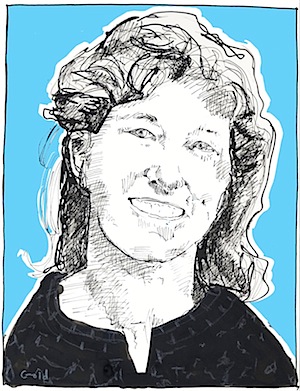
Eric Michael Johnson: Why do you think it’s important to look at mothers and infants from an evolutionary perspective?
Sarah Blaffer Hrdy: If we really want to raise Darwin’s consciousness we need to expand evolutionary perspectives to include the Darwinian selection pressures on mothers and on infants. So much of our human narrative is about selection pressures but, when you stop to think and parse the hypotheses, they’re really about selection pressures on males: hunting hypotheses or lethal intergroup conflict hypotheses to explain human brains. Well, does that mean that females don’t have brains?
Johnson: In an autobiographical sketch published in the book Leaders in Animal Behavior you wrote that: “It was no accident that I would later become interested in the evolutionary and historical origins of patrilocal marriage, male-biased inheritance, female sexuality and peoples’ obsessive concerns with controlling it.” When did you start becoming interested in these topics and what were some of the leading motivations you had at the time?
Hrdy: You have to take into account where I grew up and when. It was in south Texas. I was born in 1946 so I was growing up in the 50s. This was a very segregated and really quite patriarchal society. Growing up in Houston was a lot like growing up in South Africa. Also within my family males had a very special role. The good news, in a way, is that I was the third daughter born in a family eventually of five. It was a very wealthy family and I was sort of the heiress to spare. So they didn’t pay too much attention to what I was doing, though they certainly had very set ideas about who I should marry and what sort of life I should lead. But once I was out of sight off at school, I was pretty much out of mind which was good for me. So I went off to school when I was 16 and that really was the beginning I think of my intellectual development.
Recognition Overdue for Bayard Rustin
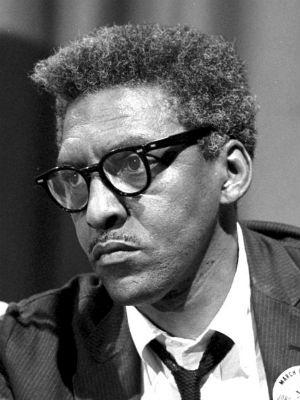
Bayard Rustin, if he were still alive, would turn 100 years old on March 17. Among Martin Luther King Jr.'s inner circle during the Montgomery Bus Boycott and the run-up to the March on Washington, Rustin rarely stepped into the spotlight and labored mostly behind the scenes before 1963.
In truth, Rustin, who died in 1987 at age 75, may have been the one essential ingredient in the mix that miraculously gelled in the 1960s to bring down Jim Crow. He was the civil rights movement's master strategist, a visionary with an abiding commitment to nonviolent action who created the blueprint for huge advances in the cause of racial equality.
“He was an intellectual bank that civil rights and political leaders could go to for ideas,” said Michael G. Long, editor of I Must Resist: Bayard Rustin's Life in Letters (City Lights), scheduled to be released on the centennial of his birth.
Nonviolent protest, the mass march, coalition building, strategically placed open letters to presidents, cultivating reporters, schmoozing influential federal officials, evolving from protest to politics — all of these movement staples and more sprang from the fertile mind of Bayard Rustin.
“He had a genius for this,” said Julian Bond, a longtime Georgia legislator and chairman emeritus of the NAACP, in an interview with The Root. Bond, who wrote the foreword for the book, added, “He'd come into a situation like Montgomery saying, you need to do this, you need to do that. He'd have these suggestions that made a tremendous difference in the outcome.”
No Kony Is an Island: Death and Profit in Central Africa

Now that the progressing phases of #Kony2012 (endorsement, backlash, Despite a vast number of takedowns, the video’s sheer arrogance tempts one to spend at least a couple grafs deconstructing it (I mean, note how IC’s Jason Russell uses his four-year old as a metonym: By speaking to a child about Kony’s evils he is literally treating us, his audience, like children!). But I will demur. backlash-to-the-backlash, It should shock no one that Kristof was a #Kony endorser, as he portrays the same type of arguments — as I note at TNI. One could even argue that Kristof’s consistent antipolitical and sensationalist “reporting” on the region has empowered and enabled Invisible Children’s ill-advised “awareness raising” militarism.and meta commentary on these phases) have played out, they have left behind a residue: broad interest in central Africa. Invisible Children’s slick movie moved many, but its arrogance and elisions set off alarms for a heartening number of others. There is now a clear gap separating the charity’s fantasy of “Africa” from the sense of “what’s really going on.” Providing texture and context can displace that fantasy; making visible the ligatures that tie central Africans to people tweeting to save them might turn this moment of Western self-promotion and aggrandizement into something less tawdry and tragic.
Kony has been the way in for millions, let him be the way out. His peripatetic habits — traversing northern Uganda, the Democratic Republic of Congo, the Central African Republic, and back — present a moving point from which to track the stunning death-making and rent extraction that occurred there over the past two decades. It’s a massive total to which Kony contributed almost nothing in the grand scheme of things. Four million people died from conflict in the DRC during the 1990s and early 2000s, and there were no media campaigns to “raise awareness” about them. This death-making is tied to resource extraction in what we might call the necroeconomics at play on the ground in many of the spaces where Kony and other militias have trod.
If successful, the #Kony2012 campaign might actually buttress this death-making because it relies fundamentally on the legitimacy and ability of the United States military to patrol and control Africa and works to provide symbolic and discursive cover for the creeping penetration of the U.S. military’s AFRICOM across the continent. In the spirit, then, of raising awareness, we might train our eyes on the AFRICOM project: What are its goals? What are the legacies of U.S. military involvement in Africa? What is the relationship between AFRICOM and these economies of death?
What We Learn We Teach Ourselves: Jean-Luc Godard’s Film Socialisme

Jean-Luc Godard skipped the press conference for his Film Socialisme when it screened at the Cannes film festival in 2010. However, not long afterwards, he held an almost two-hour long question-and-answer session with an audience that had just seen the film. A viewer asked Godard about the prominent role of black women in the film. As is Godard’s wont, he gave an answer that was apparently to a different question.
Godard responded by praising a book he had recently read, Jacques Rancière’s The Ignorant Schoolmaster (1987). In this work, Rancière examines the work of Joseph Jacotet, an early-19th-century French educator who believed that all students could teach themselves what they wanted to learn. While a teacher can guide students to a subject, it is not the teacher’s knowledge and transmission of this knowledge which constitutes education. Illiterate parents can “teach” their young to read by offering materials and challenges to willing children who can teach themselves. If a student depends on the teacher to explain the subject, this is stultifying and generates not learning, but a hierarchy of teacher and student. Explication by experts renders audiences unequal and powerless, preventing them from developing the qualities and confidence necessary to educate themselves.
The two women of color to whom the questioner referred, an African named Constance (Nadège Beausson-Diagne) and a camera operator filming for a European television network (Eye Haidara), are arguably the most perceptive adult characters in the film. Godard has these women of African origin take the roles of Jacotet’s model pupils, that is to say individuals not fully bound by European authority relationships, but people who want to learn. They make the best, most successful students for Godard. Film Socialisme is a triptych. Part one is set on a cruise ship traveling the Mediterranean with many partying, dancing, and gambling European tourists, seemingly oblivious to the heavies with (other) things on their minds who are being filmed by Godard. On the ship, it is Constance who gets perhaps the cleverest and most Godardian lines in the script. She is told some facts about French history during World War II, but teaches herself much more: “Poor Europe. Not purified, but corrupted by the suffering [la souf-France, a pun]. Not exalted, but humiliated by reconquered liberty.”
Is There More to Obesity Than Too Much Food?
From Smithsonian:

The theory is that the chemicals disrupt hormonal systems and that can cause stem cells to turn into fat cells. In other words, the thinking goes, obesogens may help flip your fat switch. But before you cleanse yourself of all responsibility for your tight-fitting clothes, keep in mind that plenty of researchers bristle at the suggestion that anything other than excess calories is to blame. In fact, a much-cited, recent study led by George Bray of Louisiana State University found that any diet can work so long as calories consumed are consistently reduced. Said Bray: “Calories count. If you can show me that it (the calories in, calories out model) doesn’t work, I’d love to see it.”
More here.
Friday Poem
Robert Harington 1558
Get you, with your almain rivetts (latest
fad from Germany), and your corselet,
and your two coats of plate! How much harness
does a man need? None, when he’s in his grave.
Your sons may have it, together with your
damask and satin gowns to show off in;
while you go to lie down in Witham church,
and the most armour I’ve seen in a will
rusts or turns ridiculous in this world.
by Fleur Adcock
from Glass Wings
publisher: Bloodaxe, Newcastle, 2013
Who Is Peter Pan?

A few writers have the kind of power that believers attribute to gods: they create men and women and children who seem to us to be real. But unlike gods, these writers do not control the lives of their most famous creations. As times passes, their tales are told and retold. Writers and dramatists and film-makers kidnap famous characters like Romeo and Juliet, Sherlock Holmes, and Superman; they change the characters’ ages and appearance, the progress and endings of their stories, and even their meanings. One of the characters most frequently kidnapped by writers, dramatists, and filmmakers is James Barrie’s Peter Pan. As a result he and his adventures have become immensely famous: there have been scores, possibly hundreds of dramatizations and condensations, prequels and sequels and spinoffs. Some are interesting and even admirable, but there have also been many cheap and even vulgar versions.
more from Alison Lurie at the NYRB here.
Thursday, March 15, 2012
IMF Economist: Crisis Begins with Inequality

International Monetary Fund rescue packages are usually associated with “structural adjustment”, privatisation and liberalisation. But IMF economist Michael Kumhof's recipe for avoiding crunches is increased equality – a conclusion that has brought him worldwide attention.
Kumhof considers the cause of the financial crisis in 2008 and the debt crisis in 2011 to be increased inequality, especially in the United States. He has argued that in order to avert future crises, the negotiating position of the majority vis-à-vis the very rich needs to be strengthened. “I bet you've never heard an IMF economist call for increased salaries before. This is highly controversial”, he says. But for an economist with hands-on experience in corporate banking who is vexed by economists who fail to anchor their theories sufficiently in the way the world actually works, it makes perfect sense.
In a article co-written with Romain Rancière in 2010,[1] Kumhof argues that increased gaps in income have led to increased household debt ratios. Nations with major income disparities tend to have the highest debt quotas, the largest financial sectors and often the biggest trade deficits. The richest five per cent of the population lends parts of its wealth to the remaining 95 per cent via an inflated financial sector. The rich try to find ways to invest their surplus wealth, while the less well-off majority attempt to maintain the level of consumption they have grown used to but no longer can afford. The result is increased indebtedness and the gradual build-up of a debt crisis. The only way of sustainably minimising this debt is to reduce income inequality.