
Category: Recommended Reading
Michael Lewis profiles Barack Obama
To understand how air-force navigator Tyler Stark ended up in a thornbush in the Libyan desert in March 2011, one must understand what it’s like to be president of the United States—and this president in particular. Hanging around Barack Obama for six months, in the White House, aboard Air Force One, and on the basketball court, Michael Lewis learns the reality of the Nobel Peace Prize winner who sent Stark into combat.
In Vanity Fair:
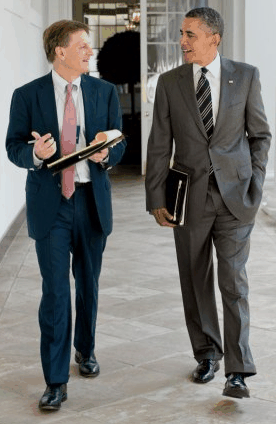
“Hey, Doc,” he shouted to the van holding the medical staff that travels with him wherever he goes. “You got my mouth guard?” The doc had his mouth guard. Obama relaxed back in his seat and said casually that he didn’t want to get his teeth knocked out this time, “since we’re only 100 days away.” From the election, he meant, then he smiled and showed me which teeth, in some previous basketball game, had been knocked out. “Exactly what kind of game is this?” I asked, and he laughed and told me not to worry. He doesn’t. “What happens is, as I get older, the chances I’m going to play well go down. When I was 30 there was, like, a one-in-two chance. By the time I was 40 it was more like one in three or one in four.” He used to focus on personal achievement, but as he can no longer achieve so much personally, he’s switched to trying to figure out how to make his team win. In his decline he’s maintaining his relevance and sense of purpose.
More here.
doing math with strogatz

Let’s begin with what our bodies can teach us. We all know that toddlers learn to count with their fingers and sometimes their toes. Those appendages are called “digits,” and it’s no accident that the same word refers to the 10 symbols 0, 1, 2, 3, 4, 5, 6, 7, 8, 9 in the decimal system. Our bodies are our first arithmetic teachers. But what is less widely known is that our bodies are also trying to teach us higher math, if only we’d let them. Look at a baby’s first hairdo: The cowlick at the center of that cute little swirl is, in mathematical parlance, a “singularity,” a point of confusion where the baby’s hair can’t seem to decide which way to grow. On the back of the cowlick the hair falls to the left; on the front it grows to the right; and on the sides it falls forward and backward. What makes a cowlick “singular” is that a variable (the hair’s direction) changes abruptly and discontinuously there.
more from Steven Strogatz at The Opinionater here.
disco and art

Instead, what prompted my familiar feelings of disbelief was reading John Baldessari’s explanation for why he decided to resign from the MOCA board of trustees. (Baldessari was the first of the four artist-trustees to resign; the others—Barbara Kruger, Catherine Opie, and Ed Ruscha—have since fallen suit.) Baldessari has made a career of appropriating photos from commercial, mass-produced entertainment and then altering or juxtaposing them with words and images in a deadpan fashion—in its 1960s iteration, this was part of a larger movement dedicated to destroying the boundary between art and life—but it turns out, and this is what surprised me, there were limits to this project. In an interview with the New York Times, Baldessari, who as recently as 2004 was still proclaiming his mission as “trying to jam the media world together with what we would call the ‘real world,’” objected to what the Times described as “a large exhibition being planned by Mr. Deitch that will explore the influence of disco culture on the visual arts and performance art.” In an interview with the Los Angeles Times, we learn that Baldessari could not believe what Deitch was planning: “When I heard about that disco show I had to read it twice. At first I thought ‘this is a joke’ but I realized, no, this is serious.”
more from Rochelle Gurstein at TNR here.
But, what a weight, O God! Was that one coffin to bear!

The Victorian era was buttoned-down in myriad ways, and one was supposed to be prim, proper, and chaste, even though the opium dens did big business, and men were hardly chastised when they ducked into an alley with a sixteen-year-old girl—or when they later gave syphilis to their wives. Again: an age at odds with itself. Decadent poetry presents us with what could well be the age’s matchless literary paradox. The reader who is expecting accounts of full-on salacity—with the legs of women making right angles with their headboards, and one remarkable debauch after another—is going to discover a different brand of decadence on these pages. One that, when fully flowing, shocks us more than a mere sex-laden account of this shadowy Sodom possibly could.
more from Colin Fleming at Boston Review here.
Deepa Mehta’s Film Adaption of ‘Midnight’s Children’
Mathew Bower in Flavorwire:

Midnight’s Children follows Saleem Sinai (played by Satya Bhabha), who, born exactly at midnight on the eve of India’s independence, is imbued with special telepathic powers, an exceptional sense of smell, an inordinately large nose, and a birthmarked face. He soon learns that everyone born at midnight on August 14th, 1947 possesses similar special powers, and makes use of his telepathy to assemble the children of India’s independence from across the disparate regions of the country. Here we see Saleem kissing Parvati the witch, another of Midnight’s Children whom he later marries. The choice of casting a relatively unknown actor as Saleem rather than a more celebrated Bollywood star is refreshing, and it seems Mehta accomplishes the same heartfelt and intensely personal performances as she has in her previous films.
More here. (Note: Thanks to dear friend Naheed Azfar)
It’s a Womans World With the End of Men
From Smithsonian:

The “end of men”—those are fighting words.
You are right. My son hates the title, which is why I dedicated the book to him. I have also heard reports of people having to hide the cover on the subway as they are reading it, so they don’t alienate the men sitting next to them.
What do you mean by “the end?” What does this look like?
What you notice about the men in the book is that they are struggling now, largely due to economic factors. We are in this transition moment where men have to really think about the future and how they can be in the future. The book is calling for and trying to make a cultural space for the rise of a new kind of man. That is where we wind up, rather than at the very end.
More here.
What Is It About an Elephant’s Tusks That Make Them So Valuable?
Rebecca J. Rosen finally answers the age old question, what do Steinways and milk protein have in common? Via The Atlantic:

More here.
Tuesday, September 11, 2012
At the elite colleges – dim white kids
Peter Schmidt in the Boston Globe:
Surf the websites of such institutions and you will find press releases boasting that they have increased their black and Hispanic enrollments, admitted bumper crops of National Merit scholars or became the destination of choice for hordes of high school valedictorians. Many are bragging about the large share of applicants they rejected, as a way of conveying to the world just how popular and selective they are.
What they almost never say is that many of the applicants who were rejected were far more qualified than those accepted. Moreover, contrary to popular belief, it was not the black and Hispanic beneficiaries of affirmative action, but the rich white kids with cash and connections who elbowed most of the worthier applicants aside.
Researchers with access to closely guarded college admissions data have found that, on the whole, about 15 percent of freshmen enrolled at America's highly selective colleges are white teens who failed to meet their institutions' minimum admissions standards.
More here.
Promoting Social Mobility

The accident of birth is a principal source of inequality in America today. American society is dividing into skilled and unskilled, and the roots of this division lie in early childhood experiences. Kids born into disadvantaged environments are at much greater risk of being unskilled, having low lifetime earnings, and facing a range of personal and social troubles, including poor health, teen pregnancy, and crime. While we celebrate equality of opportunity, we live in a society in which birth is becoming fate.
This powerful impact of birth on life chances is bad for individuals born into disadvantage. And it is bad for American society. We are losing out on the potential contributions of large numbers of our citizens.
It does not have to be this way. With smart social policy, we can arrest the polarization between skilled and unskilled. But smart policy needs to be informed by the best available scientific evidence. It requires serious attention to the costs of alternative policies, as well as to their benefits. Close attention to the evidence suggests three large lessons for social policy.
First, life success depends on more than cognitive skills. Non-cognitive characteristics—including physical and mental health, as well as perseverance, attentiveness, motivation, self-confidence, and other socio-emotional qualities—are also essential. While public attention tends to focus on cognitive skills—as measured by IQ tests, achievement tests, and tests administered by the Programme for International Student Assessment (PISA)—non-cognitive characteristics also contribute to social success and in fact help to determine scores on the tests that we use to evaluate cognitive achievement.
Second, both cognitive and socio-emotional skills develop in early childhood, and their development depends on the family environment.
A NEW BOOK CELEBRATES STANLEY SHEINBAUM
Nathan Gardels in the Huffington Post:
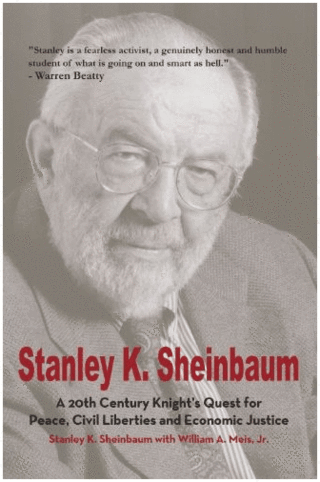
Sheinbaum has had a life of intrigue and exploits that would put many spies, politicians and even secretaries of state to shame. He's a bit of James Bond mixed with the civil rights champion Clarence Darrow. Indeed, I have always thought of him as a small Scandinavian state, audaciously leveraging the influence of his unique base as a wealthy “intellectual engage” to shift history at key moments.
As an economic development expert advising the Agency for International Development (AID) in South Vietnam in the 1960s, he exposed how the CIA used AID as cover to train police in brutal repression. When Andreas Papandreou, who later became prime minister of Greece, was arrested by the dictatorial colonels after their coup, Sheinbaum got President Lyndon Johnson to spring him from jail before he could be tortured or executed. He stepped into the breach to finance and organize Daniel Ellsberg's defense in the Pentagon Papers trial.
More here.
the fragility of complex systems

Science is a creative human enterprise. Discoveries are made in the context of our creations: our models and hypotheses about how the world works. Big failures, however, can be a wake-up call about entrenched views, and nothing produces humility or gains attention faster than an event that blindsides so many so immediately. Examples of catastrophic and systemic changes have been gathering in a variety of fields, typically in specialized contexts with little cross-connection. Only recently have we begun to look for generic patterns in the web of linked causes and effects that puts disparate events into a common framework—a framework that operates on a sufficiently high level to include geologic climate shifts, epileptic seizures, market and fishery crashes, and rapid shifts from healthy ecosystems to biological deserts. The main themes of this framework are twofold: First, they are all complex systems of interconnected and interdependent parts. Second, they are nonlinear, non-equilibrium systems that can undergo rapid and drastic state changes.
more from George Sugihara at Seed here.
What are all these people crying about?
One night, watching the Republicans with growing panic for the deteriorating state of my mental health, I remembered H.L. Mencken, who covered every national convention of both political parties from 1904 to 1948 for The Baltimore Sun. After locating The Impossible Mencken on my shelf, I sat down to read and learn how they were conducted in the past, and even more importantly how the quality of the speeches and the character and qualifications of various candidates has changed. I wasn’t disappointed. As an analysis of the type of men who run for public office in the United States, and their motives, these pieces are not only still right on the mark; they are lots of fun to read too. “Consider the matter of the so-called keynote speech,” Mencken writes in 1924. “Some hollow party hack is put up to rant and snort for an hour and a half, and when he is finished it is discovered that he has said precisely nothing.” Sure, there are exceptions. Obama gave a pretty good one in 2004. But as a rule, as Mencken points out, they consist of several thousands words of puerile platitudes and drivel, the very worst among them managing to be both instantly forgettable and enduringly irritating.
more from Charles Simic at the NYRB here.
In Defence of Parody

Leaving aside its immediate aim of making the reader laugh, parody – literary parody especially – has an infinitely wider remit. Pace F R Leavis, it is ultimately a form of literary criticism, where the judgements are arrived at by amplifying a writer’s stylistic idiosyncrasies to the point where they collapse in a wounded heap. Anyone who has read Brown over the years on one or two of the fashionable novelists that he regularly tears into would probably conclude that he dislikes their work profoundly, and that the root of this dislike lies in what he imagines to be their solipsism, their conviction that the act of writing is somehow more important than the story itself. All this is that much more effective for being conveyed by stealth, in the same way that Squire’s send-up of the first generation of Great War poets (‘O to be in Flanders/Now that April’s here…’) makes its point with a precision that half-a-dozen pages of reasoned exposition would struggle to achieve.
more from DJ Taylor at Literary Review here.
Neurotocrats vs. the Grand Old Psychosis

Not that politicians and pundits are mentally ill in a clinical sense, but politics in American national life today can only be presented in pathological form. Politics no longer involves the public use of reason; it is instead a matter of psychopathology, and is already treated as such by politicians and the public alike. Only this can account for the political centrality of the “gaffe” or slip of the tongue, an eminence that verbal inadvertencies have not enjoyed since the early days of psychoanalysis. But verbal or other symbolic blunders (Michael Dukakis looking not macho but dweeby in a battle tank; George W. Bush standing before a hubristic MISSION ACCOMPLISHED banner) are only the raw material or starting point for the practice of politico-psychopathology. The end result is an analysis—usually an accusation—of the “true” meaning not only of a politician’s words but of his hidden nature and undisclosed program. Almost invariably the true meaning reveals a taboo intention or identity.
more from Benjamin Kunkel at n+1 here.
Tuesday Poem
11.We Join Spokes Together
We join spokes together in a wheel,
but it’s the vacant hub
that makes it possible
for the cart to move.
We shape a pot to make a void
to hold whatever we want.
We stand up walls to make a house,
but the hollow within
is where living takes place.
Non-being is at the heart of being.
by Lao Tzu
from Adaptations of The Tao Te Ching
of R. Bob
Arab Artists in a Revolution
[Please click here to support this very worthy project.]
The Disappeared: How the Fatwa Changed a Writer’s Life
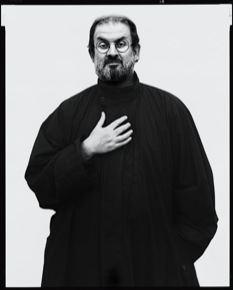
At the CBS offices, he was the big story of the day. People in the newsroom and on various monitors were already using the word that would soon be hung around his neck like a millstone. “Fatwa.”
I inform the proud Muslim people of the world that the author of the “Satanic Verses” book, which is against Islam, the Prophet and the Koran, and all those involved in its publication who were aware of its content, are sentenced to death. I ask all the Muslims to execute them wherever they find them.
Somebody gave him a printout of the text as he was escorted to the studio for his interview. His old self wanted to argue with the word “sentenced.” This was not a sentence handed down by any court that he recognized, or that had any jurisdiction over him. But he also knew that his old self’s habits were of no use anymore. He was a new self now. He was the person in the eye of the storm, no longer the Salman his friends knew but the Rushdie who was the author of “Satanic Verses,” a title that had been subtly distorted by the omission of the initial “The.” “The Satanic Verses” was a novel. “Satanic Verses” were verses that were satanic, and he was their satanic author. How easy it was to erase a man’s past and to construct a new version of him, an overwhelming version, against which it seemed impossible to fight.He looked at the journalists looking at him and he wondered if this was how people looked at men being taken to the gallows or the electric chair. One foreign correspondent came over to him to be friendly. He asked this man what he should make of Khomeini’s pronouncement. Was it just a rhetorical flourish, or something genuinely dangerous? “Oh, don’t worry too much,” the journalist said. “Khomeini sentences the President of the United States to death every Friday afternoon.”
On air, when he was asked for a response to the threat, he said, “I wish I’d written a more critical book.” He was proud, then and always, that he had said this. It was the truth. He did not feel that his book was especially critical of Islam, but, as he said on American television that morning, a religion whose leaders behaved in this way could probably use a little criticism.
Monday, September 10, 2012
Perceptions: of Common Ground – Venice Biennale 2012

Sunday, September 9, 2012
The Tragedy of the European Union and How to Resolve It
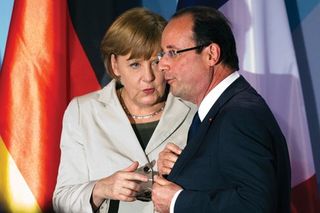
I have been a fervent supporter of the European Union as the embodiment of an open society—a voluntary association of equal states that surrendered part of their sovereignty for the common good. The euro crisis is now turning the European Union into something fundamentally different. The member countries are divided into two classes—creditors and debtors—with the creditors in charge, Germany foremost among them. Under current policies debtor countries pay substantial risk premiums for financing their government debt, and this is reflected in the cost of financing in general. This has pushed the debtor countries into depression and put them at a substantial competitive disadvantage that threatens to become permanent.
This is the result not of a deliberate plan but of a series of policy mistakes that started when the euro was introduced. It was general knowledge that the euro was an incomplete currency—it had a central bank but did not have a treasury. But member countries did not realize that by giving up the right to print their own money they exposed themselves to the risk of default. Financial markets realized it only at the onset of the Greek crisis. The financial authorities did not understand the problem, let alone see a solution. So they tried to buy time. But instead of improving, the situation deteriorated. This was entirely due to the lack of understanding and the lack of unity.
The course of events could have been arrested and reversed at almost any time but that would have required an agreed-upon plan and ample financial resources to implement it. Germany, as the largest creditor country, was in charge but was reluctant to take on any additional liabilities; as a result every opportunity to resolve the crisis was missed. The crisis spread from Greece to other deficit countries and eventually the very survival of the euro came into question. Since breakup of the euro would cause immense damage to all member countries and particularly to Germany, Germany will continue to do the minimum necessary to hold the euro together.
The policies pursued under German leadership will likely hold the euro together for an indefinite period, but not forever. The permanent division of the European Union into creditor and debtor countries with the creditors dictating terms is politically unacceptable for many Europeans. If and when the euro eventually breaks up it will destroy the common market and the European Union. Europe will be worse off than it was when the effort to unite it began, because the breakup will leave a legacy of mutual mistrust and hostility.