
Enjoying the content on 3QD? Help keep us going by donating now.
The moon rose over the bay. I had a lot of feelings
I am taken with the hot animal
of my skin, grateful to swing my limbs
and have them move as I intend, though
my knee, though my shoulder, though something
is torn or tearing. Today, a dozen squid, dead
on the harbor beach: one mostly buried,
one with skin empty as a shell and hollow
feeling, and, though the tentacles look soft,
I do not touch them. I imagine they
were startled to find themselves in the sun.
I imagine the tide simply went out
without them. I imagine they cannot
feel the black flies charting the raised hills
of their eyes. I write my name in the sand:
Donika Kelly. I watch eighteen seagulls
skim the sandbar and lift low in the sky.
I pick up a pebble that looks like a green egg.
To the ditch lily I say I am in love.
To the Jeep parked haphazardly on the narrow
street I am in love. To the roses, white
petals rimmed brown, to the yellow lined
pavement, to the house trimmed in gold I am
in love. I shout with the rough calculus
of walking. Just let me find my way back,
let me move like a tide come in.
Copyright © 2017 by Donika Kelly
from Academy of American Poets.
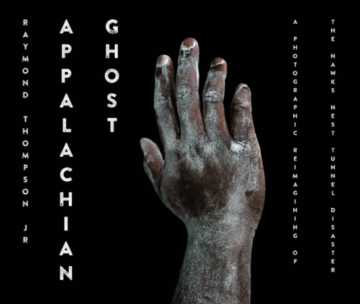 When Raymond Thompson, Jr. started looking through the archives of the Hawks Nest tunnel, he was struck by how absent the five thousand plus men who worked the dig were. It was, rather, a celebration of the engineering feat and the important men involved. Thompson’s new book, “Appalachian Ghost: A Photographic Reimagining of the Hawks Nest Tunnel Disaster ” (University Press of Kentucky, 2024,) is a photography collection that provides a necessary corrective while doing some heavy archival lifting.
 Doubts about the accepted chronology of human events are much older than Illig, Velikovsky or Freud. Already by the end of the 17th century, the Jesuit scholars
 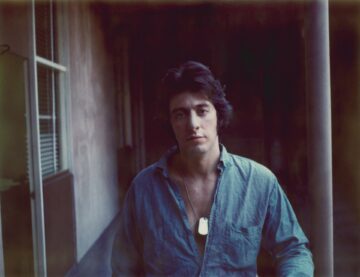 My mother began taking me to the movies when I was a little boy of three or four. She worked at factory and other menial jobs during the day, and when she came home I was the only company she had. Afterward, I’d go through the characters in my head and bring them to life, one by one, in our apartment. The movies were a place where my single mother could hide in the dark and not have to share her Sonny Boy with anyone else. That was her nickname for me. She had picked it up from the popular song by Al Jolson, which she often sang to me.
 F
F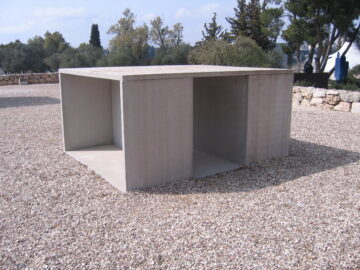 “A work needs only to be interesting,” Judd continued. And Judd’s work is interesting, even more so in Marfa than, say, MoMA, where a metal box installed in a white cube gallery contained on a city block amidst a vast grid plan makes for a rectilinear set of Russian dolls. The lunar landscape of Far West Texas—the heat and harsh sun and stark outline of emptiness—instead gives these manufactured squares an exotic leg up. At times, Judd’s objects can appear aloof, indifferent. Untitled works give way to a sense of … untitlement. But the desert itself is a poetic reflection of Judd’s aesthetic convictions, where the dominance of negative space enunciates each specific form. This enunciation culminates with the artist’s 100 untitled works in mill aluminum, 1982-1986, contained in two massive side-by-side artillery sheds at Chinati, a mile from the Block. One hundred pristine boxes—a fingerprint will permanently set in as little as 72 hours—line up on the floor like an army drill. Outwardly identical in size, each one embodies its own internal variations: a tilted top, a hollow center, solid as a rock. No two are the same.
 Explaining to the uninitiated exactly who Vinay Gupta is, and what he does, isn’t easy.
 When a protein folds, its string of amino acids wiggles and jiggles through countless conformations before it forms a fully folded, functional protein. This rapid and complex process is hard to visualize.
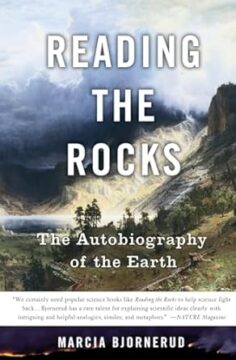 Consider that sandstone, which began, some two billion years ago, as quartz crystals buried deep inside mountains towering over what is now the Upper Midwest and southern Canada. Time took apart the mountains, and rain dissolved most of the minerals in them, but the quartz remained. It was later washed into Precambrian rivers and eventually carried to a beach, where its grains were worn smooth and spherical by the waves. That beach was tropical, partly because the contemporaneous climate was extremely warm, but also because Wisconsin, at the time, was near the equator. As the sea retreated and other rocks and minerals were deposited on top of the former strand, the grains of quartz hardened into sandstone, which was gradually sculpted by wind, water, and glacier until, aboveground, it formed the topography of Wisconsin as we know it today. Belowground, it formed an excellent aquifer, thanks to those spherical grains, which—“like marbles in a jar,” as Bjornerud puts it—leave plenty of room for storing water in between them.
 I only write in Japanese, a language that is plural by nature. It’s a language that has embraced several languages in its making, so you may hear the Chinese of the Tang, Song, Ming, or Qing periods, or the languages of Okinawa, Ainu, or Korea resonating within it. Asia is a region with an extensive history of a totally different sort from the West. Like in Africa, I guess, we inherit a thick layer of profound time in our basal memory that shapes our physical and mental subconscious gestures, and we always have to remember that.
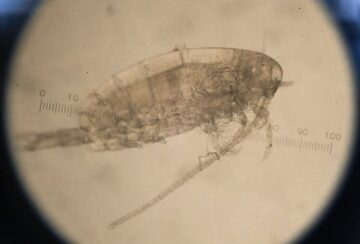 Broadly speaking, plankton fall into two big categories – the plant-like phytoplankton and the animal-like zooplankton – though quite a few species have characteristics of both. Cyanobacteria and other microbial, ocean-dwelling phytoplankton are Earth’s original photosynthesizers. About half of all photosynthesis on the planet today occurs within their cells.
 We all know the trope: a machine grows so intelligent that its apparent consciousness becomes indistinguishable from our own, and then it surpasses us – and possibly even turns against us. As investment pours into efforts to make such technology – so-called artificial general intelligence (AGI) – a reality, how scared of such scenarios should we be?
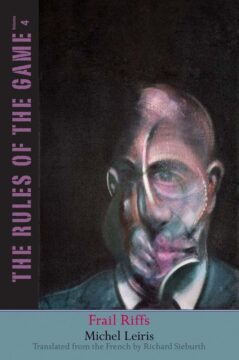 MICHEL LEIRIS WAS A SMALL, polite French man who stayed alive for most of the twentieth century and wrote a deliciously dense memoir in four bricks called The Rules of the Game. The final chunk—Frêle Bruit, whose title has been translated by Richard Sieburth as Frail Riffs,rather than the more straightforward “faint noise”—is now finally available in English. This memoir project spans the years 1948 to 1976, which is roughly the middle of Leiris’s writing career. There were, in fact, memoirs published before and after this project, and a massive set of journals (only available in French as of now) that stretch across his life from young adulthood right up to death. Taken in sum, almost all of Leiris’s writings qualify as what he called “essais autobiographiques.”
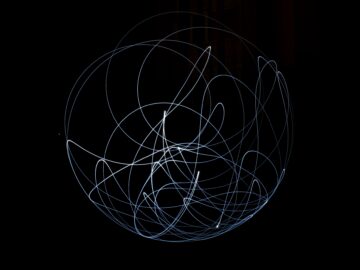 A slight shift in Cleopatra’s beauty, and the Roman Empire unravels. You miss your train, and an unexpected encounter changes the course of your life. A butterfly alights from a tree in Michoacán, triggering a hurricane halfway across the globe. These scenarios exemplify the essence of ‘chaos’, a term scientists coined during the middle of the