The World’s Most Expensive Male Prostitute

Richard Wall in Folio Weekly:
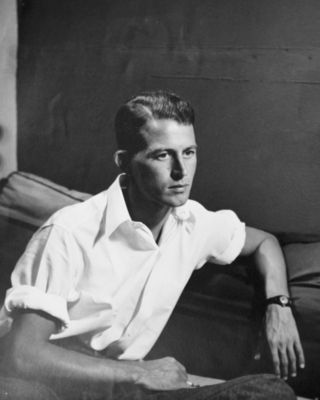
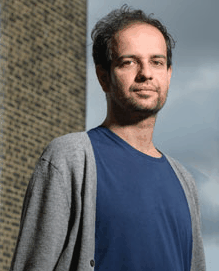
DenhamDenny Fouts (1914-1948) was handsome, charming, witty, entertaining and moody. He didn’t have money himself, but lived luxuriously off the wealth and infatuation of others. He played a starring role in the pre-war aristocratic bohemian scene in Europe, where the fun was extravagant and being gay was just fine. Denny amazed and inspired such literary greats as Truman Capote, Gore Vidal, Christopher Isherwood, Somerset Maugham and Gavin Lambert, and his personality sparks the fiction, memoirs, diaries and letters of the most noted authors and artists of his day.

Sixty-four years after his death, Denny Fouts is a cult figure in gay culture, best known by the sensational titles pinned on him. Capote dubbed him “The Best-Kept Boy in the World” (also the title of an upcoming book about Denny by Arthur Vanderbilt II). Isherwood and others repeated Denny’s reputation as “the most expensive male prostitute in the world.”

But this black sheep from Riverside was more than a switch-hitting gigolo, who parlayed his Southern charm and sexual prowess into a succession of glamorous free-rides.

A more complex Fouts can be found in the literature, and in the insights of his living relatives, which have never before been published. Alice Denham, Denny’s 79-year-old cousin who lives in New York City and is working on a book about her family and Denny, insists: “He wasn’t a male prostitute. Denny had arrangements. You couldn’t say I’ll give you this much money and he’d go with you.” He wasn’t just a hustler; he was an icon of and an influence on the acceptance of gay culture.

“Fouts was not walking the street. He had longtime lovers whose attraction for him went far beyond the sexual,” says Nick Harvill, an expert on literary references to Fouts who also assembles content-based libraries for private individuals, many in Hollywood. “Denham Fouts was a male version of the courtesan. He is one of the greatest enigmas of the 20th Century.”

Read the rest here.

The Politics of Cynicism

Image.phpGreg Afinogenov in n+1:

It is a commonplace, at least in the West, that the current regime in Russia is authoritarian, if not totalitarian. A line can be drawn—with caveats about scale and severity—from Putin straight back to Stalin, while others can be drawn sideways from Putin to the dictators he has befriended and supported: Assad, Qaddafi, Chavez, and Saddam Hussein. (If nothing else, Putin seems to have an oddly consistent and unlucky way of choosing his friends.) The recent protests against him only confirm the neatness of this symmetry.

We think we know what authoritarianism is and why it survives, but our notions about it have not changed much since the 18th century, when Montesquieu contrasted the capricious rule of a despot, who holds power through fear, with the bounded governance of a monarch, held in check by law. In our political language, monarchy has evolved into democracy, but despotism remains despotism (or authoritarianism). In comparison to monarchies and democracies, each in their own time, despotism has always seemed archaic. The gleaming military uniforms, Tolkienesque titles, and Orientalized imperial paraphernalia of modern dictators like Idi Amin, Pinochet, and Qaddafi evoke the 19th century; leaders who are truly modern are supposed to wear self-effacing suits.

If authoritarianism is a relic of a pre-democratic age, Putinism, like the late regime of Putin’s friend Silvio Berlusconi, is not authoritarian. Regimes that see themselves as successors to democracy are not rare—fascists and communists were equally convinced that liberal democracy belonged in the dustbin of history. The difference is that Putinism is partly right in seeing itself as post-democratic, which is why the problems it poses are so vexing. It represents one answer to a set of contradictions that exist not just in Russian democracy but also in contemporary democracy in general.

The Whole Thing is Tragic

Woody-Allen-01An interview with Woody Allen in The Talks:

Mr. Allen, do you truly believe that happiness in life is impossible?

This is my perspective and has always been my perspective on life. I have a very grim, pessimistic view of it. I always have since I was a little boy; it hasn’t gotten worse with age or anything. I do feel that’s it’s a grim, painful, nightmarish, meaningless experience and that the only way that you can be happy is if you tell yourself some lies and deceive yourself.

I think it’s safe to say that most people would disagree.

But I am not the first person to say this or even the most articulate person. It was said by Nietzsche, it was said by Freud, it was said by Eugene O’Neill. One must have one’s delusions to live. If you look at life too honestly and clearly, life becomes unbearable because it’s a pretty grim enterprise, you will admit.

I have a hard time imagining Woody Allen having such a hard life…

I have been very lucky and I have made my talent a very productive life for me, but everything else I am not good at. I am not good getting through life, even the simplest things. These things that are a child’s play for most people are a trauma for me.

A Bigger Victory Than We Knew

Dworkin_1-081612_jpg_470x420_q85Ronald Dworkin in the NYRB:

Just before the decision was announced, the betting public believed, by more than three to one, that the Court would declare the act unconstitutional.1 They could not have formed that expectation by reflecting on constitutional law; almost all academic constitutional lawyers were agreed that the act is plainly constitutional. The public was expecting the act’s defeat largely because it had grown used to the five conservative justices ignoring argument and overruling precedent to remake the Constitution to fit their far-right template.

The surprise lay not just in the fact that one of the conservatives voted for the legally correct result, but which of them did that. Everyone assumed that if, unexpectedly, the Court sustained the act it would be because Justice Anthony Kennedy, the least doctrinaire of the conservative justices, had decided to vote with the four more liberal justices, Justices Ruth Ginsburg, Stephen Breyer, Sonia Sotomayor, and Elena Kagan. After all, since 2005, Kennedy had joined the liberals in twenty-five cases to create 5–4 decisions they favored, rather than joining his fellow conservatives to provide five votes for their side. Two of the other conservative justices—Justices Antonin Scalia and Clarence Thomas—had done that only twice, and the two others—Chief Justice John Roberts and Justice Samuel Alito—had never done so. So most commentators thought, from the moment the Court agreed to rule on the act, that the decision would turn, one way or the other, on Kennedy’s vote, and a great many of the hundreds of briefs submitted on both sides offered arguments designed mainly to appeal to him.

the last critic at 100

Abrams_071012_620px

The modernist critic T.E. Hulme famously, and insultingly, described Romanticism as “spilt religion.” Natural Supernaturalism can be thought of as an extended proof of Hulme’s dictum, and simultaneously as a refutation of it. The energy that Christianity once devoted to imagining the end of the world and the redemption of mankind, Abrams shows, was not simply and chaotically “spilled” in Romantic literature. On the contrary, it was transformed in wonderfully complex ways. “In the increasingly secular period since the Renaissance,” Abrams writes, “we have continued to live in an intellectual milieu” shaped by the millennialism of Christianity. This shaping is “so deep and pervasive, and often so transformed from its Biblical prototype, that it has been easy to overlook both its distinctiveness and its source.” In writing about this theme, Abrams delves deeply into the Christian theological tradition, paying particular attention to the Book of Revelation, with its vision of destruction and renewal, and the Confessions of Saint Augustine, with their revolutionary analysis of human motive and guilt.

more from Adam Kirsch at Tablet here.

Ksenia Sobchak: The Jane Fonda of Russia’s Dissident Movement

Sarah A. Topol in Vice:

ScreenHunter_09 Jul. 24 13.32The American press calls her Russia’s Paris Hilton, but Sobchak is a far more prominent figure in Russia than Hilton ever was in America. She herself points out, 97 percent of Russians know who she is, even if most of them don’t like her. Only two living Russians enjoy better name recognition: Three-term president Vladimir Putin and one-term president Dmitri Medvedev.

Her father, Anatoly Sobchak, an early champion of democracy and capitalism, was the first elected mayor of St. Petersburg. He singlehandedly launched Putin’s political career, and Ksenia is rumored to be Putin’s goddaughter. In 1996, her father spiraled spectacularly to disgrace. He faced imprisonment on corruption charges, which he evaded with Putin’s help, by going into exile. When Boris Yeltsin turned Russia over to Putin, the charges disappeared and Anatoly Sobchak returned to Russia. He died in 2000 on the campaign trail for Putin. Ksenia, meanwhile, made a name for herself hosting a reality show called Dom-2 about a group of young people tasked with building a house on the outskirts of Moscow. The content combined the worst ofJersey Shore, The Real OC, and Tila Tequila. It was scandalous, deliciously addictive, and intellectually bankrupt programming. She posed for Russian Playboy, Maxim, and FHM; co-wrote Philosophy in the Boudoirand How to Marry a Millionaire. She hosted decadent parties, dated oligarchs, and wrote a column for RussianGQ. In short, she came to embody Russia’s new heady, careless, apolitical glamour.

Then, last year, she underwent a mystifying transformation. She traded her reality show for a political talk show. She broke up with her boyfriend, a government official, and started dating an opposition leader. She climbed on stages and addressed massive street rallies. Russia’s Paris Hilton had turned into a Russian Jane Fonda, or so it seemed.

More here.

Ōe on Barney Rosset

Screen-shot-2012-06-12-at-3.17.13-PM1-150x150

Barney Rosset to me represents the literary world of the latter half of the 20th century. Two hefty books—the oldest of autographed books in my library—attest to this fact. The books are The Complete Justine, Philosophy in the Bedroom and Other Writings and The Olympia Reader: Selections from the Traveler’s Companion Series, both published by Grove Press, Inc. The autographs are Barney Rosset’s dated 1965. I was then a writer aged 30, a complete unknown outside of Japan, visiting the New York publishing houses to receive a publication contract for my novel A Personal Matter. The owner of the company, knowing that I had started writing as a student majoring in French literature, asked me who, in contemporary literature, I found interesting. A soft smile spread across his face at the mention of each of my favorite French, English, and American writers and poets. He then kindly gave me the two books saying that although the work by Marquis de Sade required no comment from him, the “Olympia Reader” contained works—obtainable only in Paris—by writers whom I admired. The clear-thinking, soft-spoken man, from whose countenance exuded a youthful vigor, said: “Among the writers in this selection, the most talented is Samuel Beckett, and this book carries a brief story of how Watt came to be published. I will most likely publish all of his works.”

more from Kenzaburō Ōe at Evergreen Review here.

Tuesday Poem

Ministers In Charge Of Individuals

we have no parents no children no flesh-and-blood
loves we have no homes we have god
we haven’t got him in the sky and not in the depths not
in stones we have no prophets we have no teachers
we have no permitted books no forbidden
books we have god we don’t love him
we don’t hate him we aren’t friendly with him
we have nothing but “I” nothing but self
we are the ministers of individuals

by Benjamin Shvili
from Shiray ha tie-ar hagadol
publisher: Schocken, Tel Aviv, 1999

translation: Lisa Katz, 2012

.

Mira Nair’s 9/11 drama to open Venice film festival

From The Guardian:

Mira-Nair--007Mira Nair's latest film, the 9/11 drama The Reluctant Fundamentalist, is to open this year's Venice film festival next month. Nair's first new work since her poorly received 2009 biopic Amelia, about the aviation pioneer Amelia Earhart, the movie is based on Mohsin Hamid's novel and stars British actor Riz Ahmed as a young Pakistani man working on Wall Street in September, 2001. When terrorists strike the World Trade Center, his bright future is shattered along with his belief system, reports Deadline. Other castmembers include Kate Hudson, Kiefer Sutherland, Liev Schreiber, Martin Donovan, Om Puri and Shabana Azmi. The Reluctant Fundamentalist, for which William Wheeler has adapted Hamid's 2007 book, will screen out of competition at Venice's 69th edition, which this year runs from 29 August to 8 September.

More here. (Note: Congratulations to dear friends Mira and Mohsin!)

What Is the Nocebo Effect?

From Smithsonian:

Pristiq_pillsWhat if taking an absolutely harmless substance could make you sick? What if a sugar pill caused you to feel nausea, or a fake dose of lactose triggered unwelcome stomach symptoms in patients who are lactose intolerant? The strange truth about medicine and the brain is that they often interact in completely unpredictable and counterintuitive ways. Nowhere is this more true than with the bewildering phenomenon known as the nocebo effect. Most of us already know about the placebo effect. As part of medical studies, a control group is typically given an inert substance (usually a sugar pill) that provides a baseline to which researchers can compare the effectiveness of the new medicine being tested. The members of this group are told that the placebo is real—and surprisingly, they sometimes experience an actual improvement in their symptoms, simply because they expect that the medicine will make them feel better.

An opposite tendency—and one that has been largely overlooked by the research community—is the nocebo effect. Put simply, it is the phenomenon in which inert substances or mere suggestions of substances actually bring about negative effects in a patient or research participant. For some, being informed of a pill or procedure’s potential side effects is enough to bring on real-life symptoms. Like the placebo effect, it is still poorly understood and thought to be brought about by a combination of Pavlovian conditioning and a reaction to expectations. Last week, researchers from the Technical University of Munich in Germany published one of the most thorough reviews to date on the nocebo effect. Breaking down 31 empirical studies that involved the phenomenon, they examined the underlying biological mechanisms and the problems it causes for doctors and researchers in clinical practice. Their conclusion: although perplexing, the nocebo effect is surprisingly common and ought to be taken into consideration by medical professionals on an everyday basis.

More here.

Tino Sehgal fills Tate Modern’s Turbine Hall with storytellers

Charlotte Higgins in The Guardian:

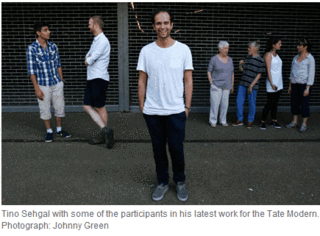
ScreenHunter_08 Jul. 24 11.20According to Sehgal the work is about the relationship between the individual and the mass: “It is about what it means to belong to a group, which is also quite a personal question for me.” The Turbine Hall was intriguing, he said, because “it is such an unusual space for a museum, since museums were invented to train visitors in polite behaviour. But the Turbine Hall is different: it is made to make people gather together and puts them in a joyful, bodily, unrestricted space.”

Several hundred participants are involved in the project. They were recruited through networks of friends and acquaintances, and rehearsed by Sehgal and his producer, Asad Raza. The stories they tell visitors are based on a set of open-ended questions asked by Sehgal, such as: “When did you feel a sense of belonging?” and “When did you experience a sense of arrival?” The participants work in four-hour shifts, with breaks, and are paid, according to the Tate curator Jessica Morgan, between £8 and £9 per hour. Most are fitting the work at Tate around other professional commitments, from posts at universities to freelance photography.

According to Raza the work “shows London to itself; it is a more accurate picture of London than something that is cooked up by one particular person”. On Monday morning though, none of the participants was black: according to Dercon, “we have complete diversity but we didn't select them as if we were casting a sitcom”.

More here.

does art matter?

ThinkPiece_2

The epilogue of DeLillo’s Point Omega returns the reader to the narrator’s sixth and final viewing of Gordon’s 24-Hour Psycho. During this visit, the protagonist interacts with other visitors and incorporates personal memories into his interpretation of the video sculpture in the gallery. His ruminations on news media, Hitchcock’s film, Gordon’s installation and his own experiences (detailed earlier in the novel), intermingle. In effect, these four forms of media – mainstream press, a classic film, a video installation and an award-winning novel – each reach their publics in different ways. But often they overlap, one folded into the other. This seems to be DeLillo’s point. His narrator’s deeply engaged reading of a contemporary art installation offers a dynamic model of the process by which art emerges from other practices, crystallizes in form and experience, only to move beyond those conditions in often-unpredictable ways to generate new narratives and knowledge. Art works are social subjects in this way, and not simply aesthetic objects. They are meaningful only when seen in relationship to a wider network of beliefs and practices, economies and exchanges. Art is the current, not the fixture.

more from Alexander Alberro at Frieze here.

Why Barack Obama And Benjamin Netanyahu Don’t Get Along

Obama-netanyahu-2Peter Beinart gave a lecture at the Everet Jewish Life Center in Chautauqua on the personal, religious, and Zionist roots on both sides of the Obama-Netanyahu relationship. The audio's not perfect but it's really worth a listen, so I recommend headphones.

Listen to the speech here.

For Beinart's bio, along with the rest of the series' speakers, click here.

Monday, July 23, 2012

Mr. Wrong: Ifti Nasim (1946 – 2011)

Note: In honor of my best friend's first death anniversary, I am posting again the obituary I wrote (with a brokem heart).

by Azra Raza

According to every convention, my friend Ifti was all wrong. He was born at the wrong time. He should have been born in 2150. He was born in the wrong country. He should have been born in Hollywood. He was born to the wrong parents. He should have been Tallulah Bankhead’s child. He was born to the wrong siblings. He should have been my sister. He was born in the wrong body. He should have been Marilyn Monroe. He was born to the wrong friends in Pakistan. His friends should have been Oscar Wilde, Dorothy Parker, Joan Crawford, Tennessee Williams, and Bette Davis. He was born to lead a life of luxury, dividing his time between the French Riviera and throwing extravagant parties in Manhattan. Instead he became a car salesman.

And if he had to become a car salesman, he should have been wearing the conventional salesman’s clothing. Ifti wore silks and brocades. He should have cinched his best car deals by groveling in front of clients. Instead, he succeeded by sassily telling Oprah Winfrey when she asked him how big the engine of the Mercedes was, “Are you going to sleep with it?” And when Mary Anne Childers asked him to open the trunk of the car she was buying from him, he famously remarked, “Honey, do it yourself, I just got my nails done.”

And while other salesmen were attending classes to polish up their PR skills, Ifti was busy being a gay activist. He created SANGAT, the organization devoted to Gays and Lesbians of South Asian origin. And why couldn’t SANGAT be content with their periodic display of solidarity by marching through town in the Annual Gay and Lesbian Pride Day Parade? Instead, Ifti raised funds to hire lawyers who have successfully fought cases to earn Immigration status for individuals seeking asylum because of their sexual preferences. And why did I regularly meet strangers in Ifti’s home who had found sanctuary in his ever-welcoming apartment?

Ifti could have been a highly successful stand-up comic. Instead he became a writer. And if he had to become a writer, he could have stuck to one genre alone. Instead he wrote poetry in Urdu, English and Punjabi; he published several books of short stories and became a serious journalist writing pithy, enormously unsettling, weekly columns unmasking the hypocrisy of some of our more pious and decent members of society; he started his own highly successful radio talk show.

And if he did decide to write about homosexuality, why could he not follow the traditions of the “love that dare not speak its name” and convey his agony through innuendo and metaphor? Instead he published the first ever book in Urdu devoted openly to homosexual love. Nirman (or Hermaphrodite) uses direct, graphic imagery and explicit language.

More here.

Sunday, July 22, 2012

Tino Sehgal’s Turbine Hall commission: ‘Attention is what I work with’

He's put children asking difficult questions into galleries, and lovers kissing. Now artist Tino Sehgal plans to revolutionise Tate Modern's Turbine Hall.

Charlotte Higgins in The Guardian:

ScreenHunter_07 Jul. 23 10.39Tino Sehgal is no ordinary interviewee. Tall, tousled, quick of speech and almost professorial in manner, the Anglo-German artist resists the general rule of the interview: that it's about the journalist harvesting maximum information from the subject. Instead, and somewhat disconcertingly, he wants us to have an actual conversation. Having been tipped off that I trained as a classicist, I can hardly get him out of the ancient world: he speculates on speech versus writing in Socrates and Plato, the politics of the act of prostration in Procopius, and the Latin derivation of the word religion.

At one point, as we sit talking in the cafe atTate Modern, I incline my head ironically and he starts talking about the decline of bowing and kneeling in western culture. A single word can set the 36-year-old artist off on a tangent: when I say “fetish”, he starts unpicking the whole concept. “I am for fetishisation!” he announces. “All of us have our favourite things and they speak to us.” Born in Britain and raised in Germany, Sehgal speaks fluent but heavily accented English.

This kind of conversational discursiveness is a key to Sehgal's work. The precise nature of the piece he is preparing for Tate Modern's Turbine Hall will remain, as with all past Unilever commissions, a secret until the moment of its unveiling next week.

More here. [The show opens today.]

Cruelty on the border

John Carlos Frey on abuses by American Border Patrol agents, via Salon:

BorderBorder Patrol protocol requires agents to provide detainees with food, drinking water and emergency medical services, to hold them under humane conditions, and to refrain from making degrading remarks, but this is rarely honored in practice, say human rights advocates. Over the past 15 years, reports documenting human rights abuses at the hands of Border Patrol agents have been published by Amnesty International, the ACLU, No More Deaths, even the United Nations. Contrary to their own protocols, Border Patrol agents have been accused of systematically denying food and water to migrants in custody, forcing them into overcrowded cells, stealing their money, confiscating medications, and denying them medical treatment. Migrants have described agents hurling verbal abuse, racial slurs and curses, and inflicting sexual assault, physical violence, even death. At least 14 migrants and border residents have died at the hands of Border Patrol agents over the past two years. These practices appear to be systemic, amounting to what No More Deaths calls “a culture of cruelty.”

Read the rest here.

Alexander Cockburn and the Radical Power of the Word

Cockburn_imgJohn Nichols in The Nation:

Alex, who has died too young at age 71 in Bad Salzhausen, Germany, loved writing. He loved it so much that he met his deadlines even as a two-year battle with cancer progressed toward its final stages. Alex's commitment to the craft—to the radical power of the word—extended far beyond his own contribution. He poked, prodded and inspired the rest of us. When I was working on an article at my home computer, he would lean over me and make suggestions. Invariably, Alex wanted to see a paragraph added on some new evil done by a corporation, some third-party candidate who had not gotten enough attention or some third-world cause that had gotten even less attention. Alex’s suggestions did not always fit where he proposed that I add them, and I asked them about this once.

“Sometimes you just have to get the story out,” he said, “anywhere you can.”

But, of course, Alex never just got the story out. His prose, honed during an Anglo-Irish childhood when he learned at the side of the master—his father Claud, the great radical British journalist of mid-century who lent him the title of his column, “Beat the Devil”—never failed. Alex knew how good he was. He knew that he could take readers where other writers could not, to the fields of India where Coca-Cola was stealing water from peasants, to the barricades of neglected labor battles in Austin, Minnesota, and Toledo, Ohio; to “The City” of London where the Libor scandal now unfolds. There were times when the going got rough; Alex's radicalism was genuine, and he could offend not just foes on the right but friends on the left. He parted company with mainstream liberals on issues ranging from gun control to global warming.

But no one could skewer the banksters, the robber barons and the crony capitalists of this broken era quite so ably as Alex.

10 Things Holden Caulfield Hates

Heba Hasan in The Atlantic:

041938_beerpong_crop[Last week was] the 61st anniversary of J.D Salinger's The Catcher in the Rye, a novel that introduced us to the most beloved/hated embodiment of disaffected youth in all of literature—and quite possibly pop culture as a whole. To celebrate, we've rounded up ten things that Holden Caulfield hates. We could have taken the easy way out and just said all of humanity, but that wouldn't have been nearly as entertaining. And besides, nothing makes you feel more grateful about the fact that you're not a self-destructive, angst-ridden teenager (anymore) than reminding yourself exactly why Holden Caulfield loathes Jesus' Disciples.

1. Bros

“He was one of those guys that think they’re being a pansy if they don’t break around forty of your fingers when they shake hands with you. God, I hate that stuff.”

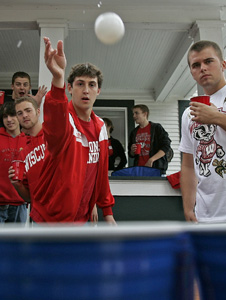
Can’t you just picture Holden at a frat party? Sitting on a couch by himself and judging how phony all those guys at the beer pong table are?

More here.