The Girls of the Millennials

Girls_HBO_Poster-e1344815157646Rachel Signer in Construction Magazine:

For all the accusations of white privilege, the prudish disgust, the constructive criticism, and naïve wistfulness for “privileged poverty” that the show Girls has sparked since it debuted in April, it cannot be denied that the show is a gift to Millennial-aged women living in cities everywhere. Because the way we talk about Girls is the way we talk about ourselves. When we criticize the contradictions in the show’s plot and characters, we are analyzing our own positions somewhere amidst self-loathing and egotism, entitlement and dedication, tolerance and insularity.

The conversation around the show reveals how hungry Millennials are for dialogue about our lives and, in particular, women’s lives. The show has given us an opportunity to dissect Millennial femininity in the wake of feminism’s third wave and in the midst of the recession, and it has revealed that at least one aspect of so-called “Millennial entitlement” may actually turn out to be a strength: the ability to speak up for ourselves and assert our opinions. In fact, one 24-year-old Emma Koenig is making a career out of voicing her Millennial anxieties and mundane pining, publishing a book, to be sold in Urban Outfitters, based on her blog “Fuck! I’m In My 20s.” Koenig’s blog shares things like crude drawings of a bloated, ugly person, next to the statement: “How I feel around other women.” Her posts are confessional (the “Why are you crying today?” checklist), banal (the “I am a sucker for” list), and often naïve (the “Friend vs. Girlfriend?” investigation), and they exploit the performative Millennial obsession with social media (“In 15 minutes I’ll stop staring at Facebook and do the dishes”). Now Koenig will profit from these inane, relatively superficial portrayals of urban, educated twenty-something living. And you know what I say to Emma Koenig? You go, girl.

When Girls debuted, critics at both The New Yorker and New York magazine hailed the show’s audacity and candor, as well as Dunham’s decision to cast herself as an imperfect, self-deprecating, angsty protagonist. Finally, we had a female heroine who cared about something besides Manolo Blahniks, and who was far from ideal in physique or career.

Separate beds are liberating

From Salon:

BedsThe British Science Festival is a pretty big deal in the world of European scientists. An event held annually since 1831, except during times of war, the festival’s history includes the first use of the term dinosaur, the first demonstration of wireless transmission, and an important early debate on Darwinism. One week in late September of 2009, thousands of researchers left their labs and set off for Guildford, the town about thirty miles outside of London where the festival was held that year, to present their latest findings and to gossip about faculty openings. It wasn’t the type of event — like, say, the Oscars, or the Cannes International Film Festival — that tabloid editors circle on their calendars because they expect something big to happen. Yet the minute Neil Stanley opened his mouth, the humble gathering of doctorates transformed into international news.

The kicker was the scientific suggestion that sharing a bed with someone you care about is great for sex, but not much else. Stanley, a well-regarded sleep researcher at the University of Surrey whose gray-thinning hair hinted at his more than two decades in the field, told his listeners that he didn’t sleep in the same bed as his wife and that they should probably think about getting their own beds, too, if they knew what was good for them. As proof, he pointed to research he conducted with a colleague which showed that someone who shared a bed was 50 percent more likely to be disturbed during the night than a person who slept alone. “Sleep is a selfish thing to do,” he said. “No one can share your sleep.”

There just wasn’t enough room, for one thing. “You have up to nine inches less per person in a double bed than a child has in a single bed,” Stanley said, grounding his argument in the can’t-argue-with-this logic of ratios. “Add to this another person who kicks, punches, snores and gets up to go to the loo and is it any wonder that we are not getting a good night’s sleep?” He wasn’t against sex, he assured his audience — only the most literal interpretation of sleeping together. “We all know what it’s like to have a cuddle and then say, ‘I’m going to sleep now,’ and go to the opposite side of the bed. So why not just toddle off down the landing?”

More here.

How Spoiled Are Our Children?

From The New York Times:

ChildA mother asked me last week whether I thought she was spoiling her child. It was the typical pediatric exam-room version of the question: In the weary, self-doubting voice of the recently postpartum, she wondered if it was right to pick up and feed her crying baby. These days, a lot of parents are wondering about the spoiling question. A recent book review by Elizabeth Kolbert in The New Yorker compared American children unfavorably with the self-reliant and competent children of a tribe in the Peruvian Amazon; she discussed “the notion that we may be raising a generation of kids who can’t, or at least won’t, tie their own shoes.”

A parenting column in The New York Times acknowledged that Ms. Kolbert’s observations had struck home with many contemporary parents; more recently, an opinion piece advised parents to stop protecting their children from every disappointment. We’re clearly having another of those moments — and they do recur, across the generations — when parents worry that they’re not doing their job and that the next generation is consequently in grave danger. In cultural convulsions about how spoiled the children are, disapproving adults look back fondly on the rigors of their own childhoods. But many of the same parents (and grandparents) who are now worrying were members of the generation that Vice President Spiro T. Agnew accused Dr. Benjamin Spock of having spoiled. Indeed, the overprivileged and overindulged child was a stock character in 19th-century novels: As veteran governesses who presumably knew the territory, the Brontë sisters wrote powerful portraits of spoiled older children. The culture changes, but many of the battlegrounds remain the same.

More here.

Monday, August 13, 2012

3 Quarks Daily News and a Request: Please Read This!

Sammy-K-2-020

Dear Reader,

We have all kinds of good news and we also need a small bit of help from you. Let me start by giving you the news.

***

First, with the help of our amazingly talented summer intern Henry Molofsky we have now completed a comprehensive design review of 3QD. Over the last eight months we examined many different blogs and websites for ideas and also solicited ideas for improvements from experts and from a select group of 3QD readers (and also our writers). We then discussed every single idea and debated whether it would be good for us or not. In the end, some ideas were rejected and others were approved resulting in a final design document which specifies the changes we will be making. These are underway and being implemented and tested as we speak. Here are just some of the improvements you will be seeing soon:

  • We will be switching to a new comments platform (and will import all 60,000+ older comments into it as well) which will allow commenting on comments themselves, editing comments, email alerts when the post (or your comment on it) receives more comments, and many other advanced features.
  • Much better integration with all kinds of social media, including Facebook “Like” and Twitter “Tweet” buttons on every post. Also integration with other social media such as Reddit, StumbleUpon, etc.
  • A new more contemporary look and feel, including a wider main column and redesigned right-hand column with much less clutter. The menu bar will be redone as will many other things but I will leave the details of this as a surprise to you. I have been working with some world-class graphic designers on this aspect of our redesign.
  • The Monday archives have been fully updated already (see here) and will soon be integrated into a redesigned and much better-organized Mondays page.
  • There will be a new 3QD Prizes page with all information related to our prizes.
  • The “Search 3QD” bar will soon actually work properly. (A pet peeve of my own!)

And there is more which you will see very soon.

***

Second, we are very excited to announce a collaboration with the Amsterdam-based Dialogue Advisory Group (DAG) to bring to our readers quarterly online symposia on topics of international peace and justice. DAG is an organization which discreetly assists government, inter-government and other actors to confidentially manage national and international mediation efforts. While their work is by its nature confidential and therefore not well known to the public, they and their remarkable successes are very well-known to actors in the field of conflict resolution. For example, DAG has recently played a central role in coordinating the International Verification Commission for the Ceasefire in the Basque Country, which will verify the ceasefire declared by Euskadi Ta Askatasuna (ETA) on January 10th 2011. The DAG/3QD Peace and Justice Symposia will consist of a well-known international figure presenting a thesis which will then be critiqued by two respondents who are also experienced in the field of international diplomacy. The original writer will then present a final rebuttal. For the first DAG/3QD Peace and Justice Symposium (which I am excited to announce will be published on 3QD on Monday, the 3rd of September), the distinguished participants are:

  • David Petrasek: Formerly Special Adviser to the Secretary-General of Amnesty International, David Petrasek has worked extensively on human rights, humanitarian and conflict resolution issues, including for Amnesty International (1990-96), for the Office of the UN High Commissioner for Human Rights (1997-98), for the International Council on Human Rights Policy (1998-02), and as Director of Policy at the HD Centre (2003-07). He has taught international human rights and/or humanitarian law courses at the Osgoode Hall Law School, the Raoul Wallenberg Institute at Lund University, Sweden, and at Oxford University. David has also worked as a consultant or adviser to several NGOs and UN agencies.
  • Gareth Evans: Australian Foreign Minister 1988-96 and President of the International Crisis Group 2000-09, co-chaired the International Commission on State Sovereignty 2001, is a member of the UN Secretary-General’s Advisory Committee on the Prevention of Genocide, and is the author of The Responsibility to Protect: Ending Mass Atrocity Crimes Once and for All (Brookings Institution Press 2008, 2009). He is Chancellor of The Australian National University.
  • Kenneth Roth: Executive Director of Human Rights Watch, one of the world's leading international human rights organizations. Roth has also served as a federal prosecutor in New York and for the Iran-Contra investigation in Washington. A graduate of Yale Law School and Brown University, Roth has conducted numerous human rights investigations and missions around the world. He has written extensively on a wide range of human rights abuses, devoting special attention to issues of international justice, counterterrorism, the foreign policies of the major powers, and the work of the United Nations.

The DAG/3QD Symposia will take place every three months.

***

Third, thanks to the leadership and organizational and research skills of our summer intern Zujaja Tauqeer, we have finalized and put into place a detailed plan to generate enough revenue through advertising and other means to become self-sustaining over time. In the meantime, we have also applied to various grant-making foundations for funds. Unfortunately this is a process which takes time and we do not yet know how much funding we are likely to receive.

***

So, finally to the request: to put all these changes into effect and to continue to do all that we do (the daily curating of the web, the Monday magazine of original writing, the quarterly 3QD prizes, the new DAG/3QD quarterly symposia) we have a current shortfall of approximately $6,800. We need you to help us raise these funds immediately to allow us to move ahead with all our plans for improvement.

Will you please take a moment to make a donation right now?

Thank you in advance. I am excited to reveal the new and improved 3QD to you as soon as possible. We are almost there!

Yours,

Abbas

Sunday, August 12, 2012

Ayn Rand Joins the Ticket

From The New Yorker:

Paul-ryan-light-465With the choice of Paul Ryan, Mitt Romney adds more to the Republican ticket than youth, vigor, and the possibility of carrying Wisconsin—he also adds the ghostly presence of the controversial Russian émigré philosopher and writer Ayn Rand. Although she died thirty years ago, Rand’s influence appears on the rise on the right. As my colleague Ryan Lizza noted in his terrific biographical Profile of Ryan, Rand’s works were an early and important influence on him, shaping his thinking as far back as high school. Later, as a Congressman, Ryan not only tried to get all of the interns in his congressional office to read Rand’s writing, he also gave copies of her novel “Atlas Shrugged” to his staff as Christmas presents, as he told the Weekly Standard in 2003.

Two years later, in 2005, Ryan paid fealty to Rand in a speech he gave to the Atlas Society, the Washington-based think tank devoted to keeping Rand’s “objectivist” philosophy alive. He credited her with inspiring his interest in public service, saying, “[T]he reason I got involved in public service, by and large, if I had to credit one thinker, one person, it would be Ayn Rand. And the fight we are in here, make no mistake about it, is a fight of individualism versus collectivism.” (One of the trustees of the Atlas Society, Clifford Asness, the co-founder of AQR Capital Management, a twenty-billion-dollar hedge fund, is one of the many outspoken Wall Street financiers who has shifted political sides, denouncing Obama, whom he supported in 2008, for interfering with capitalism by bailing out Chrysler, and by imposing tighter financial regulations after the 2008 economic collapse).

More here.

Kenan Malik on Morality Without God

Religion is often presented as the guardian of moral values. The problem with this, says the author and broadcaster, is that it diminishes what it means to be human. He draws on Plato and a medieval Arab poet to explain why.

Interview of Kenan Malik in The Browser:

Many believers think that the only way to be truly moral is to follow a religion which teaches us morality. How would you respond?

ScreenHunter_13 Aug. 12 19.05Throughout their history, one of the great selling points of religions – in particular the monotheistic religions – has been their importance as a bedrock of moral values. Without religious faith, runs the argument, we cannot anchor our moral truths or truly know right from wrong. Without belief in God we will be lost in a miasma of moral nihilism. “To remove God,” as the theologian Alister McGrath has put it, “is to eliminate the final restraint on human brutality”.

Looking back on history, one might question just how successful God has been as “the final restraint on human brutality”. What really concerns me, however, is the way that religious concepts of morality degrade what it means to be human by diminishing the importance of human agency in the creation of a moral framework. From a religious perspective, it is the weakness of human nature that ensures that God has to establish and anchor moral rules.

In truth, morality, like God, is a human creation. Even believers have to decide which of the values found in the Torah or the Bible or the Quran they accept, and which they reject. What God provides is not the source of moral values but, if you like, the ethical concrete in which those values are set. Rooting morality in religion is a means of putting certain values or practices beyond question by insisting they are God-given.

More here.

Only art can save us now

Santiago Zabala at Al Jazeera:

201251141759597734_20Perhaps rather than God, as Martin Heidegger once said, it is art that can save us. After all, artistic creations have always had political, religious and social meanings that also aimed in some way to save us. Certainly, they also express beauty, but this depends very much on the public's aesthetic taste, which varies according to the cultural environment of each society.

But when the political meaning is manifest, aesthetics (our sensations and taste) lose ground in favour of interpretation (knowledge and judgment); that is, instead of inviting us to contemplate its beauty, a work calls us to respond, react and become involved. As it turns out, art – as a channel to express reactions to significant issues – has sometimes worked better than historical or factual reconstructions.

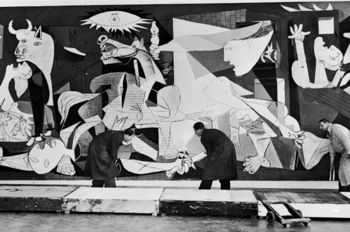
Pablo Picasso's Guernica is the example we all have in mind: painted as a response to the Spanish nationalist forces' bombing of a town in the Basque country, it was used not only to inform the public but also as a symbol of all the innocent victims of war. This is probably why “aesthetics”, a term coined by the German philosopher Alexander Baumgarten in 1735, refers not only to the study of art but also to sensory experience coupled with feelings regardless of the nature of its object. But can contemporary art, whether through music, conceptual installations or cinema actually save us from the damned circumstances, atrocities and injustices we live among?

More here.

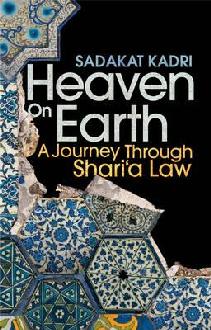
A Journey Through Shari’a Law From the Deserts of Ancient Arabia to the Streets of the Modern Muslim World

Mohamad Bazzi in the New York Times Book Review:

Heaven-on-earth-imageIn recent years, America has succumbed to a peculiar form of Shariah-phobia. According to this narrative, covert jihadis are working to usurp the law of the land and replace it with Islamic rule. A caliphate will rise on the ashes of the Constitution, Americans will be forced to pray in mosques and judges will mete out stonings and amputations. “Stealth jihadis use political, cultural, societal, religious, intellectual tools; violent jihadis use violence,” Newt Gingrich told the American Enterprise Institute in July 2010. “But in fact they’re both engaged in jihad, and they’re both seeking to impose the same end state, which is to replace Western civilization with a radical imposition of Shariah.” During the Republican presidential primaries, every candidate weighed in on the Shariah threat. In November 2010, Oklahoma voters approved a constitutional amendment banning the use of Islamic law in court. A federal appeals court blocked the amendment, but more than two dozen other states have considered legislation to restrict judges from consulting foreign and religious laws.

To Gingrich and his supporters, Shariah is a monolithic system of medieval codes, set in stone and bent on world domination. But in “Heaven on Earth,” a carefully researched history of how Islamic jurisprudence has evolved since the seventh century, Sadakat Kadri challenges the notion that Shariah is based solely on cruelty and punishment. He explains how the body of law developed alongside different strains of Islamic thought — tolerance versus intolerance, forgiveness versus punishment, innovative versus literalist. Kadri argues that over the past 40 years, governments that aspired to instill an Islamic identity have imposed austere interpretations of Shariah, ones that run counter to a millennium of transformation and universality.

More here. Also see 3QD's Feisal Naqvi's take here in the Express Tribune.

Impossible Cities

Kubla-khan5Darran Anderson in 3:AM Magazine:

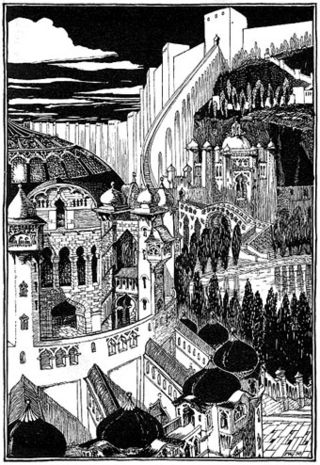
In 1298, the Venetian merchant and explorer Marco Polo found himself in a Genoese prison, having been seized at the helm of a war galley during the Battle of Curzola. There he met the chivalric writer Rustichello of Pisa to whom he related tales of his travels along the Silk Road into Asia in the previous decades. The resulting manuscript The Description of the World or The Travels of Marco Polo became a literary sensation, being reproduced across Medieval Europe. Such were the extravagant claims in this “great book of puzzles”, many were taken to be fabrications and Polo earned the nickname “the Man of a Million Lies”. It was doubted by some that he’d even travelled at all except around his own evidently vast imagination.

The accounts did however contain many genuine discoveries alongside exaggerations, half-truths and myths (‘How the Prayer of the One-Eyed Cobbler Caused the Mountain to Move’ for example) mixed together without differentiation. We can now pour scorn on his claims of desert sirens luring the unwary to their deaths, colossal birds who fed on elephants, idolaters “adept in sorceries and diabolical arts” who could control sandstorms or witnessing Noah’s Ark perched on a mountaintop where the snow never melts. At the time, these were scarcely more unbelievable than his claims of “stones that burn like logs” (coal), paper currency, seeing the highest mountains in the world (the Himalayas) or visiting vast golden cities hung with the finest silks yet we know these now to be fairly accurate descriptions.

The backbone of Polo’s travelogue is made up of his visits to various Oriental cities (Baudas, Samarcan, Caracoron and so on) culminating in the opulent palaces of the Chinese Mongol Emperor Kublai Khan, at whose court he was a guest for 17 years. His recollections of the centres and their populaces range from the mercantile (lists of industries and natural resources) to the fanciful; cities where the inhabitants are perpetually drunk, where men ride around on stags eating birds, where marriages are arranged between ghosts or the great Kaan in his marble palace drinks wine from levitating goblets. Often Polo would add boasts and hyperbole (“no one could imagine finer” is a recurring phrase) and even suggest he was holding back for fear of arousing incredulity in the readers (“I will relate none of this in this book of ours; people would be amazed if they heard it, but it would serve no good purpose”) which only served to further his ridicule. When he was on his deathbed, a priest giving last rites asked Polo if he wished to confess to exaggerating his recollections to which he replied, “I did not reveal half of what I saw because no one would have believed me.”

The Growth Delusion

201231booksleadWill Hutton in New Statesman:

How do you successfully break a mistaken and destructive intellectual consensus? Common sense has it that Britain is a front-line developed country that, as a precondition for a return to growth and full employment, must first succeed in lowering its public and private debts, dramatically and simultaneously.

Every assumption in that sentence is wrong. Britain is not a front-line developed economy. To deleverage simultaneously is to invite protracted depression. The challenge instead is to develop our economy as much as make it grow, and to ensure that overall demand, notwithstanding the overhang of private debt, grows consistently.

However, it is the other nonsense that defines public policy and the terms of our national conversation. It’s a system of thought that needs to be despatched in its entirety to the outer darkness. We should begin thinking in completely different terms and categories. The question is: how?

Paul Krugman, Larry Elliott and Dan Atkinson try to do exactly that in their latest books. Elliott and Atkinson’s thesis is that such epic economic mistakes have been made over the last generation, compounding those of the past 100 years, that the productive sinews of Britain’s economy – and its ability to renew that productive capacity – have shrunk to such a degree that Britain can no longer be considered a developed economy. In all sorts of ways – from its reliance on foreign direct investment to its faddish celebration of empty-headed, if charismatic, leaders – it displays the characteristics of a developing economy. It is wedded to a “no-strategy strategy”, as Elliott and Atkinson put it, followed by a political, financial and business elite that appears to be in denial about the country’s circumstances and needs.

Psychiatry’s Legitimacy Crisis

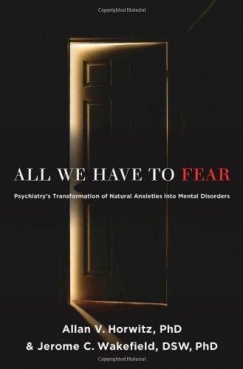
1344403039Andrew Scull on Allan V. Horwitz and Jerome C. Wakefield's All We Have to Fear: Psychiatry's Transformation of Natural Anxieties into Mental Disorders, in the LA Review of Books:

The modern psychopharmacological revolution began in 1954 with the introduction of Thorazine, hailed as the first “anti-psychotic.” It was followed in short order by so-called “minor tranquilizers:” Miltown, and then drugs like Valium and Librium. The Rolling Stones famously sang of “mother’s little helper,” which enabled the bored housewife to get through to her “busy dying day.” Mother’s helper had a huge potential market. Drug companies, however, were faced with a problem. As each company sought its own magic potion, it encountered a roadblock of sorts: its psychiatric consultants were unable to deliver homogeneous populations of test subjects suffering from the same diagnosed illness in the same way. Without breaking the amorphous catchall of “mental disturbance” into defensible sub-sets, the drug companies could not develop the data they needed to acquire licenses to market the new drugs.

In a Cold War context, much was being made about the way the Soviets were stretching the boundaries of mental illness to label dissidents as mad in order to incarcerate and forcibly medicate them. But Western critics also began to look askance at their own shrinks and to allege that the psychiatric emperor had no clothes. A renegade psychiatrist called Thomas Szasz published a best-selling broadside called The Myth of Mental Illness, suggesting that psychiatrists were pernicious agents of social control who locked up inconvenient people on behalf of a society anxious to be rid of them, invoking an illness label that had the same ontological status as the label “witch” employed some centuries before. Illness, he truculently insisted, was a purely biological thing, a demonstrable part of the natural world. Mental illness was a misplaced metaphor, a socially constructed way of permitting an ever-wider selection of behaviors to be forcibly controlled under the guise of helping people.

Democracy in Arabia

Cover00Hussein Ibish in Bookforum:

If anybody asked me, particularly in a plaintive tone of desperation, for a comprehensive backgrounder on the uprisings that have convulsed much of the Arab world since December 2010, I’d have no hesitation in pointing them to The Battle for the Arab Spring. Lin Noueihed, a Reuters editor, and Alex Warren, a consultancy expert, have joined forces to produce a remarkably far-reaching and exceptionally precise summary of the uprisings generally, but unfortunately, referred to as the “Arab Spring.” Particularly for the uninitiated or those seeking a synoptic but relatively detailed account of what has and hasn’t happened in the Arab world in the past year and a half, their book fits the bill perfectly. Dutifully and methodically, Noueihed and Warren cover all the bases. Everything is here that a specialist would expect to be provided to a popular audience seeking guidance and information, and very little that is obviously crucial is missing.

But this great strength is also the book’s most fundamental weakness. The Battle for the Arab Spring often reads like a list of lists, or a particularly well-executed Wikipedia entry, whose authors have established a logical, straightforward set of categories for its subject, and then dutifully filled them in with the appropriate facts, citations, and observations. This makes The Battle for the Arab Spring often surprisingly flat and difficult to read, particularly for anyone with a strong background in recent Middle East affairs. The combination of almost suffocating predictability and unerring reliability produces very little with which such readers can engage. Turning its pages often involves a sigh of exasperation, as the authors check box after inevitable box.

Word: As women’s status rises, so do literary ‘shes’ and ‘hers’

From MSNBC:

The prevalence of female pronouns — she, her, hers, herself — in American books could be used to track the changing status of women in the 20th century, according to a new study, which found the he/she ratio after the late 1960s mirrored advances in gender equality.

BookJean Twenge, a psychology professor at San Diego State University, and her colleagues analyzed more than a million books on Google's Ngram Viewer for the use of gendered pronouns published between 1900 and 2008.

For every “she” found in this sample between 1900 and 1945, there were about 3.5 “hes.” The gap then grew during the post-World War II era, increasing to a male-to-female ratio of about 4.5 to 1. But the use of female pronouns in books began rising in the late 1960s. By the mid-1970s, the male-to-female ratio of pronouns in American books dropped to 3 to 1. And by the 2000s, it was 2 to 1. The researchers believe these changes occurred in step with rapid advances in gender equality — evident in other factors such as more education and more participation in the labor force — starting in the late 1960s. “These trends in language quantify one of the largest, and most rapid, cultural changes ever observed: The incredible increase in women's status since the late 1960s in the U.S.,” Twenge said in a statement from Springer, which published the research in its journal Sex Roles. “Gender equality is the clear upside of the cultural movement toward individualism in the U.S., and books reflect this movement toward equality. That's exciting because it shows how we can document social change.”

More here.

Saturday, August 11, 2012

Crawling from a car crash to be greeted by a panel of strangers holding up score cards

Keith Ridgway in The New Yorker:

Writer_optI don’t know how to write. Which is unfortunate, as I do it for a living. Mind you, I don’t know how to live either. Writers are asked, particularly when we’ve got a book coming out, to write about writing. To give interviews and explain how we did this thing that we appear to have done. We even teach, as I have recently, students who want to know how to approach the peculiar occupation of fiction writing. I tell them at the beginning—I’ve got nothing for you. I don’t know. Don’t look at me.

I’ve written six books now, but instead of making it easier, it has complicated matters to the point of absurdity. I have no idea what I’m doing. All the decisions I appear to have made—about plots and characters and where to start and when to stop—are not decisions at all. They are compromises. A book is whittled down from hope, and when I start to cut my fingers I push it away from me to see what others make of it. And I wait in terror for the judgements of those others—judgements that seem, whether positive or negative, unjust, because they are about something that I didn’t really do. They are about something that happened to me. It’s a little like crawling from a car crash to be greeted by a panel of strangers holding up score cards.

More here.

Auto Crrect Ths!

James Gleick in the New York Times:

05COVER-articleInlineI mention a certain writer in an e-mail, and the reply comes back: “Comcast McCarthy??? Phoner novelist???” Did I really type “Comcast”? No. The great god Autocorrect has struck again.

It is an impish god. I try retyping the name on a different device. This time the letters reshuffle themselves into “Format McCarthy.” Welcome to the club, Format. Meet the Danish astronomer Touchpad Brahe and the Franco-American actress Natalie Portmanteau.

In the past, we were responsible for our own typographical errors. Now Autocorrect has taken charge. This is no small matter. It is a step in our evolution — the grafting of silicon into our formerly carbon-based species, in the name of collective intelligence. Or unintelligence as the case may be.

Earlier this year, the police in Hall County, Ga., locked down the West Hall schools for two hours after someone received a text message saying, “gunman be at west hall today.” The texter had typed “gunna,” but Autocorrect had a better idea.

More here.

The Quantum Measurement Problem and the Everett Interpretation

Jacek_yerka_15Jeffrey A. Barrett in Berfrois:

In the Spring of 2007, the journalist Peter Byrne interviewed Mark Everett (E of the band Eels) about Mark’s father Hugh Everett III. Mark did not know much about what his father had done for a living, and he knew even less about what he had done as a graduate student in physics at Princeton University. But when Mark’s father died in 1982, the family cleared his desk and files and put the documents they found, which included notes, papers, sketches and photographs, in a small handful of cardboard boxes. As the last surviving member of the family, Mark had the boxes in the basement of his Los Feliz home. After a quick examination of the contents, Byrne knew that he had stumbled across something of remarkable value.

As a graduate student, Hugh Everett III had formulated one of the most important and contentious physical theories of the last century. His theory was important because it might ultimately lead to a solution of the infamous quantum measurement problem. It was contentious both because of what it predicts in order to get a solution to the measurement problem, and because scholars have never been able to agree on the details of how Everett intended for his theory to be interpreted. After getting his PhD and a government job, Everett himself had remained silent in public as scholars debated the merits and best interpretation of his theory. But the documents in the cardboard boxes stacked among the empty guitar cases and personal belongings in Mark Everett’s basement showed that his father had continued to think about quantum mechanics until his death in 1982.

After graduating from Princeton, Everett went to work as an operations researcher at the Pentagon. He kept track of what people were saying about his theory and he collected letters, papers and his own notes on quantum mechanics. These documents and the work directly related to his original thesis ended up in boxes in Mark Everett’s basement.

Nope, These Birds are Not Lesbians

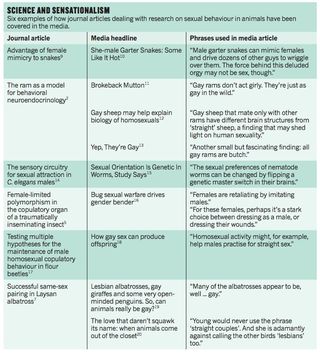
ChartoriginalAnnalee Newitz in io9:

Female Laysan albatrosses have a habit of building nests together and sharing child care responsibilities. Does this make them lesbians? Scientists say no. Still, there have been dozens of news headlines trumpeting the discovery of gay marriage among albatrosses. Now, to fight back, two scientists have done a study on how often the media misrepresents animal sexuality. Their findings are hilarious.

Writing today in Nature, biologists Andrew B. Barron and Mark J. F. Brown explain the scope of the problem:

The vast majority of studies reporting sexual contact between pairs of males or females were presented in media articles as documenting gay, lesbian or transgender behaviour. This is not innocuous – these are terms that refer to human sexuality, which encompasses lifestyle choices, partner preferences and culture, among other factors.

More worryingly, studies that invoked atypical sexual behaviour through genetic or hormonal manipulation were reported as inducing gay or lesbian behaviour or changing the animals' sexual orientation, even in the case of the nematode Caenorhabditis elegans, which has males and hermaphrodites, rather than males and females.

Humans have spent thousands of years heaping cultural ideas on top of our behavior. So when a human says she's a lesbian, it can mean a lot of things that are fairly complicated. When an animal has sex with another animal of the same sex, it doesn't really mean any more than when they have sex with an animal of the opposite sex. It's simply a variant on sexual behavior.

Barron and Brown call out one headline from New Scientist as a perfect example of this issue of translating dry scientific headlines into more exciting (but incorrect) ones:

For example, ‘Female-limited polymorphism in the copulatory organ of a traumatically inseminating insect' became ‘Bat bugs turn transsexual to avoid stabbing penises.'

The problem? Transsexuality is a human category.