Cancer-fighting Robots

From Harvard Magazine:
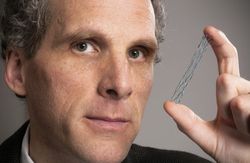
RN-DNA-closedBIn the not-so-distant future, a new kind of robot, one of the tiniest ever made, may have the ability to track down and destroy cancer cells. Films like Fantastic Voyage (1966) and Innerspace (1987) have long conjured fictional images of microscopic submarines or machinery that can travel inside the human body to cure ailments. Now Shawn Douglas, a research fellow at Harvard’s Wyss Institute for Biologically Inspired Engineering, is working on making that a reality. In a recent issue of the journal Science, Douglas described a method for creating tiny machines—roughly the size of a virus—out of strands of protein and DNA.

These devices, dubbed “DNA nanorobots,” are short hexagonal tubes made of interwoven DNA that can open along their length like a clamshell. At one end is a DNA “hinge,” and at the other, a pair of twisted DNA fragments that act as “latches” to hold the device shut. Inside the nanorobot, Douglas can enclose molecules of almost any substance, essentially turning it into a molecular “delivery truck” that can transport medication to specific cells in the body. “Our goal is to make tools that can zero in on malfunctioning cells,” he says. “We want to be able to fix things when they break—when cells go haywire due to cancer or other diseases where things just aren’t working correctly. To do that, I think it makes sense to master this kind of nanoscale construction.”

More here.

Friday, September 21, 2012

big is back

Armitage_294746h

Big history in all its guises has been inhospitable to the questions of meaning and intention so central to intellectual history. This is not simply for the banal reason that the big historians usually scrutinize such a superficial slice of recorded history at the end of their grand sweeps: the skin of paint on the top of the Eiffel Tower, in Mark Twain’s marvellous metaphor. Nor is it just because human agency dwindles in significance in the face of cosmological or even archaeological time. It is due, for the moment at least, to the essential materialism of the two main strains of big history, what we might call the biologistic and the economistic tendencies. The biologistic tendency is neurophysiologically reductive: when all human actions, including thought and culture, can be explained by brain chemistry, reflections approximate to reflexes. In the economistic strain, intellect is assimilated to interests. Each age simply “gets the thought that it needs”. For instance, whether it’s Buddhism, Christianity or Islam in the Axial Age, it’s all the same in the end: simply the product of the problem-solving capacity of some rather clever but needy chimps. In these regards, at least when it treats the questions of most concern to intellectual historians, deep history can appear to be somewhat shallow.

more from David Armitage at the TLS here.

the new burma

Schrank-1

That struggle was for democracy: for choice, human rights, and basic freedoms—ideas all the more enthralling for having always been denied. But fundamentally, that struggle had always been rooted in the granular. From underground or under the chronic scrutiny of intelligence agents and informers, Thar and Nigel and Suu Kyi and dissidents across Burma’s pro-democracy movement had fought through the darkest years of military rule for a thousand daily practicalities: to earn a degree without bribing an examiner, to have electricity, to keep the rice paddy land that your family had tilled for generations, to hold an identity card if you happened not to be part of the Buddhist majority, or, if you were, to scrap the system that required one in the first place. They wanted—they believed—they had a right to assemble in groups of more than five; to use the word “nightmare” if they chose to in the lyrics of their songs; to paste a poster on a wall and not face prison for the privilege. Their concerns, the concerns of Burma’s “most passionate dissidents,” Suu Kyi had written recently, reflected “the sense of freedom as something concrete that has to be gained through practical work, not just as a concept to be captured through philosophical argument.”

more from Delphine Schrank at VQR here.

Mare nostrum

Leggewie_mediterranean_468w

Since antiquity, the harbours of the Mediterranean have exerted a fascination over travellers and cultural researchers.[1] Visiting them today, however, one is presented with no more than a shadow – part run down, part picturesque – of their former grandeur and importance. These ports once lay at the heart of the first trans-Mediterranean phase of globalization, the central axis of which shifted to the Atlantic in the sixteenth century. Nowadays, the turnovers of even the larger Mediterranean harbours, such as Istanbul or Marseille, are easily outstripped by the container terminals in East Asia and the Gulf.[2] The Mediterranean serves as a passageway for around one third of all global transports of crude oil and natural gas. Its harbours are largely the destinations of cruise liners and ferries, just as its airports are the starting and end-points for beach holidays and city breaks.

more from Claus Leggewie at Eurozine here.

torture and parenting

Image

If parenting, even responsible parenting, made me feel like a torturer, it wasn’t exactly because I’m melodramatic or overwrought, but because the official torturers now conceive of themselves in the same terms as the parenting manuals. They, too, are technicians of the naked human personality. The “Human Resource Exploitation Manual,” a formerly classified government document used to instruct “anti-communist” Latin American security forces in the bad old 1980s, puts the theory of torture in terms that any reader of Healthy Sleep Habits, Happy Child can easily understand. The aim of torture, here called “questioning,” is “to induce regression in the subject,” i.e., to shatter that person’s identity by returning him to a state of infantile dependence on his captors. For this, violence itself is actually deemed inefficient and unnecessary (not to mention risky and unpopular once the news gets out). For some of us, the scandal of Abu Ghraib and the sadomasochistic sexual tortures of Guantanamo Bay (fake menstrual blood, simulated sex, et cetera) is less about our horror at torture than the broken taboos, the lack of restraint on display, in comparison to the refined techniques once taught in the School of the Americas.

more from Marco Roth at n+1 here.

The Strange World Of Charles Bukowski

From The Telegraph:

Bukowski1_2339971bCharles Bukowski is ideal for the latest in Reaktion's clever series of short critical appraisals of famous literary figures (called 'Critical Lives'), because the American's poetry and prose is combative and unsettling, and he was as eccentric as a box of frogs. David Stephen Calonne is a Bukowski scholar and this highly readable accounts informs and entertains without ever condescending. Bukowski's life was fascinatingly grisly. He was born in Germany on 16 August 1920 and referred to an upbringing in a “house of horrors” in Los Angeles where his apathetic mother did nothing in the face of the “imbecile savagery” of his warped father. Bukowski also remembered his father intentionally dressing him in Native American costumes so the street boys, who played cowboys, would beat him up. Violence and chaos surrounded, and sprung from, Bukowski for the rest of his life. There were volatile love affairs, a suicide attempt, depression, a spell in jail (he often carried a knife) and a host of physical ailments including his teeth falling out, dizzy spells, blackouts, alcoholism and the pain of repeated problems with haemorrhoids. It's little surprise to learn that he loved the BBC adaptation of Dennis Potter's The Singing Detective.

Oh, and Bukowski was investigated by The FBI.

Books such as Ham On Rye and screenplays such as Bar Fly made him beloved of millions and admired by people such as Tom Waits, Sean Penn, Bono, Bob Dylan and Matt Groening. Calonne spends much of the book looking at his novels and poems. He brings to life the American's ritual of writing, smoking and listening to classical music as he clanked away at the typewriter. Bukowski was clear that writing was a job and said that being a poet was employment, “like mopping a bar floor”. It's why he was dismissive of hippies, saying: “I had a job in the Post Office – 11½ hour nights with only 2 or 3 days off a month,. I was hardly a Flower Child”.

There have been biographies before – one of which provides the tale of Bukowksi stunning Arnold Schwarzenegger into silence by yelling at him “you make these sh-tty little movies, you're nothing special you megalomaniac piece of sh-t” – but this is a very readable summary of his career and Calonne does not shy away from discussing Bukowski's “self-mythologising”.

In one of his poems, Bukowski, who died of myelogenous leukaemia on 9 March 1994, wrote:

It's the order of things.
Each one gets a taste of honey,
then the knife

More here.

Ten Famed Literary Figures Based On Real-Life People

From Smithsonian:

Writers are often told to write what they know, so it should come as no surprise that many of the most famous characters in literary history are based on real people. Whether drawing inspiration from their spouses, friends and family, or finally, after decades worth of work, inserting themselves into the text, authors pull nearly every word and sentence from some element of reality, and most often, that element is people. Many characters, like Dean Moriarty in Jack Kerouac’s On the Road (based on real-life beatnik Neal Cassady), come to mind as obvious, but this list is for the real-life literary characters that do not get recognized enough, and who deserve as much credit as their fictional counterparts.

1. Prospero (The Tempest, 1611)/William Shakespeare

Considered Shakespeare’s last play, The Tempest is the artist’s farewell to the theater. Prospero is the island’s great magician, and with his powers he controls the tortoise-like character of Caliban and the sprite, spry Ariel. Prospero’s magic is in his books, and he decides when the Tempest should arrive, and who should come along with it. Sounds an awful lot like a playwright, doesn’t it? Prospero writes the script and wonders, like Shakespeare understandably would, what the future will be without him and his power. With frequent allusions to “the Globe” (the world, but also the name of Shakespeare’s theater), it is difficult to miss Prospero’s likeness to his great creator. Shakespeare critic and scholar Stephen Greenblatt says that the play brings up all of the “issues that haunted Shakespeare’s imagination throughout his career.” By writing himself into his final play, Shakespeare reminded the world of his own immortality as a public literary figure.

…3. Dorian Gray (The Picture of Dorian Gray, 1890)/ John Gray

A member of Oscar Wilde’s lively literary circle, John Gray was a lovely, boyish poet who could pass for a 15-year-old at age 25. In The Picture of Dorian Gray, Wilde describes the youth as a “young Adonis,” and judging by a black-and-white photo of John Gray, we can only suggest that he was not far off. Wilde met Gray in London at the home of a fellow artist, and, for a while was one of the author's many romantic affairs. The similarities between Gray the character and Gray the poet were striking. Like Dorian, John Gray found himself easily corrupted by the city and the title character’s first name came from an ancient Greek tribe, the Dorians, who were famous for perpetuating love among men. After the publication of The Picture of Dorian Gray people began to call John Gray Dorian, which made him so uncomfortable that he went so far as to sue a London publication for libel for making the association. The fate of this real-life hero was more dramatic than Wilde could have ever written: John Gray moved to Rome and studied for the priesthood.

More here.

Mohsin Hamid on Mira Nair’s film version of his novel, The Reluctant Fundamentalist

Amna R. Ali in Newsline:

Do you think the film has done justice to the novel vis-à-vis adaptation?

Mohsin_Hamid09-12I would put it slightly differently; I don’t think the job of a film is to be a novel on screen. A film is a work of art that is inspired by, in this case, a novel. A lot of people may say that the film didn’t do justice to the novel etc…but I would ask, is the film itself a good film? The reason why that is the right criterion to judge is because, a novel works by allowing the reader to do much of the imagining in their minds as they read it. It’s like going to a shop and buying tomatoes, onions, rice and lentils etc. and cooking a meal. It’s your shopping list. A film is like a meal that’s been cooked for you. You know what things look like, sound like – it’s all pre-imagined for you. So, it’s natural that readers will feel that the film may not do justice to the book, because the film is somebody else imagining, not you. But, I don’t think it’s the right lens to view the success of a film. What’s more important is, does the film work aesthetically? Are its politics in the right place? Does it have real integrity and power?

Did you have any input in the writing the script? Did the scriptwriters, William Wheeler and Ami Boghani coordinate with you at any point?

Mira tried to find someone from Hollywood to do it and had enormous difficulty, because she could find people who could do Wall Street, but they couldn’t do Pakistan, or people who could do Pakistan but couldn’t do Wall Street. Finally, she asked Ami Boghani, who at the time was Mira’s assistant and later became a co-producer of the film, and me, to write the first couple of drafts of the complete screenplay under her guidance. Ami and I produced a couple of drafts, after which Wheeler was hired to take it to a different level, since neither Ami nor I are trained screenwriters.

More here.

Death rituals in the animal kingdom

Jason G. Goldman at the BBC:

P00ysyd4While the details vary from tradition to tradition, the pattern is undeniable: humans seem to find value in guarding or watching the bodies of the deceased for some period of time following death.

But as we are beginning to discover, these behaviours may transcend species boundaries as well.

On 10 October 2003, a researcher watched as a female elephant named Eleanor collapsed. Her swollen trunk had been dragging on the ground while her ears and legs displayed evidence of another recent fall. One of her tusks was broken. An elephant named Grace, a member of a different social group, galloped towards Eleanor and tried to heave Eleanor back to her feet with her massive tusks, but Eleanor's back legs were too weak. The rest of the herd had moved on, but Grace remained with Eleanor at least another hour, until the sun disappeared below the horizon and night fell over Kenya. Eleanor died the following morning at 11am.

The parade of elephants that followed may – in some deep, fundamental way – be no different from those who gather to pay respects to a dignitary lying in state. Over the course of several days, the carcass was visited by five other elephant groups, including several families that were completely unrelated to Eleanor. The elephants sniffed and poked the body, touching it with their feet and trunks.

More here.

THE SEER OF PAKISTAN

Ali Sethi in The New Yorker:

Jamanto_optIn the south of Pakistan, where Hindus have lately been kidnapped for ransom and their daughters forcibly converted to Islam, Hindu families have started fleeing to India in trains. As they waved to their relatives from train windows, possibly for the last time, many Hindu girls contorted their faces and wept. To the north, near an industrial city, policemen poured paint over Koranic verses inscribed on Ahmadi graves. This is because Ahmadis have no right to Koranic verses in Pakistan: the law classifies them as non-Muslims and the media regularly portrays them as treacherous deviants from the faith. Still higher up, in a scenic mountain valley, Shias were pulled out of buses, lined up and shot dead by gunmen who may or may not belong to one of Pakistan’s many banned sectarian outfits. And just two weeks ago, not far from the pristine capital, a mob of a hundred and fifty Muslims ran after a mentally handicapped, low-caste Christian girl, wanting to burn her alive for having held in her hand—this was the rumor in her neighborhood—a singed Islamic manual.

In the rest of the country, the end of Ramadan was celebrated with the usual fanfare, show of color, and generosity of spirit.

The hysterical synchronicity of these happenings is typical of the Pakistan encountered nowadays in the news. It is also Manto-esque, which is to say that it feels like it could have been imagined, in exactly these tones, with just such a flatly ironic counterpoint for an ending, more than fifty years ago by a man called Saadat Hassan Manto, the writer whose centennial is being marked this year in Lahore amid an unshakeable and vaguely shaming sense of déjà vu.

More here.

Thursday, September 20, 2012

Naomi Wolf’s ‘Vagina’: No Carnations, Please, We’re Goddesses

Naomi_wolf_ap_img

Katha Pollitt in The Nation:

It’s hard to keep up with Naomi Wolf. She wants women to take their sexuality back from the patriarchy—but she’s written in praise of Muslim veiling and Orthodox Jewish headscarves. In a notorious New Republic piece, she argued that pregnant women are indeed fetal vessels and blamed abortion on drunken sluttery. In the last dozen years she’s gone from paid adviser to the Gore campaign to Tea Party fan to champion of Occupy who made headlines by claiming on scant evidence that local arrests were organized from on high by the federal government. She waited decades to attack Harold Bloom in a New York magazine cover story for “encroaching” on her thigh when he was her professor at Yale, but today she thinks what rape complainants need is for their names to be made public—especially the names of Julian Assange’s accusers, whom she mocks as women scorned, frail Victorian flowers, or both. Even leaving aside the 2006 interview in which she described a vision of herself transformed into a teenage boy who saw Jesus, it’s been a long, strange twenty-one years since The Beauty Myth.

Perhaps opinion-mongering, black-and-white thinking and relentless TMI are the price of remaining a world-class celebrity feminist. In any case, that process has surely reached a nadir withVagina: A New Biography. What a silly book!

By now the whole world knows that the story began when Wolf found her orgasms becoming merely clitoral, losing their “Technicolor” glow and feeling of oneness with the universe. Surgery for a trapped pelvic nerve fixed her right up, which led Wolf to her big “discovery”: like every other sentient part of the body, the vagina is connected, through the nervous system, to the brain! Furthermore, every woman’s wiring is different! No wonder a touch that thrills one woman doesn’t do much for another. That is actually a useful point: even today, women fake orgasms rather than ask for what they want, and men can be quick to judge if what worked with one girlfriend doesn’t work with the next. Unfortunately, having “discovered” that every woman is sexually unique, she proceeds to write 300 more pages arguing that they are all the same, i.e., just like Naomi Wolf.

Bourdieu’s Food Space

Bourdieu-Redux-Illustrated_loMolly Watson in Gastronomica:

In college, a Xeroxed copy of this graph (click image to enlarge) hung on our refrigerator, so taken were my housemates and I with Pierre Bourdieu’s assessment of food inDistinction: A Social Critique of the Judgement of Taste (1979). Food-specific coverage takes up just 23 pages of the 604-page tome, but it was the early 1990s and sex and gender and studies of the body were all the rage, so passages like “[t]astes in food also depend on the idea each class has of the body and of the effects of food on the body, that is, on its strength, health, and beauty… It follows that the body is the most indisputable materialization of class taste” blew us away, just as the notion that our love of Ethiopian food and yogurt said as much about our class, education, and social status as it did about our taste buds unnerved us.

I’ve long thought a chronological and geographic update is in order. When I finally pulled the well-thumbed copy of the book from the shelf and turned to page 186, I was struck again by the elegance of such complex information displayed so simply. Parts of the chart hold true 30-plus years later and a continent away (raw and recherché food can still be seen as the purview of those with more cultural than economic capital), and yet other elements have completely flip-flopped. Charcuterie, listed as a choice of those without economic or cultural capital, has, if nothing else, become recherché.

So here is a new take on Bourdieu’s “The food space” chart.

The Chutzpah of Hope, or Why Michael Chabon May Just Be the Perfect Writer for the Obama Age

A_250x375

Kathryn Schulz in New York Magazine:

Telegraph Avenue is about these two men, their families, and the rec­ord store they own, which is to say that it’s about black-white relations in America, the fate of small businesses, and the failure of fathers to stick around and raise their sons. No wonder the Obama appearance feels so right.

But there is another, deeper reason the cameo belongs in this book. In the 2004 speech that made Obama famous, he asked America a question: “Do we participate in a politics of cynicism, or do we participate in a politics of hope?” As a novelist, Michael Chabon is preoccupied with fallibility and weakness and, in the broadest sense, infidelity — our chronic failure to keep faith with each other and ourselves. Over and over, his books tell the story of the huge bang, short half-life, and inexorable decay of our dreams. And yet they are more buoyant, more in love with life, than just about anything else in contemporary American literature: escape artists in themselves, utterly unchainable by cynicism or despair. Chabon knows that whatever you are building is about to fall apart, but he will hand you the glue gun and say “Go for it.” Build and wreck and rebuild and re-wreck: That’s life, in the long view, and Chabon is a very patient man. Gonna keep on tryin’ / Till I reach my highest ground.

This is Chabon’s answer, in literary form, to Obama’s question to America. He does not have a solution to the problem of human fucked-up-ness. He does not believe that progress is inevitable, or that injustice can be ignored, or that we can outsource our issues to a higher power. He just has the very rare ability to sustain a non-naïve faith in goodness: ­vanilla without the vanilla. That requires a different kind of audacity, and more of it, than putting the president of the United States in the middle of your book. What Chabon has, to kinda quote that president, is the chutzpah of hope.

Telling Stories About the Stories We Tell

Gourevitch_37.5_selfCécile Alduy interviews Philip Gourevitch, in Boston Review:

Cécile Alduy: In your writing, you always find a balance between bringing in the long history to understand the way things develop over time and the very detailed hour-to-hour reporting on how it happened. How is your job different from that of an historian?

Philip Gourevitch: Above all, I suppose, to be a good historian you don’t necessarily have to be a good storyteller. You can be a good historian by virtue of making a contribution to the field without making a direct contribution to literature or public understanding. What historians, or anthropologists, or political scientists are interested in can overlap considerably with my interests, but the methodology, discipline, and long-term purpose are really different. I mean, I’m first and last a writer. If I weren’t writing about Rwanda right now, I’d be writing about something else entirely; and if I weren’t writing reportage, I would be writing fiction or plays. That’s not true of most historians who are going to write about Rwanda. They’re going to be coming at it as Rwandanologists. They’re going to be Africanists. They’re going to be Genocide Studies people. They’re going to be legal scholars or professors of postcolonial studies. And their frame of reference will be largely prescribed by that academic discipline—which is, I guess, as it should be.

Another big difference is that as a writer-reporter I’m not so concerned with making explicit reference to the existing literature, the way academic writers are. I’m much more interested in what I see and what I hear directly; I work in a documentary vein. For instance in recent conversations about current affairs with senior government officials in Rwanda I started to notice that a number of them, completely unprompted, began making references to late-nineteenth century events in Rwanda. That’s the time when Rwanda, which had been a proudly isolated country, was colonized, and lost its self-determination as a state. So I started mentioning this to the people I was interviewing, “You know, it’s funny that you are all bringing up that same period.” And they all expressed complete surprise. “Really, who else?” Then I would maybe mention someone, and they’d all say, “Really? He was talking about this?” So, I thought, that’s interesting, there’s this common reference that each person thinks is his own, and which each uses to make different points. And then I thought, well, is this history they are talking about reliable? Are these stories they’re telling me correct?

Thursday Poem

Nothing Twice
.
Nothing can ever happen twice.
In consequence, the sorry fact is
that we arrive here improvised
and leave without the chance to practice.
.
Even if there is no one dumber,
if you're the planet's biggest dunce,
you can't repeat the class in summer:
this course is only offered once.
.
No day copies yesterday,
no two nights will teach what bliss is
in precisely the same way,
with precisely the same kisses.
.
One day, perhaps some idle tongue
mentions your name by accident:
I feel as if a rose were flung
into the room, all hue and scent.
.
The next day, though you're here with me,
I can't help looking at the clock:
A rose? A rose? What could that be?
Is that a flower or a rock?
.
Why do we treat the fleeting day
with so much needless fear and sorrow?
It's in its nature not to stay
Today is always gone tomorrow
.
With smiles and kisses, we prefer
to seek accord beneath our star,
although we're different (we concur)
just as two drops of water are.
.
by Wislawa Szymborska
from Poems New and Collected 1957-1997
translated by Stanislaw Baranczak and Clare Cavanagh

The future of sex

From Salon:

Like_a_virgin_rect-460x307Imagine a woman being able to convert her own eggs into “pseudo-sperm” to fertilize herself – or perhaps instead an artificial womb that will carry the pregnancy to term while she continues her uninterrupted climb up the career ladder. Picture an older woman harvesting eggs from her own bone marrow to beat her ticking biological clock. Lifelong fertility, artificial wombs, “pseudo-sperm” – it sounds like the stuff of dystopian sci-fi, but a new book suggests it’s an inevitable reality. In “Like a Virgin: How Science Is Redefining the Rules of Sex,” author Aarathi Prasad writes, “This would be the great biological and social equalizer, a truly new way of thinking about sex. The question is not if it will happen, but when.” It isn’t just women who stand to benefit, either: Artificial wombs will actually give men “more potential than women to make a baby without the opposite sex,” says Prasad, a biologist and science writer. The takeaway is that “male plus female equals baby will no longer be our only path forward.”

The potential social implications of such advances are fascinating, but Prasad leaves those imaginings to the likes of Aldous Huxley. She’s more concerned with reviewing how our reproductive knowledge developed and what technologies are being developed — but in a relatively digestible way (more Jared Diamond than Jonah Lehrer). That said, Prasad cautions against future-panic, arguing that these developments could actually improve on current ethical quandaries around reproduction. For example, which is less morally fraught: stem cell eggs and artificial wombs, or paying a poor woman in a third-world country as an egg donor or surrogate mother?

More here.

Science can be improbably practical

From MSNBC:

As the impresario behind the Ig Nobel Prizes, Marc Abrahams is skilled at sniffing out what seems to be silly science — but often, there's a practical point behind the seeming silliness. Take Elena Bodnar's bra, for example. No, really. Take it. The bra that Bodnar invented can be converted into two filter masks in the event of a Chernobyl-style radiation leak or other emergency. That combination of laughability and practicality is what earned the Ukrainian physician an Ig Nobel Prize for Public Health in 2009. Abrahams recounts Bodnar's achievement and many other Ig-worthy innovations in a newly published book, “This Is Improbable,” and he'll be adding to the store on Thursday night during the 2012 Ig Nobel Prize ceremony at Harvard University. The webcast gets under way at 7:15 p.m. ET. There'll be paper airplanes flying, Nobel laureates officiating, and opera singers premiering a work titled “The Intelligent Designer and the Universe.” You can expect this year's prizes to highlight improbable but not totally impractical scientific findings such as these nuggets from “This Is Improbable”:

• Which ear is better for detecting when someone is telling a lie? If you can only afford to listen with one ear, make it the left one. A 1993 study published in the journal Neuropsychologia found that people did marginally better at discerning truth and lies when they heard it with the left ear only, as opposed to the right ear only. “It works, to the extent it works, only when a man does the lying,” Abrahams writes.

Which restroom stall should I choose? This is one of the great unresolved questions of sanitation science, along with the perennial controversy over toilet-paper orientation. One study suggested that in a four-stall restroom, the stalls on the end are most used. A different study saw indications that there was more action in the middle stalls. “The traces of these intellectual expeditions, deposited over many years in layers upon the ground, form a sort of mental compost,” Abrahams writes. “It sits, ripening, for future scholars to uncover.”

Abrahams chuckled when I brought up the restroom-stall research during a telephone chat this week. “I think back to that study, and it really doesn't matter,” he said. “There are lots of decisions in life you're asked to make every day where it doesn't matter. No matter what stall you choose, there's paper in all of 'em.” But in some cases, even Abrahams derives practical benefit from the strange studies that wind up on the Ig Nobel list. For example, Stanford University philosopher John Perry won the Literature Prize last year for his theory of structured procrastination. Simply put, if you're avoiding the No. 1 task on your to-do list, do task No. 2, 3 or 4 instead. It's even better if the unpleasant task on the top of your list is something you don't really need to do after all. “When I read that, it really did change things for me,” Abrahams said. “I adopted that as one of my personal guides every day. All day long, I'm cheating myself, happily.”

More here.

Nigel Warburton on Introductions to Philosophy

David Wolf in The Browser:

Sartre was also a novelist, and his novels are often described as philosophical. Do you think novels and novelists can really engage in philosophy, or is that only possible if you're a professional academic philosopher?

Nigel_WarburtonI think professional philosophers often like to make their subject smaller than it really is by setting arbitrary limits. As far as I'm concerned, philosophy is any human enterprise that involves critical thought about basic questions, like how we should live, what is the nature of reality and so on. Those questions can be asked seriously in all kinds of forms. So I don't see the subject as restricted to nerdy philosophical papers in refereed journals. Some of the most important contributions have been literary. If you think of classical philosophy, you have Plato's very literary dialogues, and Lucretius's On TheNature of Things is a poem! Some parts of TS Eliot's poems are very philosophical. Kierkegaard is a poetic writer who uses fictions, and Nietzsche uses aphorisms and poetry. They're all philosophers.

More here.

The Survival of the Fittists

Howard Wainer in American Scientist:

201284214999236-2012-09MacroWainerFAThe concept of replicability in scientific research was laid out by Francis Bacon in the early 17th century, and it remains the principal epistemological tenet of modern science. Replicability begins with the idea that science is not private; researchers who make claims must allow others to test those claims. Over time, the scientific community has recognized that, because initial investigations are almost always done on a small scale, they exhibit the variability inherent in small studies. Inevitably, as a consequence, some results will be reported that are epiphenomenal—false positives, for example. When novel findings appear in the scientific literature, other investigators rush to replicate. If attempts to reproduce them don’t pan out, the initial results are brushed aside as the statistical anomalies they were, and science moves on.

Scientific tradition sets an initial acceptance criterion for much research that tolerates a fair number of false positives (typically 1 out of 20). There are two reasons for this initial leniency: First, it is not practical to do preliminary research on any topic on a large enough scale to diminish the likelihood of statistical artifacts to truly tiny levels. And second, it is more difficult to rediscover a true result that was previously dismissed because it failed to reach some stringent level of acceptability than it is to reject a false positive after subsequent work fails to replicate it. This approach has meant that the scientific literature is littered with an embarrassing number of remarkable results that were later shown to be anomalous.

More here.