Flower Power, Redefined

From Smithsonian:

Cannonball-treeWith a stark white background and a splash of color, minimalist master Andrew Zuckerman has reinvented the way we look at the world around us. Known for his crisp photographs of celebrities and wildlife, Zuckerman turned his lens on the plant kingdom and captured 150 species in full bloom for his latest book Flower. The filmmaker/photographer culled through over 300 species—even visiting the Smithsonian Institution— to select plants both familiar and exotic. Armed with a 65 mega-pixel camera, Zuckerman’s images capture the color, texture and form of each flower and showcase them in a way never seen before. Smithsonian.com’s multimedia producer, Ryan R. Reed, recently interviewed Zuckerman to find out more about Flower and the creative process behind the images.

You’ve shot portraits of politicians, artists and endangered species. Why did you decide to turn your camera on flowers?

I am very interested in the natural world, honestly not as a scientist or from any intellectual place, but from a visual perspective. I am really interested in this precise translation of the natural world. I like photography as a recording device. It’s the best possible two-dimensional representation of 3D living things that we have.

More here. (Note: Do take a look at the ravishing pictures representing a magnificent collage of art and science)

Wednesday, December 12, 2012

Philip Roth Finally Gets a Life

From The Atlantic:

RothWhen Philip Roth decided to retire, I felt a personal sense of loss. Roth wasn't the first author to hang up the typewriter prematurely. Roth himself cites E.M. Foster's decision, at 40, to stop writing fiction. Kurt Vonnegut tried to retire with Timequake, though he couldn't stick with the plan. Romance writer LaVyrle Spencer retired in 1997. “I want to be free!” she said in a phone call to Publishers Weekly, adding that she wanted to spend time with her grandchildren and travel with her husband.

But this was different. This was Philip Roth! The author whose long-term, absolute devotion to his work was perfectly expressed by his young alter ego Nathan Zuckerman in The Ghost Writer: “Purity. Serenity. Simplicity. Seclusion. All one's flamboyance and originality reserved for the grueling, exalted, transcendent calling…This is how I will live.” Like so many people, I've been reading and rereading his work over the years, and it seemed that a writer as strong and obsessive as Roth, only death could halt his production. I depended on him to keep focused entirely on his vocation, decade after decade, no matter how stupid or vulgar American culture grew. Roth couldn't be dumbed down or replaced. You expect ordinary, hard-working mortals to retire from their dull and unfulfilling jobs to Floridian condos and Hawaiian shirts. But not Roth. Retirement was for the rest of us. So I walked around, went to work, and spent time with the family, all the while vaguely thinking: What will I do without any new Roth books? Then the answer came to me: I'll go and live my life. The only real changes: 1. I'll now just reread his books; and 2. Roth will finally get to live his life. Retirement, I saw, is perhaps Roth's last chance to balance the life-work equation.

More here.

100-year-old scientific hoax

From MSNBC:

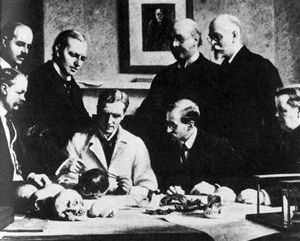
HoaxThe Piltdown Hoax is one of the most successful scientific frauds in history. In December 1912, British paleontologist Arthur Smith Woodward and amateur antiquarian Charles Dawson announced to the world that they'd found an amazing early human fossil in Piltdown, England. The curious specimen had a humanlike skull with an apelike jaw. Given the scientific name Eoanthropus dawsoni, it was more commonly called Piltdown Man. Dawson and Woodward also reported that alongside Piltdown Man were a number of other stunning finds: stone tools, fossilized mammals and even an elephant bone. In 1916, Dawson claimed to have found more remains at a second site nearby. According to Stringer's telling, some scientists did question the Piltdown Man bonanza discovery. They didn't immediately cry fraud, but suspected the fossil deposits had simply been mixed together over time, suggesting the ape jaw and humanlike skull weren't actually associated. But it wasn't until the 1950s that Piltdown Man was exposed for the fraud it was. Chemical studies found the fossil to be less than 50,000 years old, not 1 million years as Dawson and Woodward claimed. Further testing showed the skull was likely from a modern human and the jaw probably from a modern orangutan.

More here.

Norway and the Prisoners of Peace

F. J. Riopelle in Agni:

Imagine a country, I used to tell my students of Norwegian at Harvard, of beautiful fjords and impressive coastal scenery, of extensive petroleum reserves, natural gas, minerals, lumber, seafood and fresh water, with universal health care, subsidized higher education, a comprehensive social security system and very low unemployment rate. Imagine the world’s most well-functioning and stable country, where parents have forty-seven weeks of paid parental leave and prison cells look like budget hotel rooms. And—as a final flight of Lennonesque imagination—imagine all the people, or at least some, living life in peace in these cells—because they are pacifists.

That broke the spell, didn’t it? Norway’s great international reputation is well deserved, but a student of its language and culture should also learn about the embarrassments lurking behind this utopian image of Norway. There is, for instance, a curious lack of statistics for the number of convicted pacifists in Norway—the country that administers the Nobel Peace Prize, presumably because Alfred Nobel found it even more peaceful than Sweden—a curious lack of information, on Wikipedia and elsewhere, but I know, as John Lennon says in one of his protest songs, that I’m not the only one.

According to European Bureau for Conscientious Objection’s 2011 report, Norway is one of three European countries that “prosecute conscientious objectors repeatedly for their continued refusal to serve in the army” (the other countries are Greece and Turkey). “Each year, between one-hundred and two-hundred conscripts refuse to perform both military and substitute service,” and they are thereby penalized.

I am one of them—a conscientious objector, not only to the military service, but also to the substitute civilian service. In a report of 2002, researchers in Norway’s Ministry of Defense acknowledged that the civilian service, which is labor typically performed in healthcare institutions, retirement homes, kindergartens and schools, is little more than a “sanction of men who refuse to perform military service.” It “costs about 230 million Norwegian kroner per year,” and is “obviously unprofitable based on socio-economic considerations.”

Civilian service is thus a disguised penalty for pacifism; it exists in order to make it more difficult to refuse military service.

More here.

Is it a “game-changing” moment for cancer?

Mary Elizabeth Williams in Salon:

Immunology has traditionally been the redheaded stepchild of cancer research. Using the body’s own defenses to fight off tumors has long been considered a dubious proposition – too difficult to execute, too controversial because of the resources required to search for answers. The past few years, however, have brought real results that have translated into a variety of new approaches. The Gardasil vaccine is now routinely used on young men and women to prevent the HPV virus, which in turn can help prevent cervical cancer. Doctors at Roswell Park Cancer Center are now working on a cancer vaccine. And in 2011, the FDA approved Ipilimumab, a drug therapy for melanoma unlike any other that’s come before, one that works with the body’s immune system.

Five months after Ipilimumab went on the market, I was one of those patients who needed it. The malignant cancer that I had undergone surgery for a year before had returned with a vengeance, metastasized into my lungs and under my flesh. At Stage 4, I was facing a diagnosis that generally offers patients only a few months to live. I could do the math. I was looking at my birthday and Thanksgiving and Christmas but maybe not Easter. Summer was definitely a long shot. That’s when my oncologist recommended a clinical trial that was combining Ipilimumab with a new investigational drug. I jumped in as soon as possible, entering the first cohort of the first phase, a place in research where, as a doctor later admitted to me, “We usually expect a lot of losses.” Instead, three months later, I was cancer-free. Just like Emma Whitehead.

More here. And here is the story by Denise Grady in the New York Times:

Emma Whitehead has been bounding around the house lately, practicing somersaults and rugby-style tumbles that make her parents wince.

It is hard to believe, but last spring Emma, then 6, was near death from leukemia. She had relapsed twice afterchemotherapy, and doctors had run out of options.

Desperate to save her, her parents sought an experimental treatment at the Children’s Hospital of Philadelphia, one that had never before been tried in a child, or in anyone with the type of leukemia Emma had. The experiment, in April, used a disabled form of the virus that causes AIDS to reprogram Emma’s immune system genetically to kill cancer cells.

The treatment very nearly killed her. But she emerged from it cancer-free, and about seven months later is still in complete remission. She is the first child and one of the first humans ever in whom new techniques have achieved a long-sought goal — giving a patient’s own immune system the lasting ability to fight cancer.

More here. And here is more by Andy Coghlan in New Scientist:

Augmented immune cells have made an impressive impact on the survival of people with leukaemia.

Thirteen people with a form of the cancer called multiple myeloma were treated with genetically engineered T-cells, and all improved. “The fact we got a response in all 13, you can't get better than that,” says James Noble, CEO of Adaptimmune in Abingdon, UK, which developed the treatment.

Cancers often develop because T-cells have lost their ability to target tumour cells, which they normally destroy. To retune that targeting, a team led byAaron Rapoport at the University of Maryland in Baltimore engineered T-cell genes that coded for a receptor on the cell's surface. They extracted T-cells from each person, then inserted the engineered genes into these cells and re-injected them.

The souped-up cells were better able to recognise proteins called NY-ESO-1 and LAGE-1, found on myeloma cells but not healthy ones. All 13 people also had the standard treatment for multiple myeloma, which boosts white blood cell count.

Three months after the injection, 10 of the 13 were in remission or very close to it – a 77 per cent response rate – and the others showed drastic reduction in their cancer. Standard treatment alone gives a response rate of between 33 and 69 per cent. The work was presented this week at the American Society of Hematology Annual Meeting in Atlanta, Georgia.

More here. [Thanks to Margit Oberrauch.]

The God Glut

Frank Bruni in the New York Times:

Bruni_new-articleInline-v2Every year around this time, many conservatives rail against the “war on Christmas,” using a few dismantled nativities to suggest that America muffles worship.

Hardly. We have God on our dollars, God in our pledge of allegiance, God in our Congress. Last year, the House took the time to vote, 396 to 9, in favor of a resolution affirming “In God We Trust” as our national motto. How utterly needless, unless I missed some insurrectionist initiative to have that motto changed to “Buck Up, Beelzebub” or “Surrender Dorothy.”

We have God in our public schools, a few of which cling to creationism, and we have major presidential candidates — Rick Perry, Michele Bachmann, Rick Santorum — who use God in general and Christianity in particular as cornerstones of their campaigns. God’sinitial absence from the Democratic Party platform last summer stirred more outrage among Americans than the slaughter in Syria will ever provoke.

God’s wishes are cited in efforts to deny abortions to raped women and civil marriages to same-sex couples. In our country God doesn’t merely have a place at the table. He or She is the host of the prayer-heavy dinner party.

More here.

a writing cabin, shed, hut…

08stone-walden-img-blog427

It is not uncommon to mark one’s reservation at the Arcadian settings so favored by these huts, as if marking the shape of distance that serious writing must take – distance from technology, from the modern, from the city. Is there not something politically anachronistic about the image of the water trough outside Heidegger’s hut, where a spring unfailingly flows? Is anything like a progressive stance compatible with such atavistic images? Is there not a tacit repudiation of a different style of critique – the sort leveled by (say) the peripatetic eye of a Walter Benjamin at our urban Arcades? Politically perhaps Hannah Arendt had it right: “Flight from the world … can always be justified as long as reality is not ignored but acknowledged as the thing that must be escaped.” (“Men in Dark Times”). More broadly, might it not be that the bland space of the cabin, like the yellow pad, or the laptop screen, is something of a neutral ground making room for the refiguration or transformation of the real – not a flight in the sense of repudiation of the real, rather relief from the pressure of its organizing principles.

more from David Wood at The Opinionater here.

negative thinking

Think-positive-Jean-Julius-ph-Creative-Commons-Attribution-Share-Alike-3-0-Unported-300x198

“So many tangles in life are ultimately hopeless that we have no appropriate sword other than laughter,” said Gordon Allport, an American psychologist and one of the founders of the study of personality. Scientists have studied the effects of mirthful laughter, positive thinking and optimism on feelings of self-worth, mood disorders and depression since the 1970s. In The Antidote: Happiness for People Who Can’t Stand Positive Thinking British author and Guardian feature writer Oliver Burkeman takes issue with “the cult of optimism,” the convention that phony smiles, jovial laughter and positive thinking is a surefire path to happiness. Positive thinking is the problem, not the solution, Burkeman teaches us. He believes people have come to trust that a “Don’t worry. Be happy” attitude toward life is the only route to contentment. People seem to be of the conviction that if you have negative thoughts and see your own limits, you cannot be happy. So to be happy we must set out on a journey that changes your mindset from negative and inhibited to enthusiastic, fervent and animated. We are told to visualize our dreams and goals, eliminate the word “impossible” from our vocabulary and put a big fabricated smile on our physiognomy. All that actually can lead to unhappiness, Burkeman says.

more from Berit Brogaard at The Berlin Review of Books here.

Nothing More American: On James M. Cain

1355174440

WITH ITS ARTLESSLY PERFECT FIRST SENTENCE — “They threw me off the hay truck about noon” — James M. Cain’s The Postman Always Rings Twice drew a line in the sand as defiant as any in literature since The Adventures of Huckleberry Finn. Not unlike that novel, Postman forced an untamed populist voice onto more exalted cultural sensibilities; of course, nothing could be more American. Cain is a major figure of American fiction’s shadow pantheon, the one that includes not Fitzgerald, Hemingway, and Steinbeck but Paul Bowles, William Burroughs, and Philip K. Dick, with Faulkner, Miller, and Pynchon wandering the demilitarized zone between. The most commercially successful of them, Cain was also the most spiritually bleak, finding his calling late and fast in the Depression’s depths after a fitful career as a journalist. The Postman Always Rings Twice (1934) was a sensation and scandal, at the other end of the bookshelf from The Grapes of Wrath (1939): Tom Joad may have been riding that hay truck too, but Frank Chambers is the one who got thrown off.

more from Steve Erickson at the LA Review of Books here.

Princeton’s nanomesh nearly triples solar cell efficiency

Grant Brunner in Extreme Tech:

Chou_Chou-solar-color-comparison_400-300x141Led by Stephen Chou, the team has made two dramatic improvements: reducing reflectivity, and more effectively capturing the light that isn’t reflected. As you can see by the illustration below by Dimitri Karetnikov, Princeton’s new solar cell is much thinner and less reflective. By utilizing sandwiched plastic and metal with the nanomesh, this so-called “Plasmonic Cavity with Subwavelength Hole array” or “PlaCSH” substantially reduces the potential for losing the light itself. In fact, it only reflects about 4% of direct sunlight, leading to a 52% higher efficiency than conventional, organic solar cells.

PlaCSH is also capable of capturing a large amount of sunlight even when the sunlight is dispersed on cloudy days, which results in an amazing 81% increase in efficiency under indirect lighting conditions when compared to conventional organic solar cell technology. All told, PlaCSH is up to 175% more efficient than conventional solar cells. As you can see in the image above, the difference in reflectivity between conventional and PlaCSH solar cells is really quite dramatic.

The gold mesh that sits on top is incredibly small. It’s only 30 nanometers thick. The holes in the mesh are a mere 175nm in diameter. This replaces the much thicker traditional top layer made out of indium-tin-oxide (ITO). This is the most important part of the innovation. Because the mesh is actually smaller than the wavelength of the light it’s trying to collect, it exploits the bizarre way that light works in subwavelength structures.

More here.

A requiem for Syria

Amal Hanano in Foreign Policy:

Viewfromthetop2_0Being from Aleppo is unlike being from anywhere else in the world. We walked on history so deep, we did not understand it — we simply learned to call this place, older than all others, home. We grew up knowing that our insignificant existence was the thinnest layer of dust on the thick geological strata of empires, kingdoms, and generations, which lived within our stone walls. We knew without doubt, from an early age, that we were nothing but a blink of our city's eye.

When you are from Aleppo, you are plagued with a predicament: Nothing here will ever change. For some people, living in the city that never changes becomes too difficult. The city's permanence and your inability to make a mark on it push you to eventually leave Aleppo, trading comfort for change. After you leave, no matter where you are in the world, you know that Aleppo is there, waiting exactly as you left it. Instead, it is you who returns in a reinvented form each time you come home — a university graduate, a bride, a mother, each time proudly carrying your new ideas and identity to your patiently waiting city.

In Aleppo, you grow up worrying if your legacy will ever be worthy of your city's. But you never worry about your city's legacy — which we thoughtlessly leaned on — for how could we, ever, change Aleppo's legacy?

More here.

Wednesday Poem

A Visit to Ballimaran
For Prashant Keshavmurthy

No longer that alleyway
of unending pastimes,
no longer that couplet
stalling a game of dice,
no longer that foot’s pause
driving a thought home,
no longer that inspiration
turning words into kites.

Ballimaran is a busy stream
of shoes hung for sale.

No sound of hoofs
or sight of palanquins
reigns over subjects.
The colour of footwear
automobile horns
mark the citizen’s health.

I ask a man, “Which way
to Ghalib’s home?”
His eyebrows arch, “Why didn’t
you ask him the address? A
name is not enough.”

I go my way, telling Ghalib’s
ghost, “Your name has lost its
address, your address
its neighbourhood. Is that how
one gains the world?”

The guard in blue uniform
is wearier than stone. He ushers
me inside the ancient
courtyard made up to date.

I stare at forgeries on stage
set to befool children. It isn’t easy
to veil someone’s neglected
absence.

The telephone booth is an offstage
parody of callers in prosaic
hurry. No one carves like old times a
turn of phrase to perfection.

I ponder. No one anymore counts
blessings with wine. No one
disobeys god with irony. No one braids
the night with couplets.

As light sinks a girl drifts in to read
the dilemmas of Ghalib’s heart. The azan
distracts her glued eyes. She
leaves folding a secret in her dupatta.

It is time to go home. Time to leave
what is left of Ghalib in
Qasim Jaan. To leave what is left
of Qasim Jaan in Ballimaran.

Names that belong to a different
time when the air breathed
verses. And a couplet weighed heavier
than a pair of shoes.

Manash Bhattacharjee
Delhi, 12/8/2012

Tuesday, December 11, 2012

Excerpt: ‘The Intellectual and His People’ by Jacques Rancière

Factory-poster

From Chapter 6: Factory Nostalgia (Notes on an Article and Various Books)”:

All those big posters stuck on the walls, showing a strapping worker rising to the sky against a background of factories, dissolve into shreds, in the sun and in the water. Masino furious at seeing his face so proud upon the walls of the streets, while he has to go out looking for work.

– Pavese, ‘Idleness’

But the worst enemy was the people. They didn’t want to be people. ‘People yourself!’ they said to Monsieur Beaulieu. We’re just as good bourgeois as you.

– Romain Rolland, Le Théâtre du people

‘I don’t see myself as a prole. And I don’t see myself as a super- intellectual, not like a student. I’m not . . . Well, I’m here’, Christine says on the steps of the Beaubourg Centre. And Eric explains, ‘We walk about one way and another, sit on the benches and watch people pass by.’

The mute voice of a subjectivity seeking to assert itself in the abbreviations of a rarefied vocabulary? A look returned from the great voyages of proletarian self-consciousness to the zero degrees of palpable certainty: ‘That’s it, we’re here, it’s like that?’ Or rather a new trick of the dialectic that underpins the look of the observer in this apparent return to the simplicity of its origins, that little nothing that, at its birth, is identical with its being?

Beaubourg, according to popular wisdom, is like a factory. Is that the reason why this is the place to come today, to seek among these ‘non-workers of the non-working class’ those voices of alienation and rebellion that Sorbonne students looked for at Billancourt twelve years ago? At that time, as a bourgeois break- ing ranks and an activist breaking with gauchisme, this was where he saw the miracle: the working class, the concept in flesh and blood. Enough to sicken those petty bourgeois whom Marcuse, Gorz, Mallet and Belleville had led to dream of a new class of auto- mated white-collar workers, or manual workers trapped by credit and bourgeois comfort. A CGT secretary who hailed from the old Faubourg Saint-Antoine had turned the key to the fortress: the key of the evident identity of the worker in his labour and his struggle.

The European Union and the Habsburg Monarchy

Habsburg_krakow_468w

Robert Cooper in Eurozine:

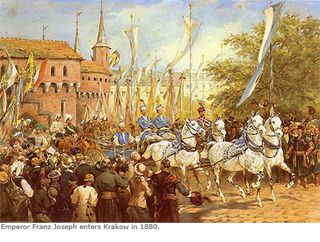
The Habsburg Monarchy lasted five centuries. It was both solid and flexible; it aroused genuine affection among its citizens. But it vanished in a puff of smoke. Should we expect the European Union, shallow in history and unloved by those it serves, to do better?

To be fair, it was more than a puff of smoke. The bullets from Gavrilo Princip's revolver killed the Arch-Duke Franz Ferdinand and his wife Sofia. What killed the Habsburg Monarchy was the four years of pounding by artillery that followed. This brought death and ruin to the old Europe; in Russia it brought revolution and tyranny, and in Germany regime change accompanied by failed revolution, then inflation and depression, and finally world war and genocide.

What arose from the ashes? The answer is: the European Union and NATO. It is the EU and its resemblance to the Habsburg Monarchy that is the subject of this essay, but something needs first to be said about NATO which was and is its indispensable partner.

A Note to You, Should You Be Thinking of Asking Me to Write For You For Free

John Scalzi in Whatever:

1. No.

2. Seriously, are you fucking kidding me?

3. Did you wake up this morning and say to yourself “You know what? A New York Timesbestselling author who has been working full-time as a writer for two decades, who frequently rails at writers for undervaluing their own work in the market and who is also the president of a writers organization that regularly goes after publishers for not paying writers adequately is exactly the person who will be receptive, through lack of other work or personal inclination, to my offer”? And if you did, what other dumb things did you do with your morning?

4. If you didn’t know that I was that guy in point three, and just asked me to write for free for you because, I don’t know, you heard I was a writer of some sort, although you couldn’t say what kind or what I had done, then what you’re saying to me is “Hey, you’re a warm body with an allegedly working brain stem and no idea of the value of your work — let me exploit you!” I want you to ask yourself what in that estimation of me would entice me to provide you with work, starting with the fact that you didn’t do even the most basic research into who I was. Rumor is, it’s not hard to find information about me on the Internet! Just type “John Scalzi” into Google and see!

5. If you try to mumble something at me about “exposure,” I’m going to laugh my ass off at you. Explain to me, slowly, what exposure you possibly think you could give me with your Web site or publication. Please factor in that this Web site gets up to 50,000 visitors on a normal day — with spikes into the hundreds of thousands when I write something particularly clicky — and that it’s regularly ranked one of the top ten book sites and top 100 entertainment sites on the entire Web by Technorati (at this moment, number five and sixty four, respectively).

More here.

James Wood and the Realism of “Mind”

The-fun-stuff-james-wood

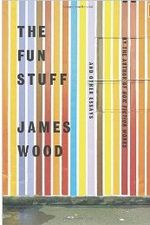
For the writer, the emphasis on the inner life of characters is itself an implicitly moral act, a least when the writer is able to fully and successfully exploit the inherent capacity of fiction to reveal the inner life. It is moral because, as Wood says of Jane Austen’s fiction, such an act allows characters and their behavior to be “gradually comprehended and finally forgiven” (“Comedy and the Irresponsible Self”). It is the writer’s success in exploiting this capacity that constitutes the “art” of the work, but the art is in the service of the moral goal. (Perhaps Wood might retort that the two cannot be so easily separated.) For the reader, the novelist’s skill in achieving this sort of compelling psychological realism allows us to inhabit a perspective other than our own, to become aware of “the thoughts of other people.” If Wood doesn’t exactly attribute a didactic moral purpose to fiction, he certainly does suggest throughout his reviews and critical essays, as well as in How Fiction Works, that the moral effects of our encounter with other “minds” are what make fiction valuable to us a form or genre of writing. And if Wood doesn’t much dwell on the “cultural” issues or implications of the fiction he considers, his selection of works or writers to assess and the consistent return to his core concerns related to narrative strategy and the portrayal of character signal a clear desire to “instruct” readers how to read fiction for what it most importantly has to offer.

more from Daniel Green at The Quarterly Conversation here.

The War on Drugs Is a War on Human Nature

Lewis Lapham in The Nation:

ScreenHunter_69 Dec. 11 14.38The question that tempts mankind to the use of substances controlled and uncontrolled is next of kin to Hamlet’s: to be, or not to be, someone or somewhere else. Escape from a grievous circumstance or the shambles of an unwanted self, the hope of finding at a higher altitude a new beginning or a better deal. Fly me to the moon, and let me play among the stars; give me leave to drown my sorrow in a quart of gin; wine, dear boy, and truth.

That the consummations of the wish to shuffle off the mortal coil are as old as the world itself was the message brought by Abraham Lincoln to an Illinois temperance society in 1842. “I have not inquired at what period of time the use of intoxicating liquors commenced,” he said, “nor is it important to know.” It is sufficient to know that on first opening our eyes “upon the stage of existence,” we found “intoxicating liquor recognized by everybody, used by everybody, repudiated by nobody.”

The state of intoxication is a house with many mansions. Fourteen centuries before the birth of Christ, the Rigveda finds Hindu priests chanting hymns to a “drop of soma,” the wise and wisdom-loving plant from which was drawn juices distilled in sheep’s wool that “make us see far; make us richer, better.” Philosophers in ancient Greece rejoiced in the literal meaning of the word symposium, a “drinking together.” The Roman Stoic Seneca recommends the judicious embrace of Bacchus as a liberation of the mind “from its slavery to cares, emancipates it, invigorates it, and emboldens it for all its undertakings.”

More here.

the coldscape

Kbc_final

More than three-quarters of the food consumed in the United States today is processed, packaged, shipped, stored, and sold under artificial refrigeration. The shiny, humming stainless steel box in your kitchen is just the tip of the iceberg, so to speak—a tiny fragment of the vast global network of temperature-controlled storage and distribution warehouses cumulatively capable of hosting uncounted billions of cubic feet of chilled flesh, fish, or fruit. Add to that an equally vast and immeasurable volume of thermally controlled space in the form of shipping containers, wine cellars, floating fish factories, international seed banks, meat-aging lockers, and livestock semen storage, and it becomes clear that the evolving architecture of coldspace is as ubiquitous as it is varied, as essential as it is overlooked.

more from Nicola Twilley at Cabinet here.