Literature in the Fortress

Hasan Altaf in The Millions:
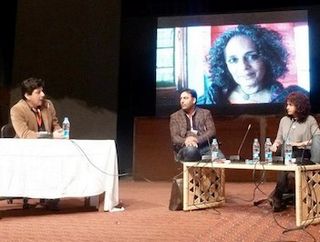
ScreenHunter_150 Mar. 26 15.40From the beginning, there was a hint of the surreal to the recent Lahore Literary Festival, but it was difficult to put my finger on the root of that unsettling emotion, especially given the overall aura of triumph. A response to similar events elsewhere in the region – the most famous in Jaipur; the most rivalry-inducing, for the last four years, in Karachi – the festival seemed its own victory party, a massive and successful gambit in Lahore’s bid to reclaim its title as the “cultural capital” of Pakistan. The excitement had Lahore full of visitors, Mall Road festooned with banners, the Alhamra Arts Council packed with people, and in the middle of all that buzz it seemed almost churlish to have the suspicion that something odd was at work.

The urge to make every(positive)thing in Pakistan somehow momentous and meaningful is dangerous – every movie cannot offer a revitalization or renaissance of cinema, every political party cannot, at this point, be logically seen as a rebirth of hope – but there was some predictable truth to the truism that the festival played, in Lahore, a very different role than it would have in a country or a city where such events are more common and less fraught. In part of course this had to do with the unimaginable odds that Pakistan has been facing, not just the most dramatic and terrible (including for example two recent, devastating attacks on the Hazara community, in Quetta; including for example the murder of a prominent doctor and his twelve-year-old son, in broad daylight as they drove to the boy’s school — located on the same Mall Road where we were gathered — simply because they were Shia), but also the more subtle and insidious, which have been at work far longer than any terrorist.

More here.

The Arms Race to Grow World’s Hottest Pepper Goes Nuclear

Spencer Jakab in the Wall Street Journal:

“Please don't try this at home—we are fully trained idiots.”

ScreenHunter_149 Mar. 26 15.30So went the disclaimer back in October 2010 as British pepper aficionado Leo Scott and his friend Lok Chi uploaded a video of themselves eating a new variety, the Naga Viper, developed by fellow grower Gerald Fowler. The warning was warranted as the two very experienced chiliheads sweated, writhed in pain and briefly lost the ability to speak after each chewing and swallowing one of the bright-red capsicums.

A month later, the Guinness Book of World Records certified what Mr. Scott found out the hard way: The Naga Viper was the hottest pepper ever grown, measuring 1.382 million Scoville Heat Units, the standard measure of heat. That is 225 times as hot as a jalapeño can sometimes be.

Unfortunately for Mr. Fowler, his record wouldn't stand for long. Four months later, the Naga was dethroned by the Trinidad Scorpion Butch T, the current record holder, at 1.464 million Scovilles.

“I was shocked,” says Mr. Scott, who lives near Bristol, England. “You've got this global community of chili growers who are competing ruthlessly with each other.”

The Naga itself had just surpassed the Infinity Chili, which held the official record for a mere eight months.

More here. [Thanks to Ruchira Paul.]

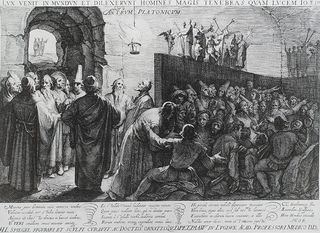
Plato, Our Comrade?

Platon_Cave_Sanraedam_1604

Daniel Tutt reviews Alain Badiou's Plato’s Republic: A Dialogue in 16 Chapters, in Berfrois:

In what Alain Badiou calls his “hyper-translation” of Plato’s Republic, we are taken into the world of Plato’s classic dialogue on politics and justice, sped up to the pace of a 21st century New York street corner. Socrates and his sophist interlocutors speak a gritty street talk that is both accessible and familiar, despite the fact they invoke intellectual figures from St. Paul to Jacques Lacan to the mathematician Paul Cohen.

Amanda, a female character who didn’t exist in Plato’s original is introduced. In some ways, Amantha plays the hysteric to Socrates, always pushing him to his next insight. Susan Spitzer’s translation of Badiou’s French into English is clearly designed for an American audience, one that resonates particularly well for a post #occupy angst that is hungry for political change. Badiou has refreshed Plato in more ways than bringing his own philosophical language into it; his wager is larger than this. He manages to traverse the twentieth century’s aversion to Plato as a totalitarian philosopher, and leaves us with new ways of understanding Plato’s conception of truth, the ideal form of government, and how we must participate in politics today.

Not surprisingly, there have already been critics of Badiou’s translation. Two interrelated problems have been raised. The first is that his translation breaks the formal rules of translation to such a degree that the original meaning of the text has lost its significance. But this critique is inadequate at face value because Badiou’s hyper-translation is forthright in its intention of taking Plato’s concepts and modifying them into his own lexicon. For example, the soul becomes the Subject, God becomes the big Other, and the true life becomes Truth – all terms that comport to Badiou’s own canon. Badiou’s hyper-translation is a type of translation that used to be common amongst philosophical texts, whereby the purpose of the translation was not to preserve the static meaning of the original, but to enable the text to speak to us in the present.

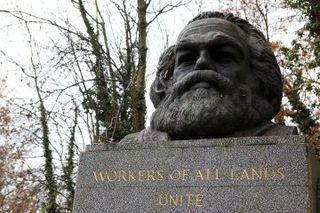
Marx’s Revenge: How Class Struggle Is Shaping the World

Karl_marx_0325

Michael Schuman in Time:

Karl Marx was supposed to be dead and buried. With the collapse of the Soviet Union and China’s Great Leap Forward into capitalism, communism faded into the quaint backdrop of James Bond movies or the deviant mantra of Kim Jong Un. The class conflict that Marx believed determined the course of history seemed to melt away in a prosperous era of free trade and free enterprise. The far-reaching power of globalization, linking the most remote corners of the planet in lucrative bonds of finance, outsourcing and “borderless” manufacturing, offered everybody from Silicon Valley tech gurus to Chinese farm girls ample opportunities to get rich. Asia in the latter decades of the 20th century witnessed perhaps the most remarkable record of poverty alleviation in human history — all thanks to the very capitalist tools of trade, entrepreneurship and foreign investment. Capitalism appeared to be fulfilling its promise — to uplift everyone to new heights of wealth and welfare.

Or so we thought. With the global economy in a protracted crisis, and workers around the world burdened by joblessness, debt and stagnant incomes, Marx’s biting critique of capitalism — that the system is inherently unjust and self-destructive — cannot be so easily dismissed. Marx theorized that the capitalist system would inevitably impoverish the masses as the world’s wealth became concentrated in the hands of a greedy few, causing economic crises and heightened conflict between the rich and working classes. “Accumulation of wealth at one pole is at the same time accumulation of misery, agony of toil, slavery, ignorance, brutality, mental degradation, at the opposite pole,” Marx wrote.

A growing dossier of evidence suggests that he may have been right.

the man without a country

1364079267

WHEN THE TIME CAME for Kurt Vonnegut to title his final book, not so long before he stumbled in his Park Avenue home, banged his head, and died, the writer turned, in a Rosebud touch, to a short story he read as an Indianapolis schoolboy during the Great Depression. That story was “The Man Without A Country” by Edward Everett Hale, first published anonymously in the December 1863 issue of a young Atlantic Monthly. Nowhere in Vonnegut’s long 2005 goodbye letter, A Man Without A Country, does he explain the title reference. This was less an oversight than a bonus message for the dwindling number of Americans who remember when Phillip Nolan, the sea-born hero-in-exile of Hale’s story, stood for allegorical and literal deracination of the saddest sort. The sly reference strikes twice. It evokes lost innocence and nostalgia for another age. Then drives a letter-opener through their heart. Vonnegut’s title also winks at the vicissitudes of literary fame. When Hale died at age 87 in 1909, he enjoyed an international reputation nearly as warm and deep as Vonnegut’s in 2005. After his once formidable output dried to a trickle, the New York Critic ranked Hale the 11th-greatest living American author.

more from Alexander Zaitchik at the LA Review of Books here.

wood for roth

Philip-Roth-010

Did anyone believe Philip Roth when, earlier this year, he announced that he was retiring from writing? Of all contemporary novelists, he is the one who has made writing seem a necessary and continuous act, inextricable from the continuities and struggles of being alive. For Roth, narration and self seem to have been born together; and, therefore, must die together, too. More than any other modern novelist, he has used fiction as confession and the displacement of confession: his ranters, complainers and alter egos, from Portnoy to Zuckerman to Mickey Sabbath all seem Rothian, even when they are only standing in for Roth. He has made his Newark childhood, his loving, annoying parents, his Jewishness, his sexuality, his very writing life familiar and vivid to millions of readers. He has seemed to need fiction as a kind of relentless performative report, which is why, in recent years, the great novels (Sabbath’s Theater, American Pastoral) have shared space with much weaker works, and why he has been so productive; the fiction at once urgent and a bit scrappy, as necessary as art and as helpless as life.

more from James Wood at The Guardian here.

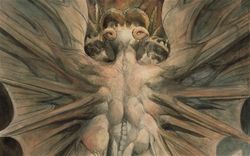
The Science of Monsters

From The Telegraph:

Kaplan_main_2516071bIn its simplest forms, we like to put a face and a form to things we don’t understand. So when ships disappeared, unaccountably, from calm seas, their loss used to be ascribed not to technical failure but to monsters who came up from the bottom of the ocean to drag the unsuspecting mariners ever downwards. Those who lived in areas prone to earth tremors and eruptions put them down to angry monsters rising up from the ground to wreak havoc. Religion, inevitably since it represents our attempt to make some sort of sense of the world around us and the random blows of fate, came to endorse some of these formulations. The devil, the ultimate monster in Christianity, so very nearly a match for God, especially if we are craven enough to believe the empty promises he whispers in our ear, is the face and form put to the abstract reality that many call evil. He also used to be employed to explain natural disasters and illness.

So the rise of science should have pensioned off such beasts, and to some extent that is the case, as Kaplan demonstrates. However, it hasn’t quite dispensed with our propensity to want to believe such tales. Faced, for example, with the horror of Myra Hindley’s crimes, many retreated even in our secular, scientific times into labelling her as the devil incarnate. And even though we may now be able to send cameras down to the floor of the deepest oceans, we still can’t quite banish the notion that there may still be something lurking there. Can’t or won’t? Kaplan is especially good on how modern literature and especially cinema continues to feed our appetite for being frightened by monsters. The whole Jaws phenomenon – books and films that echo in the memory of anyone taking a dip off an unfamiliar beach – can be seen, he argues, as a modern manifestation of older fears of Charybdis, Leviathan and the Giant Squid, the creatures of “mysterious fathoms”. And the age-old association of man and monster which allows buried human insecurity to be projected onto mythical creatures has, he suggests, found a whole new dimension in the cinematic cult of alien invaders from outer space. Alienated humans express their disconnection with the rest of society by believing in aliens.

More here.

into the woods

Fig-03-b-Brandis-samples-from-the-Kew-GardensPS_reorganized

Around 1800, the condition of German forests was known to be pitiable. Centuries of exploitation had resulted in the depletion of most of the original species, and their replacement with faster-growing trees, such as birch, willow, or alder, was meant to address the constant timber famine. These local initiatives were gradually taken over by more systematic operations, aiming at establishing productive forests as quickly as possible.5 The extensive planting of these artificial forests was informed by the work of the forest scientists who, influenced by the liberal economic theories of Adam Smith, had devised the “soil rent theory.” This held that forests, understood as the combination of land value, timber capital, and silvicultural expense, should yield an annual interest.6 As a result, German forestry developed a highly rational approach in which all these elements were meticulously calculated to maximize profitability. This approach was eventually termed “scientific forestry” and put German forestry at the forefront of the profession.

more from Dan Handel at Cabinet here.

Tuesday Poem

Last Signature
—a Ghazal for Agha Shahid Ali

Our wounds are labeled forgettable, Shahid
Our life before death is imperceptible, Shahid

Billboards proclaim, Kashmir is Paradise
God has a reason to be chimerical, Shahid

Memory threads tied to wooden roses at Khankah
Even simple prayers are incomprehensible, Shahid

At Naseem Bagh, your presence was ephemeral
Now, your absence is a spectacle, Shahid

Our laments are lost, our yearnings are empty
Grief— the source of all that is poetical, Shahid.

Fear has abandoned us; Hope has embraced us
Yours are the best words in our arsenal, Shahid

Your last illegible scrawl, an emblem of your name
The Beloved Witness, grievable, indelible, Shahid

by Ather Zia
from Kashmir Walla

The Marvels in Your Mouth

Mary Roach in The New York Times:

FaceDr. Van der Bilt and his colleagues have laid claim to a strange, occasionally repugnant patch of scientific ground. They study the mouth — more specifically, its role as the human food processor. Their findings have opened up new insights into quite a few things that most of us do every day but would rather not think about. The way you chew, for example, is as unique and consistent as the way you walk or fold your shirts. There are fast chewers and slow chewers, long chewers and short chewers, right-chewing people and left-chewing people. Some of us chew straight up and down, and others chew side-to-side, like cows. Your oral processing habits are a physiological fingerprint.

Dr. Van der Bilt studies the neuromuscular elements of chewing. You often hear about the impressive power of the jaw muscles. In terms of pressure per single burst of activity, these are the strongest muscles we have. But it is not the jaw’s power to destroy that fascinates Dr. Van der Bilt; it is its nuanced ability to protect. Think of a peanut between two molars, about to be crushed. At the precise millisecond the nut succumbs, the jaw muscles sense the yielding and reflexively let up. Without that reflex, the molars would continue to hurtle recklessly toward one another, now with no intact nut between. To keep your he-man jaw muscles from smashing your precious teeth, the only set you have, the body evolved an automated braking system faster and more sophisticated than anything on a Lexus. The jaw knows its own strength. The faster and more recklessly you close your mouth, the less force the muscles are willing to apply. Without your giving it a conscious thought. Teeth and jaws are impressive not for their strength but for their sensitivity, Dr. Van der Bilt has found. Chew on this: Human teeth can detect a grain of sand or grit 10 microns in diameter. A micron is 1/25,000 of an inch.

More here.

Monday, March 25, 2013

Sunday, March 24, 2013

Gish Jen goes from novels to nonfiction

Peter Cocchia in the Boston Globe:

ScreenHunter_147 Mar. 24 15.20Here in Cambridge’s Neighborhood Nine is your typical American house, a two-story affair in cadet grey; winters have tarnished its wrought-iron fence, the gate of which is fixed open; a flagstone path leads from there to the door. Inside, you’ll find a mixture of old and new: at one end of the kitchen, a squarish black Jotul stove, at the other, a stainless-steel fridge. Then there is Gish Jen.

Standing barefoot in the kitchen, she looks as though she could be only slightly taller than the doorbell out front. Since 1991, she has published four acclaimed novels and a prize-winning collection of short fiction, to say nothing of the fellowships she has held, the grants she has received. In a town filled with literary giants, among them Alice Hoffman, Ha Jin, and Jennifer Haigh, Jen stands tall.

“What’s most unique about Gish’s voice is that it’s humorous,” says Jennifer Ho, associate professor in the University of North Carolina-Chapel Hill’s Department of English and author of the forthcoming “Understanding Gish Jen.” “There’s a certain type of witty irony that she employs. She also has a generosity of spirit toward all of her characters, even the ones who aren’t particularly likable.”

In February, Jen made her nonfiction debut with “Tiger Writing,” an accessible work of scholarship that, without expressing a preference, contrasts the Eastern narrative with the Western, the interdependent self with the independent.

More here.

For Sri Lanka, More Empty Words

Samanth Subramanian in the New York Times:

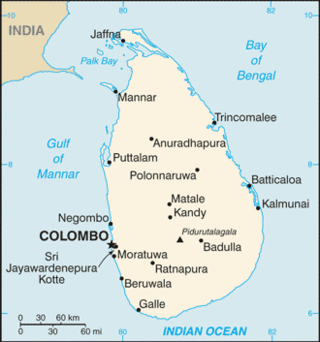
Ce-mapA year ago, when I was living in Colombo, Sri Lanka, I arranged to meet a friend for lunch, to talk about a Sri Lankan journalist who had gone missing and was presumed dead. By the time we met, my friend had a new mission: to keep another Sri Lankan safe.

The previous day, the United Nations Human Rights Council had passed aresolution “noting with concern” the Sri Lankan government’s refusal to address serious allegations of human rights abuses by the military — carried out during and after its 26-year war with the separatist Tamil Tigers, which ended with a defeat of the rebel group in 2009.

A number of Sri Lankan activists had flown to Geneva to lobby for the resolution, to their government’s dismay. Commentators on state TV lambasted them as villains and traitors, and word reached several of the activists that they might not want to rush back home. So my friend and I spent that sticky afternoon trying to help one get to safety, assembling the papers she needed to apply for a visa to the United States, where she hoped to lie low for a while.

Yesterday, the Human Rights Council voted once again to urge the Sri Lankan government to investigate “alleged violations of human rights” — or what The New York Times called “polite diplomatic shorthand” for the growing evidence that government soldiers killed tens of thousands of civilians in their bloody campaign to crush the rebels. But as with last year’s resolution, this year’s Council vote offers little more than hand-wringing.

While they carry symbolic weight, such resolutions may, in fact, be impeding progress rather than facilitating it.

More here.

Maybe Bangladesh has become the country Jinnah wanted to create

Abdul Majeed in the Express Tribune:

DownloadWhen East Pakistan decided to break away from West Pakistan in 1971, one of the leading factors was the lack of importance accorded by West Pakistan’s bureaucracy and intelligentsia towards the other part of the country. It is not a surprise that the attitude did not change even after the separation of Pakistan’s two wings.

Pakistan’s textbooks are still silent over the atrocities committed by our armed forces and their proxies in 1971. Although West Pakistan may have forgotten, but the people who were subjected to the inhumane behaviour just because they dreamt of a better future, remember it all too vividly.

The demand to prosecute the criminals from 1971 has reverberated in Bangladesh over the years. It was only in 2009 that an International Crimes Tribunal (ICT) was formed set up in Bangladesh to investigate and prosecute suspects for the atrocities committed in 1971.

It should also be noted that Bangladesh’s original constitution of 1972 had declared it a secular state but the 8th amendment, put in effect by General Hussain Mohammad Ershad in 1988, declared Islam as the state religion of Bangladesh. Interestingly, Pakistan also had a notorious 8th amendment to the 1973 constitution, giving the power to dissolve assemblies to the president, put in place by none other than General Ziaul Haq.

In 2010, the Bangladesh High Court declared the constitutional amendment that had changed the country’s secular status to that of an Islamic state was done without lawful authority.

More here.

The Brains of the Animal Kingdom

New research shows that we have grossly underestimated both the scope and the scale of animal intelligence. Primatologist Frans de Waal on memory-champ chimps, tool-using elephants and rats capable of empathy.

Frans de Waal in the Wall Street Journal:

OB-WU671_032213_G_20130322184659Who is smarter: a person or an ape? Well, it depends on the task. Consider Ayumu, a young male chimpanzee at Kyoto University who, in a 2007 study, put human memory to shame. Trained on a touch screen, Ayumu could recall a random series of nine numbers, from 1 to 9, and tap them in the right order, even though the numbers had been displayed for just a fraction of a second and then replaced with white squares.

I tried the task myself and could not keep track of more than five numbers—and I was given much more time than the brainy ape. In the study, Ayumu outperformed a group of university students by a wide margin. The next year, he took on the British memory champion Ben Pridmore and emerged the “chimpion.”

How do you give a chimp—or an elephant or an octopus or a horse—an IQ test? It may sound like the setup to a joke, but it is actually one of the thorniest questions facing science today. Over the past decade, researchers on animal cognition have come up with some ingenious solutions to the testing problem. Their findings have started to upend a view of humankind's unique place in the universe that dates back at least to ancient Greece.

More here.

The Song of Ourselves

From New Statesman:

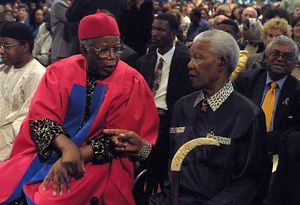
An essay by Chinua Achebe first published in 1990 on creativity, Conrad and why he was not the “grandfather of African literature”.

AchebeI did not see myself as an African to begin with. I took sides with the white men against the savages. In other words, I went through my first level of schooling thinking I was of the party of the white man in his hair-raising adventures and narrow escapes. The white man was good and reasonable and intelligent and courageous. the savages arrayed against him were sinister and stupid or, at the most, cunning. I hated their guts. But a time came when I reached the appropriate age and realised that these writers had pulled a fast one on me! I was not on Marlowe's boat steaming up the Congo in Heart of Darkness. I was one of those strange beings jumping up and down on the river bank, making horrid faces. That was when I said no, and realised that stories are not innocent; that they can be used to put you in the wrong crowd, in the party of the man who has come to dispossess you.

And talking of dispossession, what about language itself? Does my writing in the language of my coloniser not amount to acquiescing in the ultimate dispossession? This is a big and complex matter I cannot go into fully here. Let me simply say that when at the age of 13 I went to that school modelled after British public schools, it was not only English literature that I encountered there. I came in contact also for the first time in my life with many boys of my own age who did not speak my Igbo language. And they were not foreigners, but fellow Nigerians. We lived in the same dormitories, attended the same morning assembly and classes, and gathered in the same playing fields. To be able to do all that we had to put away our different mother tongues and communicate in the language of our colonisers. This paradox was not peculiar to Nigeria. It happened in every colony where the British put diverse people together under one administration. Some of my colleagues, finding this too awkward, have tried to re-write their story into a straightforward case of oppression by presenting a happy monolingual African childhood brusquely disrupted by the imposition of a domineering foreign language. This historical fantasy demands that we throw out the English language in order to restore linguistic justice and self-respect to ourselves.

My position is that anyone who feels unable to write in English should follow their desires. But they must not take liberties with our history. It is simply not true that the English forced us to learn their language. On the contrary, British colonial policy in Africa and elsewhere emphasised again and again its preference for native languages. We see remnants of that preference today in the Bantustan policies of South Africa. We chose English not because the British desired it, but because having tacitly accepted the new nationalities into which colonialism had grouped us, we needed its language to transact our business, including the business of overthrowing colonialism itself in the fulness of time. Now, that does not mean that our indigenous languages should now be neglected. It does mean that these languages must coexist and interact with the newcomer now and in the foreseeable future. For me, it is not either English or Igbo, it is both.

More here.