Going Clear: Scientology, Hollywood & the Prison of Belief

From The Guardian:

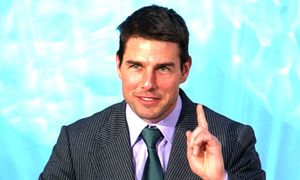
Tom-Cruise-at-opening-of--010Lafayette Ronald Hubbard published Dianetics: The Modern Science of Mental Health in 1950. According to Bridge Publications, itself an arm of the Church of Scientology, at least 80 million copies have been sold. That sounds possible, if you credit the church's claim that it has 8 million members. But then you have to reckon with more objective external estimates that the membership might be just 50,000, while one assumes that the book sales are inflated by deliberate bulk-buying by church members. So what are you going to believe?

…All of which would begin to bear out the thought that there can't be that many people who would fall for the preposterous doctrine of Scientology, or be ready to tolerate the ugly behaviour of its church. Admittedly, that is a personal opinion, but on your behalf I have acquired it from reading Lawrence Wright's account of this phenomenon. His book is admirably judicious and thoroughly researched (within the limits of secrecy or paranoia imposed by the church), but I often had the feeling that Wright himself was uncertain whether this was fit material for a sober book of non-fiction, or would he collapse in fits of helpless laughter and tears at the stuff he was obliged to report? Even if the church had just three remaining members (Tom Cruise, John Travolta and its present leader, David Miscavige), it would be a demented venture worthy of Mel Brooks or Monty Python. When I say on your behalf, I have to tell you, and remind myself, that fears of litigation are preventing publication of this book in Britain. Both the Church of Scientology and Tom Cruise have a history of being litigiously aggressive, and both have denied the veracity of a great deal of the material in the book.

More here.

‘Jeopardy’-winning super computer headed to college

From MSNBC:

JeopardyWatson, the supercomputer famous for beating the world's best human “Jeopardy!” champions, is going to college. IBM is announcing Wednesday that it will provide a Watson system to Rensselaer Polytechnic Institute, the first time the computer is being sent to a university. Just like the flesh-and-blood students who will work on it, Watson is leaving home to sharpen its skills. Course work will include English and math. “It's a big step for us,” said Michael Henesey, IBM's vice president of business development. “We consider it absolutely strategic technology for IBM in the future. And we want to evolve it, of course, thoughtfully, but also in collaboration with the best and brightest in academia.”

Watson is a cognitive system that can process massive amounts of data, including natural language. To beat “Jeopardy!” champions in 2011, it was fed the contents of encyclopedias, dictionaries, books, news dispatches and movie scripts. For its medical work, it takes in medical textbooks and journals. After it takes in data, Watson can provide information like a “Jeopardy!” answer, a medical diagnosis or an estimate of financial risk. IBM, which provided a grant to RPI to operate Watson for three years, sees it as a way to help it boost the computer's cognitive capabilities. Artificial intelligence researchers at RPI want to do things like improve Watson's mathematical ability and help it quickly figure out the meaning of new or made-up words. They want to improve its ability to handle the torrent of images, videos and emails on the Web, the sort of unstructured information that is overwhelmingly fueling the data boom.

More here.

Thursday Poem

How to Listen

I am going to cock my head tonight like a dog
in front of McGlinchy's Tavern on Locust;
I am going to stand beside the man who works all day combing
his thatch of gray hair corkscrewed in every direction.
I am going to pay attention to our lives
unraveling between the forks of his fine-tooth comb.
For once, we won't talk about the end of the world
or Vietnam or his exquisite paper shoes.
For once, I am going to ignore the profanity and
the dancing and the jukebox so I can hear his head crackle
beneath the sky's stretch of faint stars.

by Major Jackson
from Leaving Saturn, 2002

The University of Georgia Press, Athens, GA

Wednesday, January 30, 2013

That Cuddly Kitty Is Deadlier Than You Think

Natalie Angier in the New York Times:

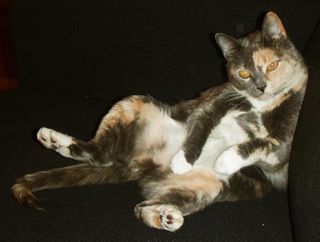
ScreenHunter_111 Jan. 30 16.10In a report that scaled up local surveys and pilot studies to national dimensions, scientists from the Smithsonian Conservation Biology Institute and the Fish and Wildlife Service estimated that domestic cats in the United States — both the pet Fluffies that spend part of the day outdoors and the unnamed strays and ferals that never leave it — kill a median of 2.4 billion birds and 12.3 billion mammals a year, most of them native mammals like shrews, chipmunks and voles rather than introduced pests like the Norway rat.

The estimated kill rates are two to four times higher than mortality figures previously bandied about, and position the domestic cat as one of the single greatest human-linked threats to wildlife in the nation. More birds and mammals die at the mouths of cats, the report said, than from automobile strikes, pesticides and poisons, collisions with skyscrapers and windmills and other so-called anthropogenic causes.

Peter Marra of the Smithsonian Conservation Biology Institute and an author of the report, said the mortality figures that emerge from the new model “are shockingly high.”

More here.

The Scariest Environmental Fact in the World

Bryan Walsh in Time:

CoalAs the data show, China is now burning almost as much coal as the rest of the world — combined. And despite impressive support from Beijing for renewable energy and a dawning understanding about the dangers of air pollution, coal use in China is poised to continue rising, if slower than it has in recent years. That’s deadly for the Chinese people — see the truly horrific air pollution in Beijing this past month — and it’s dangerous for the rest of the world. Coal already accounts for 20% of global greenhouse-gas emissions, making it one of the biggest causes of man-made climate change. Combine that with the direct damage that air pollution from coal combustion does to human health, and there’s a reason why some have called coal the enemy of the human race.

Of course, there’s a reason why coal is so popular in China and in much of the rest of the world: it’s very, very cheap. And that’s why, despite the danger coal poses to health and the environment, neither China nor many other rapidly growing developing nations are likely to turn away from it. (If you really want to get scared, see this report from the International Energy Agency — hat tip to Ed Crooks of the Financial Times — which notes that by 2017, India could be burning more importing as much coal as China.) That’s likely to remain the case in poor nations until clean energy can compete with coal on price — and that day hasn’t come yet.

The EIA’s chart also shows how limited President Obama’s ability to deal with climate change really is. The reality is that the vast majority of the carbon emissions to come will be emitted by developing nations like China — and much of that will be due to coal.

More here.

‘I feel like a stranger where I live’

Jane Kelly in The Telegraph:

Multicultural_2464391b“When you go swimming, it’s much healthier to keep your whole body completely covered, you know.” The Muslim lady behind the counter in my local pharmacy has recently started giving me advice like this. It’s kindly meant and I’m always glad to hear her views because she is one of the few people in west London where I live who talks to me.

The streets around Acton, which has been my home since 1996, have taken on a new identity. Most of the shops are now owned by Muslims and even the fish and chip shop and Indian takeaway are Halal. It seems that almost overnight it’s changed from Acton Vale into Acton Veil.

Of the 8.17 million people in London, one million are Muslim, with the majority of them young families. That is not, in reality, a great number. But because so many Muslims increasingly insist on emphasising their separateness, it feels as if they have taken over; my female neighbours flap past in full niqab, some so heavily veiled that I can’t see their eyes. I’ve made an effort to communicate by smiling deliberately at the ones I thought I was seeing out and about regularly, but this didn’t lead to conversation because they never look me in the face.

I recently went to the plainly named “Curtain Shop” and asked if they would put some up for me. Inside were a lot of elderly Muslim men. I was told that they don’t do that kind of work, and was back on the pavement within a few moments. I felt sure I had suffered discrimination and was bewildered as I had been there previously when the Muslim owners had been very friendly. Things have changed. I am living in a place where I am a stranger.

More here.

“Pride & Prejudice” Forever

1359252082

So widely admired is Pride and Prejudice today that it’s impossible to imagine our literary landscape without it. And yet, nothing about the novel’s genesis pointed to such a remarkable future. Its early publishing history was in fact downright unpromising. According to the records of Cassandra, Austen at age 20 began drafting the book in October 1796, possibly in epistolary form, under the original title First Impressions. She finished it in August 1797. In November 1797, Austen’s father, always one of his daughter’s greatest fans, wrote a letter inviting the prominent London publisher Thomas Cadell to look at a “Manuscript Novel,” probably First Impressions. Cadell declined the offer, and a few years later the title “First Impressions” appeared on a novel by Margaret Holford. More than 15 years later Thomas Egerton, the publisher of Sense and Sensibility, published Austen’s revised version of Pride and Prejudice, “lop’t and crop’t” as she put it in a letter to Cassandra, and sporting the new title, most likely borrowed from a passage in Cecilia by Frances Burney, the most famous female novelist of the late 18th century. As a market-savvy author, Austen no doubt also favored the alliterative cadence of “pride and prejudice,” something she had employed to good effect in the title of her first published book. Egerton bought the rights to Pride and Prejudice (the only time Austen allowed this) and paid Austen £110 for her labors, £40 short of what she had asked. Details about Pride and Prejudice’s early print runs are imprecise — the scholar Jan Fergus estimates that there were roughly 1,000 first editions and 750 second editions before the end of the year; a third edition was published in 1817.

more from Audrey Bilger and Susan Celia Greenfield at the LA Review of Books here.

the knotted-up man

130204_r23105_p465

Richard and Pat Nixon, two essentially shy people who would now both be a hundred years old, first met onstage. Each had a role in the Whittier Community Players’ 1938 production of “The Dark Tower,” by George S. Kaufman and Alexander Woollcott. Pat Ryan, a pretty twenty-five-year-old teacher at Whittier High, came to “The Dark Tower” with a smidgen of theatrical experience. Born in a Nevada mining-town shack and toughened by a hardworking childhood on a farm in Artesia, she had helped put herself through the University of Southern California with occasional jobs as a movie extra. But it wasn’t any real enthusiasm for the stage that brought her to the Community Players. As her daughter Julie explains in a biography of her mother, she went only because the assistant superintendent at Whittier High asked her to, and she “found it difficult to say no to a school administrator.” Nixon took to the whole business and several months later was back for more. At the urging of the Players’ director, he went on to appear in “Night of January 16th,” a melodrama by Ayn Rand in which the text itself chewed the scenery. Pat Nixon, in later years, gave three memorably painful on-camera performances opposite Richard Nixon. In each of them, she was without lines of her own, but her mute, stricken countenance became an important part of the historical impression being created and preserved.

more from Thomas Mallon at The New Yorker here.

the truth is far murkier

Cover00

On November 18, 1978, more than nine hundred members of Peoples Temple church died in a mass suicide-murder in Jonestown, Guyana. It was a horrific epilogue to the dream of building a socialist utopia in the South American jungle. Jim Jones, the Temple’s charismatic leader, had promised his flock deliverance from America’s ills: racism, sexism, capitalism, and economic burnout. Instead, he controlled his city like a police state, enforcing a paranoid regimen of loyalty oaths, suicide drills, and brainwashing. His drug-fueled sermons, beginning in the evening and lasting until 2 or 3 AM, spelled out a doomsday scenario of CIA invasion and torture. “They will not leave us in peace,” he warned his followers, but in the end it was Jones himself, the Temple’s beloved “father,” who rallied his people to their own destruction. Peoples Temple remains an enigma despite having spawned a cottage industry of books, documentaries, and scholarly studies. The most fundamental misrepresentation is that it was a cult and Jonestown the apotheosis of a collective death wish. Jim Jones, with his painted sideburns and aviator sunglasses, has become a totem of ’70s kitsch, the apocalyptic flipside to Jimmy Carter and Alfred E. Neuman. The truth captured in Leigh Fondakowski’s Stories from Jonestown, a new collection of interviews with survivors of Peoples Temple, is far murkier.

more from Jeremy Lybarger at Bookforum here.

Drawn to perfection

From The Independent:

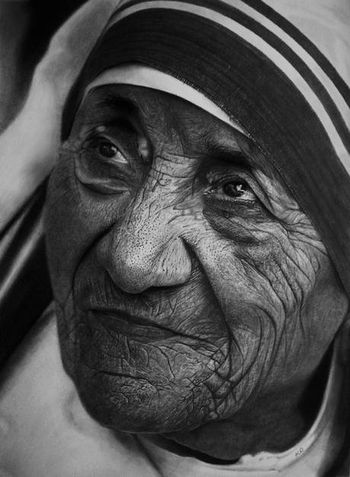
Mother-TeresaDo not adjust your screen: the above portraits are not the products of a camera but the steady hand and sharp pencil of a London artist with an astonishing eye for detail. Kelvin Okafor is one of the leading proponents of a niche but flourishing school of photo-realists. The Middlesex fine art graduate is winning plaudits and prizes for his pencil drawings, each of which can take 100 hours over a three-week period to produce. From his home in Tottenham, North London, Okafor, 27, has created portraits of celebrities as diverse as Amy Winehouse, Tinie Tempah and Mother Teresa, shown here, commanding as much as £10,000 for each work. He has more than 50 commissions to his name and awards including the Catherine Petitgas Visitors’ Choice Prize, part of the National Open Art Competition. Okafor’s portraits have also been exhibited at The Mall Galleries in central London as part of the Threadneedle Prize Exhibition. Before the artist puts the pencil to paper, he spends days analysing his source photographs, concentrating first on the eyes before using thousands of pencil strokes to build detail showing every pore and hair.

More here.

Research prize boost for Europe: Graphene and virtual brain

From Nature:

Two of the biggest awards ever made for research have gone to boosting studies of the wonder material graphene and an elaborate simulation of the brain. The winners of the European Commission’s two-year Future and Emerging Technologies ‘flagship’ competition, announced on 28 January, will receive €500 million (US$670 million) each for their planned work, which the commission hopes will help to improve the lives, health and prosperity of millions of Europeans. The Human Brain Project, a supercomputer simulation of the human brain conceived and led by neuroscientist Henry Markram at the Swiss Federal Insitute of Technology in Lausanne, scooped one of the prizes. The other winning team, led by Jari Kinaret at Chalmers University of Technology in Gothenburg, Sweden, hopes to develop the potential of graphene — an ultrathin, flexible, electrically conducting form of carbon — in applications such as personal-communication technologies, energy storage and sensors.

The size of the awards — matching funds raised by the participants are expected to bring each project’s budget up to €1 billion over ten years — have some researchers worrying that the flagship programme may draw resources from other research. And both winners have already faced criticism. Many neuroscientists have argued, for example, that the Human Brain Project’s approach to modelling the brain is too cumbersome to succeed (see Nature 482, 456–458; 2012). Markram is unfazed. He explains that the project will have three main thrusts. One will be to study the structure of the mouse brain, from the molecular to the cellular scale and up. Another will generate similar human data. A third will try to identify the brain wiring associated with particular behaviours. The long-term goals, Markram says, include improved diagnosis and treatment of brain diseases, and brain-inspired technology. “It’s a very bold project,” says Mark Fishman, president of the Novartis Institutes for BioMedical Research in Cambridge, Massachusetts, adding that it will “no doubt spawn unexpected new research directions, probably to help develop supercomputing and medical robotics”. No one knows exactly what data will be needed to simulate the human brain, he says — “the Human Brain Project will help us find out”.

More here.

Wednesday Poem

Telefunken

From years of toiling I went colour-blind,
emitted sparks, was thumped, gave up the ghost.

Now drab and dumb I stand out in the street
and can’t help thinking of that empty mask

that’s gazed and gaped at me so shamelessly.
Parroted me. Adored. Left me kaputt.

The jerk. That he could fail to see how I
ate time so lifelike from his eyes. The jerk.

I gave him Hitchcock, tits, disasters, sikhs.
I gave him eyes. Fierce fighting. Northern lights.

But I’m thrown out. And he sees more TV.
Soon I’ll be carted off and dead hours by

the kilo will die with me at the rubbish tip.

by Menno Wigman
from Dit is mijn dag
publisher: Prometheus, Amsterdam, 2004
translation: 2007, John Irons

Read more »

Tuesday, January 29, 2013

Time for some royal prerogative – let’s give Kate’s child a choice

Huw Price in The Conversation:

ScreenHunter_110 Jan. 29 16.05My main puzzle – about everyone who expresses views on these matters, from the most loyal monarchists all the way through to staunch republicans – is their apparent indifference to Baby Cambridge’s own views about whether she or he wants to be Queen or King of England (let alone Australia).

“That’s ridiculous,” you say, “The baby is not even born yet – how could we ask her?” Of course not. She (let’s call her she) won’t be in a position to decide for the best part of twenty years, at the very least – and perhaps not for years after that, since many young people don’t make up their minds how they wish to spend their lives until well into their twenties or thirties.

But that’s the point. Baby Cambridge’s peers – your children and grandchildren – will all have the opportunity that we now take for granted, to decide for themselves what to make of their lives. On what possible grounds are we, or the state, or even her parents, entitled to deny the same opportunity to her?

That’s the real question we should all be asking, in my view, and it is not about discrimination in favour of royal children. It is about discrimination against them – about the denial in their case of basic freedoms we take for granted for everyone else.

More here.

love mountain

Huey-1

Leonard Knight’s first message to the world—GOD IS LOVE—was supposed to be airborne, painted on the side of a hot-air balloon. The balloon itself was a minor miracle of persistence, scraps patched together over years. He even built a stove to inflate it, drove the whole contraption out to California’s Salton Sea, about an hour north of the Mexican border. The day was clear, good conditions. But the thing just wouldn’t lift. Burdened by his failure, Knight prayed. God’s answer was to build a mountain. Photographer Aaron Huey first met Knight in 2006, during a road trip from Los Angeles to Santa Fe. Knight was seventy-five, and still strong enough to carry a forty-pound bucket of adobe up a thirty-foot ladder, but too weak to carry the eighty-pound hay bales he’d been using to build Salvation Mountain for nearly thirty years. Huey lent a hand, and a dozen hay bales later he experienced his own epiphany.

more from Aaron Huey’s photographs at the VQR here.

decomposing in the sun

Last-train-2-Toluca-Yard-6-19-1955-Courtesy-of-the-Metro-Transportation-Library-and-Archive-under-Creative-Commons-license-CC-BY-NC-SA-3.0

The entrance to Los Angeles’s original subway system lies hidden on a brushy slope next to an apartment building that resembles a Holiday Inn. Known as the “Hollywood Subway,” the line opened in 1925; ran 4,325 feet underground, between downtown and the Westlake District; and closed in 1955. After Pacific Electric Railway decommissioned the tracks, homeless people started sleeping in the old Belmont Tunnel. Crews filmed movies such as While the City Sleeps and MacArthur in it. City officials briefly used it to store impounded vehicles, as well as first aid and 329,700 pounds of crackers during part of the Cold War. By the time the entrance was sealed around 2006, graffiti artists had been using it as a canvas for decades, endowing it with legendary status in street mural culture, and earning it numerous appearances in skateboard and other magazine shoots. Now the tunnel sits at the end of a dead-end street, incorporated into the apartment’s small garden area, resembling nothing more than another spigot in Los Angeles’s vast flood control system.

more from Aaron Gilbreath at the Paris Review here.

Cultured chimpanzees

Runciman2_319584h

Boesch doesn’t go as far as Frans de Waal in being willing to attribute to chimpanzees the rudiments of a moral sense that could be argued to underlie manifestations of what looks like righteous indignation at perceived unfairness. This, and the related question of capacity for shame or guilt which some observers have claimed to detect not only in apes but in other species, is perhaps the topic of most interest to a wider readership. But here, the hardcore opposition comes not only from psychologists or anthropologists but from philosophers. For Richard Joyce, for example, who in his The Evolution of Morality (2006) took issue directly with de Waal, “moral judgements cannot be legitimately and seriously ascribed to a non-language-user. Ergo, no moral judgements for chimps”. Well, maybe. Or maybe that categorical pronouncement will have to be revised in the face of well-validated empirical evidence which cannot be dismissed out of hand. Meanwhile, the topic on which Boesch reports some of his most intriguing observations is chimpanzees’ attitude to death. What conclusions are we to draw when they are seen to guard the bodies of dead group members, give immediate help to orphans, cover a dead body with leaves, and show signs of “sorrow” when leaving the dead and signs of “respect” by keeping youngsters at bay? “If”, says Boesch, “chimpanzees had an understanding of death, these behaviors would make perfect sense to us. If not, they make you wonder, to say the least”.

more from W. G. Runciman at the TLS here.

Victoria Pitts-Taylor on Feminism and Science

Over at Rationally Speaking:


In this episode, Massimo and Julia discuss sociology and feminism, with special guest Victoria Pitts-Taylor, professor of sociology at the Graduate Center of the City University of New York. Victoria explains how feminists in sociology are dealing with results in neuroscience and evolutionary biology, especially regarding the question: How much inborn difference is there really between women and men? Massimo and Julia challenge Victoria on some academic feminist views, and investigate how the fields of sociology and academic feminism reach their conclusions — what methods do they use, and how would we know if they were wrong?

Carnal Ethics

Anncahill

Richard Marshall interviews Ann Cahill in 3:AM Magazine:

3:AM: You say: “Intersubjectivity says the relation is first and constitutes the being of the parties involved in it, and the parties involved constitute the relationship… As humans we can not come into existence without someone caring for us. Our very being as existence is being with another. … Existence is intersubjective.” Does all your work rely on a notion of intersubjectivity? Is this connected to notions of postmodernity in that it decentres identity: are you a postmodernist philosopher?

AC: Yes, intersubjectivity is a strong thread that runs through virtually all of my work. It’s absolutely connected to postmodern theories that challenge the modern notion of the self as autonomous, self-contained, and ideally free from the demands of the other. I do identify as a postmodernist philosopher, and tend to work from and with postmodern thinkers such as Foucault, Butler, Irigaray, etc. But I don’t think the concept of intersubjectivity is contrary to identity, unless you understand identity as necessarily innate and stable. Focusing on intersubjectivity has led me to understand identity more as location. Just as one can’t have a location without reference to other entities, one can’t have an identity exception in relation to other beings. Which is not to say that one’s identity is reducible to those relations, or that one could predict aspects of a person’s identity simply by extrapolating from those relations; such assumptions would deny the dynamism of intersubjectivity. Identity and relations are co-constituting: who I am (at this moment, at this place, keeping in mind that identity is always a process) affects the kind and quality of relations I engage in, just as those relations simultaneously affect my identity. I should emphasise that I’m thinking here of the location of a being who can move, not the location of a static or fixed object (if such a thing even exists).

3:AM: You say that intersubjectivity is a ‘big word’, and by that you don’t just mean they are large but that they are unfamiliar. You defend them don’t you?

AC: Ah, I do defend them. I love big words. I understand the critique of accessibility, that is, that big words can serve to alienate and intimidate readers, and I certainly believe that philosophy (especially feminist philosophy) has a responsibility to be accountable and relevant to the real lives of human and other-than-human beings. When using big words gets in the way of that responsibility, we need to be careful. But big words also have the capacity to break through the fog of dominant assumptions, to do the hard work of substantially reframing familiar problems or questions so that we can gain new and better leverage.