Growth and Political Change: Transition Duration is Critical

Freund fig1 21 jan

Caroline Freund and Mélise Jaud in Vox:

The Arab world is undergoing a major political transition. The final outcomes of the changes are far from certain in nations where they have occurred. The geographical spread of the changes is also far from clear at this point. Nevertheless, there have been and will continue to be economic consequences from the moves towards democracy (see Besley and Kudamatsu 2007).

In recent research (Freund and Jaud 2013), we have looked at historical experiences to get an idea of likely outcomes. Specifically, to get a sense of what to expect, we identified and examined 90 attempts at transition from autocracy to democracy that took place over the last half century. Our results offer a cautiously optimistic tale for the Arab countries: most transitions are successful politically and/or economically.

In particular, we find that about 45% succeeded, 40% failed, and 15% achieved democracy gradually. Success is defined as achieving a high level of democracy within three years and maintaining it; failure is when democracy is achieved temporarily or only at very low levels; and gradual is sustained and significant democratic change that takes 4-15 years to complete.

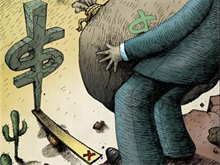
Importantly, we find that the majority of countries that underwent a transition experienced long-run gains in income growth following short-run declines (see Figure 1). Typically, countries face temporary challenges around the time of change with growth declining by 7-11 percentage points in the year of transition, though in the case of gradual transition declines were much larger around 21 percentage poiints and lasted longer.
Why the Ideas of Karl Marx are More Relevant than Ever in the 21st century

German-Political-Philosop-006

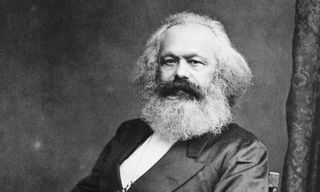
Bhaskar Sunkara in The Guardian:

Capital used to sell us visions of tomorrow. At the 1939 World's Fair in New York, corporations showcased new technologies: nylon, air conditioning, fluorescent lamps, the ever-impressive View-Master. But more than just products, an ideal of middle-class leisure and abundance was offered to those weary from economic depression and the prospect of European war.

The Futurama ride even took attendees through miniature versions of transformed landscapes, depicting new highways and development projects: the world of the future. It was a visceral attempt to renew faith in capitalism.

In the wake of the second world war, some of this vision became a reality. Capitalism thrived and, though uneven, progress was made by American workers. With pressure from below, the state was wielded by reformers, not smashed, and class compromise, not just class struggle, fostered economic growth and shared prosperity previously unimaginable.

Exploitation and oppression didn't go away, but the system seemed not only powerful and dynamic, but reconcilable with democratic ideals. The progress, however, was fleeting. Social democracy faced the structural crisis in the 1970s that Michal Kalecki, author of The Political Aspects of Full Employment, predicted decades earlier. High employment rates and welfare state protections didn't buy off workers, it encouraged militant wage demands. Capitalists kept up when times were good, but with stagflation – the intersection of poor growth and rising inflation – and the Opec embargo, a crisis of profitability ensued.

An emergent neoliberalism did curb inflation and restore profits, but only through a vicious offensive against the working class.

Torture, Drones, and Detention: A Conversation Between Laleh Khalili and Lisa Hajjar

Over at Jadaliyya Reports:

[A]n audio recording of a joint book talk held on 16 January 2013. Laleh Khalili and Lisa Hajjar recently published their Time in the Shadows: Confinement in Counterinsurgencies and Torture: A Sociology of Violence and Human Rights, respectively. The event was held at the School of Oriental and African Studies, and featured a conversation between the two authors entitled “Torture, Drones, and Detention: The Vagaries of Liberal Warfare.” The discussion ranged from the Boer War to Drone Warfare, legal torture, the role of law and everything in between.

How We Fight

From The New York Times:

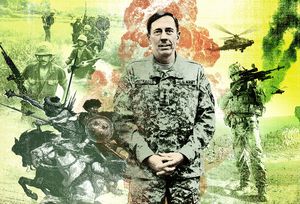
BookThe American occupation of Iraq in its early years was a swamp of incompetence and self-delusion. The tales of hubris and reality-denial have already passed into folklore. Recent college graduates were tasked with rigging up a Western-style government. Some renegade military units blasted away at what they called “anti-Iraq Forces,” spurring an inchoate insurgency. Early on, Washington hailed the mess a glorious “mission accomplished.” Meanwhile, a “forgotten war” simmered to the east in Afghanistan. By the low standards of the time, common sense passed for great wisdom. Any American military officer willing to criticize his own tactics and question the viability of the mission brought a welcome breath of fresh air. Most alarming was the atmosphere of intellectual dishonesty that swirled through the highest levels of America’s war on terror. The Pentagon banned American officers from using the word “insurgency” to describe the nationalist Iraqis who were killing them. The White House decided that if it refused to plan for an occupation, somehow the United States would slide off the hook for running Iraq. Ideas mattered, and many of the most egregious foul-ups of the era stemmed from abstract theories mindlessly applied to the real world.

There is no one better equipped to tell the story of those ideas — and their often hair-raising consequences — than Fred Kaplan, a rare combination of defense intellectual and pugnacious reporter. Kap­lan writes Slate’s War Stories column, a must-read in security circles. He brings genuine expertise to his fine storytelling, with a doctorate from M.I.T., a government career in defense policy in the 1970s and three decades as a journalist. Kaplan knows the military world inside and out; better still, he has historical perspective. With “The Insurgents: David Petraeus and the Plot to Change the American Way of War,” he has written an authoritative, gripping and somewhat terrifying account of how the American military approached two major wars in the combustible Islamic world. He tells how it was grudgingly forced to adapt; how it then overreached; and how it now appears determined to discard as much as possible of what it learned and revert to its old ways.

More here.

Why Are Superachievers So Successful?

From Smithsonian:

Super-achiever-martina-navratilova-631What does a Pulitzer Prize-winning war photographer have in common with a tennis legend? Or how about a celebrated opera diva and a Los Angeles civil rights lawyer? What does Alec Baldwin have in common with Yogi Berra? A lot, says journalist Camille Sweeney, who, along with co-author Josh Gosfield, interviewed dozens of highly accomplished men and women for a new book, The Art of Doing: How Superachievers Do What They Do and How They Do It So Well. Whether someone is setting out to create one of the most popular blogs on the Internet, as Mark Frauenfelder did with BoingBoing, or to win a record amount of money on “Jeopardy!,” people who accomplish amazing things rely on a particular collection of strategies to get to the top—and many of them are not what you’d expect.

Who is a superachiever? Somebody at the top of their craft. Ken Jennings, for example, he didn’t just win on “Jeopardy!,” he was the winningest contestant ever on “Jeopardy!”—he won 74 times. It’s the person who is going beyond success.

Do you think that the people you interviewed for the book are fundamentally different from the rest of us? No! It’s interesting. I think when we started out I might have thought that. But after talking to them and really thinking about their lives, I don’t think that they’re different. When they arrived at what they thought they were going to be doing, they just kept at it. They kept up the energy. And when all the doubters and the haters were saying, “This isn’t going to work,” they didn’t listen. When they felt like they could learn something, they took what they could. It gave me hope that if you put your mind to something, you can be a superachiever. It takes a lot of work, and the work doesn’t stop. These people are pretty 24/7 about what they’re doing.

Even if we aren’t superachievers, can regular people use these techniques and strategies in our own lives? Absolutely. There is a process of doing everything. Superachievement may seem like this impenetrable block of success, this almost intimidating concept. But when you break it down into very small things, or patterns to the way somebody does something, you can grab it and absorb it right into your life. There is this exciting opportunity for people to start seeing the world through this different lens, whether you’re looking at the people we chose or people in your life.

More here.

Saturday Poem

Djinn

Haunted, they say, believing
the soft, shifty
dunes are made up
of false promises.

Many believe
whatever happens
is the other half
of a conversation.

Many whisper
white lies
to the dead.

“The boys are doing really well.”

Some think
nothing is so
until it has been witnessed.

They believe
the bits are iffy;

the forces that bind them,
absolute.
.
.

by Rae Armantrout
from Poetry, Vol. 192, No. 3
publisher: Poetry, Chicago, 2008

Friday, January 25, 2013

Physics, Mathematics and Skepticism

9780674050136

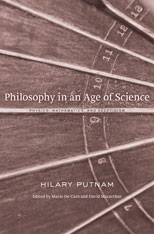
Stathis Psillos reviews Hilary Putnam's Philosophy in an Age of Science: Physics, Mathematics and Skepticism, in Notre Dame Philosophical Reviews:

In his address to the Fourth International Congress of Philosophy held at Bologna in 1911, Henri Bergson noted that “a philosopher worthy of the name has never said more than a single thing: and even then it is something he has tried to say, rather than actually said”. This single thing, he added, being “a thought which brings something new into the world”, “is of course obliged to manifest itself through the ready-made ideas it comes across and draws into its movement”.

What then is Hilary Putnam's — who has been one of the major philosophers of the twentieth century — 'single thought' and what is the 'something new' it brings into the world? Well, it's not quite a single thought but it can be captured, I think, by the following: there is something about science which is of incomparable cognitive significance and there is something about human beings which is of incomparable moral significance. The 'something new' then that Putnam's outstanding philosophical endeavour brings to the world is the fusion of the scientific image of the world with a moral image of human beings. This is the thread that runs through the papers that compose Putnam's latest collection: Philosophy in an Age of Science: Physics, Mathematics and Skepticism. As Putnam puts it: “My efforts in philosophy have always been intended to provide intellectual and moral support to those who have realistic sensibilities in science and 'cognitivist' sensibilities in ethics” (93). In this review, I will concentrate my attention to the first two parts of the book, which discuss issues in the philosophy of science and mathematics.

Putnam makes a concerted effort to dispel a popular misconception that when he criticized metaphysical realism he had also abandoned scientific realism too (see especially p. 92). Actually, those who had tried to follow his work on scientific realism closely would know that he never put scientific realism on halt. In the midst of his conversion to internal or pragmatic realism, as Putnam tended to call his verificationist turn, he published a significant (but perhaps not widely read) piece in which he did endorse scientific realism, suitably dissociated from both materialism and metaphysical realism (cf. 1982). Back in the early 1980s, scientific realism was still what it was taken to be by the Putnam of 1960s and 1970s — the ferocious critic of instrumentalism, operationalism, fictionalism and other forms of scientific anti-realism. Scientific realism was still taken to involve commitment to the following theses: theoretical entities have irreducible existence (they exist in the very same sense in which ordinary middle-sized objects exist and are irreducible to either them or complexes of sensations); theoretical terms featuring in distinct theories can and do refer to the same entities (hence, there is referential continuity in theory-change); there is convergence in the scientific image of the world; and scientific statements can be (and are) true. Yet, the verificationist Putnam of the early 1980s took truth to be “correct assertibility in the language we use” (1982, 197). So scientific realism was retained but dressed up in a verificationist garment.

Diderot, an American Exemplar? Bien Sûr!

0125OPEDshout-articleInline

Andrew Curran in the NYT:

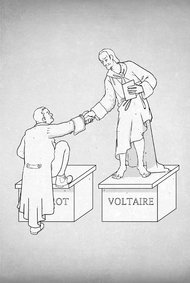
THE Enlightenment polymath Denis Diderot turns 300 this year, and his October birthday is shaping up to be special. President François Hollande has indicated that he plans to honor the philosopher and novelist with what may be France’s highest tribute: a symbolic reburial in the Panthéon. In the roughly two centuries since this massive neo-Classical church was converted into a secular mausoleum, fewer than 80 people have been admitted into its gravestone club. If inducted, Diderot will arguably be the first member to be celebrated as much for his attacks on reigning orthodoxies as for his literary stature.

Like many Enlightenment writers, Diderot preached the right of the individual to determine the course of his or her life. But the type of liberty that underpins Diderot’s body of work differs markedly from today’s hackneyed understanding of freedom. His message was of intellectual emancipation from received authorities — be they religious, political or societal — and always in the interest of the common good. More so than the deists Voltaire and Rousseau, Diderot embodied the most progressive wing of Enlightenment thought, a position that stemmed from his belief that skepticism in all matters was “the first step toward truth.” He was, in fact, the precise type of secular Enlightenment thinker that some members of the Texas State Board of Education have attempted to write out of their high school curriculum.

BBC Column: Are we naturally good or bad?

Over at Mind Hack:

It’s a question humanity has repeatedly asked itself, and one way to find out is to take a closer look at the behaviour of babies.… and use puppets.

Fundamentally speaking, are humans good or bad? It’s a question that has repeatedly been asked throughout humanity. For thousands of years, philosophers have debated whether we have a basically good nature that is corrupted by society, or a basically bad nature that is kept in check by society. Psychology has uncovered some evidence which might give the old debate a twist.

One way of asking about our most fundamental characteristics is to look at babies. Babies’ minds are a wonderful showcase for human nature. Babies are humans with the absolute minimum of cultural influence – they don’t have many friends, have never been to school and haven’t read any books. They can’t even control their own bowels, let alone speak the language, so their minds are as close to innocent as a human mind can get.

The only problem is that the lack of language makes it tricky to gauge their opinions. Normally we ask people to take part in experiments, giving them instructions or asking them to answer questions, both of which require language. Babies may be cuter to work with, but they are not known for their obedience. What’s a curious psychologist to do?

Devil’s Alternative

10978.devil-ad-1

Jatin Gandhi in Open the Magazine:

On 19 January, sycophantic Congressmen went ecstatic over the Congress Working Committee’s declaration in Jaipur that Rahul Gandhi would be the party’s new Vice-President and official No 2. They still can’t stop talking of how Gandhi’s address at the All India Congress Committee (AICC) session the next day tugged at the heart of everyone in the audience. The three-day event, which included a two-day Chintan Shivir (introspection conference) and the AICC meet, was reduced to partymen first demanding a greater role for Gandhi and then lauding the announcement.

Across the political divide, cadres of the Bharatiya Janata Party have started referring to Gujarat Chief Minister Narendra Modi with the same reverence that contemporary Congressmen reserve for the Nehru-Gandhis. And Lutyen’s Delhi saw similar scenes of madness at the principal opposition party’s Ashoka Road office last month when Modi visited. The symbolism at play in the two events is hard to miss. While the 127-year-old party shifted the action to the City of Royals to anoint a Nehru-Gandhi successor to its top leadership (in effect, its PM-in-waiting), Modi made a journey to India’s capital a day after he was sworn in as Gujarat Chief Minister for the fourth time in a row. Though Modi was officially in Delhi to attend a meeting of the National Development Council chaired by Prime Minister Manmohan Singh, the highlight of the trip was his reception at the party’s headquarters amid chants of “PM! PM! PM!”

At his victory speech in Gujarat a week before this trip, his followers had similarly shouted for him to make a pitch for the BJP’s PM candidacy. Though he had won the state election, Modi chose to speak in Hindi instead of Gujarati as he usually does within the state.

The Prejudice of the Modern

Gyan

Gyanendra Pandey in News Click (via Vijay Prashad):

Prejudice is cunning. It never appears to the subject or actor as prejudice: it is only ‘others’ who are prejudiced.

And it affects different groups and people in different ways. There are various guises in which modern prejudice masks itself: allowing sectional prejudice (what I call vernacular, visible prejudice) to be disparaged once in a while, but at the same time protecting the ‘common sense’ of our times, the beliefs of those in power (what I call universal, invisible prejudice) from being questioned.

I’ve just written a book that traces the history of modern prejudice, through an investigation of two major formal democracies, the United States and India. In both these countries there is a similar historical process for the social and political distancing of stigmatized, and marginalized populations – such as African Americans and Dalits (or ex-Untouchables). It is of course the case that the older histories of subordination are not shared between African Americans (who only enter into specific modes of modern discrimination and prejudice with plantation slavery) and Dalits (whose much longer history of subordination goes back to Vedic days, although reshaped over the centuries into its modern form). The juxtaposition of these two locations and two histories allows us a rare view of the workings of prejudice in our times.

Pandora’s Boxes: Inside nanotechnology’s little universe of big unknowns

From Orion Magazine:

DNA-unravelingThe regulation of nanoparticles has been recommended for more than a decade, but there’s no agreement on exactly how to do it. Meanwhile, the lid has already been lifted on nanotechnology. The use of man-made nanoparticles has spread into almost every area of our lives: food, clothing, medicine, shampoo, toothpaste, sunscreen, and thousands of other products. Regulatory structures, both here and abroad, are completely unprepared for this onslaught of nanoproducts, because nanoparticles don’t fit into traditional regulatory categories. Additionally, companies often shield details about them by labeling them “proprietary”; they’re difficult to detect; we don’t have protocols for judging their effects; and we haven’t even developed the right tools for tracking them. If nanotechnology and its uses represent a frontier of sorts, it’s not simply the Wild West—it’s the Chaotic, Undiscovered, Uncontrollable West.

…AS WITH MANY THINGS that are invisible and difficult to understand—think subatomic particles such as the Higgs boson, muons, gluons, or quarks—any discussion of nanoparticles quickly shifts into the realm of metaphor and analogy. People working in nanoscience seem to try to outdo each other with folksy explanations: Looking for a nanoparticle is like looking for a needle in the Grand Canyon when the canyon is filled with straw. If a nanoparticle were the size of a football, an actual football would be the size of New Zealand. A million nanoparticles could squeeze onto the period at the end of this sentence.

But what is a nanoparticle?

More here.

Nano particles with a heart of gold can kill cancer cells

From Smithsonian:

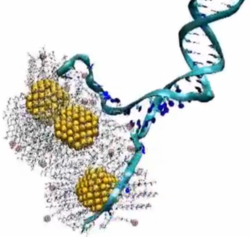
Gold-nanoparticles-cancer-600Over thousands of years, gold has been used to treat rheumatoid arthritis, inner ear infections, facial nerve paralysis, fevers and syphilis. Now, preliminary findings suggest a new application for tiny grains of gold—destroying cancer cells. Gold-carrying nanoparticles are capable of killing a common type of cancer that attacks antibody-making B cells in the blood, according to a study published today in the journal Proceedings of the National Academy of Sciences. This cancer, B-cell lymphoma, originates in the lymph glands and is the most common type of non-Hodgkin lymphoma. Last year, it resulted in nearly 19,000 deaths. Developed by researchers at Northwestern University, the nanoparticle mimics the size, shape and surface chemistry of high-density lipoprotein—natural HDL—the preferred meal of these cancer cells. HDL is the “good” cholesterol that cruises through the bloodstream, removing dangerous buildups of LDL, the harmful, “bad” cholesterol.

The bits of gold tucked inside these particles are tiny—just five nanometers wide. A billionth of a meter, a nanometer is a measurement used to size bacteria, X-rays and DNA. The width of a double helix is about two nanometers. Despite its microscopic size, the synthetic particle packs a big punch—more accurately, two of them. Recent research has shown that B-cell lymphoma is dependent on the uptake of natural HDL, from which it derives fat content, to spur cell proliferation. The nanoparticle cuts off its supply. Masquerading as natural HDL, the nanoparticle latched on to cholesterol receptors on deadly lymphoma cells. First, the nanoparticle’s spongy surface sucked out the cell’s cholesterol. Then, it plugged up the cancer cell, preventing it from absorbing natural HDL particles in the future. Deprived of this essential nutrient, the cell eventually died.

More here.

Thursday, January 24, 2013

Jeffrey Eugenides’s Advice to Young Writers

Jeffrey Eugenides in The New Yorker:

Eugenides-writer-233In his 1988 book of essays, “Prepared for the Worst,” Christopher Hitchens recalled a bit of advice given to him by the South African Nobel Laureate Nadine Gordimer. “A serious person should try to write posthumously,” Hitchens said, going on to explain: “By that I took her to mean that one should compose as if the usual constraints—of fashion, commerce, self-censorship, public and, perhaps especially, intellectual opinion—did not operate.” Hitchens’s untimely death last year, at the age of sixty-two, has thrown this remark into relief, pressing upon those of us who persist in writing the uncomfortable truth that anything we’re working on has the potential to be published posthumously; that death might not be far off, and that, given this disturbing reality, we might pay attention to it.

It’s not very nice of me to bring up death tonight, as we gather to celebrate ten emerging writers. Talented and accomplished as you all are, you’re just getting going, so why should I rain on your parade? Here’s why: because Gordimer’s advice about writing posthumously may be the best way to help your writing in the here-and-now. It may inoculate you against the intellectual and artistic viruses that, as you’re exposed to the literary world, will be eager to colonize your system.

More here.

‘Assad is facing assassination no matter what happens’ – Noam Chomsky

Last month Juvana Vukotic interviewed Noam Chomsky in The Voice of Russia:

NATO approved the deployment of Patriot missile interceptors to defend the Turkish border with Syria. What do you think, what is going to happen next?

ScreenHunter_110 Jan. 24 17.02I don’t think anybody knows. Syria is moving towards kind of suicide and there doesn’t seem to be any easy way out. This morning got even worse, as you may have seen there was a battle yesterday between the Kurdish and rebel forces. That adds a new complexity to the situation which of course very much affects Turkey. Turkey is quite worried naturally about the rise of the Kurdish autonomy region in Syria and how it might affect the huge Kurdish problem within Turkey. But inside Syria it just looks like a growing horror story with no real feasible solution insight. There are various proposals, there is another one coming along today in discussions, I believe in Dublin, with Al-Akhdar Ibrahimi and representatives of Russia and the US. But it is going to be extremely difficult to find a way out of this without just destruction of the country.

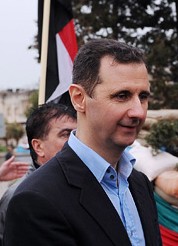
Assad himself is facing assassination no matter what happens, I mean if he agrees to leave the country – he would probably be killed by his Alawite associates because he is abandoning them to whatever fate would happen. If he doesn’t leave the country sooner or later it would be wiped out. There have been proposals, just a couple of days ago there was a proposal by one serious specialist Nicholas Noe that there will be temporary some kind of partition in which a region around Damascus is left under Assad’s control and the rest of the country is left under rebel control and see if they can work out some modus vivendi in which there could be a reduction of violence and maybe a negotiated settlement. But that’s a long shot and I haven’t really heard any other good proposal.

More here.

The Dangers of Stem Cell Cosmetics

Ferris Jabr in Scientific American:

Stem-cell-cosmetics_1When cosmetic surgeon Allan Wu first heard the woman's complaint, he wondered if she was imagining things or making it up. A resident of Los Angeles in her late sixties, she explained that she could not open her right eye without considerable pain and that every time she forced it open, she heard a strange click—a sharp sound, like a tiny castanet snapping shut. After examining her in person at The Morrow Institute in Rancho Mirage, Calif., Wu could see that something was wrong: Her eyelid drooped stubbornly, and the area around her eye was somewhat swollen. Six and a half hours of surgery later, he and his colleagues had dug out small chunks of bone from the woman's eyelid and tissue surrounding her eye, which was scratched but largely intact. The clicks she heard were the bone fragments grinding against one another.

About three months earlier the woman had opted for a relatively new kind of cosmetic procedure at a different clinic in Beverly Hills—a face-lift that made use of her ownadult stem cells. First, cosmetic surgeons had removed some the woman's abdominal fat with liposuction and isolated the adult stem cells within—a family of cells that can make many copies of themselves in an immature state and can develop into several different kinds of mature tissue. In this case the doctors extracted mesenchymal stem cells—which can turn into bone, cartilage or fat, among other tissues—and injected those cells back into her face, especially around her eyes. The procedure cost her more than $20,000, Wu recollects.

More here.

Where I Saw Tragedy, I Also Saw the Absurd

9780143123064_custom-1dd6823c9111a8964110e5851e01424a973f56f0-s6-c10

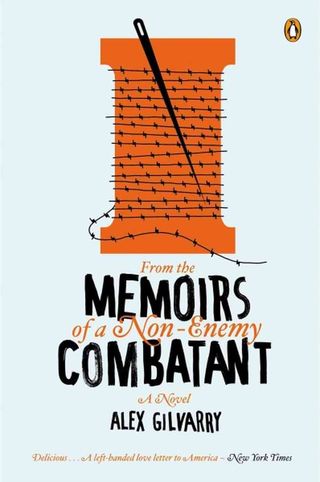
Debut novelists David Abrams and Alex Gilvarry discuss “what they learned at the movies, the literature of war, and satire’s reverberations,” in Tottenville Review:

Alex Gilvarry: I was brought up on satire. Comedy in general. Woody Allen’s Bananas and Zelig affected me quite early on before I could comprehend what was being satirized. That's the power of humor. Then there were the books I first purchased on my own. Woody’s Without Feathers, Getting Even,then S.J. Perelman. Eventually I branched out into discovering more serious literature like Catch-22. You know, I guess I was only interested in reading New York Jews. They spoke to me and my little life on Staten Island. I felt a familiar voice, a kinship. There’s that bit by Lenny Bruce which goes “If you’re from New York and you’re Catholic, you’re still Jewish.” I’m half-Filipino with a Scottish last name, but I was brought up in the same shouting, anxiety-laced household that these writers came from—where one needed to raise their voice in order to be heard. That's what first got me about Philip Roth. There are those scenes in Goodbye, Columbus where I felt like it was my family. You couldn’t take a phone call with a girl without two or three people butting in or picking up the other line. I learned to negotiate life and its embarrassments with humor.

In writing From the Memoirs of a Non-Enemy Combatant, a satire about one man's journey from young immigrant, to celebrated fashion designer, to suspected terrorist imprisoned in Guantánamo Bay, I discovered a type of book that I felt we were missing. By 2006, I suppose I was a serious reader of contemporary fiction, and not a lot of what was coming out reflected the fears and climate of what made up my twenties. That is, post-9/11 New York, two wars, and the circumvention of certain human rights. During these formative years I became obsessed with the stories of men locked up without due process, afraid that it could happen to any one of us, and the language being used to designate and dehumanize them—”enemy combatant,” “detainee.” Where I saw tragedy I also saw the absurd. And the topic I found pressing. So the novel became a combination of everything I had loved about humor and literature, with the addition of trying to stick it to the man. The only way I knew how to do that was satire.

Why Stimulus Has Failed

663c8943fbd45ca3597fff5b76de1ffb.portrait

Raghuram Rajan in Project Syndicate:

Two fundamental beliefs have driven economic policy around the world in recent years. The first is that the world suffers from a shortage of aggregate demand relative to supply; the second is that monetary and fiscal stimulus will close the gap.

Is it possible that the diagnosis is right, but that the remedy is wrong? That would explain why we have made little headway so far in restoring growth to pre-crisis levels. And it would also indicate that we must rethink our remedies.

High levels of involuntary unemployment throughout the advanced economies suggest that demand lags behind potential supply. While unemployment is significantly higher in sectors that were booming before the crisis, such as construction in the United States, it is more widespread, underpinning the view that greater demand is necessary to restore full employment.

Policymakers initially resorted to government spending and low interest rates to boost demand. As government debt has ballooned and policy interest rates have hit rock bottom, central banks have focused on increasingly innovative policy to boost demand. Yet growth continues to be painfully slow. Why?

What if the problem is the assumption that all demand is created equal? We know that pre-crisis demand was boosted by massive amounts of borrowing. When borrowing becomes easier, it is not the well-to-do, whose spending is not constrained by their incomes, who increase their consumption; rather, the increase comes from poorer and younger families whose needs and dreams far outpace their incomes. Their needs can be different from those of the rich.