A brief history of the Buffalo chicken wing

From Smithsonian:

Anchor-barFew of us realize, though, that less than 50 years ago, wings were considered one of the least desirable cuts of the chicken—a throwaway part often cooked into stock—and “buffalo” was just a wooly ungulate that wandered the Plains. Despite the recency of the invention, the event itself is shrouded in mystery. Nevertheless, there is one thing we know for certain: the “buffalo” in the name definitively refers to the city in Western New York. The most authoritative account is by New Yorker writer Calvin Trillin, who investigated the dish’s history in 1980 as he sampled the city’s most well-regarded wing joints. He presented two competing versions of how a stroke of serendipity led Teressa Bellissimo, proprietor of the Anchor Bar, to invent the dish in 1964. Her husband Frank Bellissimo, who founded the bar with Teressa in 1939, told Trillin that the invention involved a mistake—the delivery of chicken wings, instead of necks, which the family typically used when cooking up spaghetti sauce. To avoid wasting the wings, he asked Teressa to concoct a bar appetizer; the result was the wing we know today.

Dominic—Frank and Teressa’s son, who took over management of the restaurant sometime in the ’70s—told a slightly more colorful tale: It was late on a Friday night in 1964, a time when Roman Catholics still confined themselves to fish and vegetables on Fridays…Some regulars had been spending a lot of money, and Dom asked his mother to make something special to pass around gratis at the stroke of midnight. Teressa Bellissimo picked up some chicken wings—parts of a chicken that most people do not consider even good enough to give away to barflies—and the Buffalo chicken wing was born. Both Frank and Dominic agreed on a few other crucial details—that Teressa cut each wing in half to produce a “drumstick” and a “flat,” that she deep-fried them without breading and covered them in a hot sauce, and that she served them with celery (from the house antipasto) and blue cheese salad dressing. They also both reported that they became popular within weeks throughout the city, where they were (and are still) simply called “wings” or “chicken wings.”

More here. (Note: For my brother Bhaisab, who introduced me to, and who enjoyed the wings regularly during his three decades of working nextdoor to Anchor Bar as a cardiac surgeon at Buffalo General Hospital)

Tuesday, February 5, 2013

Laurie Anderson interviews Brian Eno

Laurie Anderson in Interview:

Img-brian2_152616699090If humans were able to hear light and parse the poetry of the spectrum, then perhaps there would be no need for Brian Eno, who seems to do it effortlessly. While the rest of us are generally content to hear sound, Eno can clearly see it. How else to explain the elaborate sonic color fields and glowing soundscapes that he creates, which feel as much like floating shapes and waves of light as they do music? And how else to make sense of a body of work that has been by turns challenging and definitive and spread across an expanse of disparate worlds and genres, from his early work with Roxy Music, to his ever-evolving solo oeuvre, to the colossal swoosh of his frequent collaborations with U2, to his numerous art projects, compositional gambits, and multimedia installations—not to mention the three ambient-music-generating apps, Scape, Bloom, and Trope, that he has created with musician and software designer Peter Chilvers.

Eno, though, has always had the good taste to never confuse grandeur with bombast. From his first gig with Roxy Music in 1971, it was clear that he was not going to play the role of rock musician as anyone had before. (He often preferred to play off stage, behind the mixing board, processing the sound with a VCS3 synthesizer, even as he sang background vocals.) Eno helped paint David Bowie's late-'70s “Berlin Trilogy” of Low (1977), Heroes (1977), and Lodger (1979) with a sense of minimalist discipline and a saturated electronic whir without sacrificing Bowie's sense of playfulness or his desperately romantic croon. With Eno behind the boards, Talking Heads catapulted from quirky New Wave outfit to mind-blowing world-funk collective, and his later work with Heads leader David Byrne, the co-credited 1981 album My Life in the Bush of Ghosts, successfully traversed a precarious edge of experimental music in its use of unconventional instrumentation and found and sampled sounds. But one of Eno's longest and most sustained creative partnerships has been with U2, which began when he and Daniel Lanois joined forces to produce the Irish foursome's brilliantly elliptical 1984 albumThe Unforgettable Fire, and continued as the group transformed itself from a club act into a force that could dominate football stadiums to the last great big rock group standing without ever compromising its creative ambition or sense of spirituality.

More here.

Not Talking About Pakistan

Taymiya R. Zaman in Tanqeed:

Road-shot-3I drew a secret line around the borders of Pakistan and rarely stepped over it. In the fall of 2007, I began teaching Islamic history at a small liberal arts college in San Francisco; even though my classes on South Asia and the Middle East could easily have included Pakistan, I made sure to exclude Pakistan from all my syllabi. To avoid ever having to talk about Pakistan, I changed the name of a course a predecessor had titled “History of South and Southeast Asia,” to “Indian Civilizations.” This now meant that the course took a leisurely route through the Indus Valley Civilization, the coming of the Aryans, the spread of Jainism and Buddhism in North India, the rise of the Mughal Empire and concluded with British colonial rule and the formation of India and Pakistan in 1947. But, after an emotionally charged lecture on Partition, I would begin a section on modern India and say nothing of Pakistan after the moment of its creation. My class, “The Modern Middle East,” covered American wars in Afghanistan but my syllabus screeched to a halt at the Pakistan border. Although the country inevitably featured in class discussions about U.S. foreign policy, I assigned no readings on Pakistan. In my other classes, I stayed away from the twentieth century, which meant that the question of Pakistan never arose.

Outside the classroom too, I was something of an expert at not talking about Pakistan.

More here.

The Gatekeepers: Six Israeli security chiefs stun world

Samuel Burke at CNN:

ScreenHunter_89 Feb. 05 18.54Six former heads of the Shin Bet, Israel’s secretive internal security service, have spoken out as a group for the first time and are making stunning revelations.

The men who were responsible for keeping Israel safe from terrorists now say they are afraid for Israel’s future as a democratic and Jewish state.

Israeli film director Dror Moreh managed to get them all to sit down for his new documentary: “The Gatekeepers.” It is the story of Israel’s occupation of the Palestinian Territories, as told by the people at the crossroads of some of the most crucial moments in the security history of the country.

“If there is someone who understands the Israeli-Palestinian conflict, it’s those guys,” the director told CNN’s Christiane Amanpour.

Against the backdrop of the currently frozen peace process, all six argue – to varying degrees – that the Israeli occupation of Palestinian land is bad for the state of Israel.

The oldest amongst the former chiefs, Avraham Shalom, says Israel lost touch with how to coexist with the Palestinians as far back as the aftermath of the Six Day War of 1967, with the occupation of Gaza and the West Bank, when the country started doubling down on terrorism.

“We forgot about the Palestinian issue,” Shalom says in the film.

A major impediment to a meaningful strategy, they say, are the Jewish extremists inside Israel – people like the Jewish Israeli who assassinated Prime Minister Yitzak Rabin, or the 1980 plot to blow up the Dome of the Rock Islamic shrine in Jerusalem.

More here.

A Legacy of Dark and Light

20130117_TNA37ValiunasCuriehomepage

Marie Curie’s death was brutal. She had long faced the ravages of extended radiation exposure: fevers, cataracts, respiratory distress, running sores on her hands. Aplastic pernicious anemia finished the job. She died on July 4, 1934, at the age of sixty-seven. … What would Madame Curie have thought of the long-term ramifications of her discoveries? The manifold medical and industrial uses of radioactive materials would have staggered her, in the best way. The atomic scientist Alan E. Waltar’s Radiation and Modern Life: Fulfilling Marie Curie’s Dream (2004) gives an idea of the vast scope of the technology, which is used in increasing crop production, controlling insect pests, sterilizing medical equipment, developing new drugs, medical diagnosis, cancer treatment, nuclear power, purifying cosmetics, testing soil at construction sites with radiation gauges, measuring automotive engine wear, inspecting aircraft welds through radiography, determining rail stresses, radioisotope thermoelectric generators for spacecraft, luminescent exit signs in public buildings, DNA forensics, carbon dating, enhancing the beauty of precious gems, authenticating rare paintings, and on and on.

more from Algis Valiunas at The New Atlantis here.

leaving the witness

Article_scorah

I began learning Mandarin Chinese in 2003 through a night class offered at my congregation in Vancouver. I had been a devout Jehovah’s Witness from the time I was a child, and I became a full-time missionary the day I graduated from high school. It was a pretty typical path for a young Witness. Pursuing any kind of career was frowned upon as materialistic and a distraction from what really mattered: preaching. Four days a week, I would put on my modest skirt and practical shoes, fill my briefcase with magazines and other Watchtower publications, and walk to the Kingdom Hall near my home in Kitsilano. I’d meet up with a car group of other Witnesses. We’d then head out to our assigned territory—the affluent neighborhoods of Vancouver’s west side. We would knock on doors—street by street, house by house. Some people would be polite, but most were just annoyed. Once in a while someone would slam the door in my face, or yell. But mostly people didn’t answer. Missionary work wasn’t the easiest in Vancouver.

more from Amber Scorah at The Believer here.

indirectly forthright, demure and definitive at once

Phillips_38.1_moore

Marianne Moore is always hiding in plain sight. She is the paradoxical radical, either distracting the reader from her traditionalism with avant-garde trappings or concealing rebellion in prim camouflage. She picketed for women’s rights and voted for Herbert Hoover. She distrusted the “obscenities” in William Carlos Williams and encouraged the “ability” in Allen Ginsberg. She breathed horror of “a sodomite” to one lesbian friend and signed letters to another “your affectionate albino-dactyl.” Those three-corned hats and men’s polo shirts: do they reflect an old-fashioned aversion to frippery or an innovative preference for androgyny? And her resolute urban celibacy (she lived in an apartment with her mother): a species of piety or a refusal of stereotypes? Moore’s mix of puritan and progressive seems quintessentially American—alert to the virtues of brown bread and the glories of Brancusi’s sculpture, to Pilgrim’s Progress as well as Ezra Pound. Likewise her get-to-the-point distrust of dreaming: “No wonder we hate poetry,” she writes in “Armor’s Undermining Modesty,” and “stars and harps and the new moon.” When Moore ends that poem on an “imperishable wish,” she means something as solid as the “hard yron” of another of her titles. Moore was indirectly forthright, demure and definitive at once.

more from Siobhan Phillips at Boston Review here.

Tuesday Poem

For All

Ah to be alive
on a mid-September
morn
fording a stream
barefoot, pants rolled up,
holding boots, pack
on,
sunshine, ice in the shallows,
northern rockies.

Rustle and
shimmer of icy creek waters
stones turn underfoot, small and hard as
toes
cold nose dripping
singing inside
creek music, heart
music,
smell of sun on gravel.

I pledge allegiance

I pledge
allegiance to the soil
of Turtle Island,
and to the beings who thereon
dwell
one ecosystem
in diversity
under the sun
With joyful
interpenetration for all.

by Gary Snyder

Pigeons Get a New Look

Carl Zimmer in The New York Times:

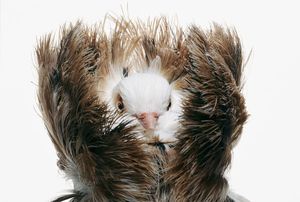
PigeonTEST-slide-P3TM-2-articleLarge-v3In 1855, Charles Darwin took up a new hobby. He started raising pigeons. In the garden of his country estate, Darwin built a dovecote. He filled it with birds he bought in London from pigeon breeders. He favored the fanciest breeds — pouters, carriers, barbs, fantails, short-faced tumblers and many more. “The diversity of the breeds is something astonishing,” he wrote a few years later in “On the Origin of Species” — a work greatly informed by his experiments with the birds. Pigeon breeding, Darwin argued, was an analogy for what happened in the wild. Nature played the part of the fancier, selecting which individuals would be able to reproduce. Natural selection might work more slowly than human breeders, but it had far more time to produce the diversity of life around us. Yet to later generations of biologists, pigeons were of little more interest than they are to, say, New Yorkers. Attention shifted to other species, like fruit flies and E. coli.

…Archaeologists have speculated that rock pigeons flocked to the first farms in the Fertile Crescent in the Middle East, where they pecked at loose grain. Farmers then domesticated them for food. Later, humans bred the birds to carry messages. By the eighth century B.C., Greeks were using pigeons to send the results of Olympic Games from town to town. Genghis Khan used pigeons to create a communication network across his empire in 12th century A.D. Eventually, people began breeding pigeons simply for pleasure. Akbar the Great, a 16th-century Mughal emperor, always traveled with his personal colony of 10,000 pigeons. He bred some of the birds for their ability to tumble through the air, and others for their extravagant beauty.

More here.

Monday, February 4, 2013

Conversations with Nicholas Hogg and Chandrahas Choudhury at the Jaipur Literature Festival

by Hannah Green

ScreenHunter_87 Feb. 04 09.49The Jaipur Literature Festival runs off the momentum of globalization and the Internet. Authors and attendees come from around the world. Multi-national corporations sponsor the event. The polite Australian woman in Indian clothing who was in charge of one of the venues (The Google Mughal tent) repeatedly told the audience where to hashtag if they were tweeting. After Sebastian Faulks read a segment of his novel on stage, Supriya Nair, who was also part of that session, said that she couldn’t wait until the talk was over that she could tweet about it.

At the same time, some of the writers lamented the state of literature in the world in light of the web’s rising power. People read less, they said, are less able to concentrate, less able to distinguish between good writing and bad, good information and bad.

To get an inside perspective, I caught up with two young writers at the Jaipur Literature Festival who are relatively new to the literary scene: Chandrahas Choudhury and Nicholas Hogg. Both of their careers have risen in sync with the growth of the Internet. (Another sign of the many options we must choose from in our complex times: I spoke to Choudhury in person and conducted my interview with Hogg over e-mail.) Choudhury’s first novel, Arzee the Dwarf was published in 2009. He told me that he started working on this novel around the same time he got into blogging. During this time, he also worked writing book reviews and as the poetry and fiction editor of The Caravan magazine. Hogg’s first novel Show me the Sky was published in 2008. Before and after the publication of his novel, he wrote short stories that explore different cultural landscapes.

On how twitter and other forms of modern communication have changed language:

Nicholas:

Language is liquid. How we communicate – speak, write, play music or make films etc – is forever evolving. From Gutenberg’s press to twitter and texting, it undoubtedly changes literature. For good or bad is subjective. Writers reflect the world they live in, whether it be Shakespeare of the 1500s or Faulkner's divided Deep South, and so their prose rhythms beat to the time.

Chandrahas:

Even on twitter it’s possible to tell the good and the bad writers apart. You need to learn to use the form not by always using abbreviations but by writing more briefly and concisely… People now on Twitter have developed the super short story. And actually one of the greatest super short stories in the history of literature is too small even for twitter-Hemingway’s six word short story: “For sale, Baby shoes, Never worn.” Which is maybe like forty or fifty characters.* There’s no reason that good writing is incompatible with twitter. But I think the most real pleasure of literature is the pleasure of seeing the mind unfolding. And that’s hard to do on twitter. That requires contrast. With a novel you can change the rhythm of a sentence, so you go from very long to very short. So to me that is the highest pleasure.

* It’s 28.

Read more »

Sunday, February 3, 2013

The Future by Al Gore – review

John Gray in The Guardian:

ScreenHunter_86 Feb. 03 21.56Applying a formidable mix of history, science and common experience, Gore has produced a luminously intelligent analysis that is packed with arresting ideas and facts. The peaking of global conventional oilproduction that occurred some 30 or more years ago, the risks to fresh water supplies posed by fracking, the rapid ongoing evolution of cyber-warfare, the dangers and potential benefits of biotechnology and the possibility of genetic engineering of human brains are only a few of the facts, likely developments and possibilities that the former American vice-president explores. Summarising this rich and ambitious book in any detail is impossible. You simply have no alternative to reading it.

Some themes stand out as being especially salient. Unlike those – pious bien-pensants as much as religious bigots – who fume and splutter whenever the subject of population is mentioned, Gore recognises the increase of human numbers as one of the world's largest challenges. “During the last century alone, we quadrupled the human population. By way of perspective, it took 200,000 years for our species to reach the one billion mark, yet we have added that many people in just the first thirteen years of this century.” With unchecked population growth and worldwide industrialisation, humankind has embarked on “an unplanned experiment with the planet”.

Despite the incessant machinations of climate deniers, there is no scientific basis for doubt as to the reality of anthropogenic climate change. Some who accept the evidence suggest that rather than attempting to halt the activities that result in global warming we should adapt to the process as it goes along; but in Gore's view, muddling through is not an option.

More here.

Before Steve Jobs and Steve Wozniak invented Apple, they hacked phones

Geeta Dayal in Slate:

1302_SBR_EXPLODINGPHONE_COVERIn his new history of phone phreaking, Exploding the Phone, engineer and consultant Phil Lapsley details the story of the 1960s and 1970s culture of hackers who, like Tufte, devised numerous ways to outwit the phone system. The foreword of the book is by Steve Wozniak, co-founder of Apple—and, as it happens, an old-school hacker himself. Before Wozniak and Steve Jobs built Apple in the 1970s, they were phone phreaks. (Wozniak’s hacker name was Berkeley Blue; Jobs’ handle was Oaf Tobar.)

In 1971, Esquire published an article about phone phreaking called “Secrets of the Little Blue Box,” by Ron Rosenbaum (aSlate columnist). It chronicled a ragtag crew sporting names like Captain Crunch and the Cheshire Cat, who prided themselves on using ingenuity and rudimentary electronics to outsmart the many-tentacled monstrosities of Ma Bell and the FBI. A blind 22-year-old named Joe Engressia was one of the scene’s heroes; according to Rosenbaum, Engressia could whistle at exactly the right frequency to place a free phone call.

Wozniak, age 20 in ’71, devoured the now-legendary article.

More here.

Did Hemingway Really Write His Famous Six-Word Story?

103934516.jpg.CROP.article250-medium

David Haglund in Slate (via The Brooklyn Institute for Social Research):

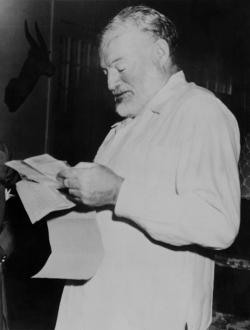
Quote Investigator is a terrific website that examines the provenance of popular quotations, which, as you may have noticed, frequently get misattributed online. On Monday, the site’s proprietor, Garson O’Toole, looked into a six-word fiction supposedly written by Ernest Hemingway: “For sale: baby shoes, never worn.”

Hemingway’s authorship of the classified ad-inspired short-short story is frequently described as a “literary legend,” which, to be fair, is a perfectly accurate way of putting it. Snopes looked into the legend a few years ago, and decided that its basis in fact was “undetermined.” But after reading O’Toole’s more thorough investigation, it’s very hard to believe that Hemingway had anything to do with the tale.

Ernest Hemingway died in 1961, and the earliest published evidence known to QI connecting him to this tale appeared in 1991. The author Peter Miller included a version of the anecdote in his book Get Published! Get Produced!: A Literary Agent’s Tips on How to Sell Your Writing. Miller stated that he was told the tale by a “well-established newspaper syndicator” circa 1974.

The case for Hemingway does not get stronger from there. As O’Toole documents, the precursor to the story seems to be a 1921 newspaper column by Roy K. Moulton, who “printed a brief note that he attributed to someone named Jerry.”

There was an ad in the Brooklyn “Home Talk” which read, “Baby carriage for sale, never used.” Wouldn’t that make a wonderful plot for the movies?

That note was reprinted in multiple newspapers.

The League of Authoritarian Gentlemen

Sco_edited_

Alexander Cooley in Foreign Policy:

For years now, the United States and its allies in Europe and Asia have been talking about the importance of common efforts to promote human rights and democratic values around the world. If the liberal democracies pooled their efforts, there seemed good reason to believe that they could embed these values in international law and succeed in fostering the growth of freedom.

It turns out, however, that the autocrats haven't been asleep at the wheel, either. And nowhere is this truer in Eurasia, where Russia, China, and the Central Asian states have been busy discovering the virtues of alliance in a common cause. They've been working hard to forge an international front of anti-democrats, developing a new set of counter-strategies and regional legal tools. It seems to be working. The latest edition of Freedom House's global survey of political rights notes that its findings are “particularly grim for Eurasian countries.”

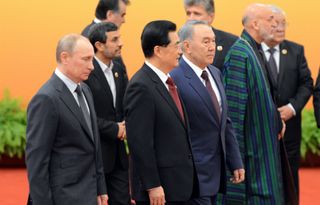
Over the last year, Vladimir Putin's Russia has renewed its crackdown on democratic opposition, most recently by staging an all-out assault on non-government organizations with foreign ties. The Chinese Communist Party has also been doingits best to silence critics and maintain its tight control over dissidents. Yet far less attention has gone to the two countries' transnational efforts to band together in their efforts to snuff out democratic impulses.

The rise of the Shanghai Cooperation Organization (SCO) is a case in point. Comprised of Russia, China, Kazakhstan, Kyrgyzstan, Tajikistan and Uzbekistan, the SCO presents itself as a new-style international organization that champions the principle of non-interference in the sovereign affairs of its member states — a not-too subtle jibe at the political and economic conditions imposed by other Western-led groups. Originally, the SCO's precursor, the Shanghai Five, resolved lingering Soviet-era border disputes among its members, but the group has now expanded its activities to include security, economic initiatives, infrastructure development and education. Though the organization's formal headquarters is in Beijing, cooperation among the SCO's internal security services are conducted through the poetically named Regional Antiterrorist Structure(RATS) located in Tashkent.

Under the mantra of combating the “three evils” of terrorism, extremism, and separatism, RATS maintains a consolidated watch list of regional “extremist” individuals and organizations. The list has expanded dramatically, initially from 15 organizations and individuals in 2006 to 42 organizations and over 1100 individuals in 2010. Human rights groups fear that this expansion is the result of authoritarian “logrolling,” as each country lists its own regime threats in exchange for agreeing to other countries' designations, which may include political opponents in addition to bona fide terrorists.

Slaying Saints and Torching Texts

AP232689183131

Emily O'Dell in Jadaliyya:

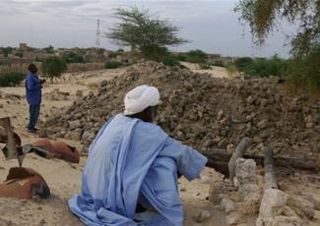
Cultural heritage in Mali is under attack. But just as the armed conflict there is not simply a battle between Islamic extremists and a weak Malian army supported by the French, nor is the destruction of Sufi shrines and Islamic manuscripts merely the result of an iconoclastic and intolerant religious fanaticism. While these violent attacks on Mali’s Islamic heritage are indeed tragic, they are sadly not isolated or unique. Sufi shrines have come under widespread assault in the past several years in Egypt, Libya, Tunisia, Pakistan, and Kashmir—and similar bouts of destruction have occurred throughout Islamic history. Sufi shrines and Sufi “bodies”—of both saints and worshippers—have recently been attacked by a wide variety of Islamists for a multitude of reasons: to repudiate grave visitation, to discourage belief in the intercessory power of deceased mystics, to oppose the government, to resist foreign occupation, to call for national liberation, and to protest the US funding of various Sufi initiatives throughout North Africa, the Middle East, and Central Asia. While these attacks on Sufi heritage have been widespread, it is only in Mali that attacks on Sufi shrines have been used to bolster the case for foreign intervention.

In mid-January at a meeting with representatives of the International Committee of Blue Shield at the World Archaeological Conference in Jordan, we discussed the “grave” situation in Mali, and the archaeological ethics of whether or not archaeologists should collaborate with the military to protect Mali’s cultural heritage. While archaeologists and anthropologists before 2001 traditionally steered clear of such collaboration, over the past decade, scholars have been working in tandem with the armed forces in Iraq, Afghanistan, Libya, Mali and Syria to provide maps—and even baseball cards—of cultural heritage sites to be protected. Having done research myself on Sufi shrines in both Mali and Afghanistan, the parallel could not be more striking between the current international outcry by scholars and the media over the desecration of Sufi heritage in Mali, and the international hysteria and politicization of the destruction of the Bamiyan Buddhas in March 2001, which was also used to build the case for a foreign military intervention in Afghanistan.

Just as the Taliban were vilified as intolerant fundamentalists incapable of grasping the importance of so-called “universal” concepts such as art, history, and world heritage, so too are groups like Ansar Deine being framed as “savages” and “barbarians.” Such a reductive analysis frames heritage solely as a victim, instead of a weapon of war cleverly employed to attract media attention, garner support and legitimacy among regional and international Islamists, and provide potent religious symbolism.

Englishness, class and manners

From New Statesman:

EnglishThe author takes us through history to describe how manners originated at royal courts but then became the province of the middle class. They also had much to do with the concept of personal space and allowing the integrity of the individual; and they have a great deal to do with bodily functions. Almost all of those we wish to do without the gaze of others, apart from the function that usually requires two. It became a mark of refinement not to emit toxic odours, or to belch, or to smell for want of attention to personal hygiene: but all that was quite recent.

Perhaps it is true (not that Hitchings says so) that nowhere else in the western world is such attention paid to table manners, and nowhere is there such a link between a certain sort of manners and class. The person who holds his or her knife like a pen remains an object of outrage in golf cubs all round suburban England. Indeed, it remains a metaphor for the “not quite one of us” school to speak of such an outsider as one “who does not hold his knife and fork properly”.

More here.