
Category: Recommended Reading
3-D Printer Makes Synthetic Tissues from Watery Drops
Ed Yong over at Not Exactly Rocket Science:
In the University of Oxford, Gabriel Villar has created a 3-D printer with a difference. While most such printers create three-dimensional objects by laying down metals or plastics in thin layers, this one prints in watery droplets. And rather than making dolls or artworks or replica dinosaur skulls, it fashions the droplets into something a bit like living tissue.
Each of your cells, whether it’s a neuron or muscle cell, is basically a ball of liquid encased by a membrane. The membrane is made from fat-like molecules called lipids, which line up next to one another to create two layers. And that’s exactly what Villar’s 3-D printer makes—balls of liquid encased by a double-layer of lipids.
Other scientists have already created 3-D printers that spit out human cellsin the shape of living tissues, and some have even created facsimiles of entire organs. But Hagan Bayley, who led Villar’s study, thinks that there’s value in creating tissues that look and behave like living ones, but that don’t actually contain any cells. They would probably be cheaper and without any genetic material, you don’t have to worry about controlling growth or division.
The team’s printer has two nozzles that exude incredibly small droplets, each one just 65 picolitres—65 billionths of a millilitre—in volume. The nozzles “print” the drops into oil at the rate of one per second, laying them down with extreme precision. As each drop settles, it picks up a layer of lipids from the surrounding oil, and the layers of neighbouring drops unite to create a double-layered membrane, just like in our cells.
Rediscovering Gandhi
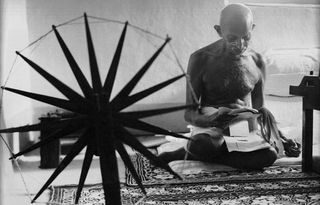
Tridip Suhrud in Caravan the Magazine:
IN CONVERSATIONS, social theorist Ashis Nandy fondly recalls an exchange between philosopher Ramachandra Gandhi and poet Umashankar Joshi. The philosopher argued that MK Gandhi was inconceivable without his spiritual strivings, while the poet—and one suspects Ashis Nandy too—insisted that Gandhi’s significance lay in his willingness to engage and transform the “slum of politics”.
This divide between the religious, spiritual Gandhi and the political one or, more aptly, the divide between Gandhi the ashramite and Gandhi the satyagrahi has come to shape not only our academic engagement with the life and thought of Gandhi, but also our memory of the man whom we revere, revile or remain indifferent to. The dichotomy is a superficial one. Gandhi saw himself as a satyagrahi and an ashramite. His politics was imbued with spiritual strivings and his relationship with religion was a deeply political one.
A long, rich and diverse biographical tradition, which has deepened our understanding of Gandhi’s life and his strivings, has not escaped this divide either. This tradition has been partial to the satyagrahi Gandhi; whereas the ashram, the ashram community, his striving to see “god face to face”, his fasts and his experiments with brahamcharya remain shadowy. Gandhi’s practices of silence, fasting, walking and spinning, his brahmacharya, and his need for prayer were integral to his self-search and to swaraj and yet we are still casting about for adequate modes of capturing and recounting these practices.
We have few serious studies on Gandhi’s ashrams. There is one by Mark Thompson titled Gandhi and His Ashrams (1993); another major exception is the recent four-volume biography of Gandhi, My Life is My Message (2009), by Narayan Desai. Desai, an ashramite himself, understands that Gandhi’s politics was not possible without the ashram as a site of experimentation, and in the absence of the ashramites who were his co-experimenters.
Our limited understanding of the ashram is also due to our neglect of the diaries of Mahadev Desai, Gandhi’s closest associate and secretary. Desai wrote a diary for each day that he spent with Gandhi from 1917 until the former’s death in the Aga Khan Palace prison in 1942. The diaries are not just records of letters sent and received and accounts of all those who visited Gandhi; running to 23 volumes in Gujarati, they are the most detailed accounts of Gandhi’s “experiments with truth”.
Was Chilean Poet Pablo Neruda Poisoned?

Oakland Ross in The Star [h/t: Pablo Policzer]:
What — or who — killed Pablo Neruda?
Nobody knows for certain, but the world may soon find out.
This Sunday or Monday, the celebrated but long-dead poet is supposed to rise from the tomb — and maybe, just maybe, he will speak.
In a decision that may well owe more than a little to the expert opinion of three Canadian toxicologists, an investigating judge named Mario Carroza has ordered the removal of Neruda’s body from its grave near the Nobel laureate’s home at Isla Negra on Chile’s Pacific coast, following nearly 40 years of interment in two different locations.
The purpose: to try to determine whether the poet was poisoned, as many now suspect.
A committed socialist and long-time Communist party member, Neruda died just 12 days after the military coup in September 1973 that overthrew the democratically elected government of Marxist president Salvador Allende.
Amid mounting suspicion of foul play, the Chilean Communist party has spearheaded a campaign for a judicial investigation.
It has also demanded the exhumation of the poet’s remains, so that they may be tested for evidence of poisoning.
Last month, Carroza ordered that the disinterment go ahead, but there continues to be some uncertainty about who will be responsible for analyzing Neruda’s corpse and whether foreign experts, including three Canadians, will be involved.
sylvia

The Ariel poems were so remarkable because women poets had never written like this before: they are personal, raw, incantatory. But they are also informed by Plath’s talent, and years of hard graft: her virtuosity is on display throughout. Poems such as the unforgettable “Daddy” used the rhythms and imagery of a nursery rhyme to reject, defiantly, the father figure who would infantilise her. Imagining marriage as being shackled to yet another “Fascist”, the speaker symbolically kills off the men who have held her back: “If I’ve killed one man, I’ve killed two/ … Daddy, you can lie back now./ There’s a stake in your fat black heart/ And the villagers never liked you./ They are dancing and stamping on you./ They always knew it was you./ Daddy, daddy, you bastard, I’m through.” In 1965, this was electrifying stuff, a call to feminist arms, and Plath became a heroine, giving voice to women’s frustration – but also to their tenderness, and maternity. If the Ariel poems vibrate with outrage, they also seek an escape hatch, trying to rise above the meanness of rage.
more from Sarah Churchwell at the FT here.
katznelson on fdr
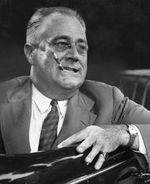
It’s a powerful argument, swept along by Katznelson’s robust prose and the imposing scholarship that lies behind it. Only at the very end of the book, though, does he acknowledge another side of the story. For all its compromises, the New Deal gave millions of Americans a sense of belonging — a sense of rights — they’d never had before. That sense swept through the industrial working class, where union buttons suddenly became badges of honor. It swept through all those ethnic communities that until the 1930s had been treated as not quite American. And despite the racial dynamics Katznelson so ably describes, it swept through African-American communities too. No doubt that’s why Bubbeh Frima saw Roosevelt as such a towering figure, because where she lived up in Washington Heights, America seemed a better place than it had been before he took office. That’s also why, just a few years after Roosevelt’s death, Jim Crow began to come tumbling down, shattered by a social movement that had been invigorated by the promise, if not necessarily the practice, of the New Deal era. Roosevelt can’t be given credit for that extraordinary triumph, of course; that belongs to the men, women and children who risked their lives on the streets of the South. But he played a role, however indirect.
more from Kevin Boyle at the NY Times here.
We make war, it's what we do
We have a tradition of glorious cruelty
and moneyed interests
……………………. —Roshi Bob
Prisoners
Usually at the helipad
I see them stumble-dance
across the hot asphalt
with crockersack over their heads,
moving toward the interrogation huts,
thin-faced as box kites
of sticks and black silk
anticipating a hard wind
that'll tug and snatch them
out into space. I think
some must be laughing
under their dust-colored hoods,
knowing rockets are aimed
at Chu Lai—that the water's
evaporating & soon the nail
will make contact with metal.
How can anyone anywhere love
these half-broken figures
bent under the sky's brightness?
The weight they carry
is the soil we tread night & day.
Who can cry for them?
I've heard the old ones
are the hardest to break.
An arm twist, a combat boot
against the skull, a .45
jabbed into the mouth, nothing
works. When they start talking
with ancestors faint as camphor
smoke in pagodas, you know
you'll have to kill them
to get an answer.
Sunlight throws
scythes against the afternoon.
Everything's a heat mirage; a river
tugs at their slow feet.
I stand alone & amazed,
with a pill-happy door gunner
signaling for me to board the Cobra.
I remember how one day
I almost bowed to such figures
walking toward me, under
a corporal's ironclad stare.
I can't say why.
From a half-mile away
trees huddle together,
& the prisoners look like
marionettes hooked to strings of light.
.
by Yusef Komunyakaa
from Unaccustomed Mercy
Soldier-Poets of the Vietnam War
Texas Tech University Press, 1989
Photographing Love
From The New Yorker:

More here.
The Messenger and the Message
From The New York Times:

…Orphaned in childhood in Mecca, an Arabian trading hub, he rose to be the trusted business agent and later husband of Khadija, a wealthy merchant woman. This respectable citizen took to climbing into the mountains overlooking the town, where he would spend nights in solitary meditation. Eventually he received a revelation, in the form of the voice of the angel Gabriel, who began to dictate the verses of the Koran. As the messenger of this radical new form of monotheism, he disrupted the power structure and eventually led his followers out of Mecca to nearby Medina, where he took full political control and began military operations against the rulers of his birthplace. By the time of his death, Islam had been embraced throughout the Arabian Peninsula and was spreading farther afield. “The First Muslim” tells this story with a sort of jaunty immediacy. Bardic competitions are “the sixth-century equivalent of poetry slams.” The section of the Koran known as the Sura of the Morning has “an almost environmentalist approach to the natural world.” Theological ideas and literary tropes are “memes” that can go “viral.” Readers irritated by such straining for a contemporary tone will find it offset by much useful and fascinating context on everything from the economics of the Meccan caravan trade to the pre-Islamic lineage of prophets called hanifs, who promoted monotheism and rejected idolatry.
More here.
Friday, April 5, 2013
tony judt and the crappy generation

If Judt had merely been an anti-Communist “cold warrior”, in the stale vocabulary of another age, he might have gloated over the disintegration of the structure Lenin and Stalin had built. To the contrary, he saw that the downfall had “undermined not just communism, but a whole progressive narrative of advance and collectivization”. Judt now became a ferocious critic of “Bush’s useful idiots”, the so-called liberal interventionists who had provided supposedly enlightened cover for brutish policies. He was dismayed by the self-evisceration of the democratic Left, exemplified by New Labour, and he saw that the historical background to this disturbing loss of moral confidence was “in large measure the collapse of the old Left, with all its faults, and the attendant ascendancy of the soft cultural Left”. At the very end of his life, Judt said that he was “more or less the same age as George W. Bush, Bill Clinton, Hillary Clinton, Gerhard Schröder, Tony Blair and Gordon Brown – a pretty crappy generation, when you come to think of it . . . a generation that grew up in the 1960s in western Europe or in America, in a world of no hard choices, neither economic nor political”.
more from Geoffrey Wheatcroft at the TLS here.
post-hysterics

The nineties were strange years. For a decade after history had purportedly “ended” a lot happened. The Soviet Union dissolved, seemingly in days and without a gunshot. A bloody war broke out between rival ethnic groups in the former Yugoslavia. The United States and much of the West were experiencing a burst of economic activity after decades of stagnation, and a revolutionary new mode of communication had emerged: the Internet. But running alongside the monumental was the downright absurd. Americans, it seemed, had not only grown prosperous in the years after the Cold War but also preposterous. In the midst of a government shutdown, the president of the United States ate pizza while he cavorted with an intern only slightly older than his daughter. The Internet turned out to be a blessing and a curse. Life felt diffuse, centrifugal, spread thin. We could trace a track-pad finger across the globe, and yet there was often nothing to touch, nothing to see, and nothing to feel. In an increasingly postindustrial age, our lives felt more and more disconnected, our labor more and more abstract. Billboard hits rang with paralyzed irony. “How bizarre”—as one particularly catchy refrain went—“how bizarre, how bizarre.”
more from David Marcus at Dissent here.
cyprus and the eurozone

The west did not follow in Cyprus’ footsteps; rather, it is the other way around. It is the west that encouraged Cyprus to embrace its model of financialisation, opening up to foreign capital and services. But this will no longer be the case. The austerity imposed by Germany and the IMF is so harsh that no cash is available any more to buy any commodity, whether “real” or “fictitious”. Merkel’s anti–inflationist and neo–liberal policy is undermining Germany’s own export–led model of economic success. Austerity in the periphery is bound to hit core economies badly – in fact, it does already. In other words, Germany is digging its own grave but it has no right to take others down with it, including Britain, a country in which austerity has already become pronounced (new taxation on families and households, abolition of benefits etc.). If this analysis is by and large correct, then the Eurozone has no prospects of survival. Sooner or later it will disintegrate and it is almost certain that there are already contingency plans drawn up for this eventuality.
more from Constantine Dimoulas and Vassilis K. Fouskas at Eurozine here.
In the beginning was the code
From Kurzweil:
A transcript of Jürgen Schmidhuber’s TEDx talk in Belgium: I will talk about the simplest explanation of the universe. The universe is following strange rules. Einstein’s relativity. Planck’s quantum physics. But the universe may be even stranger than you think. And even simpler than you think.
Is the universe being created by a computer program?
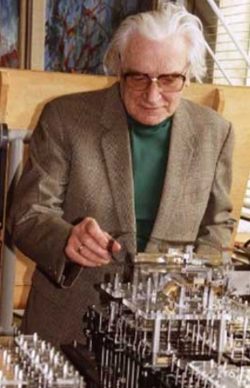
To a man with a hammer, everything looks like a nail. To a man with a computer, everything looks like a computation.
More here.
does she or doesn’t she?
Malcolm Gladwell:
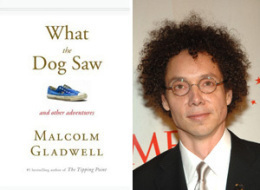
“Miss Clairol gave American women the ability, for the first time, to color their hair quickly and easily at home. But there was still the stigma — the prospect of the disapproving mother-in-law. Shirley Polykoff knew immediately what she wanted to say, because if she believed that a woman had a right to be a blonde, she also believed that a woman ought to be able to exercise that right with discretion. 'Does she or doesn't she?' she wrote, [echoing her own mother-in-law's disdainful comment 'Fahrbt zi der huer? Oder fahrbt zi nisht?' and] translating from the Yiddish to the English. 'Only her hairdresser knows for sure.' Clairol bought thirteen ad pages in Life in the fall of 1956, and Miss Clairol took off like a bird. That was the beginning. For Nice 'n Easy, Clairol's breakthrough shampoo-in hair color, she wrote, 'The closer he gets, the better you look.' For Lady Clairol, the cream-and-bleach combination that brought silver and platinum shades to Middle America, she wrote, 'Is it true blondes have more fun?' and then, even more memorably, 'If I've only one life, let me live it as a blonde!' (In the summer of 1962, just before The Feminine Mystique was published, Betty Friedan was, in the words of her biographer, so 'bewitched' by that phrase that she bleached her hair.) Shirley Polykoff wrote the lines; Clairol perfected the product. And from the fifties to the seventies, when Polykoff gave up the account, the number of American women coloring their hair rose from 7 percent to more than 40 percent.
More here.
The Nocebo Effect: How We Worry Ourselves Sick
Gareth Cook in The New Yorker:

Wi-Fi syndrome does, however, make sense in the context of a larger phenomenon: the “nocebo effect,” the placebo effect’s malevolent Mr. Hyde. With placebos (“I will please” in Latin), the mere expectation that treatment will help brings a diminution of symptoms, even if the patient is given a sugar pill. With nocebos (“I will harm”), dark expectations breed dark realities. In clinical drug trials, people often report the side effects they were warned about, even if they are taking a placebo. In research on fibromyalgia treatments, eleven per cent of the people taking the equivalent of sugar pills experienced such debilitating side effects that they dropped out.
More here. [Thanks to Aditya Dev Sood.]
Nelson Mandela – Retirement Speech: “Don’t call me, I’ll call you”
To Save Everything, Click Here

“Farhad Manjoo and Evgeny Morozov debate Morozov’s new book on “the folly of technological solutionism,” over in Slate. Manjoo:
Dear Evgeny,
A few weeks ago, while traveling from my home in Palo Alto to the South by Southwest Interactive Festival—that is, between two of your favorite places in the world—I loaded up the Kindle app on my phone and began reading your new book, To Save Everything, Click Here: The Folly of Technological Solutionism. Since then I’ve cycled through a variety of devices and apps to read and jot down my reactions to your polemic against the tech industry and its windy boosters, and I’m thrilled to be chatting with you about it this week.
You and I have very different visceral reactions to technology. You keep your router and smartphone locked in a safe; I’ve quit reading books and magazines on paper. Still, I’ve long been an admirer of your work. You’re the most sensitive bullshit detector in tech punditry—when someone in this industry is talking out of his ass, I can count on you to take him down. Readers not familiar with your work should start with your masterful skewering of puffed-up blogger Jeff Jarvis, of whose book, Public Parts, you wrote: “This is a book that should have stayed a tweet.”
Not surprisingly, Jarvis is one of your main targets in To Save Everything, and what I like best about your book is that you’re still not pulling any punches. (Disclosure: You critically cite my own work in a couple of places, though, mercifully, I’m one of the few people you handle with kid gloves.) I enjoyed the many barbs you hurled at Jarvis and your other intellectual opponents, including the speculation that their ignorance stems from being “too young or inexperienced with books” and the claim that they possess a “knowledge of history … reduced to tweet-length CliffsNotes.” You’re one of those writers who likes to show off his superiority by quoting your opponents’ grammatical errors with an appended [sic]. In other words, you’re a fighter, Morozov—and it’s not without a bit of trepidation that I jump into the ring with you.
Playing Roulette with Seven Sexes

Roli Roberts in the PLOS Biologue:
Have you ever watched “Seven Brides for Seven Brothers”? There are these seven brothers and, well you get the idea… But that was complicated enough with the two sexes that we boring old humans have – what if you had seven? That’s the exotic situation that the ciliate Tetrahymena finds itself in.
We can only speculate as to how these creatures handle their private lives, but thanks to a paper just published in PLOS Biology we now know how they decide which of the seven sexes to be.
PLOS Biology recently published another example of ciliate madness – the bizarre 16,000 chromosomes of Oxytricha. Each generation that creature makes a “working copy” of its genome by a massive cut’n'paste job that results in almost one chromosome per gene. Tetrahymena does a similar thing, though not as spectacularly (a mere 225 chromosomes – as published in another PLOS Biology paper), and that’s where the sex decision is taken.
Marcella Cervantes, Eduardo Orias and colleagues now show how this happens, and it involves playing genomic roulette.
Together against Orbán: Hungary’s new opposition
Robert Hodonyi and Helga Trüpel in Eurozine:
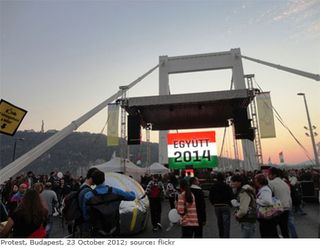
At the beginning of the year Prime Minister Victor Orbán predicted that 2013 would be the “Year of Harvest” for Hungary and that everything would be better than in 2012. To reap the fruits of his own policies, as he had already declared in a speech to Hungarian diplomats in August 2012, the path of “unorthodox” measures would be continued and further conflicts even with the EU would not be shied away from. Orbán's announcement may well impress his followers but to minorities in the country, the opposition and European institutions it must seem like a cynical threat. Although Orbán is still leading in the polls, the right-wing conservative government coalition Fidesz-KNDP has lost a significant share of the votes (41 per cent, down 12 per cent compared with 2010). The two-thirds majority is a thing of the past.
A determination to cement power
Since the “revolution at the ballot box” (in Orbán's words) the government has been pulling out all the stops to implement laws aimed at cementing its own power and in the long term preventing other political majorities. The latest example of this is the introduction of the compulsory registration of voters, which for the time being has been blocked by the Hungarian constitutional court; this is, however, only one element of the proposed electoral reform that Orbán has declared a priority for his current term in office. Compulsory registration would have barred spontaneous voters and citizens without any clear party political preferences from voting, thus favouring the Orbán camp. The government is not contesting the ruling of the constitutional court. Rather than admit defeat it is in the process of preparing a law aimed at overturning the prevailing constitutional practice and henceforth prohibiting the court from using its own rulings of the last 22 years as a basis for its judgement.With such “reforms”, Orbán's Fidesz Party is already positioning itself for the next general election to be held in the spring of 2014. And the Hungarian public is already eyeing next year's election as a “key election for the state of the nation”. In the wake of the “cold civil war” between the Left and the Right, an anti-Orbán alliance has formed and is now in the process of establishing itself as an institution and exploring possible coalitions with parliamentary oppositions for 2014. But also, profound changes are taking place in the relationship to “Brussels” and the European partners, not to mention the constant flirtation and increased economic co-operation with authoritarian regimes such as Russia, China, Kazakhstan and Azerbaijan. This article looks at both the state of the conflict with the EU on the one hand and the new awakening of civil society on the other, as well as the relation between these phenomena.
Thursday, April 4, 2013
Playing the “Islamophobia” Card
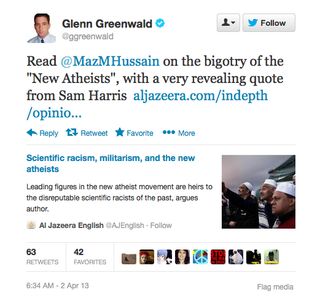
Jerry Coyne over at Why Evolution is True weighs in on the Sam Harris-Glenn Greenwald debate on the New Atheists and Islam:
The thing that distresses me the most, as I suspect it does Harris, is the fast-and-loose use of the term “Islamophobia”, intended as a brand of “racism,” to criticize those who emphasize the dangers of Islam. This puzzles me, as New Atheists have never been accused of “Christian-phobia” or “Hindu-phobia.” There is a double standard at work here—one enacted in a misguided defense of multiculturalism and moral relativism. Those who accuse others of “Islamophobia” are, I suspect, a bit bigoted themselves, for underlying it is the notion that we’re supposed to hold adherents of Islam to behavioral standards lower than those we expect from adherents to other faiths. It’s patronizing.
It is obvious to any objective person that, among all faiths, Islam poses the most danger to our world. Followers of which faith riot and kill over cartoons, subjugate women in the most offensive ways possible, send suicide bombers to weddings, blow up airplanes, buses, and embassies, advocate a form of law that would destroy democracy, issue fatwas and death threats against writers they don’t like, and espouse death to apostates, converts, and unbelievers? If you think that all religions are equally dangerous—that, for instance, Islam is no more dangerous than the Anglican Church, Quakers, or even Catholics (an invidious faith itself)—then you’re living in a fantasy world. If we had a choice to improve our world by dispelling just one brand of religious belief, I know which one I’d choose. That doesn’t mean, of course, that other faiths aren’t dangerous as well, or that we should work toward dispelling religious belief in general.
But what is Islamophobia? It’s certainly not racism, because racism is a form of bigotry against people based on things they cannot change: the genes that make them look different from others. Religious beliefs, on the other hand, are not genetically based, can be changed, and are often inherently dangerous. It’s no more “racism” to criticize Islam than it is to criticize the beliefs of Republicans or Tories.
In truth, those who hurl charges of “Islamophobia” never define it. That’s because it is, at bottom, only “criticism of the tenets of Islam,” and that doesn’t sound so bad. And it’s all in the name of multiculturalism. Indeed, ethnic diversity has good things going for it, as it exposes people to different points of view, enriches a society by exposing it to other cultures, and actually dispels racism by showing people that members of other “races” are human beings like themselves. It’s this exposure, in fact, that Peter Singer and Steve Pinker hold largely responsible for the increasing morality of our species. And I am proud to be a liberal who, like many of my kind, defends the benefits of multiculturalism.