tracking baba yaga

P5_Glaser_344095m

Why do Russian literary creations, from Gogol’s promenading nose to Bulgakov’s talking cat, hold such a captivating and enigmatic place among the classics of world literature? Perhaps the answer lies with the old woman who haunts Russian fairy tales. “If people are too inquisitive,” says Baba Yaga to her visitor, “I eat them.” This abrupt admonition, like many of the jarring oneliners in Robert Chandler’s new collection of Russian magic tales, at once surprises and perplexes, inviting us into a world where logic and understanding must yield to imagination. Russian Magic Tales from Pushkin to Platonov is full of bears who force children to play blind man’s buff, livestock who give birth to human heroes, and talking gates. Like all folk tales, these stories contain moral elements (humility is rewarded, vanity is punished), but they are worth retelling for their delightful absurdities.

more from Amelia Glaser at the TLS here.

a fault line of European civilization

Moscow-img

By the mid-thirties there were already fifty seven large cinemas in Moscow and hundreds of other places where films could be shown. The party was very well aware of the propaganda potential of the medium, and generous provision was made for cinemas in the general plan for the city. Naturally, the medium was not untouched by the omnipotent party hand. Sergei Eisenstein was forced to withdraw his film Bezhin Meadow, a dramatisation of the tale of Pavlik Morozov, an apparently apocryphal fable of an odious child who shopped his own father to the authorities and was then murdered by his family. Eisenstein went on to redeem himself in Stalin’s eyes by producing Aleksandr Nevskii, a panegyric of Russian greatness, the following year. The Soviet film industry was very productive, and not all this production was propagandistic. In music, the USSR could show some outstanding talents, and these were the years when David Oistrakh and Emil Gilels, subsequently to achieve world fame, came to public notice. After a lively debate, Pravda declared authoritatively that there was a place for proletarian Soviet dzhaz. Its main exponent was Leonid Utesov, who rose through the cabaret scene to become one of the most popular Soviet musicians. A typically “Soviet” form of light music was provided by Isaak Dunaevskii, prominent as the writer of the score for Soviet musicals such as The Jolly Fellows. The most famous Soviet musician at the time was of course Shostakovich. His opera, Lady Macbeth of the Mtsensk District, had been denounced by Pravda in January 1936 as “chaos instead of music”. He spent 1937 working on his Fifth Symphony, which was premiered in Leningrad to great acclaim in November of that year.

more from Pádraig Murphy at the Dublin Review of Books here.

calvino’s letters

Italo-calvino-02

Calvino does not have any sort of eye on posterity, as so many other modern letter-writers do. He is living in the present, not constructing a future monument. This may offer something of a surprise to the reader who comes to the letters from the fiction and who may at first miss the expected intricacy and play. It’s not that there is no fun in the letters, but the sense of direct communication, of a man being as clear as he can about a host of matters, complex and simple, is quite different from that created by the artistic density of Calvino’s prose fiction. In his art, the wit and the irony are ways of reflecting the difficulties of the world while hanging on to his sanity – instruments of reason in a world of madness. “I am in favour,” Calvino says in one letter, “of a clown-like mimesis of contemporary reality.” Clowns are often sad and all too sane; but their relation to reality is oblique. Calvino’s writing is part of a great literary project of hinting and suggesting, making memorable shapes and images, rather than giving information or offering explanations. In his letters, Calvino tells rather than shows his correspondents what he means – with great and often moving success.

more from Michael Wood at The New Statesman here.

Thursday Poem

If You Could See Her After Drinking Wine . . .

—to Micheál agus Michelle
If you could see her after drinking wine, 
Wine from Chile of the berry-red kind
Prancing ahead of me in the middle of the night
Through the business district with her face alight
Having left the pub late and a little tight.
Ah, if you could see her after drinking wine.
.

If you could see her after drinking wine.
Wine called Hoch from Germany’s Rhine
Her hands like birds fluttering in flight
In a sugawn café when the day is high
Her voice louder than the crowd’s by just a mite.
Oh, if you could see her after drinking wine.
.

If you could see her after drinking wine,
Beaujolais Nouveau, strawberries and cream
At a garden party under autumn’s gleam
Her bike by the gate lost in a dream
Of the road home as the sun goes to sleep.
Ah, if you could see her after drinking wine.
.

If you could see her after drinking wine.
Wine from California’s grape-fields fresh and new
Hopping through the Stack-of-Barley a bit askew
In her oh so new blue suede shoes.
If you could see her, as I see her, after drinking wine . . .

.
by Colm Breathnach
from Chiaroscura
publisher: Coiscéim, Dublin, 2006

Evolution shapes new rules for ant behavior

From PhysOrg:

AntsIn ancient Greece, the city-states that waited until their own harvest was in before attacking and destroying a rival community's crops often experienced better long-term success. It turns out that ant colonies that show similar selectivity when gathering food yield a similar result. The latest findings from Stanford biology Professor Deborah M. Gordon's long-term study of harvester ants reveal that the colonies that restrain their foraging except in prime conditions also experience improved rates of reproductive success. Importantly, the study provides the first evidence of natural selection shaping collective behavior, said Gordon, who is also a senior fellow at the Stanford Woods Institute for the Environment.

A long-held belief in biology has posited that the amount of food an animal acquires can serve as a proxy for its reproductive success. The hummingbirds that drink the most nectar, for example, stand the best chance of surviving to reproduce. But the math isn't always so straightforward. The harvester ants that Gordon studies in the desert in southeast Arizona, for instance, have to spend water to obtain water: an ant loses water while foraging, and obtains water from the fats in the seeds it eats. The ants use simple positive feedback interactions to regulate foraging activity. Foragers wait near the opening of the nest, and bump antennae with ants returning with food. The faster outgoing foragers meet ants returning with seeds, the more ants go out to forage. (Last year, Gordon, Katie Dektar, an undergraduate, and Balaji Prabhakar, a professor of computer science and of electrical engineering at Stanford, showed that the ants' “Anternet” algorithm follows the same rules as the protocols that regulate data traffic congestion in the Internet).

More here.

“It’s like the British during the Blitz:” How It Feels to Lose Your Breasts

Liz Kulze in The Atlantic:

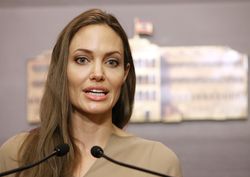
Kulze_jolie_postWhen I first saw Angelina Jolie's announcement about her double mastectomy, my mind immediately conjured up a picture of her once-magnificent chest, the prominent supporting-actors in Tomb Raider eliminated from her commanding figure. But of course, her famous breasts were skillfully, and I assume rather beautifully, restored. In an age where stardom now includes the fetishization of particular body parts, she had no other choice. Yet, as equalizing and humanizing as Jolie's words were, the reality of mastectomy is quite different for much of the world, and cuts a bit deeper than even Jolie herself has bravely let on. Much of yesterday's discussion was right in praising her brave choice and assuring us that Jolie, and all women like her, are indeed “still women.” However, it is both flippant and naive not to acknowledge that this procedure changes women , however intact their femininity remains. As any survivor will tell you, breast cancer shows no clemency. As a girl my cousins and I used to sneak into my grandmother's room to play with her boobs. She kept them in her sock drawer, palm-sized silicon inserts that gave one the sensation of a balloon filled with jelly. Her real breasts had been removed at the age of 57, before the tumors had a chance to prey on the remainder of her still-youthful figure. Looking back, I realize I never took a moment to think about the experience she had withstood. I had known her in no other way. The subdued contour of her silk blouses were entirely normal to me. But as I spent last night contemplating my own two breasts (and asking my boyfriend obnoxious questions like, “What do these mean to you?”), only then did I begin to understand both the literal and figurative parts of her that were lost.

I called her, and to my surprise, she had once been a rather voluptuous woman. “My breasts were huge!” she told me as if recalling some exciting memory of the past, “Huge! But you know after you have seven children they get pendulous. I had to sort of stuff them into a bra.” After losing them, the most harrowing part, she tells me, was the loss of sensitivity—something faced even by those like Jolie who have reconstruction. It's a kind of sexual evisceration, a source of tremendous pleasure tossed out like spoiled milk. The public, and even doctors, often forget about this. When she heard her surgeons telling my grandfather, “Oh she's so lucky, we'll just remove both her breasts, and she'll be fine,” my grandmother remembered thinking to herself, “Well god, why don't you go get your penis cut off and see how you feel?!” (to which I said, Grandmama!). Following a hysterectomy ten years prior, the additional loss of her breasts precipitated a swift end to her sex life. “It was probably a lot harder on your Granddaddy,” she said, “but I just couldn't care anymore. It would have been worse if I was younger.” Luckily my grandmother was approaching her 60s, a time where breasts and sex and one's public image begin to figure relatively less into one's day-to-day existence. But unfortunately many young women are also victims of this diabolical disruption, and at increasing rates.

More here.

Wednesday, May 15, 2013

Where Thomas Nagel Went Wrong

Michael Chorost in the Chronicle of Higher Education:
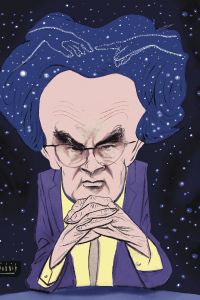
Photo_36649_portrait_largeThomas Nagel is a leading figure in philosophy, now enjoying the title of university professor at New York University, a testament to the scope and influence of his work. His 1974 essay “What Is It Like to Be a Bat?” has been read by legions of undergraduates, with its argument that the inner experience of a brain is truly knowable only to that brain. Since then he has published 11 books, on philosophy of mind, ethics, and epistemology.

But Nagel's academic golden years are less peaceful than he might have wished. His latest book, Mind and Cosmos (Oxford University Press, 2012), has been greeted by a storm of rebuttals, ripostes, and pure snark. “The shoddy reasoning of a once-great thinker,” Steven Pinker tweeted. The Weekly Standard quoted the philosopher Daniel Dennett calling Nagel a member of a “retrograde gang” whose work “isn't worth anything—it's cute and it's clever and it's not worth a damn.”

The critics have focused much of their ire on what Nagel calls “natural teleology,” the hypothesis that the universe has an internal logic that inevitably drives matter from nonliving to living, from simple to complex, from chemistry to consciousness, from instinctual to intellectual.

This internal logic isn't God, Nagel is careful to say. It is not to be found in religion. Still, the critics haven't been mollified. According to orthodox Darwinism, nature has no goals, no direction, no inevitable outcomes. Jerry Coyne, an evolutionary biologist at the University of Chicago, is among those who took umbrage. When I asked him to comment for this article, he wrote, “Nagel is a teleologist, and although not an explicit creationist, his views are pretty much anti-science and not worth highlighting. However, that's The Chronicle's decision: If they want an article on astrology (which is the equivalent of what Nagel is saying), well, fine and good.”

More here.

Albert Hirschman: An Original Thinker of Our Time

Cass R. Sunstein in the New York Review of Books:

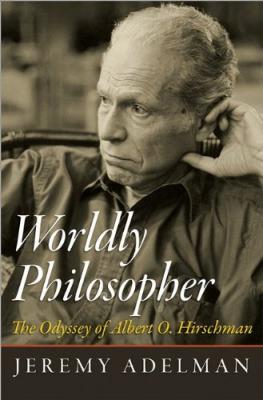
9780691155678Albert Hirschman, who died late last year, was one of the most interesting and unusual thinkers of the last century. An anti-utopian reformer with a keen eye for detail, Hirschman insisted on the complexity of social life and human nature. He opposed intransigence in all its forms. He believed that political and economic possibilities could be found in the most surprising places.

Hirschman is principally known for four remarkable books. The most influential,Exit, Voice, and Loyalty (1970), explores two ways to respond to unjust, exasperating, or inefficient organizations and relationships. You can leave (“exit”) or you can complain (“voice”). If you are loyal, you will not exit, and you may or may not speak out. The Passions and the Interests (1977) uncovers a long-lost argument for capitalism in general and commercial interactions in particular. The argument is that trade softens social passions and enmities, ensuring that people see one another not as members of competing tribes, but as potential trading partners. Shifting Involvements(1982) investigates the dramatically different attractions of political engagement and private life, and shows how the disappointments of one can lead to heightened interest in the other. For example, the protest movements of the 1960s were inspired, at least in part, by widespread disappointment with the experience of wealth-seeking and consumption, emphasized in the 1950s.

Finally, The Rhetoric of Reaction (1991) is a study of the reactionary’s tool kit, identifying the standard objections to any and all proposals for reform.

More here.

3-D Scans Reveal Caterpillars Turning Into Butterflies

Ed Yong in Not Exactly Rocket Science:

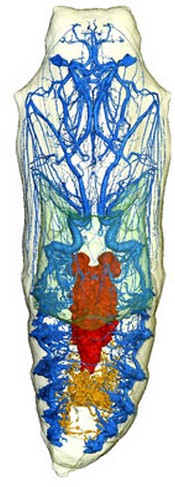
ScreenHunter_196 May. 15 15.39The transformation from caterpillar to butterfly is one of the most exquisite in the natural world. Within the chrysalis, an inching, cylindrical eating machine remakes itself into a beautiful flying creature that drinks through a straw.

This strategy—known as holometaboly, or complete metamorphosis—partitions youngsters and adults into completely different worlds, so that neither competes with the other. It’s such a successful way of life that it’s used by the majority of insects (and therefore, the majority of all animals). Butterflies, ants, beetles and flies all radically remodel their bodies within a pupa as they develop from larvae to adults.

But what goes on inside a pupa? We know that a larva releases enzymes that break down many of its tissues into their constituent proteins. Textbooks will commonly talk about the insect dissolving into a kind of “soup”, but that’s not entirely accurate. Some organs stay intact. Others, like muscles, break down into clumps of cells that can be re-used, like a Lego sculpture decomposing into bricks. And some cells create imaginal discs—structures that produce adult body parts. There’s a pair for the antennae, a pair for the eyes, one for each leg and wing, and so on. So if the pupa contains a soup, it’s an organised broth full of chunky bits.

More here.

The organic myth of the British constitution

Michael Gardiner writes at openDemocracy on 'public' services in Britain:

William BeveridgeThe British left is packed with voices demanding an unreflective defence of ‘public services’. This public is frozen beyond any evaluation of commonality, is held to be equalising even as its bases fall away to reveal the private ownership concealed within them. The barrage is triggered in part by the Great Recession, but also in part by the sovereignty challenge being felt in the UK, concretely in Scotland in 2014. Now is a good time to reflect that the British sovereignty behind these public services has always in fact defined itself as a defence against popular sovereignty, a defence projected as timeless inheritance which is intuitive and ‘just there’.

If the nationalism standing behind the ‘British public’ throughout the press and left commentary seems oddly transparent, this transparency derives from Britain’s unusual licence to exist ‘beyond’ the national. For this is less a nation than it is a rationalisation of credit. The British union arises from the import of the Anglo-Dutch financial system after 1688, its guarantee in perpetuity by the Hanoverian crown, and central banks which supported it from the 1690s. As Daniel Defoe was describing at exactly the time of the Acts of Union in 1706-07, Britain’s raison d’état is as an investment entity, a guarantor of global money. As has been described in many accounts of the close of the seventeenth century, in this new state citizenship is understood in terms of naturalised property and the avoidance rather than the promotion of shared action. Reform it as much as you like, but collectivity is not within the scope of the British constitution.

Read the rest here.

M. J. Rosenberg: Pro-Palestinian Is Not Anti-Israel But the Opposite

M. J. Rosenberg in the Washington Spectator:

Arafat-rabin_whSometimes it is instructive to listen to what Harvard law professor Alan Dershowitz says because his way of seeing the Israel-Palestinian conflict is typical of the thinking of both the Netanyahu government and its lobby here. I say “sometimes,” because most of Dershowitz’s opinions can be found in a dozen other places — from AIPAC, the “major Jewish organizations,” neocon websites like Commentary and in statements and tweetsfrom the Israeli government itself.

But sometimes Dershowitz inadvertently provides solid insight into the mentality that enables a 45-year occupation that, even Dershowitz admits, has proven so destructive to Israel.

In a debate last week with Peter Beinart, theDaily Beast columnist and author of the bestseller, The Crisis of Zionism, Dershowitz said that, for Jews, Israel is now “an embarrassment.”

In 1967, Jews were able to beat their chest and say “wow, we’re proud to be Israel [sic], look how tough Israelis are. It was a source of pride. Today, it’s a source of embarrassment.”

And he knows why, as evidenced by his reference to 1967, the year the occupation began.

But when Beinart pointed that out, Dershowitz responded that Israel’s evolution into “an embarrassment” has nothing to do with the occupation.

More here.

infinite fossil fuel

Mag-article-large

For years, environmentalists have hoped that the imminent exhaustion of oil will, in effect, force us to undergo this virtuous transition; given a choice between no power and solar power, even the most shortsighted person would choose the latter. That hope seems likely to be denied. Cheap, abundant petroleum threw sand in the gears of solar power in the 1980s and stands ready to do it again. Plentiful natural gas, a geopolitical and economic boon, is a climatological shackle. To Vaclav Smil, the University of Manitoba environmental scientist, the notion that we can move so fast is naive, even preposterous. “Energy transitions are always slow,” he told me by e-mail. Modern energy infrastructures, assembled over decades, cannot be revamped overnight. Worse still, in his view, there is little public appetite for beginning the process, or even appreciating the magnitude of what lies ahead. “The world has been running into fossil fuels, not away from them.”

more from Charles C. Mann at The Atlantic Monthly here.

Permanent Present Tense

Permanent-present-tense-the-unforgettable-life-of-the-amnesic-patient-h-m

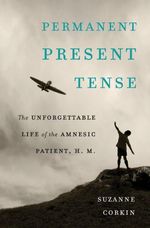
Henry had his first epileptic episode in 1936, at the age of ten; by 1953 his seizures had become increasingly frequent and debilitating. His family doctor referred him to William Beecher Scoville, a leading neurosurgeon at Yale Medical School. When massive doses of medication failed to quell his attacks and EEGs revealed no obvious locus of brain damage, Scoville suggested a novel surgical procedure. Using a trepanning drill he had constructed himself from auto parts, he cut two coin-sized holes in the skull, ‘doorways to Henry’s brain’, and suctioned out most of his medial temporal lobes, the front half of the hippocampus and most of the amygdala. After recovery, Henry’s seizures were significantly reduced, but it soon become apparent that the operation had vacuumed away any recollection of his hospital stay, and indeed most of the significant events of the previous few years. Catastrophically, it had also created a global anterograde amnesia: the loss of the ability to form new memories of any kind.

more from Mike Jay at the LRB here.

isadora duncan

Isadora Duncan y el mar

From childhood, Duncan saw herself as a liberator, opposed but never vanquished by philistines. In My Life she recalls that in elementary school she gave an impromptu lecture in front of the class on how there was no Santa Claus, whereupon she was sent home by an angry teacher. This was not the last of what, with pride, she called her “famous speeches.” When she became a professional, she routinely ended her concerts by coming out in front of the curtain and describing to the audience, at length, how profound her way of dancing was, as opposed to the triviality of other ways—she called ballet “an expression of degeneration, of living death”—and on how, therefore, they should contribute to the expenses of her school. (This declamatory bent was probably the least attractive aspect of Duncan’s personality, as it is of My Life, and some reviewers had a lot of fun with it.) What appeared to her most vile about ballet was its unnaturalness: the rigid back, the studied positions, the relentless daintiness. Duncan was an exemplary bohemian—a quality that was partly rooted, no doubt, in the fact that she was from California. (She was born in San Francisco and raised, mostly, in Oakland.) That region has a history of breeding idealists, animists, nonconformists.

more from Joan Acocella at the NYRB here.

Princess Not-So-Charming

From Harvard Magazine:

MJ13-mont“Fairy tales have always tapped into the subconscious, bringing to light children’s deepest fears,” says Soman Chainani ’01. In his new fantasy-adventure novel, The School for Good and Evil, he has brought that tenet into the twenty-first century. The first of a trilogy for middle-grade readers (ages nine and up), The School for Good and Evil tracks two archetypal heroines: the lovely Sophie, with her waist-long blond hair and her dreams of becoming a princess, and her friend Agatha, an unattractive, unpopular contrarian who chooses to wear black. A giant bird snatches the pair and carries them off to the School for Good and Evil, a two-pronged magical academy that trains children to become fairy-tale heroes and villains. When, to her horror, Sophie arrives at the Evil branch to learn “uglification,” death curses, and other dark arts, while Agatha finds herself at the School for Good amid handsome princes and fair maidens, the line between good and evil blurs, the meaning of beauty twists, and the girls reveal their true natures.

At the core of their journey is the “princess culture,” which Chainani defines as today’s “tyranny of pink in young-girl marketing. It tells them their responsibility is to be pink, sparkly, ultra-feminine, and—most of all—pretty.” With such an emphasis on looks, “girly girls are terrified of being ugly, and normal girls are afraid of being outcasts.” Even boys are unnerved. “They have no idea how to live up to the expectations,” he says.That’s what I am interested in capturing: what kids fear most today.” Sophie and Agatha inhabit a world like that of classic fairy tales: a place where magic and reality coexist, and dangers lurk. Yet those dangers reflect modern issues. Several episodes tackle the fear of aging; one chapter riffs on the current obsession with physical self-improvement. In a scene where Sophie is asked to contribute to the school, she becomes a campus celebrity by offering “Malevolent Makeovers” and a presentation titled “Just Say No to Drab.” When Agatha challenges her, Sophie replies, “Isn’t this compassion? Isn’t this kindness and wisdom? I’m helping those who can’t help themselves!”

“So much is based on image,” Chainani explains. “It’s such a pervasive, destructive thing.”

More here.

The emergence of individuality in genetically identical mice

From Kurzweil AI:

Cage-designHow do people and other organisms evolve into individuals that are distinguished from others by their own personal brain structure and behavior? Why do identical twins not resemble each other perfectly even when they grew up together? To shed light on these questions, the scientists observed 40 genetically identical mice that were kept in an enclosure that offered a rich shared environment with a large variety of activity and exploration options. They showed that individual experiences influence the development of new neurons in mice, leading to measurable changes in the brain. “The animals were not only genetically identical, they were also living in the same environment,” explained principal investigator Gerd Kempermann, Professor for Genomics of Regeneration, CRTD, and Site Speaker of the DZNE in Dresden. “However, this environment was so rich that each mouse gathered its own individual experiences in it. Over time, the animals therefore increasingly differed in their realm of experience and behavior.” Each of the mice was equipped with a special microchip emitting electromagnetic signals. This allowed the scientists to construct the mice movement profiles and quantify their exploratory behavior.

The result: despite a common environment and identical genes, the mice showed highly individualized behavioral patterns. In the course of the three-month experiment, these differences increased in size.

“These differences were associated with differences in the generation of new neurons in the hippocampus, a region of the brain that supports learning and memory,” said Kempermann “Animals that explored the environment to a greater degree also grew more new neurons than animals that were more passive.” Adult neurogenesis [generation of new neurons] in the hippocampus allows the brain to react to new information flexibly. With this study, the authors show for the first time that personal experiences and ensuing behavior contribute to the “individualization of the brain.” The individualization they observed cannot be reduced to differences in environment or genetic makeup. “Adult neurogenesis also occurs in the hippocampus of humans,” said Kempermann. “Hence we assume that we have tracked down a neurobiological foundation for individuality that also applies to humans.”

More here.

Tuesday, May 14, 2013

How the Case for Austerity Has Crumbled

Krugman_1-060613_jpg_230x1199_q85

In the New York Review of Books, Paul Krugman reviews Neil Irwin's The Alchemists: Three Central Bankers and a World on Fire, David A. Stockman's The Great Deformation: The Corruption of Capitalism in America, and Mark Blyth's Austerity: The History of a Dangerous Idea:

It’s an ill wind that blows nobody good, and the Greek crisis was a godsend for anti-Keynesians. They had been warning about the dangers of deficit spending; the Greek debacle seemed to show just how dangerous fiscal profligacy can be. To this day, anyone arguing against fiscal austerity, let alone suggesting that we need another round of stimulus, can expect to be attacked as someone who will turn America (or Britain, as the case may be) into another Greece.

If Greece provided the obvious real-world cautionary tale, Reinhart and Rogoff seemed to provide the math. Their paper seemed to show not just that debt hurts growth, but that there is a “threshold,” a sort of trigger point, when debt crosses 90 percent of GDP. Go beyond that point, their numbers suggested, and economic growth stalls. Greece, of course, already had debt greater than the magic number. More to the point, major advanced countries, the United States included, were running large budget deficits and closing in on the threshold. Put Greece and Reinhart-Rogoff together, and there seemed to be a compelling case for a sharp, immediate turn toward austerity.

But wouldn’t such a turn toward austerity in an economy still depressed by private deleveraging have an immediate negative impact? Not to worry, said another remarkably influential academic paper, “Large Changes in Fiscal Policy: Taxes Versus Spending,” by Alberto Alesina and Silvia Ardagna.

One of the especially good things in Mark Blyth’s Austerity: The History of a Dangerous Idea is the way he traces the rise and fall of the idea of “expansionary austerity,” the proposition that cutting spending would actually lead to higher output. As he shows, this is very much a proposition associated with a group of Italian economists (whom he dubs “the Bocconi boys”) who made their case with a series of papers that grew more strident and less qualified over time, culminating in the 2009 analysis by Alesina and Ardagna.

In essence, Alesina and Ardagna made a full frontal assault on the Keynesian proposition that cutting spending in a weak economy produces further weakness. Like Reinhart and Rogoff, they marshaled historical evidence to make their case. According to Alesina and Ardagna, large spending cuts in advanced countries were, on average, followed by expansion rather than contraction. The reason, they suggested, was that decisive fiscal austerity created confidence in the private sector, and this increased confidence more than offset any direct drag from smaller government outlays.

The case against empathy

Paul Bloom in The New Yorker:

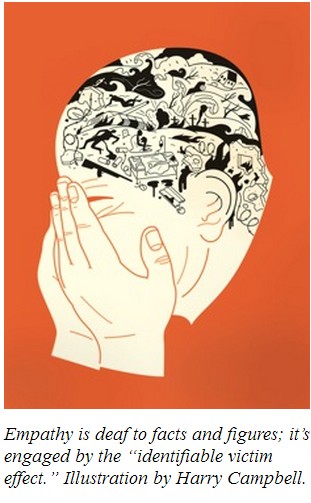
ScreenHunter_195 May. 14 16.25The immense power of empathy has been demonstrated again and again. It is why Americans were rivetted by the fate of Natalee Holloway, the teen-ager who went missing in Aruba, in 2005. It’s why, in the wake of widely reported tragedies and disasters—the tsunami of 2004, Hurricane Katrina the year after, or Sandy last year—people gave time, money, and even blood. It’s why, last December, when twenty children were murdered at Sandy Hook Elementary School, in Newtown, Connecticut, there was a widespread sense of grief, and an intense desire to help. Last month, of course, saw a similar outpouring of support for the victims of the Boston Marathon bombing.

Why do people respond to these misfortunes and not to others? The psychologist Paul Slovic points out that, when Holloway disappeared, the story of her plight took up far more television time than the concurrent genocide in Darfur. Each day, more than ten times the number of people who died in Hurricane Katrina die because of preventable diseases, and more than thirteen times as many perish from malnutrition.

More here.

Commercial quantum computer leaves PC in the dust

Jacob Aron in New Scientist:

Dn23519-1_300For the first time, a commercially available quantum computer has been pitted against an ordinary PC – and the quantum device left the regular machine in the dust.

D-Wave, a company based in Burnaby, Canada, has been selling quantum computers since 2011, although critics expressed doubt that their chips were actually harnessing the spooky action of quantum mechanics. That's because they use a non-mainstream method called adiabatic quantum computing.

Unlike classical bits, quantum bits, or qubits, can take the values 0 and 1 at the same time, theoretically offering much faster computing speed. To be truly quantum, the qubits must be linked via the quantum property of entanglement. That's impossible to measure while the device is operating. But in March, two separate tests of the D-Wave device showed indirect evidence for entanglement.

Now Catherine McGeoch of Amherst College, Massachusetts, a consultant to D-Wave, has put their computer through its paces and shown that it can beat regular machines. The D-Wave hardware is designed to solve a particular kind of optimisation problem: minimising the solution of a complicated equation by choosing the values of certain variables. It sounds esoteric, but the problem crops up in many practical applications, such as image recognition and machine learning.

McGeoch and her colleague Cong Wang of Simon Fraser University, in Burnaby, ran the problem on a D-Wave Two computer, which has 439 qubits formed from superconducting niobium loops. They also tried to solve the problem using three leading algorithms running on a high-end desktop computer. The D-Wave machine turned out to be around 3600 times faster than the best conventional algorithm.

More here.