Fetish and brutish

Image

The big, desert city of El Paso, on the US border with Mexico, for years felt like a lesson from the work of Giorgio Agamben. In his book Homo Sacer: Sovereign Power and Bare Life, Agamben analyzes a law from the Roman Empire specifying that if a man committed certain crimes, all of his citizenship rights would be revoked. This punishment, oddly enough, rendered the criminal a homo sacer, a sacred man, whom it was forbidden to ritually sacrifice to the gods. Yet in the everyday world the sacred man could be killed by anyone, with no penalty at all invoked on the killer. He inspired the highest veneration and the basest contempt. He constituted yet another category from Agamben’s work: bare life, or human existence stripped of its social nature and reduced to the purely biological. Bare life defines brutes. Homo sacer, brutes fetishized.

more from Debbie Nathan at n+1 here.

the calvino letters

0e5bb7d1-61a2-405a-a556-248c315e62bb

When Italo Calvino was becoming a big name in the English-speaking world in the 1970s and 1980s, he was seen as a somewhat rarefied figure: an Italian master of French-style abstraction who seemed to observe life from a serene ironic distance. And because of the timing of his death – at 61, after a cerebral haemorrhage, in 1985 – the prevailing image of him outside Italy has more or less stayed that way. His witty meta-novel If on a Winter’s Night a Traveller (1979) has for years been used to teach the rudiments of postmodernism, while Invisible Cities (1972) – “a totally decadent book”, he wrote casually in a letter – has acquired the status of a fetish among architects, urban theorists and purveyors of art-speak. Yet the role of chic metropolitan guru wasn’t one that Calvino sought or felt comfortable in. An agronomist’s son from the Ligurian Riviera, he started out as a writer under the auspices of the Italian Communist party, having joined while fighting as a partisan during the second world war. Hemingway and Chekhov were his first literary models and, early on, he was stymied by his unsuccessful efforts to write a novel documenting social conditions in industrial Turin.

more from Christopher Tayler at the FT here.

The Letters of William Gaddis

19BRADFEILD-articleInline

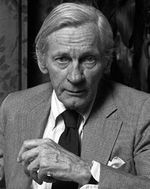
“America has odd ways of making one feel one’s self a failure. And looking over the fragments of our correspondence assembled, I am just terribly struck at the consistency, from my end, of howls about money, and from yours of reassurances, hopes, encouragement: of course this isn’t really news (and probably hardly unique in your file of writers), but seeing it so all at once did overwhelm me with a clearer sense of what I’ve put you through year after year, and I wish to Christ it had finally come up on the note of triumph you have hoped and worked so hard for.” Like most sensible serious writers, Gaddis never actually planned for his “triumph” to be posthumous; nor was he trying to write books that would be considered unreadable (usually by people who hadn’t read them). “What pained me most about the reviewers,” he writes in 1960, referring to the notoriously inadequate reception for “The Recognitions,” “was their refusal — their fear — to relax somewhat with the book and be entertained.” To be fair, one can understand why your average reviewer might not have been able to “relax” when faced by a thousand-page novel packed with theological allusions, inventive (but consistent) punctuation, dense, tiny typography and huge, tree-trunk-wide paragraphs. It’s a daunting task just lifting one of Gaddis’s best novels — let alone reading it.

more from Scott Bradfield at the NY Times here.

Saturday Poem

Through the Speckled Land
.
I

She won’t speak to me anymore, this place
my tongue is received with poor grace.

My roots penetrated only so far
and they wither for lack of water.

Salt was spread on the upper scraw
and ploughed through to the lower layer.

She can no longer nourish her brood,
In my own land as a stranger viewed.

II

On the road between two cities
each of which has two names,
I read the words on the signs.

I am travelling through the speckled land
and every town here has two names.

Claonadh – Clane
Cill Dara – Kildare
Baile Dháith – Littleton
Cúil an tSúdaire – Portarlington

the native name
in italic script
a biased telling of the lore of place
the native name
in the lesser script
a muted telling, in slow fade . . .

III

As I travel through the speckled land
I move from white to black
my journey is taken aslant
the way I follow is zig-zagged.
I am the knight going the long way round
to attack from behind, to try to confound
but there are castles I can’t assault
and clerics before me, proud and preening,
I can’t protect my own queen even
my road is blocked by lowly pawns.

IV

Between two hues
between two names
between two views
between two words
between two tongues
between two worlds
I live my life
between two lives.
.

by Colm Breathnach
from An Fearann Breac
publisher: Coiscéim, Dublin, 1982

Friday, May 17, 2013

Mortify Our Wolves

Amiens_cathedral

Though I have in my life experienced gout, bladder stones, a botched bone marrow biopsy, and various other screamable insults, until recently I had no idea what pain was. It islands you. You sit there in your little skeletal constriction of self—of disappearing self—watching everyone you love, however steadfastly they may remain by your side, drift farther and farther away. There is too much cancer packed into my bone marrow, which is inflamed and expanding, creating pressure outward on the bones. “Bones don’t like to stretch,” a doctor tells me. Indeed. It is in my legs mostly, but also up in one shoulder and in my face. It is a dull devouring pain, as if the earth were already—but slowly—eating me. And then, with a wrong move or simply a shift in breath, it is a lightning strike of absolute feeling and absolute oblivion fused in one flash. Mornings I make my way out of bed very early and, after taking all of the pain medicine I can take without dying, sit on the couch and try to make myself small by bending over and holding my ankles. And I pray. Not to God, who also seems to have abandoned this island, but to the pain. That it ease up ever so little, that it let me breathe. That it not—though I know it will—get worse.

more from Christian Wiman at The American Scholar here.

the hudson review

Hudson-Review-Volume-1-Number-1

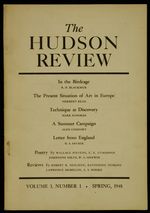
The Hudson Review may lack the name recognition of the Paris Review (founded in 1953) or the New York Review of Books (1963). Its circulation is just 2,500, and its annual budget is almost enough to buy a studio apartment on the Upper West Side. What it has, though, is an extreme clarity of mission: publishing worthy authors who keep alive the love of literature. It’s all considerably less bewildering once a reader is introduced to the magazine’s editor, Paula Deitz, who combines a quick eye for talent with a nearly career-long devotion to the project. Ms. Deitz, who is 74, became editor in 1998, just as the Internet began to dissolve the established media order. By that time, the Hudson Review had earned its reputation for independence, publishing authors from Wallace Stevens and Sylvia Plath to Octavio Paz and Joyce Carol Oates. The magazine was founded by Frederick Morgan and Joseph Bennett, two young men from Princeton University’s class of 1943 who were encouraged by their teacher, poet Allen Tate, to establish a magazine. After returning from World War II, the pair set up shop inside the Sapolio soap factory, owned by Morgan’s father. Located at the corner of West and Bank streets, it overlooked the Hudson River, hence the name of the journal.

more from Pia Catton at the WSJ here.

wagner in new york?

Germania_opt

In his last years, Richard Wagner often spoke of immigrating to America. The composer had enthusiastically greeted the founding of the German Empire in 1871, but in the following decade, as Bismarck and the Kaiser failed to provide funds for his nascent festival at Bayreuth, his chauvinism waned, and he entertained the idea of escaping to the New World. Cosima Wagner, his second wife, wrote in her diary in 1880: “Again and again he keeps coming back to America, says it is the only place on the whole map which he can gaze upon with any pleasure: ‘What the Greeks were among the peoples of this earth, this continent is among its countries.’” In consultation with Newell Jenkins, an American dentist who had become a family friend, Wagner drew up a plan whereby American supporters would raise a million dollars to resettle the composer and his family in a “favorable climate”; in return, America would receive proceeds from “Parsifal,” his opera-in-progress, and all other future work. “Thus would America have bought me from Europe for all time,” Wagner wrote. The pleasant climate he had in mind was, surprisingly, Minnesota. What might have happened if, against all odds, Wagner had realized his American scheme?

more from Alex Ross at The New Yorker here.

Here’s how to change the world

From Salon:

John-Paul-Flintoff_no-cred-required-11-620x412“How to Change the World” takes as its modest premise the idea that everyone is capable of creating massive, global change — if only we start small and set manageable goals. It’s just like quitting smoking! The book’s author, British journalist and life coach John-Paul Flintoff, has some experience in this area: for his last book, “Sew Your Own,” he learned to make all his own clothes. This allowed him to opt out of the unethical labor practices of the big clothing companies, and also gave him something to do with an old sewing machine. He reports that shirts are his favorite things to make. “How to Change the World” is different from “Sew Your Own” in that it doesn’t offer a roadmap for a particular kind of change — instead, Flintoff invites us to imagine what kinds of change we’d like to make, and suggests some ways to go about it.

For example, Flintoff tells a story about how he got very worried about global warming and decided the only solution was for everyone to grow their own produce. It wasn’t enough to just change his own habits — everyone would need to pitch in to make a dent in carbon consumption. He wanted to start with the people living in his section of London, but rather than harangue his neighbors, Flintoff devised a plan. First, around harvest time, he brought an armload of ripe tomatoes around to his neighbors’ doors, explaining he couldn’t possibly eat all the fruit he had grown. They accepted gladly. Phase I, Buttering Up, was a success. The next spring, he brought around tomato seedlings to the same neighbors. He had some cover story about having planted too many, and asked if they would be interested in growing their own tomatoes this year. Remembering the good tomatoes from last year, most accepted the plant. He had essentially tricked his neighborhood into growing its own tomatoes.

Devious? Maybe. Effective? In Flintoff’s case, yes. Although Flintoff doesn’t advise trickery in every case, he has some ideas about how to convince others to join in your righteous mission — including, paradoxically, offering them a gracious way out. “People do like to give advice or help,” he said. “The only time they don’t feel that happy is if they feel cornered.”

More here.

Obama must Make Fighting Climate Change National Project, or Die the death of a thousand Scandals

Juan Cole in Informed Comment:

Juan-colePresident Obama, like George H. W. Bush, has a problem with the ‘vision thing.’ And that is the reason for which he is being dogged by critics and ‘scandals.’ He presides over a huge bureaucracy and things will go wrong in it, for which he will be blamed if he allows others to control the narrative. Moreover, it is always possible to depict perfectly ordinary decisions by bureaucrats as somehow outrageous.

Thus, there was no cover-up in Benghazi, but all governments would want to be careful about how talking points were shaped in the aftermath of a crisis (if anything the one most responsible for the insistence that crowd reaction against an Islamophobic film was part of the Benghazi story was Republican David Petraeus, then head of the CIA).

The IRS scrutiny of Tea Party groups applying for tax exempt charitable status derived from a legitimate concern at the more than doubling of such requests after the Citizens United ruling, and a suspicion that the groups were backed by Republican billionaires intending to use them for politics, not charity. It may be that the scrutiny was sometimes invidious, but it is not obvious on the surface as to whether the bureaucrats actually did anything out of the ordinary (left wing requests for tax exempt status were flat; if they had suddenly doubled presumably they would have attracted attention, too.)

But these minor bureaucratic issues only crowd in to dominate the headlines because politics, like nature, abhors a vacuum. Obama should be making the headlines, should be setting a coherent national agenda. He offered to drive the USA Bus for another four years. But where is he taking us? Not clear.

More here.

Stephen Wolfram: Dropping In on Gottfried Leibniz

Stephen Wolfram in his blog:

ScreenHunter_199 May. 17 13.52I have always found Leibniz a somewhat confusing figure. He did many seemingly disparate and unrelated things—in philosophy, mathematics, theology, law, physics, history, and more. And he described what he was doing in what seem to us now as strange 17th century terms.

But as I’ve learned more, and gotten a better feeling for Leibniz as a person, I’ve realized that underneath much of what he did was a core intellectual direction that is curiously close to the modern computational one that I, for example, have followed.

Gottfried Leibniz was born in Leipzig in what’s now Germany in 1646 (four years after Galileo died, and four years after Newton was born). His father was a professor of philosophy; his mother’s family was in the book trade. Leibniz’s father died when Leibniz was 6—and after a 2-year deliberation on its suitability for one so young, Leibniz was allowed into his father’s library, and began to read his way through its diverse collection of books. He went to the local university at age 15, studying philosophy and law—and graduated in both of them at age 20.

More here. [Thanks to Justin E. H. Smith.]

The Ayatollah’s Game Plan

Mohsen Milani in Foreign Affairs:

Milani__TheAyatollahs_411In normal presidential elections, it is only the candidates and their platforms that matter. Not so in Iran. There, the key player in the upcoming presidential elections is the septuagenarian supreme leader, Ayatollah Ali Khamenei, who is constitutionally barred from running for the office. He recognizes that the election result will have a profound impact on his own rule and on the stability of the Islamic Republic. So behind the scenes, he has been doing everything in his power to make sure that the election serves his interests. But the eleventh-hour declarations of candidacy by Hashemi Rafsanjani, Iran's president between 1989 and 1997, and by Esfandiar Rahim Mashaei, President Mahmoud Ahmadinejad’s chief of staff and close confidant, have made his task more difficult.

The first part of Khamenei’s four-pronged strategy is to conduct an orderly election. The nightmare scenario for Khamenei is a repeat of the June 2009 presidential election, in which allegations that Ahmadinejad had stolen victory from his challenger, Mir Hossein Mousavi, led to massive demonstrations and the birth of the popular reformist Green Movement.

Khamenei could have stayed above the fray, as elites expected him to do. Instead, he lost credibility as a neutral arbiter when he sided with Ahmadinejad, rejected all allegations of fraud, and blamed Ahmadinejad’s opponents for inciting violence. His offer of public support for the president opened a fissure among the elites that has never quite healed. It also preceded a massive crackdown on activists who were castigated as American stooges and arrested. Even more, the disputed election alienated millions who felt truly robbed of their voices.

More here.

Friday Poem

Meeting at Night

The gray sea and the long black land;
And the yellow half-moon large and low:
And the startled little waves that leap
In fiery ringlets from their sleep,
As I gain the cove with pushing prow,
And quench its speed i’ the slushy sand.

Then a mile of warm sea-scented beach;
Three fields to cross till a farm appears;
A tap at the pane, the quick sharp scratch
And blue spurt of a lighted match,
And a voice less loud, through joys and fears,
Than the two hearts beating each to each!

by Robert Browning

Shocks to the brain improve mathematical abilities

From Nature:

BrainThe 'three Rs' of reading, writing and arithmetic could become four. Random electrical stimulation, a technique that applies a gentle current through the skull, leads to a long-lasting boost in the speed of mental calculations, a small laboratory study of university students has found1. If unobtrusive brain stimulation proves safe and effective in larger classroom trials, the technology could augment traditional forms of study, says Roi Cohen Kadosh, a cognitive neuroscientist at the University of Oxford, UK, who led the study. “Some people will say that those who are bad at mathematics will stay bad. That might not be the case.” Cohen Kadosh’s team made headlines in 2010, when it showed that a different form of electrical jolt — transcranial direct-current stimulation (TDCS) — helped volunteers to learn and remember a number system made up of unfamiliar symbols.

In TDCS, electrical current flows continuously between electrodes placed on different parts of the scalp, activating neurons in one area and quieting them in another. It feels like a baby tugging gently on your hair. By contrast, with transcranial random-noise stimulation (TRNS), “people ask ‘are you sure it’s on?’” says Cohen Kadosh. As the name implies, the technique involves electrical currents flowing through electrodes in random pulses, activating neurons in multiple brain areas. There is no evidence to suggest that either method is unsafe, he says. In the latest study1, his team tasked 25 Oxford students with rote memorization of mathematical facts (such as 2 x 17 = 34) and more complicated calculations (for example, 32 – 17 + 5). Thirteen volunteers received TRNS to their prefrontal cortices, a part of the brain involved in higher cognition, while doing these problems for five days in a row. They became faster at both tasks than volunteers in the control group, who were electrically stimulated only briefly.

More here.

Thursday, May 16, 2013

The First New Atheist? Kierkegaard

Our own Morgan Meis in The Smart Set:

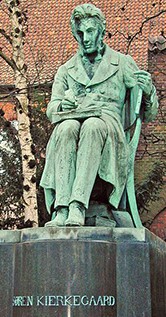
ScreenHunter_198 May. 16 18.13Søren Kierkegaard was born in Denmark on May 5, 1813. He was a difficult and troublesome boy. He quarreled with his father and lived a flippant and self-indulgent life as a young man. Then he had a conversion experience. He broke with his fiancé and became an urban hermit of sorts. He studied philosophy and started to write. He believed that he had a truth to tell the people of his time. The people didn't want to be told — do they ever? This caused him to fight with his fellow Danes and anyone else who got in his way. He became an object of ridicule around Copenhagen. The local papers made fun of him for his hunched back and clubbed foot. He wrote many books under various false names, most of which were ignored. He died in relative obscurity at the age of 42.

Thus, the short and painful life of Søren Kierkegaard. Over the last 200 years, however, Kierkegaard's writings have resurfaced in influential places. A mad German named Friedrich Nietzsche was impressed with Kierkegaard's writings. He helped to keep Kierkegaard from falling into complete oblivion. Another rascally German rediscovered Kierkegaard in the early 20th century. This was Martin Heidegger who, unintentionally, turned Kierkegaard into an intellectual predecessor of Existentialist philosophy. More recently the Post-Modernists rediscovered Kierkegaard, fascinated by his use of fragmentary writing and multiple narrative voices. Kierkegaard is the philosopher who will not go away.

Today, at the 200th anniversary of his birth, Kierkegaard seems as relevant as ever. That’s because there is a public discussion about faith in America today. Kierkegaard’s central concern was faith and the problems of faith. Today, the evolutionary biologist and sometimes children's author Richard Dawkins is at the forefront of the faith debate. The philosopher and cognitive scientist Daniel Dennett is a frequent contributor, as well as the neuroscientist Sam Harris. The late, great Christopher Hitchens was the angriest and funniest participant. We'll call these figures The New Atheists.

More here.

KFC smugglers bring buckets of chicken through Gaza tunnels

Ahmed Aldabba in the Christian Science Monitor:

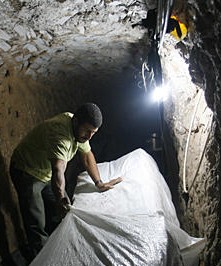
ScreenHunter_197 May. 16 18.03For six years, Rafat Shororo longed for the taste of a KFC sandwich he had eaten in Egypt. This week, he got his finger lickin' fix at home in the Gaza Strip after a local delivery company managed to smuggle it from Egypt through underground tunnels.

“It has been a dream, and this company has made my dream come true,” says Mr. Shororo, an accountant, as he receives his order from the delivery guy.

The al-Yamama company advertises its unorthodox new fast-food smuggling service on Facebook. It gets tens of orders a week for KFC meals despite having to triple the price to 100 shekels ($30) to cover transportation and smuggling fees. The deliveries go from the fryers at the Al-Arish KFC joint 35 miles away to customers' doorsteps in about three hours.

The fact that the tunnels operate quickly and cheaply enough for the Colonel’s secret recipe to be enjoyed in the tightly controlled Gaza Strip shows just how much of a sieve the Egypt-Gaza border has become.

More here.

How do Finnish kids excel without rote learning and standardized testing?

Erin Millar in The Globe and Mail:

Two+girls+with+microscope+-+from+archiveOne September morning in 2003, a group of engineers gathered for a marathon brainstorming session at NASA’s Jet Propulsion Lab in Pasadena, Calif. Their intent was ambitious; they wanted to dream up a new way to land spacecraft on Mars.

The meeting stretched to three days of scribbling options on whiteboards, and the solution they came to for landing the SUV-sized rover Curiosity was radical. When Curiosity was 10 kilometres above ground, a contraption they called a sky crane would detach. Then rocket engines would slow the crane to 3 kmh, so it almost hovered above ground as it gently lowered the rover on cables to the ground before flying off and crash landing a safe distance away.

The idea marked a dramatic reversal in NASA’s design philosophy by favouring a complex, risky technology over the simpler, safer, albeit imprecise, previously used options of airbags and legs. Observers thought it was crazy. But on Aug. 5, 2012, after a nail-biting entry into the atmosphere of Mars, Curiosity landed safely.

The sky crane typifies a modern sort of innovation; the big, transformative ideas of today are often complicated and collaborative. Innovation is no longer necessarily about inventions produced by a single person, but about collective knowledge and team-based problem solving.

So if innovation requires people who thrive on collaboration, why are our education systems so focused on individual achievement?

More here.

The Superhero Factory

Paul Morton skips through Sean Howe's history of Marvel comics at The Millions:

Marvel comicsAt some point, at 4, at 8 or 25, every child learns he will not become a superhero. It won’t be his first disillusionment. He will meet men and women who won’t return his affections. He will discover he has only a limited talent for the vocation he honors. He’ll still indulge his initial fantasies from time to time, usually through stories that imbue the superhero mythos with a hint of realism, some concept of what a superhero would look and act like if he inhabited our world. In the ’60s Marvel Comics comforted its readers by creating superheroes as neurotic as themselves. Ben Grimm was a powerful but impotent rock-man who could only be sated by the love of a blind woman. Reed Richards had no curiosity for the sexual possibilities of his body, which could stretch in any and all directions. By the ’80s, the concept of superhero-comic realism led to the ultra-violence of DC’s Watchmen and The Dark Knight Returns. But in the ’60s Marvel Comics avoided anything like Alan Moore’s misanthropy and Frank Miller’s fascism. The Marvel Universe was at once familiar and psychedelic, mature and juvenile, populated by likable good-looking freaks. It was a happy place.

Read the rest of the essay here.

tracking baba yaga

P5_Glaser_344095m

Why do Russian literary creations, from Gogol’s promenading nose to Bulgakov’s talking cat, hold such a captivating and enigmatic place among the classics of world literature? Perhaps the answer lies with the old woman who haunts Russian fairy tales. “If people are too inquisitive,” says Baba Yaga to her visitor, “I eat them.” This abrupt admonition, like many of the jarring oneliners in Robert Chandler’s new collection of Russian magic tales, at once surprises and perplexes, inviting us into a world where logic and understanding must yield to imagination. Russian Magic Tales from Pushkin to Platonov is full of bears who force children to play blind man’s buff, livestock who give birth to human heroes, and talking gates. Like all folk tales, these stories contain moral elements (humility is rewarded, vanity is punished), but they are worth retelling for their delightful absurdities.

more from Amelia Glaser at the TLS here.