Shutting Down the Extra Chromosome in Down’s Syndrome Cells

Ed Yong in Not Exactly Rocket Science:
ScreenHunter_246 Jul. 18 12.38Many genetic disorders are caused by faulty versions of a single gene. In the last decade, scientists have made tremendous strides in correctingthese faults through “gene therapy”—using viruses to sneak in working versions of the affected genes.

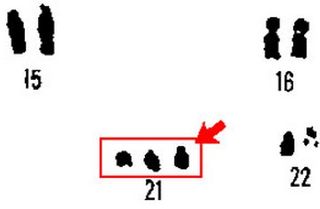
But some disorders pose greater challenges. Down’s syndrome, for example, happens when people are born with three copies of the 21stchromosome, rather than the usual two. This condition, called trisomy, leads to hundreds of abnormally active genes rather than just one. You cannot address it by correcting a single gene. You’d need a way of shutting down an entire chromosome.

But half of us do that already. Women are masters of chromosomal silencing.

Women are born with two copies of the X chromosome, while men have just one. This double dose of X-linked genes might cause problems, so women inactivate one copy of X in each cell.

This is the work of a gene called XIST (pronounced “exist”). It produces a large piece of RNA (a molecule closely related to DNA) that coats one of the two X chromosomes and condenses it into a dense, inaccessible bundle. It’s like crunching up a book’s pages to make them unreadable and useless. XIST exists on the X chromosome, so that’s what it silences. But it should be able to shut down other chromosomes too, if we could just insert it into the right place.

That’s exactly what Jun Jiang from the University of Massachusetts Medical School has done: she used XIST to shut down chromosome 21.

More here.
Rolling Stone’s Boston Bomber Cover Is Brilliant

Mark Joseph Stern in Slate:

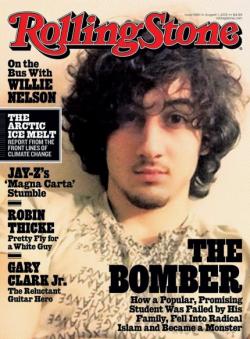
Rolling_tsarnaev.jpg.CROP.article250-mediumRolling Stone has unveiled its next cover, featuring a dreamy photo of Boston bombing suspect Dzhokhar Tsarnaev, and many people have erupted in outrage. Some critics say the image depicts Tsarnaev as a kind of celebrity; others believe it turns him into a martyr. Massachusetts Governor Deval Patrick called the cover “out of taste,” while CVS has banned the issue “out of respect for the victims of the attack and their loved ones.” A smaller chain of New England stores is also boycotting the magazine for “glorify[ing] evil actions.” Never mind that the picture itself once appeared on the front page of the New York Times; when Rolling Stone uses it, they’re “tasteless,” “trashy,” and “exploitative.”

As the Washington Post’s Erik Wemple points out, the image is exploitative—but it isn’t just exploitative: It’s also smart, unnerving journalism. By depicting a terrorist as sweet and handsome rather than ugly and terrifying, Rolling Stone has subverted our expectations and hinted at a larger truth. The cover presents a stark contrast with our usual image of terrorists. It asks, “What did we expect to see in Tsarnaev? What did we hope to see?” The answer, most likely, is a monster, a brutish dolt with outward manifestations of evil. What we get instead, however, is the most alarming sight of all: a boy who looks like someone we might know.

Judging from the article itself, the image is disconcertingly apt. The story, a two-month investigative report by Janet Reitman, tracks Tsarnaev’s tragic, dangerous path from a well-liked student to a monster, focusing on the increasing influence of radical Islam. (The headline on the cover suggests as much; those immediately outraged by the picture might do well to read the accompanying text.)

More here.

The Surprising Origins of Evolutionary Complexity

Carl Zimmer in Scientific American:

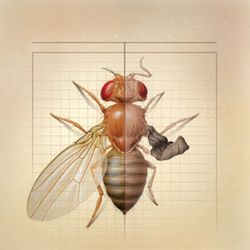
FlyCharles Darwin was not yet 30 when he got the basic idea for the theory of evolution. But it wasn't until he turned 50 that he presented his argument to the world. He spent those two decades methodically compiling evidence for his theory and coming up with responses to every skeptical counterargument he could think of. And the counterargument he anticipated most of all was that the gradual evolutionary process he envisioned could not produce certain complex structures.

Consider the human eye. It is made up of many parts—a retina, a lens, muscles, jelly, and so on—all of which must interact for sight to occur. Damage one part—detach the retina, for instance—and blindness can follow. In fact, the eye functions only if the parts are of the right size and shape to work with one another. If Darwin was right, then the complex eye had evolved from simple precursors. In On the Origin of Species, Darwin wrote that this idea “seems, I freely confess, absurd in the highest possible degree.” But Darwin could nonetheless see a path to the evolution of complexity. In each generation, individuals varied in their traits. Some variations increased their survival and allowed them to have more offspring. Over generations those advantageous variations would become more common—would, in a word, be “selected.” As new variations emerged and spread, they could gradually tinker with anatomy, producing complex structures.

More here.

Clinical Trials for Cancer, One Patient at a Time

From Columbia University Newsroom:

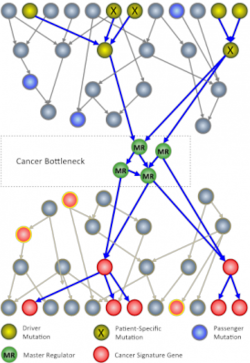
Image006-274x398Columbia University Medical Center (CUMC) researchers are developing a new approach to cancer clinical trials, in which therapies are designed and tested one patient at a time. The patient’s tumor is “reverse engineered” to determine its unique genetic characteristics and to identify existing U.S. Food and Drug Administration (FDA)-approved drugs that may target them. Rather than focusing on the usual mutated genes, only a very small number of which can be used to guide successful therapeutic strategies, the method analyzes the regulatory logic of the cell to identify genes and gene pairs that are critical for the survival of the tumor but are not critical for normal cells. FDA-approved drugs that inhibit these genes are then tested in a mouse model of the patient’s tumor and, if successful, considered as potential therapeutic agents for the patient — a journey from bedside to bench and back again that takes about six to nine months.

“We are taking a rather different approach to tailor therapy to the individual cancer patient,” said principal investigator Andrea Califano, PhD, professor and chair of CUMC’s new Department of Systems Biology (see below). “If we have learned one thing about this disease, it’s that it has tremendous heterogeneity both across patients and within individual patients. When we expect different patients with the same tumor subtype or different cells within the same tumor to respond the same way to a treatment, we make a huge simplification. Yet this is how clinical studies are currently conducted. To address this problem, we are trying to understand how tumors are regulated one at a time. Eventually, we hope to be able to treat patients not on an individual basis, but based on common vulnerabilities of the cancer cellular machinery, of which genetic mutations are only indirect evidence. Genetic alterations are clearly responsible for tumorigenesis but control points in molecular networks may be better therapeutic targets.”

More here.

Wednesday Poem

Variations On the Word Sleep
.
I would like to watch you sleeping,
which may not happen.
I would like to watch you,
sleeping. I would like to sleep
with you, to enter
your sleep as its smooth dark wave
slides over my head

and walk with you through that lucent
wavering forest of bluegreen leaves
with its watery sun & three moons
towards the cave where you must descend,
towards your worst fear
I would like to give you the silver
branch, the small white flower, the one
word that will protect you
from the grief at the center
of your dream, from the grief
at the center. I would like to follow
you up the long stairway
again & become
the boat that would row you back
carefully, a flame
in two cupped hands
to where your body lies
beside me, and you enter
it as easily as breathing in

I would like to be the air
that inhabits you for a moment
only. I would like to be that unnoticed
& that necessary.

by Margaret Atwood

Derrida’s Life as an Algerian Jew

Derrida_071013_620px

Scott Krane in Tablet:

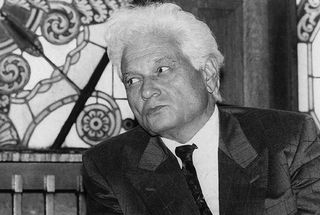
Derrida’s attitude toward biography may have also been shaped by the experiences of his own family and his resulting loss of verifiable connection to his origins. Most of the papers concerning Derrida’s family life and his early life growing up as a Jew in Algiers have disappeared. In a book review for the Guardian, literary theorist Terry Eagleton wrote:

At the age of 12, Derrida was excluded from his lycee when the Algerian government, anxious to outdo the Vichy regime in its anti-semitic zeal, decided to lower the quota of Jewish pupils. … Paradoxically, the effect of this brutal rejection on a “little black and very Arab Jew” as he described himself, was not only to make him feel an outsider, but to breed in him a lifelong aversion to communities. He was taken in by a Jewish school, and hated the idea of being defined by his Jewish identity. Identity and homogeneity were what he would later seek to deconstruct. Yet the experience also gave him a deep suspicion of solidarity.

In an interview, Peeters said, “In 1942, anti-Semitic measures taken by the Vichy regime had him excluded from school for a year. Like other Jews of Algeria, he was stripped of French nationality. These experiences marked him forever. But this time, he also kept away from the Jewish school founded by teachers excluded from formal education. These themes run throughout his life and his work.”

In 1962, Derrida’s parents left their home and his birthplace of El Biar in the “hill suburbs of Algiers.” But Peeters manages to capture content that may have seemed elusive to researchers and searchers for autobiographical sentiment. “I was part of an extraordinary transformation of French Judaism in Algeria: My great-grandparents were still very close to the Arabs in language and customs,” Derrida once recalled during a later-in-life interview quoted by Peeters.

Bring Back Egypt’s Elected Government

Images (5)

Jeffrey D. Sachs in Project Syndicate:

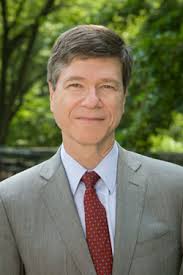
Putting an end to Egypt’s deepening polarization and rising bloodshed requires one urgent first step: the reinstatement of Mohamed Morsi as Egypt’s duly elected president. His removal by military coup was unjustified. While it is true that millions of demonstrators opposed Morsi’s rule, even massive street protests do not constitute a valid case for a military coup in the name of the “people” when election results repeatedly say otherwise.

here is no doubt that Egyptian society is deeply divided along sectarian, ideological, class, and regional lines. Yet the country has gone to the polls several times since the February 2011 overthrow of Mubarak’s 30-year rule. The results have demonstrated strong popular support for Islamist parties and positions, though they also make clear the country’s schisms.

In late 2011 and early 2012, Egypt held parliamentary elections. Morsi’s Freedom and Justice Party, created by the Muslim Brotherhood, secured a plurality, and the two major Islamist blocs together received roughly two-thirds of the vote. In June 2012, Morsi defeated his rival Ahmed Shafik, Mubarak’s final prime minister, by a margin of 52-48% to win the presidency. In a national referendum in December 2012, a 64% majority of those voting approved a draft constitution backed by the Muslim Brotherhood (though turnout was low).

The secular argument that Morsi’s lust for power jeopardized Egypt’s nascent democracy does not bear scrutiny. Secular, military, and Mubarak-era foes of the Muslim Brotherhood have used every lever at their disposal, democratic or not, to block the Islamist parties’ democratic exercise of power. This is consistent with a decades-old pattern in Egyptian history, in which the Brothers – and Islamist political forces in general – were outlawed, and their members imprisoned, tortured, and exiled.

Claims that Morsi ruled undemocratically stem from his repeated attempts to extricate the popularly elected parliament and presidency from anti-democratic traps set by the military.

Afghanistan: The War After the War

20130714-lieven-part1_jpg_470x629_q85

Anatol Lieven in the NYRB blog:

The attempt at talks between the United States and the Afghan Taliban appears to have broken down for the moment. This is not unexpected, and is not in itself cause for despair. Almost every negotiating process in history aimed at ending insurgencies and civil wars has taken a very long time, and encountered numerous reverses along the way. Things are especially difficult because the conflict is not simply an insurgency against an “occupier,” but also a civil war between local groups, with one of them supported from outside. This means that negotiations have to be between three or more parties—the US, the Taliban, the Karzai government, and other anti-Taliban forces.

This kind of negotiating situation is not new: it was true in Northern Ireland, which involved the British, the IRA, and the Ulster protestant parties; in Algeria with the French government, the FLN and the French settlers in Algeria; and in Vietnam with the US, North Vietnam, and South Vietnam. Of course, one solution is for the outside power simply to abandon its local allies and reach a settlement with the enemy without them (of course, with face-saving provisions, but with the implicit understanding that these allies are being thrown to the dogs). This is what the insurgents always aim at—and what in Algeria and Vietnam they eventually achieved, after immense bloodshed: splitting the foreign power from its local allies or proxies. And this is precisely what Karzai and his supporters fear most, accounting for the sometimes hysterical nature of their protests against negotiations with the Taliban.

Seen from Kabul, there are good reasons to fear that the US will negotiate some sort of deal with the Taliban and quit Afghanistan entirely.

Tuesday, July 16, 2013

A Chat With Author and Former Pornographer Dave Pounder

Gad Saad in Psychology Today:

129065-128278David Mech, aka Dave Pounder, contacted me several years ago to explore the possibility of pursuing his PhD under my tutelage. To suggest that he had a unique profile would be an understatement. Dave has had a successful career as a pornographer including having starred in countless films as an actor. From my perspective as an evolutionary consumer psychologist, his experience in the adult industry offered a rare opportunity to tackle research questions that might have otherwise been difficult to investigate. Although Dave was accepted into our doctoral program and was offered an attractive financial package, he decided to remain in Florida as he felt that the Montreal winters would be too difficult to bear! Recently, he advised me that his book and documentary dealing with the porn industry were published and released respectively. I thought that it might be an instructive and fun exercise to interview him about his former career and recently completed projects. Here are the highlights of our recent e-chat. GS and DM refer to Gad Saad and David Mech respectively.

GS: What led you to pursue a career in pornography?

DM: I decided to follow a career in pornography because I wanted to align myself with an industry that was unnecessarily stigmatized. I never saw an issue with sex, yet many people did. Whenever I would ask people why they had an aversion to sex, they never really had a concrete, valid answer. Gandhi once said, “Be the change you wish to see in the world.” I figured if I could use my desirable background (e.g., educated, well-spoken, no criminal history, etc.) and align it with the adult media business, then I could start having conversations with people about the adult industry (and sex more generally) and begin a process of social change.

More here.

The Imperial Kitchen

Topkapi Palace Kitchens

Jason Goodwin in Lapham's Quarterly:

Among the kiosks, halls, reception chambers, and harem baths, I suspect that visitors [to Topkapi Palace in Istanbul] today spend the least time of all in the palace kitchens—unless they have an interest in Chinese porcelain, which is displayed in there. Otherwise there’s nothing much to see, just a series of domed rooms. Outside you can count the ten pairs of massive chimneys, but there’s no smoke.

It’s a pity that the building is so quiet, because it was in here, over four centuries, that one aspect of Istanbul’s imperial purpose was most vividly expressed. The imperial kitchen quarters extended well beyond the great domed chambers, each of which was devoted to particular specialties, such as the making of sweets, pickles, and cures. There were pantries and storerooms and offices for the team of clerks who kept meticulous records of what was bought, and how much was spent. Hundreds of men, commanded by sixty specialty chefs, lived and worked here, feeding up to ten thousand people a day. The soup, the pilaf, the helva, the vegetable dishes, meats, breads, pastries were each produced by a master chef, with as many as a hundred apprentices. They had their own dormitories, a fountain, a mosque, and a hammam where they could bathe.

The Life of Karl Marx: Berfrois Interviews Jonathan Sperber

3-marx

In Berfrois:

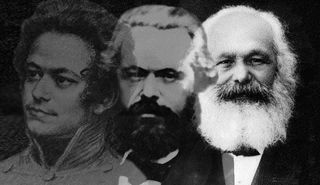
Historians are notoriously reluctant to give yes-or-no answers to any question, and this one is a particularly apt candidate for an ambivalent response. Marx certainly made lots of hostile comments about Jews in his correspondence, whether about his encounters with obscure individuals or in regard to his relations with his pupil and rival Ferdinand Lassalle. In his 1844 essay “On the Jewish Question,” he denounced Judaism as a religion encouraging haggling, greed, obsession with money and a whole host of obnoxious capitalist attitudes. A post-capitalist regime would be, Marx went on, one in which the Jewish religion and Jewish identity would come to an end. Such assertions certainly sound, by today’s standards, distinctly anti-Semitic. From such remarks, many authors have concluded that Marx was a self-hating Jew, that he saw Jews as embodying capitalism and so hated them, making his ideas precursors to both the Nazis’ and the communists’ anti-Semitism.

There is another side to Marx’s attitude, though. In that same essay on the Jewish Question he insisted, in no uncertain terms, on the emancipation of the Jews, that is on their having the same citizenship and civil rights as Gentiles, asserting that such emancipation was a central element in the development of a democratic and republican form of government. Marx’s attitude toward his Jewish ancestry appears in the letters he wrote to his uncle Lion Philips, his mother’s sister’s husband, a person he admired and who was rather a father figure for the adult Marx. In one such letter writing about the development of the higher criticism of the Old Testament, he stated that, “Since…Darwin has proven our common descent form the apes, scarcely any shock whatsoever can shake ‘our pride in our ancestors.’” In another Marx described the Tory leader Benjamin Disraeli, (whom Marx greatly admired, regarding, as the smartest man in British politics) as “our tribal comrade.”

The Zimmerman Verdict

Justin Smith over at his website:

To the extent that I, as a matter of principle, do not believe in incarceration, I am never sad when someone else is not sent to prison. I would have liked to see Zimmerman found guilty, and I would have liked for him to be compelled to spend his life doing things that would have made him a better person, as a starter things that would not involve guns. I would not like to have seen him sent to a place where the travesty of racial essentialism and inequality in America is concentrated and heightened to an absurd degree, and where people are forced to identify with racial clans in order to stay alive. In prison he would not have learned to regret shooting Trayvon Martin; he would have been deposited into a world that can only make sense by appeal to the same false virtues –self-defense, looking after one's own– that caused him to commit the murder in the first place.

When I taught in a maximum security prison in Ohio, the guards had to check every day to make sure the class was perfectly balanced between 'races', so that no one group of racially affiliated inmates would feel emboldened enough to gang up on the others and stab them with their pencils (a potential weapon issued cautiously in reward of good conduct) right before my eyes. I've seen enough of prisons to know that no good can come of them. None at all.

If the punishment were to sit in a confined space for years and years in atonement for one's crime, that would be one thing. But that's not what the punishment of imprisonment is. Imprisonment involves living in constant fear of being raped and beaten, and it involves submitting to the very grossest rules of a Hobbesian nightmare world in order to avoid these outcomes. But this is not fitting punishment for any crime.

Of humans and nature

From The Washington Post:

BookTwo recent books — “The Kingdom of Rarities,” by Eric Dinerstein, and “Butterfly People,” by William Leach — explore humans’ quests for nature and their larger implications. While they capture these expeditions with different degrees of success, both writers shed light on why we fixate on species that are so different from us, and what their status in the world says about our own shortcomings.

While “The Kingdom of Rarities” explores two wonky scientific questions — why are certain species rare, and how does this phenomenon inform modern-day conservation? — the book is more of an adventure story than an academic treatise. Dinerstein, who has worked as a World Wildlife Fund scientist for nearly a quarter century, has spent his career traveling to some of the world’s most remote places, taking such good notes that he can relate those encounters in vivid detail. From the greater one-horned rhinoceros to the flamboyant Andean cock-of-the-rock, whose nearly flourescent orange plumage and elaborate song and feather-shaking make it stand out in the Amazon, he has enjoyed nearly unparalleled access to some of the globe’s rarest inhabitants.

More here.

Researchers glimpse microbial ‘dark matter’

From Nature:

BacteriaSingle-cell sequencing enables scientists to decipher the genome of just one cell by amplifying its DNA by 1-billion-fold, opening the way to studying ‘microbial dark matter’. These are organisms that have been discovered through methods such as metagenomics studies — which examine batches of micro-organisms living in a common environment — but are difficult or impossible to grow in the lab. Woyke and her group attempted to explore this dark matter by selecting a highly diverse range of microbes and sequencing a portion of their genomes (which could range from less than 10% to more than 90% depending on the cell). The sequences clarified the microbes’ relationships to one another and to other species. The work reveals that some conventional boundaries between the kingdoms of life are not as rigid as has been thought. For instance, the researchers suggest that one bacterial lineage synthesizes purine bases — building blocks of DNA and RNA — using enzymes previously thought to exist only in archaea. Meanwhile, three of the archaeal cells sequenced in the study harbour sigma factors, which initiate RNA transcription and have previously been found only in bacteria. The researchers also found a bacterium that has ‘recoded’ the three-letter series of bases UGA — known as the opal stop codon. In almost every other organism, this nucleotide sequence signals the cell to stop translating RNA into protein. But in this organism, it tells the cell to make the amino acid glycine. The team propose to place it into a new bacterial phylum, called Gracilibacteria. A similar recoding has been found in another bacterium, suggesting that the code of life may be more flexible than scientists have assumed. “If you consider all the novelty we found in these 201 genomes, it’s astounding, because we’re only looking at a small part of the tremendous diversity out there,” Woyke says.

The researchers say that their work can help put more leaves on the bare branches of the tree of life.

More here.

Literary guide to India

Amit Chaudhury in The Telegraph:

ScreenHunter_245 Jul. 16 11.47It goes without saying that it’s not possible to find one book that has everything about India. The work that comes closest is the Mahabharata– but it’s hard to get an excellent contemporary translation in English. Besides, its plethora of characters might “bamboozle” (to invoke the word that the Lonely Planet uses to describe the country’s initial impact) you on a first reading. Better to begin with a slight but charming book calledIn Search of the Mahabharata by Jean-Claude Carrière, who wrote the script of Peter Brook’s version of the epic. The book is a skeletal but magical account of travels through India, of interviewing and watching performers for whom the epic is their bread and butter, these excursions necessitated by the knowledge that no new adaptation could be possible without lived experience: “We knew the poem, we wanted to see the country.”

For writing on modern India, it’s de rigueur to first check out fiction set in Bombay; there’s much to choose from, given it’s the one Indian city in which English has been the dominant middle-class language. And so it’s worth reading what at least some members of that class consider their defining epic, Rushdie’s vivacious masterpiece, Midnight’s Children, as well as Suketu Mehta’s Maximum City, a non-fiction account of Bombay’s amoral transition towards free-market energy.

More here.

The Case for Abolishing the Department of Homeland Security

Charles Kenny in Bloomberg Businessweek:

ScreenHunter_244 Jul. 16 11.38On Friday, Secretary of Homeland Security Janet Napolitano resigned to take up a post running California’s university system. With her departure, there are now 15 vacant positions at the top of the department. That suggests it would be a particularly humane moment to shut the whole thing down. The U.S. Department of Homeland Security was a panicked reaction to the Sept. 11 attacks. It owes its continued existence to a vastly exaggerated assessment of the threat of terrorism. The department is also responsible for some of the least cost-effective spending in the U.S. government. It’s time to admit that creating it was a mistake.

In 2002 the George W. Bush administration presented a budget request for massively increased spending on homeland security, at that point coordinated out of the Office of Homeland Security. “A new wave of terrorism, involving new weapons, looms in America’s future,” the White House said. “It is a challenge unlike any ever faced by our nation.” In proposing a new cabinet-level agency, Bush said, “The changing nature of the threats facing America requires a new government structure to protect against invisible enemies that can strike with a wide variety of weapons.” Because of “experience gained since Sept. 11 and new information we have learned about our enemies while fighting a war,” the president concluded that “our nation needs a more unified homeland security structure.”

More than a decade later, it’s increasingly clear that the danger to Americans posed by terrorism remains smaller than that of myriad other threats, from infectious disease to gun violence to drunk driving.

More here.

Virginia Heffernan’s Shameful Confession: She says she’s a creationist. Seriously.

Laura Helmuth in Slate:

130715_SCI_VirginiaHeffernan.jpg.CROP.article250-mediumUntil Project Runway, I never really understood people who are intimidated by science. My officemates at the time were fascinated with the show and talked about it with great passion. They used words I didn’t know and cited famous people I’d never heard of. I felt queasy, confused, and self-conscious.

What did I do about my uneasy ignorance? Did I watch the show, read smart articles about fashion, educate myself about its history and practice? Of course not. I rolled my eyes with disdain. And after a while I finally had my epiphany: Oh! So this is what people feel like when they say they don’t like science and don’tget it and don’t think it’s worth the bother.

This is all just to say that I am trying to sympathize, I really am, with Virginia Heffernan. Heffernan is a writer for Yahoo News, formerly of the New York Times and formerly-formerly a TV critic for Slate. Last week she published an essay in which she revealed that she is a creationist. I’m not exaggerating. The essay is titled “Why I’m a Creationist,” and she wrote: “Also, at heart, I am a creationist. There, I said it.”

More here.

Monday, July 15, 2013