Summertime

Charler Simic in the New York Review of Books:
PAR92257_jpg_470x494_q85What kind of birdie are you? Whistling outside my window as if a pretty girl was passing by?

A wind so mild this afternoon it touches our faces as we lie in the shade like little children going to sleep.

This must be a very important fly that has just flown into my room. It’s bigger than others, has a loud buzz as if accustomed to having its wishes obeyed. Instead of pastries and other dainties, all it finds on my table and floor are closed and open books, whose titles it inspects on the run and unimpressed flies out of the window.

Are rocking chairs in this country, I’m asking myself, being rocked on summer evenings as much as they once were? Or do they stand abandoned and motionless on dark porches across the land, now that their elderly owners tend to relieve their boredom by sitting in front of their computers?

“If God had been here this summer, and seen the things that I have seen—I guess that He would think His Paradise superfluous,” writes Emily Dickinson in a letter from 1856. I wish we could brag in similar fashion about our summer this year, but there has been too much rain.

To my great regret, I no longer know how to be lazy, and summer is no fun without sloth. Indolence requires patience—to lie in the sun, for instance, day after day—and I have none left. When I could, it was bliss. I lived liked the old Greeks, who knew nothing of hours, minutes, and seconds. No wonder they did so much thinking back then. When Socrates staggered home late after a day of philosophizing with Plato, his bad-tempered wife Xantippe could not point to a clock on the wall as she started chewing him out.

In my youth, I had a reputation of being extraordinarily lazy. My fame extended beyond our neighborhood. When my name was mentioned, my teachers in school used to roll their eyes and cross themselves. My mother could not agree more. She’d tell about the day I started for school wearing just one shoe, and when I realized my mistake, instead of going back home to get the other, I stayed where I was in the street watching a piano being lifted to several stories up to some apartment, till I was late for school.

More here.

JK Rowling’s secret bestseller: The Cuckoo’s Calling, by ‘Robert Galbraith’

Richard Osley in The Independent:

ScreenHunter_242 Jul. 14 20.26JK Rowling, the author of the Harry Potter books, secretly penned a crime novel which became a rave-review bestseller without readers realising she had written it.

The Cuckoo’s Calling, a story about the mysterious death of a model falling from a balcony which is probed by a war veteran turned private investigator, won universal praise from critics when it came out in April.

It was released by Sphere, part of the Little Brown publishing, and marked as a debut novel from ‘Robert Galbraith’.

Ms Rowling told the Sunday Times that she had hoped the true identity behind her pen name ‘Robert Galbraith’ would have been concealed for longer.

“Being Robert Galbraith has been such a liberating experience,” she said. “It has been wonderful to publish without hype and expectation and pure pleasure to get feedback under a different name.”

The book’s listing on Little Brown’s website confirms that Galbraith is a pseudonym. The biographical details say the writer spent seven “several years with the Royal Military Police”.

The 450 page novel has been likened to the works of prolific crime fiction writers Ruth Rendell and PD James.

More here.

Can We Still Build Real Architecture?

From City Journal:

One of Dickens’s villains boasts that he’s never moved by a pretty face, for he can see the grinning skull beneath. That’s realism, he says. But it’s a strange kind of realism that can look through life in all its vibrancy to focus only on death. Much of today’s architecture brings that misanthrope to mind. Beauty? For our advanced culture, it’s as spectral as classical philosophy’s two other highest values: the good and the true. A building might be cutting-edge, boundary-breaking, transgressive. But simply beautiful? The arts have transcended such illusions.

A pity. Part of the pleasure of metropolitan life is the pre–World War II city’s manifold loveliness. When you see the illuminated Chrysler Building glowing through the evening fog, or walk by the magnolias blooming in front of Henry Frick’s museum, ravishing outside and in, or gaze up at the endlessly varied historicism of lower Broadway’s pioneering skyscrapers, you know you are Someplace—someplace where human inventiveness and aspiration have left lasting monuments proclaiming that our life is more than mere biology and has a meaning beyond the brute fact of mortality. Like all our manners and ceremonies, from table etiquette to weddings, beauty in architecture humanizes the facts of life. So we don’t want a machine for living—a high-tech lair to service our animal needs—but rather a cathedral, a capitol, a home, expressive of the grandeur, refinement, urbanity, and coziness of which our life is capable. Two recent Manhattan buildings gracefully exemplify the life-affirming architectural humanism I have in mind. First is a gemlike house at 5 East 95th Street, just east of Central Park, by celebrated London architect John Simpson, designer of the enchanting Queen’s Gallery at Buckingham Palace.

More here.

Sunday Poem

Human Chain
.
-for Terence Brown
.
Seeing the bags of meal passed hand to hand
In close-up by the aid workers, and soldiers
Firing over the mob, I was braced again
.
With a grip on two sack corners,
Two packed wads of grain I'd worked to lugs
To give me purchase, ready for the heave—
.
The eye-to-eye, one-two, one-two upswing
On to the trailer, then the stoop and drag and drain
Of the next lift. Nothing surpassed
.
That quick unburdening, backbreak's truest payback,
A Letting go which will not come again.
Or it will, once. And for all.
.
.
by Seamus Heaney
from Human Chain
publisher: Farrar, Straus and Giroux, 2010

Fantastical Scenes at the Montréal Botanical Garden

From Smithsonian:

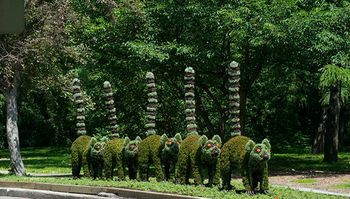
EarthPerhaps you have heard of topiary, the decorative pruning of shrubs into animals and other shapes. But, what about mosaïculture? The term was new to me when I read the definition that organizers prescribe to at Mosaïcultures Internationales, a competition staged every three years at a park or municipal garden somewhere in the world. “Mosaïculture,” says the competition’s website, “is a refined horticultural art that involves creating and mounting living artworks made primarily from plants with colourful foliage (generally annuals, and occasionally perennials).”

The process works a bit like this. To start, horticultural artists build metal frames for their sculptures. LemursThey cover the frames with soil netting and then plant seeds of different flora in that soil, much like a ceramicist lays tiles in a mosaic. The task draws on an artist’s skills in a variety of different areas, notes Mosaïcultures Internationales—”on sculpture for its structure and volume, on painting for its palette, and on horticulture in its use of plants in a living, constantly changing environment.” Grown in greenhouses during the spring months, the artworks, when fully grown, are installed outdoors, in parks and gardens. This summer, about 50 sculptures and reliefs, consisting of some 22,000 species, dot a 1.3-mile path through the Montréal Botanical Garden, site of Mosaïcultures Internationales de Montréal 2013.

More here. (Note: For dear friends Zoovia and Saleem Hamiduddin who share a passion for topiary)

The Mystery of The Rare Male Sea Monkey

Carl Zimmer in The Loom:

Here we see a happy, typical family of sea monkeys. Note the red bow and plump lips that indicate the female of the species, and the tall body and protective stance of the male. I assume that the father’s well-placed tail blocks some other clues to his identity. The parallels between the sea monkeys and the human family (see inset) are uncanny and surely nothing more than a coincidence.

Photo by justaghost, via Creative Commons. Image linked to source.

Photo by justaghost, via Creative Commons. Image linked to source.

The real life of sea monkeys (brine shrimp, or Artemia) is a pretty far cry from Ozzie and Harriet. Sea monkeys don’t live in families, for one thing. And in a lot of populations, the females have no need for males. Their eggs can develop into healthy embryos–and, eventually, adults–without the need of sperm. You can take that picture of sea monkeys and wipe Dad out.

From an evolutionary perspective, this father-free way of life has a lot going for it. Let’s say you’ve got a sexual pair of male and female shrimp in one tank, and two asexual females in the other. Let them breed for a while. Sexual species typically produce a roughly even ratio of sons and daughters. So only half of the sexual population can produce eggs, while every individual in the asexual one can. It won’t be long before the asexual population is far bigger than the sexual one. Out in the wild, this proliferation should mean that the genes for male-free reproduction should quickly dominate populations. Down with sex, in other words.

Daniel Dennett on the Chinese Room

Over at Philosophy Bites:

Can a computer think? John Searle famously used the Chinese Room thought experiment to suggest that it can't. Daniel Dennett is not convinced. He thinks that Searle's thought experiment is what he calls a 'boom crutch' – a faulty intuition pump. Here, in conversation with Nigel Warburton, he explains why.

Listen to Daniel Dennett on the Chinese Room

Listen to an earlier Philosophy Bites interview with Daniel Dennett on Free Will Worth Wanting

Saturday, July 13, 2013

The Dispensable Nation: American Foreign Policy in Retreat

Steve Coll reviews Vali Nasr's new book in the New York Review of Books:

ScreenHunter_241 Jul. 13 20.46For the last decade or so, Vali Nasr has published original, pragmatic work about Middle Eastern politics. The Shia Revival, his 2006 book, confidently mapped how the Bush administration’s invasion of Iraq strengthened Iran and reanimated sectarian conflict in the Arab world and beyond. Forces of Fortune followed three years later; it described presciently the potential of Arab middle classes just before Tunisian, Egyptian, and Libyan urbanites helped ignite the “Arab Spring.” By that time Nasr had entered the State Department as a senior adviser to Ambassador Richard Holbrooke, whom President Obama appointed as a special representative to Afghanistan and Pakistan. After Holbrooke died suddenly in December 2010, Nasr left the State Department and in 2012 became dean of the Paul H. Nitze School of Advanced International Studies at Johns Hopkins University in Washington.

In The Dispensable Nation, Nasr dissects what he regards as the overlapping failures of the Obama administration’s foreign policies across the Middle East and South Asia, from Pakistan to Iran to revolutionary Egypt. The book begins as a detailed, analytical memoir of disappointment over how “a small cabal of relatively inexperienced White House advisers” undermined Holbrooke’s diplomatic mission in South Asia, as Nasr looked on. The author then embarks on a withering review of first-term Obama administration diplomacy.

He concludes with criticism of Obama’s most important foreign policy conception, the announced American “pivot” toward Asia and away from the Middle East, a reorientation of policy, alliance priorities, and military deployments made possible by the reduction of American involvement in the wars Obama inherited in Iraq and Afghanistan. Most provocatively, Nasr argues that by retreating from the Middle East—and by signaling a withdrawal from “the exuberant American desire to lead in the world”—Obama has yielded strategic advantage to China, for which the United States will pay a heavy price in the future.

More here.

Foucault On Obscurantism: ‘They Made Me Do It!’

Eugene Wolters in the blog Critical Theory:

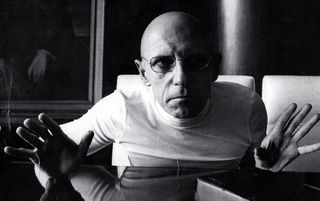
Foucault-obscurantistMany scholars attack critical theory as “obscurantist” and nonsensical after their brief forays into the field make them realize, “hey, reading is hard.” To be fair, plenty of critical theory is nonsensical bullshit, that despite being empirically invalidated, seems to cling on to dear life in the dark corners of academia. And as we’ve noted before, Noam Chomsky has called out Lacan for being entirely self-aware of his chicanery and also took a jab at Slavoj Zizek. Interestingly enough, Chomsky differentiates Foucault from these alleged charlatans.

Chomsky noted that Foucault, unlike his colleagues, was actually intelligible if you sat him down in conversation. Chomsky said:

I’ve met: Foucault (we even have a several-hour discussion, which is in print, and spent quite a few hours in very pleasant conversation, on real issues, and using language that was perfectly comprehensible — he speaking French, me English)…

I don’t particularly blame Foucault for it: it’s such a deeply rooted part of the corrupt intellectual culture of Paris that he fell into it pretty naturally, though to his credit, he distanced himself from it.

Now, as Open Culture notes, Foucault admitted to his friend John Searle that he intentionally complicated his writings to appease his French audience. Searle claims Foucault told him: “In France, you gotta have ten percent incomprehensible, otherwise people won’t think it’s deep–they won’t think you’re a profound thinker.”

More here.

Uncommon Measure: Acoustic Result Could Change Definition of Temperature

Lee Billings in Scientific American:

Acoustic-result-could-change-temperature-definition_1The most accurate thermometer in the known universe sits in a rather nondescript white building in Teddington, England, on the campus of the U.K.’s National Physical Laboratory (NPL). It looks nothing like a slender tube filled with mercury or colored alcohol. Instead, it’s a copper vessel about the size of a large cantaloupe, filled with dilute ultrapure argon gas and studded with microphones and microwave antennas, precisely shaped by a diamond-tipped lathe so that its radius varies with an uncertainty of only about 12 atomic layers of copper. The purpose of this thermometer is not really to measure temperature, however. Rather, new results from this and other similar devices could soon allow scientists to redefine temperature completely and bring it in line with the meter and other standard international units of measurement.

What the device actually measures is the relation between energy, as measured in joules, and temperature, as measured in the international standard unit, the kelvin. This relation is expressed as the Boltzmann constant and, in a perfect world, would be the kelvin’s ideal physical basis. That it’s not is purely a historical accident born of the fact that most of our planet’s surface is covered with liquid water, a substance which conveniently changes to ice or vapor at well-known thresholds of temperature.

More here.

Who Ruined the Humanities?

Lee Siegel in the Wall Street Journal:

RV-AL068A_HUMAN_DV_20130712191136When people wax plaintive about the fate of the humanities, they talk, in particular, about the slow extinction of English majors. Never mind that the preponderance of English majors go into other fields, such as law or advertising, and that students who don't major in English can still take literature courses. In the current alarming view, large numbers of people devoting four years mostly to studying novels, poems and plays are all that stand between us and sociocultural nightfall.

The remarkably insignificant fact that, a half-century ago, 14% of the undergraduate population majored in the humanities (mostly in literature, but also in art, philosophy, history, classics and religion) as opposed to 7% today has given rise to grave reflections on the nature and purpose of an education in the liberal arts.

Such ruminations always come to the same conclusion: We are told that the lack of a formal education, mostly in literature, leads to numerous pernicious personal conditions, such as the inability to think critically, to write clearly, to empathize with other people, to be curious about other people and places, to engage with great literature after graduation, to recognize truth, beauty and goodness.

These solemn anxieties are grand, lofty, civic-minded, admirably virtuous and virtuously admirable. They are also a sentimental fantasy.

More here.

Human-powered helicopter hovers accurately for 60 seconds, beats ‘impossible’ challenge

Carl Franzen in AlterNet:

ScreenHunter_239 Jul. 13 15.01A Canadian duo and their Kickstarter-funded, pedal-powered helicopter have won one of the longest-standing challenges in the history of aviation — keeping a human-powered aircraft hovering up in the air at height of at least 9.8 feet, within a 32.8 by 32.8-foot square, for 60 seconds minimum. The challenge, known as the Sikorsky prize, has withstood at numerous failed attempts since it was established in 1980, 33 years ago, even with a $250,000 bounty. But it was finally bested earlier in June by the Atlas, a gigantic human-powered helicopter designed by Cameron Robertson and Todd Reichert, aeronautical engineers from the University of Toronto, who cofounded a company AeroVelo.

The pair funded the construction of their winning aircraft through a successful Kickstarter campaign last year, and just barely managed to beat a rival team from the University of Maryland, whose craft Gamera failed to stay within the square-foot range required by the prize, as Popular Mechanics reports.

The Atlas is controlled by having a single pilot pedal a bicycle-like wheel to turn the aircraft's four enormous, independent rotors (one at each corner). The entire span of the craft is 190 feet.

More here.

Children of the Jacaranda Tree

Kamila Shamsie in The Guardian:

Supporters-of-Mirhossein--010Children of the Jacaranda Tree is a novel with a great weight of history attached to it. This much is made explicit by the author's note that accompanies the proof copies, telling readers that this is “an attempt … to shed light on this dark moment in Iranian history, on its tales of violence, prison and death … to give voice not only to the victims of this atrocity but also to the ordeal of their families and their children”. The “dark moment” is 1988, when thousands, or tens of thousands, of political prisoners were assassinated in Iran; their number included Sahar Delijani's uncle. Her parents were fortunate to have been released from prison prior to the “purge”.

…At the centre of the web of connections are three women prisoners – Azar, who gives birth in prison; Firoozeh, who is known to have turned informant in exchange for prison privileges; Parisa, who has one child growing up outside prison and is pregnant with a second. Through these women and their families a narrative emerges that is more effective than one that cleaves to an individual. The pain of women prisoners who have to give up their children; the pain of parents and sisters who don't know what is happening to those they love who are imprisoned; the pain of letting go of the nephews and nieces you've been raising, when their mothers are finally released from prison; the pain of suppressing the truth; the pain of discovering the truth; the pain of leaving Iran, the pain of staying and the pain of return: all these are held within these linked stories.

More here.

Stardust Memories

Maureen Dowd in The New York Times:

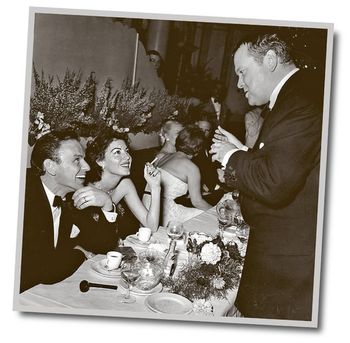
DowdThe amateur magician and the magical beauty. Their first names alone conjure a time when the words Hollywood and glamour still held hands. Ava Gardner was “essential to the Hollywood myth about itself,” as her friend Dirk Bogarde observed, and so was Orson Welles. Orson was “his own greatest production,” as the Hollywood chronicler Peter Biskind writes, and so was Ava. Two new books — “My Lunches With Orson” and “Ava Gardner: The Secret Conversations” — unearth vintage conversations with the stars in their final years, when they were broke, in bad health, unable to get work and mourning their lost grandeur. But oh, what gorgeous wrecks they were, and what mesmerizing stories they told, these Sunset Boulevard Scheherazades.

…Even maudlin, Welles and Gardner are magnificent. “A lot of booze has flowed under the bridgework,” Ava says. Both hit the big time as teenagers, Boy Genius and Girl Vamp, landing Time covers in their 20s. They had in common a bawdy honesty, a desire to shock and a lust for living extravagantly. The lion and lioness in winter are poignant. The cosmopolitan man who made “Citizen Kane” could not get financing to make a movie. The green-eyed woman who dazzled in Technicolor in “The Barefoot Contessa” was drinking, smoking, coughing and listening to old Sinatra-Tommy Dorsey recordings that Sinatra sent her after her strokes. “Who’d have thought the highlight of my day is walking the dog,” dryly notes Gardner, who once danced all night and then began drinking Dom Pérignon in the studio makeup room at 5 a.m. “I miss Frank,” she says, even the fights. She knows he will outlive her: “Bastards are always the best survivors.”

More here.

Saturday Poem

Noguchi's Fountain
.
The release of water in the base
so controlled that the surface tension,
tabletop of stability, a mirror,
remains unbroken. Moisture seeps
down polished basalt sides.
.
This is how I grieve, barely
enough to dampen river stones,
until fibers in my husband’s
tweed jacket brush my fingers
as I fold it into a box. How close
the whirlpool under my feet.
.
.
by Helen T. Glenn
from the Nimrod International Journal, Vol. 56, no. 1, 2012

The Dreyfus Affair Holds a Sacred Place in French History. Is There Room for Debate?

Dreyfus_071013_620px

Vox Tablet over at Tablet magazine, a podcast:

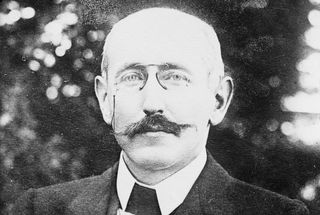
Nearly 120 years after the Dreyfus Affair shook the world, you would think we know all there is to know about the seminal case involving a French Jewish officer falsely accused of treason. Alfred Dreyfus was found guilty and deported to prison on a small, remote island, and it was only after his family, joined by leading intellectuals of the time, rallied in protest that he was acquitted, his case becoming a cornerstone of the democratic French republic.

A flood of books on the topic followed, from Emile Zola’sJ’Accuse onward. Yet French historians showed remarkably little interest when, a few years ago, the French army made available parts of its archive that include the notorious secret dossier that had been used to indict the Jewish captain. The file sheds light not only on the case itself but also on the complex web of personalities, institutions, and societal attitudes that surrounded it.

All these details might have remained in the shadows were it not for the dogged work of French historian Pierre Gervais. Gervais is the co-author of a recent book, available in French only, about the secret file. On today’s podcast, from his apartment in Paris, Gervais speaks with Tablet Magazine’s Liel Leibovitz about his discoveries. Leibovitz has also written a book on these latest revelations about the Dreyfus Affair; it’s just out as an Amazon Kindle Singlepublished by Tablet Magazine. [Running time: 19:50.]