
Category: Recommended Reading
Some innovations spread fast. How do you speed the ones that don’t?
Atul Gawande in The New Yorker:
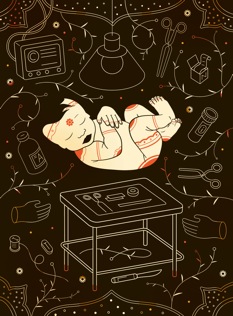
The technical complexity might have been part of the difficulty. Giving Lister’s methods “a try” required painstaking attention to detail. Surgeons had to be scrupulous about soaking their hands, their instruments, and even their catgut sutures in antiseptic solution. Lister also set up a device that continuously sprayed a mist of antiseptic over the surgical field.
But anesthesia was no easier. Obtaining ether and constructing the inhaler could be difficult. You had to make sure that the device delivered an adequate dosage, and the mechanism required constant tinkering. Yet most surgeons stuck with it—or else they switched to chloroform, which was found to be an even more powerful anesthetic, but posed its own problems. (An imprecise dosage killed people.) Faced with the complexities, they didn’t give up; instead, they formed an entire new medical specialty—anesthesiology.
So what were the key differences?
More here.
Inner speech speaks volumes about the brain
From KurzweilAI:
This explains why we don’t overload our brain when we speak. “By attenuating the impact our own voice has on our hearing — using the ‘corollary discharge’ prediction — our hearing can remain sensitive to other sounds,” Scott said. But Scott also speculated that the internal copy of our voice produced by corollary discharge can be generated even when there isn’t any external sound, meaning that the sound we hear when we talk inside our heads is actually the internal prediction of the sound of our own voice. Curiously, Scott found that the impact of an external sound was significantly reduced when participants said a syllable in their heads that matched the external sound. Their performance was not significantly affected, however, when the syllable they said in their head didn’t match the one they heard. These findings provide evidence that internal speech makes use of a system that is primarily involved in processing external speech, and may help shed light on certain pathological conditions.
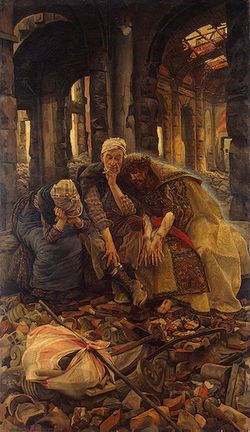
Picture: Inner voices, by James Tissot
More here.
Searching for Meaningful Markers of Aging
David Stipp in The New York Times:
How fast are you aging?

Earlier this year Dr. Zhang and his colleagues in San Diego reported that a kind of molecular aging clock is embedded in our genomes whose speed can be measured via blood testing. The moving parts of the clock consist of chemical tags on DNA molecules that control whether genes are active in cells. The researchers found that the patterns of the tags, called epigenetic markers, predictably change with age. In a study published in January in Molecular Cell, the scientists scrutinized around 485,000 of these tags in blood cells of 656 people aged 19 to 101. Some 70,387 tags were predictive of chronological age, the scientists found. Collectively these tags spell out a “signature for age” that is “largely not changed by disease or ethnic background,” said Ronald Kohanski, an expert on biomarkers of aging at the National Institute on Aging. That means these markers may be less muddied by confounders than other factors tied to aging. Of the markers, 71 most indicative of chronological age were selected to measure the speed at which people are growing old. That was calculated by comparing a subject’s epigenetic tags to the norm for his or her age — a 40-year-old whose pattern closely resembled the typical one for 50-year-olds, for example, would apparently be aging 25 percent faster than normal.
Already the molecular clock has yielded interesting findings. Men appear to age on average 4 percent faster than women, the scientists have found, which may largely explain why women’s life expectancy exceeds men’s by about 6 percent worldwide. And the research has shed intriguing light on cancer: The clock indicated that tumor cells have aged, on average, 40 percent more than normal cells taken from the same patients.
More here.
Grandad and a Pramload of Clocks
Wheeling them in,
the yard gate at half-mast
with its ticking hinge,
the tin bucket with a hairnet of webs,
the privy door ajar,
the path gloved with moss
ploughed by metal
through a scalped tyre –
in the shadows of the hood,
in the ripped silk
of the rocking, buckled pram,
none of the dead clocks moving.
And carrying them in
to a kitchen table,
a near-lifetime’s Woodies
coating each cough,
he will tickle them awake;
will hold like primitive headphones
the tinkling shells to each ear,
select and apply unfailingly
the right tool to the right cog
and with movements
as unpredictable as the pram’s
will wind and counter-wind
the scrap to metronomic life.
And at the pub,
at the Grey Horse or Houldsworth,
furtive as unpaid tax,
Rolex and Timex
and brands beneath naming
will change hands for the price of a bevy,
a fish supper
or a down payment
on early retirement
on a horse called Clockwork
running in the three-thirty at Aintree.
by John Lindley
Monday, July 22, 2013
perceptions

Sunday, July 21, 2013
Every suicide’s an asshole
Clancy Martin in Harper's Magazine:
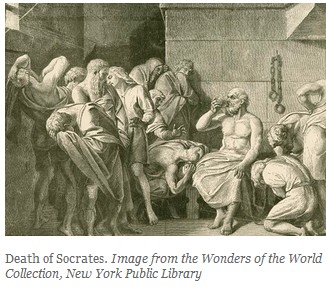
We tend to talk about suicide most when a famous person kills himself. There was, we all remember, the flurry of argument about suicide — much of it indignant, even outraged — when David Foster Wallace took his own life. His friends were deeply hurt, and many of them were writers, so they wrote about it. “[E]very suicide’s an asshole,” wrote Mary Karr, in a poem about Wallace’s death. “There is a good reason I am not/ God, for I would cruelly smite the self-smitten.” Suicide, seen as among the most selfish of acts, pushes a button in us that even murder doesn’t.
More here.
Physicists Debate Whether the World Is Made of Particles or Fields or Something Else Entirely
Meinard Kuhlmann in Scientific American:

The problem is not that physicists lack a valid theory of the subatomic realm. They do have one: it is called quantum field theory. Theorists developed it between the late 1920s and early 1950s by merging the earlier theory of quantum mechanics with Einstein's special theory of relativity. Quantum field theory provides the conceptual underpinnings of the Standard Model of particle physics, which describes the fundamental building blocks of matter and their interactions in one common framework. In terms of empirical precision, it is the most successful theory in the history of science. Physicists use it every day to calculate the aftermath of particle collisions, the synthesis of matter in the big bang, the extreme conditions inside atomic nuclei, and much besides.
So it may come as a surprise that physicists are not even sure what the theory says—what its “ontology,” or basic physical picture, is. This confusion is separate from the much discussed mysteries of quantum mechanics, such as whether a cat in a sealed box can be both alive and dead at the same time.
More here.
The Grand Scam: Spinning Egypt’s Military Coup
Esam Al-Amin in CounterPunch:
Every coup d’état in history begins with a military General announcing the overthrow and arrest of the country’s leader, the suspension of the constitution, and the dissolution of the legislature. If people resist, it turns bloody. Egypt is no exception.
As the dust settles and the fog over the events unfolding across Egypt dissipates, the political scene becomes much clearer. Regardless of how one dresses the situation on the ground, the political and ideological battle that has been raging for over a year between the Islamist parties and their liberal and secular counterparts was decided because of a single decisive factor: military intervention by Egypt’s generals on behalf of the latter.
As I argued before in several of my articles (as have others), there is no doubt that President Mohammad Morsi and the Muslim Brotherhood (MB) committed political miscalculations and made numerous mistakes, especially by ignoring the demands of many of the revolutionary youth groups and abandoning their former opposition partners. They frequently behaved in a naïve and arrogant manner. But in any civilized and democratic society, the price of incompetence or narcissism is exacted politically at the ballot box.
More here. [Thanks to Nadia Guessous.]
Sunday Poem
Rehearsal Dinner
My son claims that he is somebody now that he is
marrying into wealth. The bride’s family pays
for my trip to their Napa Valley home, where good fences,
manicured and surrounded by snapdragons, are still
fences. At rehearsal they serve the opposite of what I
ordered for the reception. The salmon skin, burnt and
curling, reminds me why I checked the box marked
chicken. His mother-to-be hands me a whiskey glass full
of frozen paradise apple flowers. She tells me that the
petals contain cyanide precursors and can only be
consumed in moderation. I compare her to the flower.
She does not laugh. My son leads me away from the
table, pleading in polished whispers for me to stop
darkening his crimson. I take this moment alone to offer him
an early wedding gift. He opens the box and feels the worn
fabric. I ask him to try it on. But my son claims that the
somebody he is now won’t fit into his father’s old suit.
by Paige Lewis
from Gravel, A Literary Journal
Color, light, impurity, and devotion in Louis Comfort Tiffany’s forgotten chapel
Our own Morgan Meis in The Smart Set:

Tiffany began his artistic career as a painter. But he was never satisfied with painting. Tiffany was drawn to glass. Perhaps he was fated to love the shininess of glass, being the son of famous jewelry maker Charles Lewis Tiffany. Looking at all those precious stones in his father’s shops, a young Louis Tiffany became obsessed with light and color as it penetrates jewels like diamonds and rubies. The opaque surface of the painter’s canvas was never going to light up that way. But stained glass does. Have you ever seen the way evening light comes through the Gothic stained glass windows of Sainte Chapelle in Paris? Then you know something of Tiffany’s obsession. Standing inside of Sainte Chapelle is like standing inside a jewel box.
Louis Comfort Tiffany wanted to learn the old secrets of getting color into glass. The stained glass of the 19th century couldn’t even begin to compare with the incredible work in the 13th century cathedrals. Tiffany figured out why. It was a matter of impurities. Stained glass doesn’t respond well to refinement, to the industrial techniques that were being used in the 19th century. You can mass-produce colored glass with those techniques, but you can’t make the artful, deeply colored glass like the old masters once made.
More here.
monty python: summarize proust
The Macabre Beauty of Medical Photographs
From Smithsonian:

Barker and Iacobuzio-Donahue share in interest in how medical photography can take diseased tissue and render it otherworldly, abstract, vibrant and thought-provoking. Together, they collected nearly 100 images of human diseases and other ailments from more than 60 medical science professionals for Hidden Beauty, a book and accompanying exhibition. In each image, there is an underlying tension. The jarring moment, of course, is when viewers realize that the subject of the lovely image before them is something that can cause so much pain and distress.
Picture: HIV.
More here.
Hitchens v. Lennox
Pierre-Laurent Aimard plays debussy
RISE OF THE FLYING SIKH
From NewStraitsTimes:
FOR nearly six decades, Indians have revelled in this Punjabi joke in all its quirky broadness: “How are you? Relaxing?”
“No, I am Milkha Singh.”
It has taken them as long, and a biopic, to recognise the modestly educated soldier-sportsman who has been the butt of that joke. Bhag Milkha Bhag (Run Milkha Run) on the life of India's most famous sports icon has begun brisk business at the box office, even as critics compete to shower plaudits or aim barbs. Born in 1935 in Faisalabad, now in Pakistan, Milkha was a victim of India's brutal Partition in 1947. Seeing his kin being killed, he ran to escape. He kept running on arrival in Delhi as a refugee — from his memories, from the police as he became a little thug and an unrequited love. The “run” as a metaphor of life's expedient circumstances, threads through the narrative. udiences empathise with Milkha not only because he ran fast, but because he wasn't afraid to stumble, falter, fall, rise and run again. He found a sense of purpose in the Indian Army. The lure of milk, eggs and freedom from fatigue duty made him take to sports. Years of hard work helped him break national records; wins at the Asian and Commonwealth games. But the hot favourite at the Rome Olympics (1960), although he broke yet another record, came fourth, losing a medal by hair's breadth. Milkha has lived through two catharses: one of bitter Partition memories and the other, not bagging an Olympic medal. Fate helped him overcome both. On Indian prime minister Jawaharlal Nehru's persuasion and Pakistan president Ayub Khan's invitation in 1962, he ran in Pakistan and washed off the double agony. He raced ahead of Abdul Khaliq, the winner of the 100m gold at the Tokyo Asian Games. Ayub Khan christened him “The Flying Sikh”. In distilling these catharses, Bollywood has performed an unusual, but commendable task amidst continuing mistrust between India and Pakistan. Bhag Milkha Bhag seems inspired by a vision of the future and a departure from the countless narratives of the terrible past and a present that does not hold much hope.
More here. (Note: A lovely film now playing in New York and maybe elsewhere.)
Saturday, July 20, 2013
unknown otto
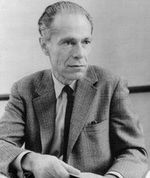
Over the next two decades, Otto, in chronological order, (1) got a business degree in Paris; (2) studied at the London School of Economics; (3) fought for the Republicans in the Spanish Civil War; (4) earned a doctorate in economics at the University of Trieste while acting as a courier for the Italian anti-Fascist resistance; (5) served in the French Army during its futile defense against German invasion; (6) biked and walked to the unoccupied Vichy southern France where, under the alias Albert Hermant (and the nickname Beamish, for his ingratiating manner), he helped spirit Hannah Arendt, Marc Chagall and thousands of other refugees from Marseille to the United States; (7) made his own way to New Jersey, where he changed his name to Albert O. Hirschman; (8) continued west to the University of California, Berkeley, where he wrote his first book and met his wife-to-be, a beautiful French-Russian refugee who had been a favorite student of Simone de Beauvoir in Paris; (9) volunteered for the American Army, ending up as a translator for the Office of Strategic Services, the precursor to the C.I.A., and serving as interpreter for a German general in the first Allied war-crimes trial; (10) worked for the Federal Reserve in Washington as a top adviser on the Marshall Plan to rebuild Europe; and, (11) driven from employment in cold war Washington by suspicions about his colorful past, moved with his family to Bogotá in 1952 to advise the Colombian government on behalf of the World Bank.
more from Justin Fox at the NY Times here.
a strange marvel

Kafka was not quite 41 when he died in a sanatorium outside Vienna in June 1924. Little-known in his own lifetime, he would later be recognised as one of the 20th century’s most important writers. Samuel Beckett was drawn to his bleak and unsparing vision; today his admirers include JM Coetzee, Lydia Davis and Jonathan Franzen. If Kafka still speaks to us, it is because he is a sort of 20th-century Dante, who wrote a story of Everyman who sets out in search of salvation in this world, only to encounter a proliferating darkness. A writer of such mystique would need a very good biographer and, at first, it looked as though Kafka had found him in his literary executor Max Brod, who had refused to burn his work as instructed, and seen to its publication. While Brod’s 1937 biography had much to say about Kafka’s fiction and inner life (as well as his famed sensitivity to noise and unlikely interest in Prague nightlife), it viewed Kafka as an essentially redemptive figure, whose perceived Jewish “spirituality” was the commanding side of his personality. It is true that Kafka’s literary friends and almost his entire circle in Prague were Jews; yet the word “Jewish” does not appear anywhere in his fiction. Like many German-speaking Jews within the Austro-Hungarian empire, Kafka saw assimilation as a means of escape from the pogrom-tainted past. Nevertheless, he was fascinated by Yiddish culture and Yiddish literature; his Jewish identity was conflicted at best.
more from Ian Thomson at the FT here.
holloway

For Macfarlane is clear that holloways are possessed of the past in the way other places, and other roads, are not: “You do not have to be a mystic,” he writes, “to accept that certain paths are linear only in a simple sense. Like trees, they have branches and like rivers they have tributaries. They are rifts within which time might exist as pure surface, prone to recapitulation and rhyme, weird morphologies, uncanny doublings.” Walking along such paths, he says, “you might walk up strange pasts, in the hunter’s sense of ‘walking up’ meaning ‘to flush out, to disturb what is concealed’.” In this he follows Thomas, who claimed to have heard “the voices of long-dead Roman soldiers as he walked an ancient trackway near Trawsfynydd in Wales. In Hampshire, where a stand of aspens whispered at the cross-roads of two old paths, he listened to the speech of a vanished village: the ringing of hammer, shoe, and anvil from the smithy, the clink, the hum, the roar, the random singing from the inn.” Thomas’s poems, Macfarlane writes, “are thronged with ghosts, doubles and paths that run through people as surely as they run through places”.
more from William Dalrymple at The Guardian here.
How Forensic Linguistics Outed J.K. Rowling (Not to Mention James Madison, Barack Obama, and the Rest of Us)
Virginia Hughes in her National Geographic blog, Only Human:

One of Brooks’s colleagues got an anonymous tip on Twitter claiming that Galbraith was Rowling. The tipster’s Twitter account was then swiftly deleted. Before confronting the publisher with the question, Brooks’s team did some web sleuthing. They found that the two authors shared the same publisher and agent. And, after consulting with two computer scientists, they discovered that The Cuckoo’s Calling and Rowling’s other books show striking linguistic similarities. Satisfied that the Twitter tipster was right, Brooks reached out to Rowling. Finally, on Saturday morning, as the New York Times reports, “he received a response from a Rowling spokeswoman, who said that she had ‘decided to fess up’.”
While the literary world was buzzing about whether that anonymous tipster was actually Rowling’s publisher, Little, Brown and Company (it wasn’t), I wanted to know how those computer scientists did their mysterious linguistic analyses. I called both of them yesterday and learned not only how the Rowling investigation worked, but about the fascinating world of forensic linguistics.
More here.