Myth, History and Norman O. Brown

Todd Walton in Counterpunch:
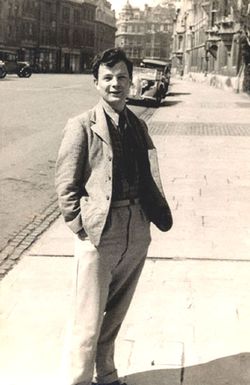
NOBin34web4Before I tell you a little more about Norman O. Brown, I would like to recount a scene from Nikos Kazantzakis’s The Last Temptation of Christ, the novel, not the movie.

…“Great things happen when God mixes with man.” — Nikos Kazantzakis

So…in The Last Temptation of Christ there is a memo­rable scene in which Jesus and his disciples are sitting around a campfire after a long day of spreading their gospel, when Matthew, a recent addition to the crew, is suddenly impelled by angels (or so he claims) to write the biography of Jesus. So he gets out quill and papyrus and sets to work transcribing the angelic dictation; and Jesus, curious to see what’s gotten into his latest convert, takes a peek over Matthew’s shoulder and reads the opening lines of what will one day be a very famous gospel. Jesus is outraged. “None of this is true,” he cries, or words to that effect. And then Judas (I’m pretty sure it was Judas and not Andrew) calms Jesus down with a Norman O. Brown-like bit of wisdom, something along the lines of: “You know, Jesus, in the long run it really doesn’t matter if he writes the truth or not. You’re a myth now, so you’d better get used to everybody and his aunt coming up with his or her version of who you are.” Kazantzakis, trust me, wrote the scene much more poetically and marvelously than the way I just recounted it, but…

“All good books have one thing in common. They are truer than if they had really happened.” — Ernest Hemingway

Back to Norman O. Brown. In the late 1960s, Nor­man was among the most famous pop academic writers in the world. Not only had he written Life Against Death: The Psychoanalytical Meaning of History, which made him famous, he had just published (in 1966) Love’s Body, a mainstream and academic bestseller exploring the impact of erotic love on human history; or was it the struggle between eroticism and civilization? In any case, here is one of my favorite blurbs from the hundreds of reviews that made Love’s Body so famous in its time. I will digress again (thank you, Norman) by saying if any book I ever publish gets a blurb even remotely as stupendous as the following, and said blurb appears in, say, the San Francisco Chronicle or even the Santa Rosa Press Democrat, drinks are on me.

“Norman O. Brown is variously considered the architect of a new view of man, a modern-day shaman, and a Pied Piper leading the youth of America astray. His more ardent admirers, of whom I am one, judge him one of the seminal thinkers who profoundly challenge the dominant assumptions of the age. Although he is a classicist by training who came late to the study of Freud and later to mysticism, he has already created a revolution in psy­chological theory.” — Sam Keen, Psychology Today

The myth and history web site known as Wikipedia says that Norman was a much-loved professor at UC Santa Cruz where he taught and lived to the end of his days (he died in 2002, or so they say).

More here. (Note: Why am I posting a 2011 article today? Because I am in the process of re-reading Brown and am deeply deeply affected. Please read his Life against Death and The Prophetic Tradition for a stunning snapshot of what history and the collective psyche of an epoch looks like when the mind-forged manacles are cast off)
Losing Face, Leaping Forward

Joseph Kahn in The New York Times:

ChinaAs told in the magnum opus of ancient Chinese history, “Records of the Grand Historian,” King Goujian knew how to nurse a grievance. At the start of his reign in the fifth century B.C., Goujian’s archenemy attacked his kingdom, captured Goujian and made him a slave. The king was granted amnesty after three years and allowed to reclaim his throne. But Goujian swore off the trappings of monarchy, eating peasant food and living simply. He slept on a bed of brushwood and dangled a gallbladder from the ceiling, licking it to taste its bitterness every day. A Chinese aphorism, “sleeping on sticks and tasting gall,” celebrates his determination to remember the shame and humiliation he suffered — and to draw strength from it.

In “Wealth and Power,” their engaging narrative of the intellectual and cultural origins of China’s modern rise, Orville Schell and John Delury note that the story of Goujian was a favorite of Generalissimo Chiang Kai-shek, who united China under his rule before being forced into exile in Taiwan. They might have called it the defining theme of contemporary China. From Wei Yuan in the early 19th century, the first major intellectual to insist that the mighty Chinese Empire had fundamental flaws, to Xi Jinping, who became China’s top leader last year, the humiliations China has suffered at the hands of foreigners over the past century and a half are the glue that keeps the country together. Many nations revel in their victories. America has its War of Independence. The British still churn out documentaries about World War II. But even $3 trillion in foreign exchange reserves has not healed the psychological trauma of 1842, the year of China’s defeat at the hands of the British in the first Opium War. After that conflict, China was dismembered, first by the European powers, then, more devastatingly, by Japan. Chinese troops expelled the Japanese, and the country was reunified more than 60 years ago. But it is determined to keep the memory of the abuses it suffered from fading into history.

Shame often acts as a depressant. But through the 11 biographical sketches that constitute their book, Schell and Delury argue that for generations of influential Chinese, shame has been a stimulant.

More here.

The Spark: Starting a Revolution

Alex-bw-620x410

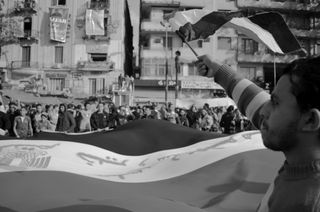
Egyptian activist Ahmed Salah's account of the 2011 protests in Tahir Square and the toppling of the Mubarak regime, in the new journal The Brooklyn Quarterly (with Alex Mayyasi, photo by Alex Mayyasi). (You can read it on Atavist’s multimedia platform here. And if you are so inclined, they are raising money to help launch the journal via a Kickstarter campaign to fund the first issue.)

“Tahrir” means “liberation” in Arabic, but the symbolic value of Tahrir Square goes beyond the name. It is the beating heart not only of Cairo but of the entire nation, surrounded by symbols of the government’s power: the headquarters of the regime’s political party and of the Arab League, a major mosque where state funerals take place, and a massive bureaucratic building called the Mugamma. Egyptians have rallied there in protest since the days of British rule. Western businesses have also left their mark on it: enormous billboards top the surrounding apartment buildings, fast food chains line the sidewalks, a Ritz Carlton is under construction, and the old American University in Cairo lies at the southeast end of the square. A three-lane traffic rotary fed by seven streets dominates the central space; the entire square has a surface area equal to 10 American football fields. On its northern edge stands the Egyptian Museum, where on a normal day tourists line up for hours to see treasures like the burial mask of King Tut.

Yet January 25, 2011 was not a normal day. Around 4 p.m. I gazed up at the iconic pink stone of the museum as I approached Tahrir — with 6,000 other Egyptians marching all around me. When we entered the square, we realized we were entering a battlefield. Several people joining our rally told us that security forces had blocked the nearby 6th October Bridge spanning the Nile. Police were fighting to keep a similar-sized crowd on the other side of the square from crossing to our side. Dense smoke clouded the square, but I could make out the hazy forms of protesters and a dark tide of police opposite them.

Very few of the people around me had been to a protest before, let alone the sort of violent confrontation this was sure to become, and yet with a yell, they charged forward without hesitation. Spreading out into the open space, they sprinted four or five hundred yards to the frontlines halfway across the square, all the while ducking the stones and tear gas canisters that rained down on us. I remember thinking — even as I huffed and puffed in the back — that this was the scene I had always dreamt of seeing. And now I was seeing it.

Turns of the Century

Big_38bde39263

Martin Eiermann in The European Magazine (photo by Eitan Abramovich):

As I am writing this, 300,000 people are marching in Rio de Janeiro against corruption and public sector cuts ahead of next year’s soccer World Cup. It must be bad if Brazilians start anti-soccer riots. In Greece, protests have been ongoing for several years. In Spain, Italy and Portugal, popular discontent has ousted several governments and continues to cause a headache for their successors (in Greece, the government coalition is crumbling right now). In Great Britain, cuts to the National Health Service inspired regular demonstrations and a special segment during the Olympic opening ceremony in 2012, which defiantly celebrated the NHS as one of the great achievements of modern British society. Look at any newspaper front page today, and you are likely to see one or more photos of police in riot gear, shooting tear gas into crowds of protesters.

The decades since World War II have brought unprecedented increases in expectations about living standards in much of the world. I’m saying “expectations” because the actual increase in wealth and living standards has often been highly stratified: Those at the top benefit the most, sometimes at the expense of those at the bottom. In many countries of the Global North, inequality has increased significantly since the 1970s as real wages have stagnated or declined for many income groups. In the countries of South America, Asia, and parts of Africa, living standards for the middle class have increased somewhat, but the amount of money accumulating at the top meant that middle class expectations often continued to outpace actual improvements. No wonder, then, that protests in Rio have driven a broad cross-section of the population into the streets. As the BBC’s Paul Mason reminds us, the chances for upheaval are much higher when the middle class grows frustrated: “Even where you get rapid economic growth, it cannot absorb the demographic bulge of young people fast enough to deliver rising living standards for enough of them.”

Gettier and Justified True Belief: Fifty Years On

Fred Dretske in The Philosopher's Magazine:

Prior to Gettier it was more or less assumed (without explicit defence) that knowledge, knowing that some proposition P was true (when it was in fact true), was to be distinguished from mere belief (opinion) that it was true, by one’s justification, evidence, or reasons for believing it true. I could believe – truly believe – that my horse would win the third race without knowing it would win. To know it would win I need more – some reason, evidence or justification (the race is fixed?) that would promote my true belief to the status of knowledge. Gettier produced examples to show that this simple equation of knowledge (K) with justified true belief (JTB) was too simplistic. His examples triggered a widespread search for a more satisfactory account of knowledge.

Gettier’s counterexamples are constructed on the basis of two assumptions about justification, both of which were (at the time he made them) entirely uncontentious. The first of these was that:

1: The justification one needs to know that P is true is a justification one can have for a false proposition.

Almost all philosophers who aren’t sceptics accept 1 without hesitation. After all, if one can, as we all believe we can – sometimes at least – come to know (just by looking) that there are bananas in the fruit bowl and (by glancing at the fuel gauge) fuel in the automobile tank, then given the existence of wax bananas and defective gauges, the justification, the kind of evidence, needed to know is clearly less than conclusive. It is something one can have for a false proposition.

Nonetheless, despite the overwhelming appeal of 1, accepting it lands one in the epistemological soup. Well, almost in the soup. The added push is supplied by Gettier’s second assumption:

2: If you are justified in believing P, and you know that P entails Q and accept Q as a result, you are justified in believing Q.

The idea behind 2, of course, is that one does not lose justification by performing deductive inferences one knows to be valid. If you have reasons to believe P is true, and you know P can’t be true unless Q is true, then you have equally good reasons to believe Q is true. It is difficult to see how 2 could be false if logic is to be regarded as a useful tool for expanding one’s corpus of rationally held beliefs.

But, alas, accepting both 1 and 2 lands you in deep trouble. Gettier explains why.

Friday, July 19, 2013

Proust Centennial

Our own Morgan Meis in French Culture:

ScreenHunter_246 Jul. 19 19.06I first opened Swann’s Way on a train. This is more than twenty years ago, Amtrak heading from New York City up the Hudson and finally to Montreal. It was a nine-hour train ride, the way I remember it. I remember stepping off the train in Montreal and wondering where the hours had gone.

Of course, I’d been in Combray for those nine hours, strolling through the sun-soaked gardens and the rich object-laden rooms of Proust’s childhood. Proust’s great aunts are teasing his grandmother again, poking at her with their relentless barbs. Then the book wavers and twitches in my hand. My head lolls back into that specific nook between the train-seat headrest and the window. The giant trees of the Hudson River are flickering past. The morning sun slides across the water, sparkling as tiny waves lick at the light. A morning yellow that isn’t even quite yellow yet. The presaging of yellow. The train car is quiet with morning readers, morning nappers.

Proust is trying to get to sleep again. Only, the wandering of his thoughts and memories will not let sleep come. Or is it the other way around? Maybe he’s been pulling the dream world so completely into his waking life that he doesn’t know how to be fully awake anymore. The train has reached full speed and rocks like a metronome slowly side to side even as it plunges ahead, north, north, away from the city and into the forests and rivers of another world, the world of Frederic Church and Thomas Cole and the Hudson River School of painters who tried, again and again, to capture the roundy, orange-tinged leafy luminescence of the landscape along the river.

More here.

Fukushima: One Man’s Story

0314ILFE01_MIL

Over at More Intelligent Life:

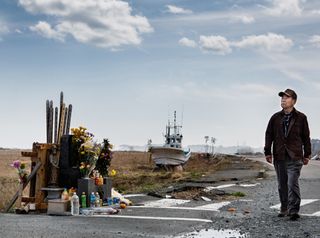
BEFORE THE DISASTER, there was always something reassuring about life by the sea in Ukedo, on the Fukushima coastline. Farther up Japan’s north-eastern shores, the rias, or inlets, would often become deathtraps when tsunamis barrelled up the narrow coves, crashing over isolated villages before the residents had time to flee. But in Ukedo, which lies on a smooth grey beach, ruffled in the early morning only by gulls’ feet and crabs’ claws, the Pacific Ocean was typically gentler. In summer, surfers would lie idly for hours out at sea waiting for a wave big enough to ride. If ever the waves did rise, giant concrete sea walls stood between them and the village like grim-faced centurions.

For generations, villagers came together twice a year to celebrate the bounty of the ocean. At New Year, dozens of fishing boats, festooned with flags, would join a parade out to sea, their horns blaring. In the lead was the vessel that had caught the most fish the year before. Two months later, when the sea was cold and rough and the fishermen needed an excuse to stay on shore drinking, the main matsuri, or Shinto festival, was held. It honoured the sea and the paddy fields of Ukedo, which together provided the two staple ingredients of every Japanese table: fish and rice. Children would dress up in gaudy costumes, with red and yellow flowers on their hats, speckled robes and red clogs, dancing to songs that celebrated life by the sea. Young fishermen would strip down to a pair of tight white shorts, and, fired up with slugs of the village’s sake, they would hurl themselves into the icy water, carrying heavy wooden shrines that sloshed about on the waves. The name of the festival spoke to the success of their entreaties to the Shinto spirits of the sea. It was called the Amba Matsuri, or Festival of the Safe Wave.

On the Foundations of Physics

Maudlin_615

Richard Marshall interviews Tim Maudlin in 3:AM Magazine:

3:AM: You’re working in the area of philosophy of physics and science. This hasn’t been an altogether happy relationship and recent spats have broken out that suggest that physicists don’t think they need to heed philosophy and philosophers think physicists are inept at interpreting their own theories. You tend to be in this latter camp don’t you, and have been pretty vociferous in arguing that there is a role for philosophy in understanding physics. How do you diagnose the problem – and how come it is philosophy that tends to be sober in their interpretations and the scientists who seem more content with paradoxes and contradictions and expensive ontologies like multiverses?

TM: I don’t think that the spats between physicists and philosophers are more heated, or of a different kind, then the spats that break out among philosophers or among physicists; they just get more public attention. Disputes in foundations of physics typically cannot be settled by observation or experiment, so argumentation has to come to the fore. And the analysis and evaluation of arguments requires a certain fastidiousness about terms and concepts that can be fostered by a background in philosophy.

That said, though, I do not see any deep fissure that runs between the two fields. In my view, the greatest philosopher of physics in the first half of the 20th century was Einstein and in the second half was John Stewart Bell. So physicists who say that professional philosophers have not made the greatest contributions to foundations of physics are correct. But both Einstein and Bell had philosophical temperaments, and Einstein explicitly complained about physicists who had no grounding in philosophy. The community of people who work in foundations of physics is about evenly divided between members of philosophy departments, members of physics departments and members of math departments. Many of us on all sides are trying to open and broaden channels of communication across disciplinary boundaries. And I don’t see that there is much correlation between disciplinary affiliation and sobriety: no one is more sober than Bell and Einstein were, or more cavalier (at times) than Bohr or John Wheeler. A more salient division in contemporary foundations is between those, like myself, who judge that Bell was basically correct in almost everything he wrote and those who think that his theorem does not show much of interest and his complaints about the unprofessional vagueness that infects quantum theory are misplaced.

Plastic Planes

5abfc0bc60f111e2a87e12313b025831

To understand why Dreamliners catch fire, we must look all the way back to the immediate aftermath of the Cold War, when major defense contractors were facing the prospect of declining defense budgets and consequent diminishing profits. In response, William Perry, newly installed as Deputy Secretary of Defense in the Clinton Administration, presided over a series of mergers between the big firms, which produced an industry dominated by five giant “primes.” Perry offered handsome subsidies to the firms as encouragement to merge, promoting the initiative as beneficial to the taxpayer because it would cut down on wasteful overhead. Needless to say there were no such savings for taxpayers, and the resultant corporate oligopoly inevitably led to increased weapons costs. One of the mergers united Boeing, the world’s pre-eminent commercial-airliner manufacturer, with McDonnell Douglas, a pure defense company. Boeing was of course also a defense contractor, but top management had traditionally kept the civil and defense divisions separate for fear that the defense team might infect the civilians with their culture of cost overruns, schedule slippage, and risky or unfeasible technical initiatives. These habits were all very well when the taxpayer was footing the bill for cost-plus contracts that might or might not result in a useful product, but they could obviously have proved disastrous when it came to competing with the company’s own money in a free-enterprise market.

more from Andrew Cockburn at Harper’s here.

Slavoj Žižek Responds to Noam Chomsky: ‘I Don’t Know a Guy Who Was So Often Empirically Wrong’

Zizek_in_Liverpool_-e1374080308396

Over at Open Culture (I guess it's on):

Well with all deep respect that I do have for Chomsky, my first point is that Chomsky, who always emphasizes how one has to be empirical, accurate, not just some crazy Lacanian speculations and so on… well I don’t think I know a guy who was so often empirically wrong in his descriptions in his whatever! Let’s look… I remember when he defended this demonstration of Khmer Rouge. And he wrote a couple of texts claiming: No, this is Western propaganda. Khmer Rouge are not as horrible as that.” And when later he was compelled to admit that Khmer Rouge were not the nicest guys in the Universe and so on, his defense was quite shocking for me. It was that “No, with the data that we had at that point, I was right. At that point we didn’t yet know enough, so… you know.” But I totally reject this line of reasoning.

For example, concerning Stalinism. The point is not that you have to know, you have photo evidence of gulag or whatever. My God you just have to listen to the public discourse of Stalinism, of Khmer Rouge, to get it that something terrifyingly pathological is going on there. For example, Khmer Rouge: Even if we have no data about their prisons and so on, isn’t it in a perverse way almost fascinating to have a regime which in the first two years (’75 to ’77) behaved towards itself, treated itself, as illegal? You know the regime was nameless. It was called “Angka,” an organization — not communist party of Cambodia — an organization. Leaders were nameless. If you ask “Who is my leader?” your head was chopped off immediately and so on.

letters from angola

1373536144902

I have arrived – finally – in Gago Coutinho, after an apocalyptic journey, the kind of journey I never imagined I would make in my entire life: we set off in buses at three o’clock in the morning on the 22nd, to travel from Luanda to Nova Lisboa, through the most marvellous scenery, which by eleven o’clock at night I began to find somewhat wearisome. We reached Nova Lisboa at dawn, where we slept in our seats, and at three o’clock in the afternoon of the 29th (or was it the 23rd?), after 600 km on the bus, they put us on a train to Luso: two days of travelling in fourth-class carriages – that celebrated English invention for the inhabitants of the third world, and which the Benguela railway company has, very Englishly, adopted – in which we formed great mounds of arms and legs, weapons and heads. These carriages are fitted with only three long benches: two running on either side beneath the windows and a double one in the middle, like a line drawn down the centre. Since there were not enough carriages, the scene was indescribable: from every side there emerged limbs that appeared to belong to no particular body. I ended up scratching my head with someone else’s hand. I slept, or pretended to sleep, and ate some canned food – the floor was awash with cans and spilled sauces – that played havoc with my insides. Jews being deported to some Nazi concentration camp.

more from António Lobo Antunes at Granta here.

vermeer’s secrets

Vermeer_and_music_x8128.pr_

The charm of Vermeer is at once obvious and elusive. Everyone feels the pull of these paintings. No one can quite say how they exercise their magnetism, their unique beauty, their compelling mood. When people attempt to define the paintings, they often speak of Vermeer’s “poetry”. If you are a poet, you wonder what they mean by this. After all, there are many kinds of poetry, as Auden noted in “Letter to Lord Byron”: “By all means let us touch our humble caps to/La poésie pure, the epic narrative;/But comedy shall get its round of claps, too.” On 20 June, in his Guardian blog, Jonathan Jones talked about “the camera-crisp art of Vermeer”. Which is exactly wrong. Crisp. The paintings are clear, yes, but with a faint, phantom nimbus, much subtler than Man Ray’s photographic solarisations, where the image is surrounded by an edge of fierce light like an eclipse of the sun. Vermeer’s images are as if magnified. They have that shimmering granular quality you experience looking through binoculars. There is an indefinite surrounding glow, an almost infinitesimal tremor of light, common to the face of his ermine-clad female guitar player, the city of Delft and a milkmaid pouring from a jug, wearing coarse workaday cloth next to her white skin and the dark russet-pink of her hands.

more from Craig Raine at The New Statesman here.

Questlove: Trayvon Martin and I Ain’t Shit

Ahmir Questlove Thompson in New York Magazine:

A_250x375I'm trying not to internalize these feelings about the Trayvon Martin case and make it about me — but hey, it is what it is, and maybe I'm melodramatic. All I'm consumed with is my positioning in life.

I often tell cute, self-deprecating celebrity run-in stories that end with my own “pie in the face” moment. But rarely do I share stories of a more serious nature, another genre of “pie in the face” moments, mostly because in the age of social media, most people are quick to dismiss my tales as #FirstWorldProblems. But I can't tell you how many times a year I'm in a serious situation, only to hear the magic words “Oh, wait … Questlove?” Hey guys, it's Questlove. “We're so sorry, you can go!” Like, five to seven times a year, a night ending in the words “Thank God for that Afro or we'd never have recognized you” happens to me.

I'm in scenarios all the time in which primitive, exotic-looking me — six-foot-two, 300 pounds, uncivilized Afro, for starters — finds himself in places where people who look like me aren't normally found. I mean, what can I do? I have to be somewhere on Earth, correct? In the beginning — let's say 2002, when the gates of “Hey, Ahmir, would you like to come to [swanky elitist place]?” opened — I'd say “no,” mostly because it's been hammered in my DNA to not “rock the boat,” which means not making “certain people” feel uncomfortable.

I mean, that is a crazy way to live. Seriously, imagine a life in which you think of other people's safety and comfort first, before your own. You're programmed and taught that from the gate. It's like the opposite of entitlement.

More here.

Pataudi: Nawab of cricket

From The Telegraph:

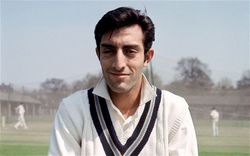
Pataudiweb_2619191bWhen the eighth Nawab of Pataudi died of a heart attack during a polo match at the age of 41, the Wisden obituary paid fulsome tribute. It noted Pataudi’s brilliant achievements for Oxford University’s First XI in the early Thirties, his superb century on his debut for England, and his dignified captaincy of the Indian team which toured England in 1946. It also recorded that he had left behind “an 11-year-old son who has shown promise of developing into a good cricketer”. That sentence soon looked like the understatement of the century. Dispatched to Winchester, the ninth Nawab (tutored by such outstanding schoolmasters as Harry Altham, “Podge” Brodhurst and Hubert Doggart) broke every batting record. By 1957, aged 16, he was playing first-class cricket for Sussex. By 1959 he broke the record for runs scored at Winchester in a single season. At Oxford the Nawab – known as “Tiger” to his friends – performed staggering feats that equalled even those of his remarkable father.

Then disaster struck. He lost his right eye in a car accident, and it was assumed that he could never play cricket at the top level again. Amazingly, he overcame this disability. Within six months he had made his Test debut for India against England, scoring a century in his third match. Asked at what point he first believed he could play Test cricket after his eye injury, he replied: “When I first saw the English bowling.” Three months later he was captain of India, and he went on to captain his country 40 times. Suresh Menon’s beautifully produced book, a collection of essays from family and friends, is a moving and much-needed tribute to a wonderful cricketer who died in 2011. It is a portrait of a man born out of his time, and is a pure delight.

More here.

Friday Poem

What the Old Woman Said

I will tell you this. There was a garden by the pump. Fallow land given me.
My father built flowerbeds. Offshoots of paths. Geometric patterns.
Cuttings. Bulbs from my mother. The texture of earth.
Stone. The smell of water. I could grow anything.

I will tell you this. There was a pond. Wrinkles of mud. Pups that were drowned there.
Dragged to the bank. Sacksful slit open. Way beyond saving.
Names that I gave them. Returned to the water. Each small splash.
Spirals expanding. My own face rippling.

I will tell you this. There was a heron. Constant. Returning.
Stilt-leg. Growing above water. Curtain of willows.
Everything still. A crowning of feathers.
Inflections of music. Nothing was moving.

I will tell you this. There were meadows. Light. Nectar from clover.
More flowers than I could name. Armfuls I carried.
Stems that I split. Smelling of summer.
Chains on my neck. Ankles. The bones of my wrists. Knowing nothing.

I will tell you this. There was a boy. Eyes like the sky.
Eyes like my father's. Children imagined. Rooms that were borrowed.
Rooms that were painted. Stories invented.
Histories. Futures. We knew everything.

I will tell you this. There was a man. Veins under skin.
Bones. Barely there. His stuttered breathing.
Green light on a screen. Intermittent beeping.
False light. False music. Someone was dying.

I will tell you this. I had seen his face on the shroud.
Running and bleeding. Wounds on his hands.
Pictures on glass. Coloured and leaded.
Faces on statues. A cross through his heart. Light always fading.

I will tell you this. There was a room. White. A white plate on the table.
A man at the table. Notes in his voice. A tune that I knew.
Beauty in the movements of his face. His arms. Frisson of wings.
Touch. Touch me. But he already had. I had forgotten everything.

I will tell you this. Some days are unbearable. Horizontal planes.
Moment to moment. Each long tick. I have been lonely.
Last night. A dream of a heron. The span of his wings.
Sounding through air. Listen. Listen. I am disappearing.

by Eileen Sheehan
from Song of the Midnight Fox
Doghouse Books, Tralee, 2004

Genome of largest viruses yet discovered hints at ‘fourth domain’ of life

From Nature:

VirusThe organism was initially called NLF, for “new life form”. Jean-Michel Claverie and Chantal Abergel, evolutionary biologists at Aix-Marseille University in France, found it in a water sample collected off the coast of Chile, where it seemed to be infecting and killing amoebae. Under a microscope, it appeared as a large, dark spot, about the size of a small bacterial cell. Later, after the researchers discovered a similar organism in a pond in Australia, they realized that both are viruses — the largest yet found. Each is around 1 micrometre long and 0.5 micrometres across, and their respective genomes top out at 1.9 million and 2.5 million bases — making the viruses larger than many bacteria and even some eukaryotic cells. But these viruses, described today in Science1, are more than mere record-breakers — they also hint at unknown parts of the tree of life. Just 7% of their genes match those in existing databases.

“What the hell is going on with the other genes?” asks Claverie. “This opens a Pandora’s box. What kinds of discoveries are going to come from studying the contents?” The researchers call these giants Pandoraviruses. “This is a major discovery that substantially expands the complexity of the giant viruses and confirms that viral diversity is still largely underexplored,” says Christelle Desnues, a virologist at the French National Centre for Scientific Research in Marseilles, who was not involved in the study.

More here.

Thursday, July 18, 2013

Dear Taliban leader, thank you for your letter to Malala Yousafzai

Mohammed Hanif in The Guardian:

Malala-Yousafzai-at-the-U-008Dear Adnan Rasheed,

I am writing to you in my personal capacity. This may not be the opinion of the people of Pakistan or the policy of the government, but I write to thank you in response to the generous letter you have written to Malala Yousafzai. Thanks for owning up that your comrades tried to kill her by shooting her in the head. Many of your well-wishers in Pakistan had been claiming the Taliban wouldn't attack a minor girl. They were of the opinion that Malala had shot herself in order to become a celebrity and get a UK visa. Women, as we know, will go to any lengths to get what they want. So thanks for saying that a 14-year-old girl was the Taliban's foe. And if she rolls out the old cliche that the pen is mightier than sword, she must face the sword and find it for herself.

Like you, there are others who are still not sure whether it was “Islamically correct or wrong”, or whether she deserved to be “killed or not”, but then you go on to suggest that we leave it to Allah.

There are a lot of people in Pakistan, some of them not even Muslims, who, when faced with difficult choices or everyday hardships, say let's leave it to Allah. Sometimes it's the only solace for the helpless. But most people don't say leave it to Allah after shooting a kid in the face. The whole point of leaving it to Allah is that He is a better judge than any human being, and there are matters that are beyond our comprehension – maybe even beyond your favourite writer Bertrand Russell's comprehension.

More here.

Khatyn

P10_Snyder_357253h

The Second World War was two separate wars for the Soviet Union, one to be entirely forgotten and one to be selectively remembered. Between 1939 and 1941, the Soviet Union fought as a German ally, invading or occupying Poland, Finland, Estonia, Latvia, Lithuania and Romania. During this period, the Soviets committed mass murder among populations that had not been Soviet citizens before the war, such as the Poles at Katyń, in 1940. Between 1941 and 1945, after Hitler betrayed Stalin and Germany invaded the Soviet Union, Germany committed mass murders on a still greater scale, such as those of Belarusians at Khatyn in 1943. Between 1945 and 1991, from the end of the war to the collapse of the Soviet Union, Soviet propaganda sought to displace the first war with the second, such that the Soviet Union and its citizens appeared unambiguously as victims and victors. German atrocities were supposed to annul Soviet atrocities. Khatyn was to supplant Katyń. In 1969, the opening of the memorial to the murdered Belarusians of Khatyn transformed the unfathomable suffering of Soviet citizens in Belarus into geopolitical propaganda. The chilling cynicism was required by the system: if all that mattered was the future of the socialist state, then the only past worth recalling was the one that served the present. The effect was to confuse minds about both the Soviet murder of Poles at Katyń and the German murder of Belarusians at Khatyn. As Soviet propagandists understood, few people can remember both.

more from Timothy Snyder at the TLS here.

after gezi park

Gezi3

The dominant Western narrative of the events so far is serious, if formulaic, and well suited to a liberal appetite. The battle is against Erdoğan, a religious conservative, and his Justice and Development Party (AKP). Part of the antipathy towards Erdoğan is due to his assault on the urban middle-class lifestyle. Istanbul, for a Westerner, is quite a cheap city: not much more than a dollar for a kebab, half that to ferry across the Bosphorus, and under five dollars for an excellent, multi-course meal at a neighborhood restaurant. Alcohol is a different matter; because of taxes levied by the akp it costs roughly the same to have a drink in either Istanbul or Chicago. Under a new law, alcohol can’t be sold after 10 p.m. I can’t recall a time, though, when I made it to Taksim Square much before midnight. Crowds buy beer from small convenience shops and drink outside before going to bars. On warm nights students often stay outside, sitting underneath Galata Tower. Many of those small shops, I have to imagine, won’t survive under the new laws. People are afraid the new alcohol legislation is symptomatic of a wider push to impose a regime of conservative social values in a country regionally renowned for its secularism. This is the partial story the Western media has done an admirable job covering: the occupation as a reaction to an assault on liberal rights. And so the Western media has in a certain sense maintained a legitimacy in Turkey not afforded to the Turkish press: in a much-discussed incident on June 2nd, while cnn covered the brutal police reaction to the occupation, the satellite network cnn Türk broadcast a documentary on penguins. (Protestors have since taken to the street in penguin masks.)

more from William Harris at The Point here.