What Urban Planners Can Learn From a Hindu Religious Festival

From Smithsonian:

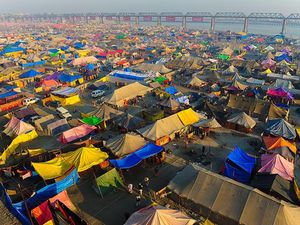
KumbhWhat they don’t tell you about Varanasi, probably India’s holiest city, is that in addition to being filled with sacred temples, mischievous monkeys and bearded ascetics, it’s also full of waste of all kinds: mountains of fetid cow and other, much worse kinds of dung, muddy tributaries of dubious origin, mounds of fast-decaying flowers, shards of shattered clay cups. As I left the utter squalor of Varanasi, a permanent and ancient city of four million, for a temporary religious celebration of even more people nearby, I could only imagine the enormous crowds, inescapable filth and utter chaos that it would produce.

…In the mythology of the Kumbh Mela, gods and demons fought for 12 days over a pitcher (kumbh) of nectar of immortality from the primordial ocean, and the nectar spilled onto the earth at four different places, including Allahabad. The gathering (mela) takes place every three years at one of the four locales in a 12-year cycle—a day of the gods’ time corresponds to a year of human time—with the largest (maha) celebration in Allahabad. The first written record of its occurrence dates to the seventh century A.D. I arrived by taxi at the Kumbh at sunset, expecting throngs of cars, cows and human beings blocking all access points. Instead I glided comfortably into my camp, which sat on a hilltop. I looked out over the fleeting city before me: makeshift shelters constructed on the floodplain of a river that was sure to overflow again in a few months. The soundtrack consisted of dissonant chords of shrill songs, snippets of amped-up holy recitations, a distorted line from a dramatic performance of an Indian epic and the constant rumble of millions of people cooking, chatting, snoring and singing. The horizon was dark and smoky red, with colorful flickers of light piercing the haze in orderly, geometric rows that stretched as far as I could see in three directions. I’d come to witness the spectacle for myself, but also to meet a group of Harvard researchers from the university’s Graduate School of Design. Led by Rahul Mehrotra, an architect from Mumbai before he went stateside to teach, they would closely analyze this unparalleled feat of spontaneous urban organization. “We call this a pop-up megacity,” said Mehrotra, a bearded 54-year-old. “It’s a real city, but it’s built in just a few weeks to instantly accommodate tens of millions of residents and visitors. It’s fascinating in its own right, of course. But our main interest is in what can we learn from this city that we can then apply to designing and building all kinds of other pop-up megacities like it. Can what we see here teach us something that will help the next time the world has to build refugee camps or emergency settlements?”

More here.
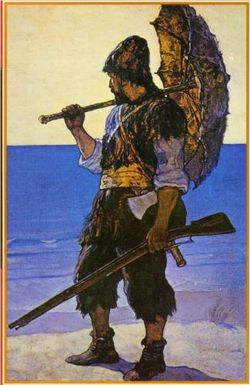
robinson crusoe, daniel defoe, and debtor’s prison

From DelanceyPlace:

Robinson-crusoe-illustration.jpg!Blog“On October 29, 1692, Daniel Defoe, merchant, pamphleteer, and future best-selling author of Robinson Crusoe, was committed to King's Bench Prison in London because he owed more than 17,000 pounds and could not pay his debts. Before Defoe was declared bankrupt, he had undertaken such far-flung ventures as underwriting marine insurance, importing wine from Portugal, buying a diving bell used to search for buried treasure, and investing in some seventy civet cats, whose musk secretions were prized for the manufacture of perfume.

…”Typically, creditors obtained a writ of seizure of the debtor's assets. (Historians record that Defoe's civet cats were rounded up by the sheriff's men.) If the assets were insufficient to settle the debt, another writ would send the bankrupt to prison, from which he could win release only by coming to terms with his creditors. Defoe had no fewer than 140 creditors, but he managed to negotiate his freedom in February 1693, though he would continue to evade debt collectors for the next fifteen years. His misadventures later informed Robinson Crusoe (1719), whose fictional protagonist faces financial ruin and expresses remorse at pursuing 'projects and undertakings beyond my reach' and ending up 'the willful agent of all my own miseries.'

…”Defoe's thrice-weekly newspaper, A Review of the State of the English Nation, reported on the progress of the bill and served as its most authoritative advocate. The government, looking to drum up support, purchased and distributed copies, increasing its paid circulation to fifteen hundred. The act was understood as an emergency measure to restore commerce; it was to remain in force for just three years.”

More here.

Wednesday Poem

Country Life
.
.
Sowing a row of early wonder
beets, let's say, or a border
of nasturtiums, you stop
to wonder where you're traveling
by knee.
Into the August tool-shed musk
into a fermenting apple.

There goes the plow sealing
with a new two-foot snowbank
the driveway you cleared all morning.
There go the geese back to the lake
after their dusk feeding
on corn stubble:
it must be March:
next they'll go north to nest.
And if you lie flat and silent
you can hear the suburbs coming
on their elbows.

The stones dance in place.
On one of them a mole is knocking
but it won't come out, this
is its day for dancing.
.

by William Matthews
from Sleek for the Long Flight
White Pine Press, 1988

Tuesday, September 3, 2013

Do You Believe in Sharing?

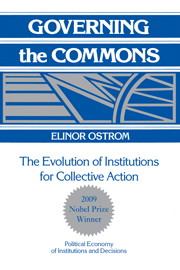
9780521405997

Tim Harford, the Undercover Economist, on Garrett Hardin and Elinor Ostrom on the common pool resources, at his website (via Marginal Revolution):

The story goes as follows: imagine common pasture, land owned by everyone and no one, “open to all” for grazing livestock. Now consider the incentives faced by people bringing animals to feed. Each new cow brought to the pasture represents pure private profit for the individual herdsman in question. But the commons cannot sustain an infinite number of cows. At some stage it will be overgrazed and the ecosystem may fail. That risk is not borne by any individual, however, but by society as a whole.

With a little mathematical elaboration Hardin showed that these incentives led inescapably to ecological disaster and the collapse of the commons. The idea of a communally owned resource might be appealing but it was ultimately self-defeating.

It was in this context that Hardin deployed the word “tragedy”. He didn’t use it to suggest that this was sad. He meant that this was inevitable. Hardin, who argued that much of the natural sciences was grounded by limits – such as the speed of light or the force of gravity – quoted the philosopher Alfred North Whitehead, who wrote that tragedy “resides in the solemnity of the remorseless working of things”.

Lin Ostrom never believed in “the remorseless working of things”. Born Elinor Awan in Los Angeles in 1933, by the time she first saw Garrett Hardin present his ideas she had already beaten the odds.

The Truth About the Pill

158871151.jpg.CROP.rectangle3-large

Lindsay Beyerstein in Slate:

In her new book Sweetening the Pill: or How We Got Hooked on Hormonal Birth Control, Holly Grigg-Spall offers what she calls a “feminist critique” of hormonal contraception. She argues that the so-called liberating force of the pill has been illusory. She claims that the pill keeps women in the thrall of patriarchal capitalism and destroys their health in the process. The addiction allusion in the title is not a metaphor—Grigg-Spall is convinced that the pill is an addictive drug.

It would be tempting to dismiss the author as an isolated crank, but she is part of a disturbing effort to reduce women to their biological functions in the name of feminism. Sexists have been trying to reduce women to incubators since time immemorial, but recently some self-proclaimed feminists have jumped on the bandwagon, arguing that true liberation means being left alone to experience feminine bodily functions like ovulation, childbirth, and breast-feeding in all their natural glory. To these “feminists,” tampons and epidurals are keeping women down. And now, the birth control pill is, too.

Grigg-Spall’s argument rests heavily on her own bad experience with Bayer’s Yasmin (which she blames for turning her into an emotional wreck) and comments on various websites dedicated to sharing pill horror stories. She indignantly anticipates that readers will dismiss these anecdotes: “I was sick, and then, I was well,” she writes. “That this is not enough evidence of the pill’s impact reveals so much about why women are encouraged to take this drug in the first place.” In other words, she accuses her critics of being sexist if they won’t accept her cherry-picked testimonials as proof that the pill harms all women.

Actually, there are good reasons to be suspicious of uncorroborated anecdotal evidence about the effects of drugs on our bodies. Millions of American women take the pill every day, so it’s a statistical certainty that some of them will have symptoms like depression, headaches, and weight gain, which are among the afflictions most commonly blamed on the pill. The only way to separate true side effects from coincidence, selective recall, and the power of suggestion is to conduct controlled clinical trials.

I Contradict Myself

QuakerNat Case in Aeon:

Magical stories moved me to tears. I vividly remember, at the age of eight, being surprised at how deeply the second chapter of Astrid Lindgren’s The Brothers Lionheart (1973) affected me. The narrator dies and goes to the land where sagas come from, and when he arrives he finds that all that he had wanted — to be strong, healthy and beautiful like his older brother — has come to be, and that his beloved brother is there, too. And this is just the beginning of the story. I remember arriving at the end of Penelope Farmer’s The Summer Birds(1962) and weeping bitterly as the children, who have spent the summer flying about the English countryside, return gravity-bound to school while their lonely classmate and the strange bird-boy fly off together over the ocean.

This essay wasn’t supposed to be about the stories I read as a child. It was supposed to be about how I manage to be an atheist within a religious community, and why I dislike the term ‘atheism’. But however I wrote that essay, the words died on the page. That story comes down to this: I do not believe in God, and I am bored with atheism. But these stories, this magic, and their presence in my heart, they don’t bore me — they are alive. Even though I know they are fiction, I believe in them.

My main religious practice today is meeting for worship with the Religious Society of Friends: I am a Quaker. Meeting for worship, to a newcomer, can feel like a blank page. Within the tradition of Friends, it is anything but blank: it is a religious service, expectant waiting upon the presence of God. So it’s not meditation, or ‘free time’. But that’s how I came to it at first, at the Quaker high school I attended.

After almost 15 years away, I returned to Quakerism in 1997. During a difficult patch of my life, a friend said I needed to do something for myself. So I started going to the meeting house on Sunday mornings. What I rediscovered was the simple fact of space. It was a hiatus, a parenthesis inserted into a complicated, twisty life. Even if it held nothing but breath, it was a relief, and in that relief, quiet notions emerged that had been trampled into the ground of everyday life.

I am an atheist, but I’ve been bothered for a long time by the mushiness I’ve found in the liberal spiritual communities that admit non-believers such as me. I’ve spent the better part of two decades trying to put my finger on the source of this unease, but it is not a question to be solved by the intellect: it must be lived through.

bleeding edge

Cover00

Of course, Pynchon is famous for his complexity. V., The Crying of Lot 49 (1966), and Gravity’s Rainbow (1973) virtually set the template for the paranoid style in American fiction, and for what’s semi-synonymously called the systems novel—vast interrogations in which character and plot get subsumed in grander architectures built to explain or exhaust various systems of control (political, technological, financial, chemical, etc.). Other high priests of this tendency include the stylistically diverse William Gaddis, Don DeLillo, and David Foster Wallace; The Corrections has one foot in this tradition, as do many of William Gibson’s novels. If you double the list of key figures, most will still be dudes. At times, the systems novel can seem like the ultimate in what we now call “mansplaining.” In Bleeding Edge, Pynchon is keenly conscious of this gender divide, and even seems to address it. “Generally, all-male narratives, unless it’s the NBA, challenge Maxine’s patience,” he writes. “Now and then [her sons] will hustle her into watching an action movie, but if there aren’t that many women in the opening credits, she’ll tend to drift away.”

more from Ed Park at Bookforum here.

Loose as the wind, as large as store

Stubbs_09_13

Herbert as much as Donne voices the waywardness of the passions, the anger that can send a child charging like an escaping balloon. But Herbert looks for a solution where Donne insists there is only a puzzle. For Donne, knowledge lies in dilemma, in paradox; for Herbert, this is only a stage. Their poetic language is also entirely different. In his famous ‘Song: Go, and catch a falling star’, for example, in telling his listener to ‘Ride … Till age snow white hairs on thee’, Donne uses a metaphor from Horace, which an ancient book on rhetoric, Quintilian’s Institutio Oratoria, explicitly disapproved of as ‘far-fetched’. He even goes a step or three further. Snow is a metaphor for the visible effects of old age (white hair) and indeed age itself, but it is hard or even silly to visualise ‘white hairs’ literally snowing down onto someone’s head. We have to go beyond that idea, by degrees, to the one Donne intends. There is no such bad behaviour in Herbert. Because of this and other differences, the two poets have their camps of rival supporters; Drury avowedly belongs to Herbert’s. In life, Donne and Herbert took mutual benefit from their diverse casts of mind. Although Donne was twenty years senior, he didn’t treat Herbert as the younger man. They spent the summer of plague in 1625 together at the home of Herbert’s stepfather in Chelsea and became respectful friends.

more from John Stubbs at Literary Review here.

intervention

Image

In retrospect it’s easy to see that the argument over humanitarian intervention that should have taken place in the years after Kosovo was replaced and muddled by an argument over the Bush doctrine of preemptive war. In 2000–01, a high-powered international commission convened to discuss what the international community should do in the event of a human rights crisis in a failing state; one of their recommendations was that the concept of “humanitarian intervention” be scrapped, as being needlessly prejudicial (like “pro-life”), and replaced with the more capacious, less necessarily violent “responsibility to protect.” The group’s report was humane and intelligent, though not without problems; it was also presented before the UN Security Council in December 2001, at which point it had been “O.B.E.,” as they say in Washington—overtaken by events. The same happened with Samantha Power’s “A Problem from Hell”: America and the Age of Genocide, the summa theologica of liberal interventionist historiography, which was published in 2002. The book immediately became part of the debate over Iraq, with George W. Bush famously scribbling NOMW (“not on my watch”) in a memo outlining its arguments. Not long after, he invaded Iraq.

more from the editors at n+1 here.

What Have I Been Reading

Wolffimage

Robert Paul Wolff over at his blog:

I have just finished reading Mind & Cosmos: Why the Materialist Neo-Darwinian Conception of Nature is Almost Certainly False, by my old friend and one-time student, Thomas Nagel. I am sorry to say that I did not find it an illuminating or persuasive book, for a variety of reasons. In this brief discussion, I should like to focus on just one, which I think has relevance for a certain kind of philosophy in general, and not just for Tom's book.

Let me begin, somewhat implausibly, by quoting a thirty-year old story from my autobiography about the famous biologist and founder of Sociobiology, E. O. Wilson [pp. 537-540]. I have edited it down a bit.

“A Canadian philosopher, Michael Ruse, asked whether I would like to meet E. O. Wilson. I said sure, and Ruse set it up. It was agreed that I would spend an afternoon in his office, which doubled as his laboratory. In advance of therendezvous, we exchanged gifts. I sent him, through Michael, a copy of The Poverty of Liberalism, and he sent back a copy of his latest book, Promethean Fire, co-authored by Wilson and Charles Lumsden. The volume, which sits on my shelves today, is inscribed “For Robert Paul Wolff, with warm regards, Edward O. Wilson, Museum of Comparative Zoology, Harvard U., January 25, 1984.”

We met in Wilson's office in the Museum. After the usual greetings, he showed me the centerpiece of the office, a large table on which, under a Plexiglas dome, was a bustling, complex ant colony. Wilson banged the side of the table, which set the ants scurrying, and as they poured out of the anthill he pointed out the soldier ants, worker ants, and so forth. I didn't have much in the way of conversation. What can you say about an anthill, after all? So, casting about for something to say, I mused aloud, “I wonder how many ants there are in the entire colony.” “Fifteen thousand,” Wilson replied. “How can you be sure?” I asked. “I counted them,” he said.

There are moments in life when the scales fall from your eyes and you suddenly see clearly something that has hitherto been obscured from view. This was one of those moments. I had from time to time reflected on how different the workaday lives are of people in different corners of the Academy, even though we all call ourselves “Professor.” Here was E. O. Wilson, the creator of Sociobiology, who thought nothing at all about counting fifteen thousand ants. Had anyone asked me to figure out the number of ants in an anthill, the farthest I would have gone was watching eight or ten walk by and then guesstimating the rest.

To be sure, philosophers sometimes descend to the level of the particular. But our tendency is to go in somewhat the opposite direction. Confronted with the real world, the reflex reaction of philosophers is to ask about possible worlds. It was clear to me that although we were both professors and authors, Wilson and I led lives so utterly different that no real mutual understanding was likely.

The Story of the Jews

From The Telegraph:

JewsSuch beautiful names, such terrible ends. Doulcea, the sweet one, cut to pieces on the streets of Worms in 1196, trying to summon help while her daughters Hannah and Bellette lay dying inside the house; Licoricia, tough as nails, twice-widowed, moneybags loaded, who survived three spells in the Tower of London, only to be murdered in her Winchester house along with her Christian maidservant in 1277; Zipporah of Worms, the bird caught in a suicide trap, in the spring of 1096, Crusader bands shouting for the blood of the Christ-killers, imploring her husband to kill her first so she might be spared the sight of her son slaughtered by his father’s knife; Sarit of Cologne, the comely bride, sliced up the middle, groin to throat, by her father-in-law Judah the Levite, her nuptials turned into a blood wedding; the women on the bridge, two from Cologne, two from Trier, watching their sisters dragged mercilessly to the baptismal font, resolving on a defiant counter-baptism, jumping to a drowning death in the dark waters of the Mosel; the nameless convert who had married Rabbi David Todros of Narbonne, pursued by her outraged family, finding sheltering obscurity in Monieux until a crusading gang killed Rabbi David, seized two of their children for captive conversions, leaving the widowed proselyte destitute with her infant boy.

And then there was Poulceline, whom everyone would hear about, fair Poulceline, close – very close, according to Ephraim of Bonn – to Thibaut, Count of Blois, seneschal of France, the king’s brother-in-law, none of which was any help when the Jews of Blois were being burned alive on a pyre in 1171, Poulceline included. What had she done? What had any of the beautiful names done? As usual, nothing except to be born Jews. What they were said to have done, though, was kill children, especially Christian children. No actual body was needed for the accusation to become credible. No one in Blois ever found a body, nor was any child missing, but in May a serving man happened to be watering his horse by the Loire when he saw something small and pale slip from the grasp of a Jew beside the river. What that Jew had been holding was, in fact, a batch of untanned hides, but when one splashed into the water, the servant reported to his master, his horse shied and refused to drink, a sure sign that something foul had been committed to the river. A skin was a skin.

More here.

Mystery of the Missing Women in Science

Natalie Angier in The New York Times:

AngPeter Ostrander, the tireless coordinator and cheerleader for a renowned science and mathematics magnet program at Montgomery Blair High School in Silver Spring, Md., was not satisfied. Over the past few years, the pool of applicants had included nearly as many girls as boys, and the acceptance rate — based largely on test scores and grades — had followed suit. Yet when it came to which of the invitees ended up choosing Blair’s magnet option over other offerings in the area, the scales tilted male. In 2012, for example, 80 percent of the eligible boys said yes, but only 70 percent of the girls. In 2010, the figures had been 93 percent and 56 percent. Convinced the program could do better at pitching its product to girls, Mr. Ostrander recruited teams of upper-class girls last spring to call their hesitant young counterparts. Extol the wonders of the program, he said. Dispel the tired geek myths. “The stereotype is out there that the magnet is filled with nerdy people,” he said. “Whatever that means.” The upper-class students took to the phone banks with verve. (Full disclosure: my daughter was one of them.) They talked of fun, extracurriculars and sisterhood. They secured many yes votes and earned pizza and sandwiches — but still, fewer qualified girls than boys are entering the magnet this fall. As a result, the demanding, gratifying, even thrilling four-year immersion in physics, chemistry, biology, calculus, computer science, astronomy, entomology, the proper use of power tools — and yes, the humanities and social sciences — remains almost two-thirds male.

Montgomery Blair’s experience is by no means unique. Even as girls prove their prowess in science and math, their ambivalence lingers when it comes to fields formerly painted boy blue. As researchers see it, that reluctance, that slight and possibly subliminal case of unfounded quantipathy, must be confronted and understood if the wider inequities in science are to be rooted out for good.

More here.

Tuesday Poem

September 1, 1939

I sit in one of the dives
On Fifty-second Street
Uncertain and afraid
As the clever hopes expire
Of a low dishonest decade:
Waves of anger and fear
Circulate over the bright
And darkened lands of the earth,
Obsessing our private lives;
The unmentionable odour of death
Offends the September night.

Accurate scholarship can
Unearth the whole offence
From Luther until now
That has driven a culture mad,
Find what occurred at Linz,
What huge imago made
A psychopathic god:
I and the public know
What all schoolchildren learn,
Those to whom evil is done
Do evil in return.

Exiled Thucydides knew
All that a speech can say
About Democracy,
And what dictators do,
The elderly rubbish they talk
To an apathetic grave;
Analysed all in his book,
The enlightenment driven away,
The habit-forming pain,
Mismanagement and grief:
We must suffer them all again.
Read more »

Monday, September 2, 2013

Sunday, September 1, 2013

Joseph Stiglitz Sees Bleak Future for America If We Don’t Reverse Inequality

Lynn Stuart Parramore in AlterNet:

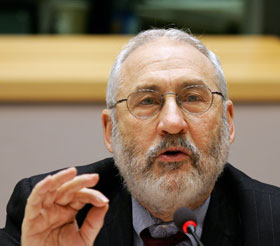
StiglitzNobel Prize-winning economist Joseph Stiglitz, one of America's most prescient voices, wrote an article for Vanity Fair several months before Occupy Wall Street was born. “Of the 1%, by the 1%, for the 1%” called attention to the widening gap between rich and poor and its deadly impact on our society and its democratic institutions. In his newly released book, The Price of Inequality, Stiglitz returns to this theme of a divided society, delving into the origins and consequences of economic unfairness. I caught up with Professor Stiglitz and talked to him about how the persistent myths and beliefs associated with our capitalist system help to drive this trend, turning America from a land of opportunity to a land of broken dreams.

Lynn Parramore: An argument has been made, particularly since the end of the Cold War, that capitalism is great at producing things that can improve our lives, and so we ought to therefore tolerate some unfairness. What's wrong with that narrative?

Joseph Stiglitz: Well, capitalism does have a lot of strengths, including producing things that are very innovative. But what drives capitalism is the profit motive. You can profit not only by making good things, but also by exploiting people, by exploiting the environment, by doing things that are not so good. The narrative that you describe ignores the extent to which a lot of the inequalities in the United States are not the result of creative activity but of exploitive activity. And if you look at the people at the top, what is so striking is that the people who've made the most important creative contributions are not there.

More here.

In our dark times we need poetry more than ever, argues Adrienne Rich

Adrienne Rich in The Guardian:

In “The Defence of Poetry” 1821, Shelley claimed that “poets are the unacknowledged legislators of the world”. This has been taken to suggest that simply by virtue of composing verse, poets exert some exemplary moral power – in a vague unthreatening way. In fact, in his earlier political essay, “A Philosophic View of Reform,” Shelley had written that “Poets and philosophers are the unacknowledged” etc. The philosophers he was talking about were revolutionary-minded: Thomas Paine, William Godwin, Voltaire, Mary Wollstonecraft.

And Shelley was, no mistake, out to change the legislation of his time. For him there was no contradiction between poetry, political philosophy, and active confrontation with illegitimate authority. For him, art bore an integral relationship to the “struggle between Revolution and Oppression”. His “West Wind” was the “trumpet of a prophecy”, driving “dead thoughts … like withered leaves, to quicken a new birth”.

I'm both a poet and one of the “everybodies” of my country. I live with manipulated fear, ignorance, cultural confusion and social antagonism huddling together on the faultline of an empire. I hope never to idealise poetry – it has suffered enough from that. Poetry is not a healing lotion, an emotional massage, a kind of linguistic aromatherapy. Neither is it a blueprint, nor an instruction manual, nor a billboard. There is no universal Poetry, anyway, only poetries and poetics, and the streaming, intertwining histories to which they belong. There is room, indeed necessity, for both Neruda and César Valléjo, for Pier Paolo Pasolini and Alfonsina Storni, for both Ezra Pound and Nelly Sachs. Poetries are no more pure and simple than human histories are pure and simple. And there are colonised poetics and resilient poetics, transmissions across frontiers not easily traced.

More here.

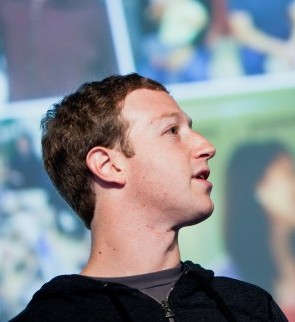
Zuckerberg Explains Facebook’s Plan to Get Entire Planet Online

Steven Levy in Wired:

ScreenHunter_293 Sep. 01 18.16Last week, in an effort to reach this lofty goal, the Facebook CEO announced the establishment ofInternet.org, a consortium that allied his company with handset makers (Nokia, Samsung, Ericcson), a browser company (Opera), and network infrastructure manufacturers (Qualcomm, MediaTek). In a 10-page white paper shared on, yes, Facebook, he postulated that a connected world could address economic disparity and outlined a vision of even the poorest people connecting to low-cost, low-data versions of basic Internet services.

Reaction was mixed, both to the white paper and to the accompanying video, which used a John F. Kennedy speech to amplify a visual message that connectivity leads to better human relations. So WIRED welcomed the opportunity to discuss the plan face-to-face with Zuckerberg on the company’s Menlo Park, California campus. Here is the interview, edited for space and clarity.

WIRED: Why form a coalition to spread global connectivity?

Zuckerberg: The Internet is an important foundation in improving the world, but it doesn’t build itself. Over the past few years, we’ve invested more than a billion dollars in connecting people in developing countries. We have a product called Facebook for Every Phone, which provides our service on feature phones; it has 100 million users. But no one company or government can build out a full stack of infrastructure to support this around the world. So you need to work together with folks. Since we’ve announced Internet.org, we’ve heard from operators around the world and governments who want to work with us. This is going to provide momentum to make this work over the next 3 to 5 years, or however long it’s going to take.

More here.

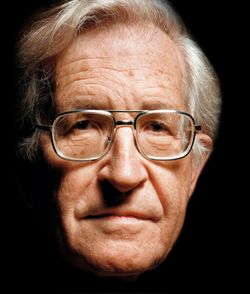
Noam Chomsky: The Arab world has harbored fantasies about the supernatural power of the United States

Mohammed Attar Interviews Noam Chomsky at the website of the Heinrich Böll Stiftung:

Your discourse unambiguously states that America and Israel have no desire to see the regime fall and that their actions are determined by the “better the devil you know” principle. How do you explain a counter-discourse, promulgated by analysts and intellectuals, especially among Leftist circles in Europe the US and the Arab world, which is based on the supposition of an American/Israeli/imperialist plot? For some people, the revolution in Syria has been a conspiracy from the outset. For others it was hijacked by the conspiracy.

Chomsky1For a long time, the Arab world and other places beside have played host to stories and illusions about the supernatural power of the United States, which controls everything through complex conspiracies and plots. In this worldview, everything that takes place can be explained in terms of imperialist conspiracies. This is an error. Without a doubt, the UnitedStates are still a great power and capable of influencing events, but they are not always able to manipulate them by means of complex conspiracies: this really is beyond their capacities. Of course the Americans do sometimes try to do this, but they fail, too. What happened in Syria is not outside our understanding: it began as a popular and democratic protest movement demanding democratic reforms, but instead of responding to it in a constructive, positive manner, Assad reacted with violent repression. The usual outcome of such a course of action is either a successful crushing of the protests or otherwise, to see them evolve and militarize, and this is what took place in Syria. When a protest movement enters this phase we see new dynamics at play: usually, the rise of the most extremist and brutal elements to the front ranks.

More here. [Thanks to Omar Ali.]

How can we still the noise within?

Tim Parks in Aeon:

SilenceSilence, then, is always relative. Our experience of it is more interesting than the acoustic effect itself. And the most interesting kind of silence is that of a mind free of words, free of thoughts, free of language, a mental silence —

…The process is neither that of a single switch being turned, nor of a steady continuum, but of a series of small gains and losses; perhaps a larger step forward, then a small relapse. If one is persistent, undaunted, in one’s attempts to concentrate, if one is successful in showing neither aversion to pain nor indulgence in pleasure, then, very slowly, the stillness and silence deepen in an atmosphere of beatitude that is simultaneously and indivisibly both physical and mental. It is as if, as the body is slowly put together and all its component parts unite in an intense present, so the historical self is taken apart and falls away. At no point is it experienced as a loss, but rather as a fullness of existence; something brimful, very ordinary and very beautiful. The words we constantly use and the narratives we write reinforce a drama of selfhood that we in the West complacently celebrate. There is also much consolation taken in the way in which writing and narrative can transform emotional pain into a form of entertainment, wise and poignant in its vision of our passage through the world, intense and thrilled by its own intensity. Narrative is so often the narrative of misery and of the passage through misery. What silence and meditation leaves us wondering, after we stand up, unexpectedly refreshed and well-disposed after an hour of stillness and silence, is whether there isn’t something deeply perverse in this culture of ours, even in its greatest achievements in narrative and art. So much of what we read, even when it is great entertainment, is deeply unhelpful.

More here.