
Category: Recommended Reading
The Possibility of Self-Sacrifice
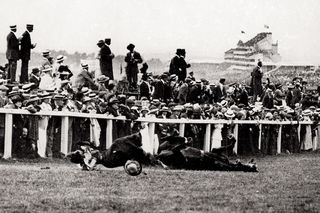
Oded Na’aman in Boston Review:
Normally, death is present in our lives as an ending-yet-to-arrive. For most of us, Simone Weil writes, “Death appears as a limit set in advance on the future.” We make plans, pursue goals, navigate relationships—all under the condition of death. We lead our lives under the condition of death; our actions are shaped by it as a surface is shaped by its boundaries.
However, as we approach this boundary, when our end is present, we are nothing but terror. All pursuits disintegrate, and our self-understanding collapses. At once we are expelled from the sphere of meaning. We are nothing more than this body. This body and its last breath. It is not simply that we cannot survive our own death; we cannot bear the sight of it. We do not want to die. Not now.
And yet the possibility of self-sacrifice suggests that this terror can be overcome, that death can be meaningful. One recent example is that of Mohamed Bouazizi, the Tunisian street vendor who set himself on fire in December 2010 and whose death put in motion the massive uprising known as the Arab Spring. But there are many less noted acts of self-sacrifice. In different places and moments in time, in different languages and cultures, soldiers, activists, lovers, friends, and parents exhibit a willingness to die that demands our attention.
Such acts, so difficult to comprehend, may seem at first sight unworthy of serious consideration. But rushing to this conclusion would be a mistake. It is not only that by dismissing acts of self-sacrifice as unintelligible we disavow a prevalent and influential human phenomenon. Understanding these acts may also shed light on the way we value things more generally. Indeed, we will see that even if most of us will never actually take such extreme measures, the possibility of self-sacrifice is part of living a meaningful life.
More here.
space is the place
Ants Swarm Like Brains Think

Carrie Arnold in Nautilus:
Each of the brain’s 86 billion neurons can be connected to many thousands of others. When a neuron fires, it sends a signal to nearby neurons that changes the probability that they will also fire. Some neurons are excitatory, and increase the chances that other neurons will fire. Others are inhibitory, and reduce this chance. A combination of inputs from a given neuron’s neighbors will determine if it fires. If two neurons make each other fire often, the synapse between them (a small gap across which chemical or electrical signals are passed) will strengthen, so that they can more readily provide feedback to each other.
“This is where you get the saying that ‘Neurons that fire together, wire together,’ ” says Dmitri Chklovskii, a neuroscientist at the Howard Hughes Medical Institute. But what is often not appreciated about this adage is that wiring also requires the second neuron to send a message to the first that it, too, has fired.
“The only way the upstream neuron knows that the second neuron fired is that it produces a feedback spike. This helps the synapse make the decision to get stronger,” Chklovskii says. Feedback is where the similarity with ants begins. “Feedback loops are everywhere on every level. They allow the system to realize that what it used to be doing isn’t working any more, and to try something new.”
Both ants and brains actually rely on two types of feedback, held in a delicate balance: negative (or inhibitory) feedback, and positive (or excitatory) feedback. “Negative feedback tends to cause stability. Positive feedback tends to cause runaway behavior,” said Tomer Czaczkes, an ant biologist at the University of Regensburg in Germany. “These two simple rules make something very powerful.”
The foraging response to food is an example of a positive feedback loop, and familiar to anyone who has had a picnic ruined by a line of ants marching in single file toward their meal. But knowing when not to leave the nest and risk predation and dehydration may be just as important as knowing when to take advantage of a windfall of seeds. At low levels of an input (a small amount of food, for example) positive feedback dominates. At high levels of input, negative feedback dominates, helping to prevent runaway processes.
More here.
lord, send me an angel
India: Censorship by the Batra Brigade

Wendy Doniger in the NYRB (photo: Kuni Takahashi/The New York Times/Redux):
In February of this year, after a long career of relative obscurity in the ivory tower, I suddenly became notorious. In 2010, Penguin India had published a book of mine,The Hindus: An Alternative History, which won two awards in India: in 2012, the Ramnath Goenka Award, and in 2013, the Colonel James Tod Award. But within months of its publication in India, a then-eighty-one-year-old retired headmaster named Dina Nath Batra, a proud member of the far-right organization Rashtriya Swayamsevak Sangh (RSS), had brought the first of a series of civil and criminal actions against the book, arguing that it violated Article 295a of the Indian Penal Code, which forbids “deliberate and malicious acts intended to outrage religious feelings of any class” of citizens.
After fighting the case for four years, Penguin India, which had recently merged with Bertelsmann, abandoned the lawsuit, agreeing to cease publishing the book. (It also agreed to pulp all remaining copies, but—as it turned out—not a single book was destroyed; all extant copies were quickly bought up from the bookstores.) When Penguin told me it was all over, I thought it was all over, and was grateful for the long run we’d had.
There wasn’t anything special about my book; Batra had been attacking other books for some time. But what was special, and unexpected, was the volume and intensity and duration of the outcry in reaction to Penguin’s action: other authors withdrew their books from Penguin, defying it to pulp them, too; people accused the publishers of cowardice for giving up without even taking the case to court, in contrast with their former courage in successfully (and at very great expense) defending Lady Chatterley’s Lover in 1960. One Bangalore law firm issued a legal notice suggesting that the Penguin logo be changed from a penguin to a chicken.
More here.
Davidson and Derrida
Richard Marshall interviews Sam Wheeler III in 3:AM Magazine:
3:AM: So firstly, what are the similarities between Davidson and Derrida you find interesting? And how is Wittgenstein part of this ‘deconstruction’ mix you develop? You say it’s taken you longer to work out how Davidson and Derrida differ? Have you got it sorted now? What are the differences?
SW: The correspondences are between notions like indeterminacy of interpretation and Derrida’s “free play” and their shared denial that there is a given. Absent a language (the logoi, the language of thought, Fregean senses) whose words, by their very nature, refer to their referents, interpreting one system of signs in terms of another allows choices. That is, without a common thing that expressions from two systems express, there is nothing to go on but what people say when. So, there is slack.
Without a given domain of objects, another kind of fixity of meaning, “referring to the same object” is unavailable. Derrida in relation to Heidegger is somewhat akin to Davidson in relation to Quine, in dropping the remaining bit of realistic metaphysics.
Derrida and Davidson go in different directions. Davidson’s applications of his semantics and ontological views is largely on topics central to analytic philosophy, with some exceptions. Derrida, of course, primarily writes about topics in continental philosophy. He is interested in interpretations that go beyond the logical/truth-conditional. He takes the denial of logoi to mean that rhetorical features of a discourse can be just as important as what we would regard as “logical.” So, many of Derrida’s interpretations of, say Plato, rest on what we could regard as accidental features, for instance that “pharmakon” is both drug and poison.
The one figure I know they both thought about is J.L. Austin. Davidson spent several classes on Austin’s How to Do Things with Words in his 1967 class on philosophy of language. Derrida wrote Signature, Event, Context on the same text. They raise some of the same issues. Both Davidson and Derrida are suspicious of theories which ignore “marginal” cases. Davidson was particularly interested in arguing that what you can do with a sentence is not a good starting-point for semantics. Derrida and Davidson both point out that there is no way to fix a particular speech act to a sentence. Davidson’s notes that no sign can label something an assertion. Derrida makes a similar point about signatures.
Derrida may have read Davidson, since he did read my essay relating his views to indeterminacy of interpretation. I’m pretty sure Davidson never read Derrida. But Derrida would have very much admired Davidson’s essay on James Joyce, I think. Davidson would, if patient, have admired Derrida’s “White Mythology.”
More here.
Toward Cultural Citizenship
Jonathan Shaw in Harvard Magazine:

Humanistic interpretation also plays an important role in coping with the outpouring of information from the digital world, Bhabha says. “As we teach our students how to interpret, that allows the flood of facts and information to be turned into knowledge. Interpretation is the mediating force that winnows through all the information” to produce and categorize knowledge.
More here.
Gabriel García Márquez: ‘His world was mine’
Salman Rushdie in The Telegraph:

One Hundred Years of Solitude is 47 years old now, and in spite of its colossal and enduring popularity, its style – magic realism – has largely given way, in Latin America, to other forms of narration, in part as a reaction against the sheer size of García Márquez’s achievement. The most highly regarded writer of the next generation, Roberto Bolaño, notoriously declared that magic realism “stinks”, and jeered at García Márquez’s fame, calling him “a man terribly pleased to have hobnobbed with so many Presidents and Archbishops”. It was a childish outburst, but it showed that for many Latin American writers the presence of the great colossus in their midst was more than a little burdensome. (“I have the feeling,” Carlos Fuentes once said to me, “that writers in Latin America can’t use the word ‘solitude’ anymore, because they worry that people will think it’s a reference to Gabo. And I’m afraid,” he added, mischievously, “that soon we will not be able to use the phrase ‘one hundred years’ either.”) No writer in the world has had a comparable impact in the past half-century. Ian McEwan has accurately compared his pre-eminence to that of Charles Dickens. No writer since Dickens was so widely read, and so deeply loved, as Gabriel García Márquez.
More here.
Saturday, April 26, 2014
The Art of Willem de Kooning
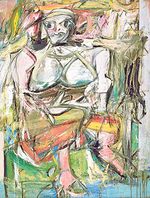
As postwar art recedes into history, its giant figures stand out more starkly. In American painting, the status of Willem de Kooning, last of the abstract expressionists to die, in 1997, is outstripping that of everyone else.
His career was not only longer, but more unexpected and contrary, less dependent on a signature style, than those of his peers Jackson Pollock the Dripper, Barnett Newman the Zipper, or Mark Rothko, the high priest of transcendent rectangles. De Kooning is as rowdy and irreverent as a pop artist, but tuned into European modernism in ways that give depth and emotional richness. By refusing to conform to ideals of abstraction, dissolving gaps between figurative and non-figurative, he appears immediate and present within today’s non-hierarchical approaches.
Not that he is easy. A show at New York’s Gagosian Gallery last winter reignited the debate over his old-age work: is it exquisite simplicity, or the outpourings of an alcoholic, demented fool?
more here.
Akhil Sharma: ‘I feel as if I’ve shattered my youth on this book’
Nicholas Wade in The Guardian:
Just as Sharma moved to New York with his parents and elder brother, Anup, so the eight-year-old Ajay Mishra makes the same journey in Family Life. While Ajay finds the transition difficult, his elder brother Birju thrives in America, and even wins a place at a prestigious high school. But shortly before term starts Birju hits his head on the bottom of a swimming pool and lays unconscious underwater for three minutes, resulting in catastrophic brain damage that leaves him blind and unable to communicate or move. After two years in hospital and nursing homes the family take Birju home, and the rest of Ajay's childhood is played out against a backdrop of 24-hour care, a stream of crackpot faith healers and a family increasingly defined by alcoholism, destructive tensions and lies. But while the broad facts of that story match those of Sharma and his brother Anup's own lives, finding a way to most effectively tell it proved almost insuperable. From the beginning he was aware that it was “a coming-of-age story, an illness story and the story of a child's love for his parents and his brother”.
More here.
The Romantics and the Orient: What English Poetry owes to the Middle East
Samar Attar in Informed Comment:

Ironically, even in the poetry of the Romantics, I cannot escape the haunting images of past such paroxysms of violence in my homeland. Coleridge much admired Hulagu,the brother of Kublai Khan (the Mongol Emperor of China), but Syrians remember him as a tyrant who sacked northern Syria in 1260, and attempted to destroy the latest traces of civilization. Byron greatly admired Timur Lang (Tamerlane), who destroyed Aleppo and Damascus in the fourteenth century, leaving behind him mountains of skulls out of which hundreds of towers and pyramids were built. But neither of these icons of the romantics can be blamed for the current destruction. It is the Syrians themselves who are engaged in self-destruction, not, as in former times, intruders.
More here.
Time’s Arrow Traced to Quantum Source
Natalie Wolchover in Quanta:

But to the bafflement of generations of physicists, the arrow of time does not seem to follow from the underlying laws of physics, which work the same going forward in time as in reverse. By those laws, it seemed that if someone knew the paths of all the particles in the universe and flipped them around, energy would accumulate rather than disperse: Tepid coffee would spontaneously heat up, buildings would rise from their rubble and sunlight would slink back into the sun.
“In classical physics, we were struggling,” said Sandu Popescu, a professor of physics at the University of Bristol in the United Kingdom. “If I knew more, could I reverse the event, put together all the molecules of the egg that broke? Why am I relevant?”
Surely, he said, time’s arrow is not steered by human ignorance. And yet, since the birth of thermodynamics in the 1850s, the only known approach for calculating the spread of energy was to formulate statistical distributions of the unknown trajectories of particles, and show that, over time, the ignorance smeared things out.
Now, physicists are unmasking a more fundamental source for the arrow of time: Energy disperses and objects equilibrate, they say, because of the way elementary particles become intertwined when they interact — a strange effect called “quantum entanglement.”
More here.
Vicious Circle – Piano By Yasser Farouk & The Best Hoola Hoop Player
Ali Dayan Hasan: The Wrong Kind of Pakistani
Ali Dayan Hasan in Guernica:
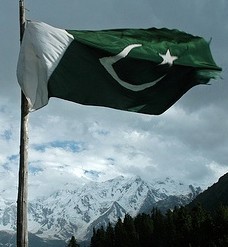
I should just be grateful that my friend Raza is alive. I was. I am.
But then, to come to terms with my relief, I engaged in an act of self-destructive rebellion—foolhardy, irresponsible and potentially fatal. I went for a long drive through the streets of Lahore, alone. As people often do. As I did often until “security-related restricted movement” became an embarrassing part of my life. As Raza could have possibly, until recently, when the price of life became self-imposed house arrest or exile for him.
More here.
Massachusetts Maverick
Amy Chozick in The New York Times:

…Before she ran for office, she had become a leading expert in debates about predatory lending practices and bankruptcy legislation, as well as a thorn in the financial industry’s side. The idea that some banks are too big to fail, Warren writes in “A Fighting Chance,” “allows the megabanks to operate like drunks on a wild weekend in Vegas.” Families who fall behind on their debts are usually “desperately ashamed of their situation,” and have been saddled with health care costs or tricked into taking out subprime mortgages with egregious terms hidden in the fine print. That message first brought Warren national attention with her 2003 book, “The Two-Income Trap: Why Middle-Class Parents Are Going Broke,” written with her daughter, Amelia Warren Tyagi. In that book, they wrote about a meeting with Hillary Clinton in 1998 to discuss bankruptcy protections for struggling middle-class families. (Before Warren began her pitch the first lady “snapped her head sharply to the side and called to no one in particular, ‘Where’s lunch? I’m hungry.’ ”)
More here.
Saturday Poem
Pigs
Us all on sore cement was we.
Not warmed then with glares. Not glutting mush
under that pole the lightning's tied to.
No farrow-shit in milk to make us randy.
Us back in cool god-shit. We ate crisp.
We nosed up good rank in the tunnelled bush.
Us all fuckers then. And Big, huh? Tusked
the balls-biting dog and gutsed him wet.
Us shoved down the soft cement of rivers.
Us snored the earth hollow, filled farrow, grunted.
Never stopped growing. We sloughed, we soughed
and balked no weird till the high ridgebacks was us
with weight-buried hooves. Or bristly, with milk.
Us never knowed like slitting nor hose-biff then.
Nor the terrible sheet-cutting screams up ahead.
The burnt water kicking. This gone-already feeling
here in no place with our heads on upside down.
by Les Murray
from Translations from the Natural World, 1992
Thomas Piketty on Wealth, Income and Inequality
The Accidental Controversialist: Deeper Reflections on Thomas Piketty’s “Capital
Thomas Palley over at his website [h/t: Mona Ali]:
Using a conventional marginal productivity framework, Piketty provides an explanation of rising inequality based on increases in the gap between the marginal product of capital, which determines the rate of profit (r), and the rate of growth (g). Because capital ownership is so concentrated, a higher profit rate or slower growth rate increases inequality as the incomes of the wealthy grow faster than the overall economy.
The conventional character of Piketty’s theoretical thinking rears its head in his policy prescriptions. His neoclassical growth framework leads him to focus on taxation as the remedy. There is little attention to issues of economic institutions and structures of economic power because these are not part of the neoclassical framework. That substantially explains progressive economists’ diffident embrace of the book. Furthermore, even if technically feasible, Piketty’s tax prescriptions are politically naïve given capital increasingly controls the political process.
These features have led some critics to raise old “Cambridge” arguments about the intellectual incoherence of marginal productivity income distribution theory. Critics also assert Piketty conflates physical and financial capital, overlooking the role of finance in determining rates of return and patterns of income and wealth distribution. There are two problems with these responses. First, mainstream economists determined long ago to turn a blind eye and deaf ear to such arguments. Second, these arguments miss the bulls-eye which is the nature of capitalism.
A better response is for critics to stick with the rate of profit versus growth argument while dumping the neoclassical marginal productivity aspect of Piketty’s theoretical argument. Mainstream economists will assert the conventional story about the profit rate being technologically determined. However, as Piketty occasionally hints, in reality the profit rate is politically and socially determined by factors influencing the distribution of economic and political power.
More here.
Friday, April 25, 2014
Revolutionary Russia

In all revolutions there comes a moment when the high ideals of the revolutionaries crash onto the hard rocks of reality. In Russia that moment came in March 1921, when the Bolsheviks retreated from their first attempt to introduce a planned economy—by which they had thought to impose communism by decree—and let back elements of private trade to rescue their regime from popular rebellions.
Chronic shortages had built up over seven years of war, revolution, and the Civil War, especially in the austere years of the latter, between 1918 and 1920, when the Red Army had fought against the Whites, and leather-jacketed commissars had waged another war on the market.
Townsmen traveled to the countryside to barter with the peasants, who were reluctant to sell foodstuffs for paper money when there was nothing they could buy with it. They left with bags of clothes and household goods to sell or exchange in the rural markets and returned with bags of food. The railways were paralyzed by these armies of “bagmen.”
more here.