
Category: Recommended Reading
How To Write A Classic
Mark Davie at OUPblog:
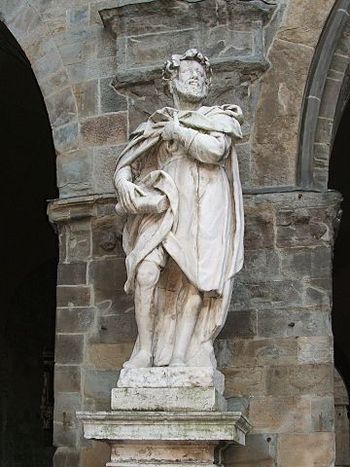
Some of Tasso’s drafts had leaked out during the poem’s long gestation and had been published without his consent, so the poem was eagerly awaited, and it immediately had its devotees. Not everyone, however, was impressed. Among those who were not was Galileo, who wrote a series of acerbic notes on the poem some time before 1609. His criticisms are mostly on details of language and style, but in one revealing comment he compares Tasso’s poetic conceits to ostentatiously difficult dance steps, which are pleasing only if they are ‘carried through with supreme accomplishment, so that their gracefulness overrides their affectation’. Grazia versus affettazione: the terms are taken from Castiglione’s Book of the Courtier, that indispensable guide to Renaissance manners which decreed that the courtier’s accomplishments should be displayed with an appearance of effortless nonchalance. Tasso’s offence against courtly manners was that he tried too hard.
Read the rest here.
Immortality through advanced technology and primitive diet
Charlotte Allen in The Weekly Standard:

…De Grey subscribes to the reigning theory of the live-forever movement: that aging, the process by which living things ultimately wear themselves out and die, isn’t an inevitable part of the human condition. Instead, aging is just another disease, not really different in kind from any of the other serious ailments, such as heart failure or cancer, that kill us. And as with other diseases, de Grey believes that aging has a cure or series of cures that scientists will eventually discover. “Aging is a side effect of being alive,” he said during our interview. “The human body is exactly the same as a car or an airplane. It’s a machine, and any machine, if you run it, will effect changes on itself that require repairs. Living systems have a great deal of capacity for self-repair, but over time some of those changes only accumulate very slowly, so we don’t notice them until we are very old.”
More here.
The making of a Marx: The life of Eleanor Marx
Rachel Holmes in The Independent:
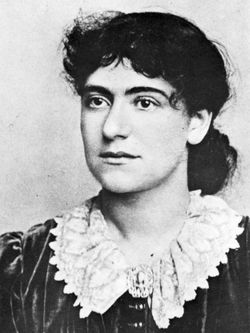
What started for Karl Marx as a 30- to 50-page essay, developed into a life’s work that his youngest daughter inherited. She sat on her father’s knee, played around him and learned to write and draw by his side at the kitchen table, where he worked in the early years of the project. Tussy and Capital grew up together. Marx said: “Tussy is me.” Her life and character form an epic story of adventure, morality, dilemma, contradiction and tragedy. Her thoughts and actions embody Britain’s history of struggle to achieve social democracy and equality.
More here.
Sunday Poem
Lust
If only he could touch her,
Her name like an old wish
In the stopped weather of salt
On a snail. He longs to be
Words, juicy as passionfruit
On her tongue. He’d do anything,
Would dance three days & nights
To make the most terrible gods
Rise out of ashes of the yew,
To step from the naked
Fray, to be as tender
As meat imagined off
The bluegill’s pearlish
Bones. He longs to be
An orange, to feel fingernails
Run a seam through him.
Yusef Komunyakaa
from Poetry, Vol. 175, No. 1, October/November
publisher: Poetry, Chicago, 1999
Saturday, May 3, 2014
‘Congo: The Epic History of a People’
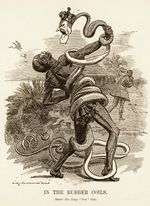
On June 5, 1978, the Congolese dictator Joseph-Désiré Mobutu stood on a hot grassy bluff in the south of his vast country — then named Zaire — and watched as the engines on a space rocket ignited. “Slowly, the rocket rose from the launching pad. A hundred kilometers into the atmosphere, that’s where it was headed, a new step forward in African space travel.” After a few moments, though, “the rocket listed, cut a neat arc to the left and landed a few hundred meters away, in the valley of the Luvua, where it exploded.” For David Van Reybrouck the rocket represents Mobutu’s regime: “A parabola of soot. . . . After the steep rise of the first years, his Zaire toppled inexorably and plunged straight into the abyss.”
Watching the failed rocket launch on YouTube is both Pythonesque and distressing. How did the West German space company Otrag get absolute control of an area of Congo the size of Iceland? Imagine if Mobutu’s state had been better run, not just that Congo had become a launchpad for interstellar travel, but that it had been able to project a stabilizing influence on neighboring Rwanda, heading off the 1994 genocide there.
more here.
how the Higgs particle was found

To find the Higgs – or to rule out its existence – was one of the aims of the Large Hadron Collider, a huge machine that accelerates protons (sub-nuclear particles) to within a squillionth of the speed of light before smashing them together (hence the book's title). If the particle existed, it should have quickly fallen apart into other particles in ways that experimenters could study. This is much easier said than done: as Butterworth explains, it was always going to be extremely difficult to pin down the particle, as the evidence was expected to be largely – but not completely – obscured by huge numbers of tracks due to other subatomic processes. Several months after the collider was switched on, there was no clear sign of the particle, leading some theoreticians to get cold feet and even to doubt its existence.
Butterworth tells the story of how the particle was eventually tracked down, making clear the extent of the challenge. He is an engaging guide, generous to all his colleagues, especially in the media – “We should be more forgiving of some of the excitable headlines” – but is sometimes a tad harsh on theoreticians.
more here.
A monumental study of the globalising age that was the 19th century

From one perspective, attempts to write panoramic, all-encompassing accounts of humanity are nothing new. On the contrary, they have been around for a very long time. One early example was Sir Walter Raleigh’s The History of the World, published exactly 400 years ago while its author was languishing as a prisoner in the Tower of London. Yet despite its million words, Raleigh took his story only from the creation down to the Ancient Greeks and Romans, and since he died in 1618, he never even got to the birth of Jesus Christ.
More recent practitioners of the genre include HG Wells, whose The Outline of History (1920) provided a single narrative extending from the origins of the earth to the first world war. Professional historians did not like it, but Wells’s book was a popular success, and it was remarkably free of the Eurocentric and racist attitudes much in evidence at the time. On a very different scale was Arnold Toynbee’s A Study of History, which appeared in 12 vast volumes between 1934 and 1961, and which chronicled the rise and fall of the many separate civilisations that Toynbee believed divided the past. Once again, the scholarly fraternity disapproved, and it is only recently that such broad-based approaches to the long, varied, dispersed and yet also joined-up story of humanity have acquired serious academic credibility.
more here.
Where Have All The Workers Gone
Cait Murphy in Inc. Magazine:

What’s a 60-employee family-owned company to do?
Join the club, Gretchen Zierick. Business owners everywhere, it seems, complain they can’t find good help these days. It’s a staple of conversation from talk radio to chats over the donuts and coffee at Chamber meetings.
That concern is reflected in numerous recent surveys of businesses—big and small. Almost four in 10 U.S. employers told Manpower, a staffing company, that they were having difficulty filling jobs. The feeling is particularly acute at small and midsize companies. In a U.S. Chamber of Commerce study, 53 percent of leaders at smaller businesses said they faced a “very or fairly major challenge in recruiting nonmanagerial employees.”
And in a survey of Inc. 5000 CEOs last year, 76 percent said that finding qualified people was a major problem.
What’s really interesting about all this is that it’s not just the usual suspects who are complaining about the lack of good workers. You know: software companies that want to hire programmers from India. It turns out that good old manufacturers are having trouble finding excellent employees.
So, what is going on? And why is this happening?
Read the rest here.
The novel is dead (this time it’s for real)
Literary fiction used to be central to the culture. No more: in the digital age, not only is the physical book in decline, but the very idea of 'difficult' reading is being challenged. The future of the serious novel, argues Will Self, is as a specialised interest.
Will Self in The Guardian:

A miner, if he has any sense, treats his canary well, so I began gently remonstrating with him. Yes, I said, it's true that the web and the internet have created a permanent Now, eliminating our sense of musical eras; it's also the case that the queered demographics of our longer-living, lower-birthing population means that the middle-aged squat on top of the pyramid of endeavour, crushing the young with our nostalgic tastes. What's more, the decimation of the revenue streams once generated by analogues of recorded music have put paid to many a musician's income. But my canary had to appreciate this: if you took the long view, the advent of the 78rpm shellac disc had also been a disaster for musicians who in the teens and 20s of the last century made their daily bread by live performance. I repeated one of my favourite anecdotes: when the first wax cylinder recording of Feodor Chaliapin singing “The Song of the Volga Boatmen“ was played, its listeners, despite a lowness of fidelity that would seem laughable to us (imagine a man holding forth from a giant bowl of snapping, crackling and popping Rice Krispies), were nonetheless convinced the portly Russian must be in the room, and searched behind drapes and underneath chaise longues for him.
So recorded sound blew away the nimbus of authenticity surrounding live performers – but it did worse things. My canaries have often heard me tell how back in the 1970s heyday of the pop charts, all you needed was a writing credit on some loathsome chirpy-chirpy-cheep-cheeping ditty in order to spend the rest of your born days lying by a guitar-shaped pool in the Hollywood Hills hoovering up cocaine.
More here.
The Origin of Ideology
Chris Mooney in Washington Monthly:
In a recent experiment by psychologists Russell Fazio and Natalie Shook, a group of self-identified liberals and conservatives played BeanFest. And their strategies of play tended to be quite different. Liberals tried out all sorts of beans. They racked up big point gains as a result, but also big point losses—and they learned a lot about different kinds of beans and what they did. Conservatives, though, tended to play more defensively. They tested out fewer beans. They were risk averse, losing less but also gathering less information.
One reason this is a telling experiment is that it’s very hard to argue that playing BeanFest has anything directly to do with politics. It’s difficult to imagine, for example, that results like these are confounded or contaminated by subtle cues or extraneous factors that push liberals and conservatives to play the game differently. In the experiment, they simply sit down in front of a game—an incredibly simple game—and play. So the ensuing differences in strategy very likely reflect differences in who’s playing.
The BeanFest experiment is just one of dozens summarized in two new additions to the growing science-of-politics book genre: Predisposed: Liberals, Conservatives, and the Biology of Political Differences, by political scientists John R. Hibbing, Kevin B. Smith, and John R. Alford, and Our Political Nature, by evolutionary anthropologist Avi Tuschman. The two books agree almost perfectly on what science is now finding about the psychological, biological, and even genetic differences between those who opt for the political left and those who tilt toward the right.
More here.
Portrait of Lotte – 0 to 14 years in 4 minutes
Love Story: Isaiah Berlin and Anna Akhmatova
David Brooks in The New York Times:

Today we live in a utilitarian moment. We’re surrounded by data and fast-flowing information. “Our reason has become an instrumental reason,” as Leon Wieseltier once put it, to be used to solve practical problems. The night Berlin and Akhmatova spent together stands as the beau ideal of a different sort of communication. It’s communication between people who think that the knowledge most worth attending to is not found in data but in the great works of culture, in humanity’s inherited storehouse of moral, emotional and existential wisdom. Berlin and Akhmatova were from a culture that assumed that, if you want to live a decent life, you have to possess a certain intellectual scope. You have to grapple with the big ideas and the big books that teach you how to experience life in all its richness and make subtle moral and emotional judgments.
More here.
How I learned to stop worrying and love errorbars
Chris Holdgraf in Berkeley Science Review:
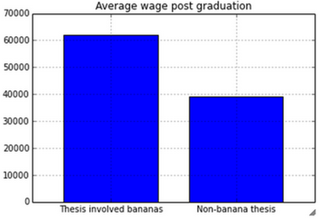
That’s right – the proof is in the pudding. Bananas increase your wage. Case closed.
“But wait”, you might say, “not only is this argument completely stupid, but your graph is totally meaningless.”
And you would be right, but stuff like this happens in the media, on the web, even in academiaall the time. Setting aside for the moment the numerous problems with the above argument, there’s one in particular that takes the cake in terms of it’s common (mis)use. I’m speaking, of course, about error bars.
More here.
Saturday Poem
Poem
Form is the woods: the beast,
a bobcat padding through wet sumac,
the pheasant in break or goldenrod
that he stalks — both rise to the flush,
the brief low flutter and catch in air;
and trees, rich green, the moving of boughs
and the separate leaf, yield
to conclusions they do not care about
or watch — the dead, frayed bird,
the beautiful plumage,
the spoor of feathers
and the slight pink bones.
by Jim Harrison
from The Shape of the Journey
Copper Canyon Press, 1998
Friday, May 2, 2014
Where Yinz At? Why Pennsylvania is the most linguistically rich state in the country
Matthew J.X. Malady in Slate:

From Center City Philly to about Reamstown, it’s all Eagles and Phillies and Flyers stickers. Then there’s a 150-mile stretch of road where anything goes. Penn State paraphernalia, Jesus fish, and stickers about deer hunting mix with every other form of car commentary to create a hodgepodge that predominates until about Bedford. From there, it really is all Steelers stuff. And for those who make this drive fairly often, that bumper sticker progression serves as an old-school GPS. Of course, you’ll also spot stickers referencing cheesesteak lingo, as well as those emblazoned with “N’AT,” on this trip. And if you’re from out of state and decide to rest-stop query the owner of a car bearing one of those stickers, within the first few words of that person’s spoken response you’ll realize why linguists love the Keystone State.
More here.
Human fat cells can be used to regenerate damaged hearts and ageing joints. So should we start piling on the pounds?
Jalees Rehman in Aeon:
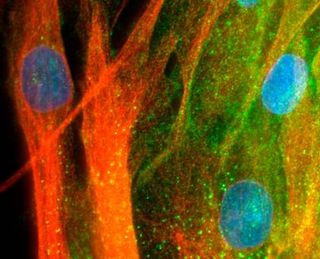
I had joined Keith March’s research laboratory at Indiana University as a postdoctoral fellow in the summer of 2001. At the time, his group was trying to improve upon stents, small mesh tubes that can be placed inside blocked coronary arteries to keep them open, restoring an adequate supply of blood and oxygen to the heart. But even the best stents were no cure for heart tissue that had already been irreversibly damaged by a heart attack. The wave of the future, I felt, was the newly emerging field of cardiovascular regeneration, the idea of using stem cells to repair the heart and grow new blood vessels.
Yet when Keith suggested I use fat to generate those cells, I thought he was making an inside joke. We were both overweight and often made fun of ourselves. And the history of fat cures was rife with superstition and myth. For centuries, people had believed that rubbing one’s arms and legs with balms made out of human fat could cure broken bones, crippled limbs and joint pains. Societal mores prevented the dissection of human bodies for the purpose of removing human fluids or tissues, but these rules didn’t apply to executed criminals, especially when there were no family members to claim the body. Until the mid-18th century, this presented a lucrative opportunity for a group of social outcasts: executioners, who became expert extractors, with a skill-set and knowledge of anatomy that often surpassed that of academic physicians. In her book, Defiled Trades and Social Outcasts (2000), the historian Kathy Stuart from the University of California, Davis, gives a gripping account of the work and lives of executioners. Some executioners even started their own medical practices, selling products such as human fat themselves.
More here.
Pakistan: Who’s Afraid of the ISI?
Ali Sethi in the New York Review of Books:
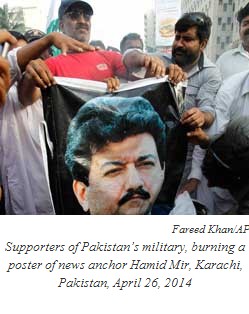
On April 19, as the forty-eight-year-old Mir was being driven out of Karachi’s airport, a man fired nine shots at him with a 9mm pistol, hitting him in the ribs, stomach, hand, and thigh, before fleeing the scene. Mir was rushed to a hospital, where he remains in critical condition. A few hours later, his younger brother went on Geo News and laid the blame for the shooting not on some extremist group, but on the ISI itself. “A few elements in the ISI are against Hamid Mir due to his viewpoint about [former military dictator] Pervez Musharraf and the Balochistan crisis,” said Amir Mir, who also works for Jang-Geo. He added that he held the head of the ISI, Lieutenant General Zaheer-ul-Islam, “personally responsible” for the attack. Still more explicit was the montage of pictures used by Geo News to illustrate this accusation: an unconscious Hamid Mir with a respirator on his mouth; a bullet-riddled car; and a photograph of Zaheer-ul-Islam—a man who shuns television appearances—looking smug and serene as he shook hands with soldiers at a ceremony.
Within minutes there was a furious response to these charges: first on Facebook and Twitter, where mysterious cyber-entities, many of them with sultry female names, unleashed a torrent of hate against the “traitors” at Geo TV; then, a few hours later, on Geo’s rival TV channels, Express and ARY, where assorted analysts and columnists attacked Hamid Mir, tried to portray the allegations against the ISI as an Indian-American conspiracy, and raised questions about the intentions of Mir Shakilur Rahman, Geo’s eccentric, Dubai-based owner.
More here.
Why Only One Top Banker Went to Jail for the Financial Crisis
Jesse Eisinger in NYTimes Magazine:

Read the rest here.