from arts and crafts to “makers”

140113_r24479_p233Evgeny Morozov at The New Yorker:

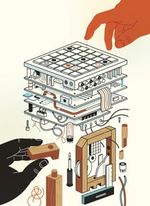
A reluctance to talk about institutions and political change doomed the Arts and Crafts movement, channelling the spirit of labor reform into consumerism and D.I.Y. tinkering. The same thing is happening to the movement’s successors. Our tech imagination, to judge from catalogues like “Cool Tools,” is at its zenith. (Never before have so many had access to thermostatically warmed toilet seats.) But our institutional imagination has stalled, and with it the democratizing potential of radical technologies. We carry personal computers in our pockets—nothing could be more decentralized than this!—but have surrendered control of our data, which is stored on centralized servers, far away from our pockets. The hackers won their fight against I.B.M.—only to lose it to Facebook and Google. And the spooks at the National Security Agency must be surprised to learn that gadgets were supposed to usher in the “de-institutionalization of society.”

The lure of the technological sublime has ruined more than one social movement, and, in this respect, even Mary Dennett fared no better than Felsenstein. For all her sensitivity to questions of inequality, she also believed that, once “cheap electric power” is “at every village door,” the “emancipation of the craftsman and the unchaining of art” would naturally follow. What electric company would disagree?

more here.
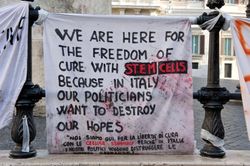
Leaked files slam stem-cell therapy

Alison Abbott in Nature:

NatureA series of damning documents seen by Nature expose deep concerns over the safety and efficacy of the controversial stem-cell therapy promoted by Italy’s Stamina Foundation. The leaked papers reveal the true nature of the processes involved, long withheld by Stamina’s president, Davide Vannoni. Other disclosures show that the successes claimed by Stamina for its treatments have been over-stated. And, in an unexpected twist, top Italian scientists are dissociating themselves from an influential Miami-based clinician over his apparent support for the foundation. Stamina, based in Brescia, claims that it successfully treated more than 80 patients, mostly children, for a wide range of conditions, from Parkinson’s disease to muscular dystrophy, before the health authorities halted its operations in August 2012. A clinical trial to assess the treatment formally was approved by the Italian government last May, and an expert committee was convened by the health ministry to study Stamina’s method and to recommend which illnesses the trial should target.

Stamina says that its technique involves extracting mesenchymal stem cells from a patient’s bone marrow, culturing them so that they turn into nerve cells, and then injecting them back into the same patient. But full details of the method have never been revealed, and Vannoni provided the full protocol to the expert committee only in August. In October, the committee’s report prompted health minister Beatrice Lorenzin to halt plans for the clinical trial. That led to public protests in support of Stamina, and, after an appeal by Vannoni, a court ruled in early December that the expert committee was unlawfully biased. Some members had previously expressed negative opinions of the method, the ruling said. As a result, Lorenzin appointed a new committee on 28 December, reopening the possibility of a clinical trial.

More here.

Friday Poem

A Summer Garden

Several weeks ago I discovered a photograph of my mother

sitting in the sun, her face flushed as with achievement or triumph.

The sun was shining. The dogs

were sleeping at her feet where time was also sleeping,

calm and unmoving as in all photographs.

I wiped the dust from my mother’s face.

Indeed, dust covered everything; it seemed to me the persistent

haze of nostalgia that protects all relics of childhood.

In the background, an assortment of park furniture, trees and shrubbery.

The sun moved lower in the sky, the shadows lengthened and darkened.

The more dust I removed, the more these shadows grew.

Summer arrived. The children

leaned over the rose border, their shadows

merging with the shadows of the roses.

A word came into my head, referring

to this shifting and changing, these erasures

that were now obvious—

it appeared, and as quickly vanished.

Was it blindness or darkness, peril, confusion?

Summer arrived, then autumn. The leaves turning,

the children bright spots in a mash of bronze and sienna.

Read more »

Thursday, January 9, 2014

Five books to argue with

Kenan Malik in Pandaemonium:

The best kind of book, to my mind, is the kind of book you can have an argument with. Not a book so wrong that I want to throw it across the room, but one that I disagree with and yet find challenging enough to force me to re-examine my own views, and often to put down my disagreements in writing to help me better to clarify them. So, here are five books for me to argue with over the next few months. And a sixth that I hope everyone else will be arguing about.

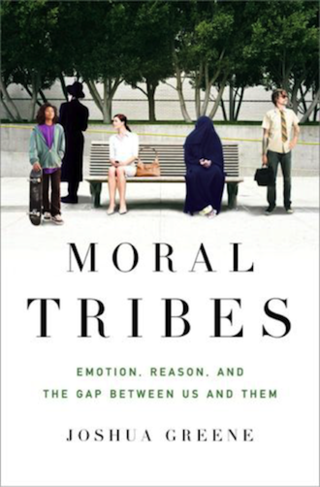
Moral Tribes: Emotion, Reason, and the Gap Between Us and Them by Joshua Greene

Greene-tribesThe contradictions of our moral lives, psychologist and philosopher Joshua Greene suggests, lies in our evolutionary history. Our brains were designed for tribal life. But we live in a globalized world that creates conflicts of interest and clashes of values that we find difficult to negotiate. Not only are we caught between the landscape of our evolved minds and the reality of the modern world, we are also caught between two mechanisms for moral thinking. Like a digital camera, human morality can work both in ‘auto mode’ or in ‘manual mode’. In automatic, point-and-shoot mode, the camera can take pictures quickly and easily, but often goes awry in difficult conditions. In manual mode, the camera can be fine-tuned to take perfect photos in even the trickiest conditions. But such fine-tuning is fiddly and takes time. Auto mode, in other words, is fast but inflexible, manual mode highly flexible, but slow and tricky to set up. The same is true, Greene suggests, of moral thinking. Normally we rely on point-and-shoot moral answers, responding quickly, instinctively, almost unthinkingly to moral problems. Our fast, instinctive point-and-shoot moral snapshot answers have developed against the background of our evolutionary history. We can, however, also step back from our intuitions, and reason our way to a moral answer.

More here.

The Unlearnt Lessons of Iraq

Tim Black in Spiked:

ScreenHunter_487 Jan. 09 17.58On 1 May this year, it will be exactly 11 years since the then US president, George W Bush stood on board the USS Abraham Lincoln and said of the US-led invasion of Iraq, ‘mission accomplished’. It was not exactly the most accurate statement, even by Bush junior’s standards. Despite the coalition troops having officially departed Iraq at the end of 2011, the mission, such as it was – and is – remains steadfastly unaccomplished. The insurgence is still surging, and Iraq’s government, led by the divisive prime minister, Nouri al-Maliki, is still begging the US for military help, a request to which President Obama relented a few weeks ago when he agreed to send over missiles and drones.

In fact, the situation in Iraq, a country supposedly liberated over a decade ago, looks to be deteriorating, not improving. The infrastructural basics, from healthcare to public sewerage, are still in a parlous state. The Shia-dominated government, seemingly set against Iraq’s minority Sunni population, appears to be as illegitimate as ever. And according to IraqBodyCount.org, the number of civilians killed last year as a result of the continued insurgency – about 9,000 – makes 2013 the deadliest year since 2008.

In a grisly irony, given the ‘war on terror’ rationale for much of recent Western interventionism, it now seems that the principal beneficiaries of the US-driven destruction of Saddam Hussein’s tinpot tyranny, beginning with the brutal UN sanctions regime imposed on Iraq in the 1990s and culminating in the 2003 invasion, have not been ordinary Iraqis, but a range of al-Qaeda spin-offs and affiliates, backed by various Middle Eastern states jostling for position in Iraq.

More here.

A good new year’s resolution from Sean Carroll

Sean Carroll in Preposterous Universe:

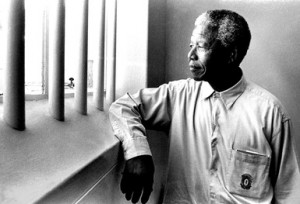
Mandela-cell-jpg_extra_big-300x204Nelson Mandela was a complicated person. He was no pushover; he was an activist, a revolutionary, someone who got things done and wasn’t afraid to break a few eggs when necessary. But his greatest contribution wasn’t the overthrow of apartheid in South Africa, which arguably would have happened at some point anyway — it was the peaceful way in which the transition happened, and the inclusiveness, forgiveness, and ability to look forward with which he led the nation thereafter.

Now, the concept of “New Year’s Resolutions” is a pretty awful one. Most people resolve to lose weight or some generic version of being nicer, and most fall off the wagon pretty quickly. A health club I used to go to would display signs in January saying “Regulars: don’t worry about the crowds, most of them will be gone soon.” Not very encouraging, but pretty accurate.

But the idea of resolving to be a better person is a good one, and the beginning of a new year is as good a time as any. So without making an official resolution, this year I’d like to be more like Nelson Mandela.

More here.

Surreal love in prague

P4_Shore_397411kMarci Shore at the Times Literary Supplement:

It was an ecstatic encounter. The Czech poets fell in love with the French poets – and miraculously for the Czechs, that love was reciprocated. Éluard told Nezval that Paris seemed cold and sad after his time in Prague. Breton wrote that he had taken from Prague the most beautiful memories of his life. He wanted Nezval to know that “you have acquired me completely, that for you I am willing to do everything, that you are my best friends”. The sentiments were mutual. “No feeling”, Nezval told Breton, “has seemed to me so valuable, so sublime as the thought that I can call you my adored friend.” In a letter to Éluard (not cited by Sayer), Nezval enclosed some of his poems in literal French translation: “Dear friend, that these lines have been permitted to find themselves before your eyes has already justified my entire life . . . . I love you. We all love you”.

Nezval represented what was already the third generation of Czech modernists. In the 1890s, Czech modernism had emerged as a revolt against mechanistic positivism and as a call for individualism in an age of nation-building. “We want truth in art”, proclaimed the Manifesto of Czech Modernism (1895), “not truth that is a photograph of exterior things, but honest, interior truth.” This was before Czechoslovakia existed, when the Czech lands were the possession of the Austro-Hungarian Habsburg Empire.

more here.

marshall berman’s last lecture

1388713280bermancrossbronxexpNARA2666Marshall Berman at Dissent:

I would like to begin with a little time travel: first, back to the 1950s, ’60s, and ’70s—and particularly the South Bronx of the 1970s; then, back to the Bible, back to the sixth century BCE, back to the first destruction of Jerusalem, and the start of its renewal; then a final leap into a twenty-first-century Manhattan that is full of echoes of both. I’m not going to talk now about the horrors of 9/11, or of Boston, or about the vulnerability of New York Harbor. I pay homage to the people of those places. But I’m going to focus on a distinctive landscape of ruins, an amazing, dreadful landscape that came to define the South Bronx, and for many people to define New York, for the last decades of the twentieth century. Those ruins were one of New York’s great negatives. I want to try to do what Hegel says: look the negative in the face.

The ruin was a process. It began in the late 1950s and 1960s, when the center of the Bronx was blasted and bulldozed to build the Cross Bronx Expressway. But the ruin grew far beyond anything anyone could imagine. In the 1970s there were waves of fire; in a decade the Bronx lost more than 300,000 people. Life stabilized only at the century’s end. The Bronx is still New York’s poorest borough, but its vast empty spaces are full of people again. Its population has risen, close to its 1950 peak. We will focus on the years when it was down. I invented a word for this process: URBICIDE, the murder of a city. Did I really invent it? Once you said it, it seemed obvious enough. But how do people in a murdered city live?

more here.

more on the “undergraduate atheists”

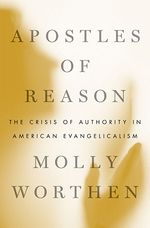
140103_SBR_APOSTLES_COVER.jpg.CROP.original-originalMichael Robbins at Slate:

The “undergraduate atheists,” as the philosopher Mark Johnston dubbed them inSaving God, have been definitively refuted by Hart, Terry Eagleton, Marilynne Robinson, Johnston himself, and others. As intellectual bloodbaths go, it’s been entertaining—like watching Jon Stewart skewer Glenn Beck. But of course Richard Dawkins is merely a symptom. I have encountered atheists who seem not only to have never met an intelligent, educated believer, but to doubt that such a creature could exist.

Such unbelievers seem to me to have missed something quite fundamental about the nature of being, as it appears to the human animal, something that the major theistic traditions attempt to address with rather more nuance and generosity than contemporary updates to logical positivism can muster. You don’t, obviously, have to believe in God to feel humbled and bewildered before what Heidegger called “the question of the meaning of Being.” (Indeed, I often think the notion of “belief” is more trouble than it’s worth.) But you do have to acknowledge that there is a question, “the major question that revolves around you,” as John Ashbery puts it: “your being here.” And you have to recognize that it concerns something outside the scope of the natural sciences.

more here.

secret to writing a best-selling novel? avoid cliches and excessive use of verbs

Mathew Sparkes in The Telegraph:

BookScientists have developed an algorithm which can analyse a book and predict with 84 per cent accuracy whether or not it will be a commercial success. A technique called statistical stylometry, which mathematically examines the use of words and grammar, was found to be “surprisingly effective” in determining how popular a book would be. The group of computer scientists from Stony Brook University in New York said that a range of factors determine whether or not a book will enjoy success, including “interestingness”, novelty, style of writing, and how engaging the storyline is, but admit that external factors such as luck can also play a role.

By downloading classic books from the Project Gutenberg archive they were able to analyse texts with their algorithm and compare its predictions to historical information on the success of the work. Everything from science fiction to classic literature and poetry was included. It was found that the predictions matched the actual popularity of the book 84 per cent of the time. They found several trends that were often found in successful books, including heavy use of conjunctions such as “and” and “but” and large numbers of nouns and adjectives. Less successful work tended to include more verbs and adverbs and relied on words that explicitly describe actions and emotions such as “wanted”, “took” or “promised”, while more successful books favoured verbs that describe thought processes such as “recognised” or “remembered”. To find “less successful” books for their tests, the researchers scoured Amazon for low-ranking books in terms of sales. They also included Dan Brown’s The Lost Symbol, despite its commercial success, because of “negative critiques if had attracted from media”.

More here.

“Unnatural killer cells” zap circulating tumor cells in the bloodstream

From KurzweialAI:

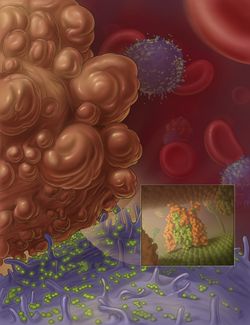
Nanoscale_liposomes_trailCornell biomedical engineers have discovered a new way to destroy metastasizing cancer cells traveling through the bloodstream by hitching cancer-killing proteins along for a ride on life-saving white blood cells. “These circulating cancer cells are doomed,” said Michael King, Cornell professor of biomedical engineering and the study’s senior author. “About 90 percent of cancer deaths are related to metastases, but now we’ve found a way to dispatch an army of killer white blood cells that cause apoptosis — the cancer cell’s own death — obliterating them from the bloodstream. “When surrounded by these guys, it becomes nearly impossible for the cancer cell to escape.” Metastasis is the spread of a cancer cells to other parts of the body. Surgery and radiation are effective at treating primary tumors, but difficulty in detecting metastatic cancer cells has made treatment of the spreading cancers problematic, say the scientists.

King and his colleagues injected human blood samples, and later mice, with two proteins: E-selectin (ES, an adhesive) and TRAIL (Tumor Necrosis Factor Related Apoptosis-Inducing Ligand). The TRAIL protein joined with the E-selectin protein was able to stick to leukocytes (white blood cells) abundant in the bloodstream. When a cancer cell comes into contact with TRAIL, which is nearly unavoidable in the frenzied flow of blood, the cancer cell essentially kills itself.

More here.

Thursday Poem

Not Fade Away

Half of the Beatles have fallen
and half are yet to fall.
Keith Moon has set. Hank Williams
hasn’t answered yet.

Children sing for Alex Chilton.
Whitney Houston’s left the Hilton.
Hendrix, Guru, Bonham, Janis.
They have a tendency to vanish.

Bolan, Bell, and Boon by car.
How I wonder where they are.
Hell is now Jeff Hanneman’s.
Adam Yauch and three Ramones.

[This space held in reserve
for Zimmerman and Osterberg,
for Bruce and Neil and Keith,
that sere and yellow leaf.]

Johnny Cash and Waylon Jennings,
Stinson, Sterling, Otis Redding.
Johnny Thunders and Joe Strummer,
Ronnie Dio, Donna Summer.

Randy Rhoads and Kurt Cobain,
Patsy Cline and Ronnie Lane.
Poly Styrene, Teena Marie.
Timor mortis conturbat me.

by Michael Robbins
From: Poetry, Vol. 203, No. 4, January, 2014

Wednesday, January 8, 2014

Roth Unbound: A Writer and his Books

Ian Thomson in the Financial Times:

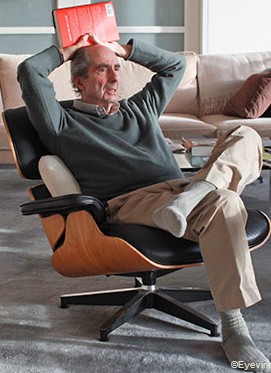
ScreenHunter_487 Jan. 08 18.21Philip Roth, the last of the Great American Novelists, was born in 1933 in New Jersey. His parents, Herman and Bess Roth, were “Americans from day one”, Roth recalled, yet they retained something of their forebears’ Polish-Galician and Russian- Jewish identity. Philip and his older brother, Sandy, were provided with Hebrew instruction and went to synagogue for the most important festivals. Roth as an adult may have regarded his Jewishness as an “irrelevance”, yet he was unavoidably shaped by it, and by the experience of being Jewish in America. His scabrous novel of sexual yearning and death, Sabbath’s Theater (1995), is suffused with a memory of the pogroms and derision inflicted on Jews in the Russian Pale in the 19th century.

In Roth Unbound, a smoothly readable hybrid of biography and criticism, Claudia Roth Pierpont (no relation) considers Roth’s awkward relationship with the American Jewish establishment. His first book of stories, Goodbye, Columbus, published in 1959, brought accusations of Jewish self-hatred and even anti-Semitism. “What is being done to silence this man?” a New York rabbi demanded to know of the 26-year-old New Jersey author. Roth’s third and most famous early novel, Portnoy’s Complaint (1969), told of the sexually repressed Alexander Portnoy and the recreational use he makes of (among other things) raw liver. “When had so much dirty Jewish laundry ever been displayed before so many Gentiles?” Pierpont asks. Roth was now not merely famous, but notorious.

More here.

The Mathematical Reality of Reality: An Interview with Cosmologist Max Tegmark

Lex Berko in Motherboard:

ScreenHunter_486 Jan. 08 17.57Max Tegmark has a theory about reality. According to Max, who is a cosmologist and professor of physics at MIT, all that exists, all this familiar stuff—that ergonomic chair you are sitting on, your body and your brain, even the space surrounding you— is math and we are merely “self-aware parts of a giant mathematical object.”

It’s a heady concept, but what does it even mean? In his new book Our Mathematical Universe, Max calls this idea the Mathematical Universe Hypothesis, wherein the universe is envisaged as a mathematical structure. A mathematical structure is “an abstract set of entities with relations between them,” expounds Max in his book, and these relations do not just describe all that is, but actually are all that is.

Reading Our Mathematical Universe, which is part mind-bending scientific treatise and part autobiography, is no casual jaunt. While the book offers a lot to readers, it also asks a lot in return. When I had the opportunity to chat with Max just before the holidays, I felt obligated to preface our conversation with the fact that although I had read the entirety of the book, I experienced difficulties in understanding chunks of it. To him, this presented no problem at all.

“You have to remember, Lex, that if you don’t feel you understand 100 percent about our Universe, nobody else does either!”

Fortunately for me, and anyone else interested in the possible realities of reality, Max is open to having his brain probed, which is what I hoped to achieve in our conversation.

More here.

How America became a torturing regime in the ‘war on terror’

Lisa Hajjar in Dawn:

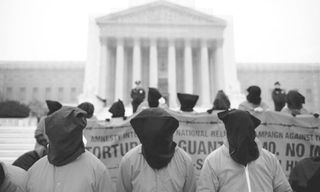
52cd101c9950dOn the television programme ‘Meet the Press’ on September 16, 2001, five days after the 9/11 terrorist attacks, vice president Dick Cheney said: “We’ll have to work … the dark side, if you will. We’ve got to spend time in the shadows in the intelligence world. A lot of what needs to be done here will have to be done quietly, without any discussion, using sources and methods that are available to our intelligence agencies — if we are going to be successful.” The following day, president George W. Bush signed a memorandum of understanding granting the CIA authority to establish a secret detention and interrogation operation overseas.

By December 2001, Pentagon officials were exploring how to “reverse engineer” SERE (survival, evasion, resistance, extraction) techniques that had been developed during the Cold War to train US soldiers to withstand torture in case they were captured by regimes that don’t adhere to the Geneva Conventions. The Clinton-era rendition programme of sending detainees captured abroad to foreign states for trial was revamped as “extraordinary rendition” to permit the CIA to kidnap people from anywhere in the world and disappear them into secret prisons, euphemised as “black sites,” where they could be held as “ghost detainees” — i.e., with no record of their identities or whereabouts and no access to monitors from the International Committee of the Red Cross (ICRC) — or transferred extra-legally to other states for interrogation.

Cheney and other officials in the Bush administration devised a “new paradigm” according to which the president, as commander-in-chief, has unfettered powers to wage war. On November 13, 2001, president Bush issued a military order declaring that captured terror suspects were “unlawful combatants,” a heretofore non-existent category conceived to place such prisoners outside of the law. Anyone taken into US custody could be designated an unlawful combatant by presidential fiat rather than on the basis of any status review by a tribunal, and could be held incommunicado indefinitely.

More here.

the importance of paper

Xquill-statue-448.jpg.pagespeed.ic.EQ3rTpv_pGAli Pechman at Poetry Magazine:

For thousands of years writing surfaces such as papyrus, animal skins, and stone had been alternately celebrated and eschewed for the advancements they provided to memory, but none had been as utilitarian as paper. Basbanes, “a self-confessed bibliophile,” gives a number of dates for paper’s first appearance: fragments have been found from as far back as 150 A.D. in China, although the first identifiable printed book appeared there in 868 A.D. Use quickly spread from China to the Middle East and eventually to medieval Europe, where paper mills proliferated. Usefulness, Basbanes argues, is paper’s defining merit: in 20,000 different iterations, it can be handled and physically present in the face of an increasingly abstract world. Basbanes quotes from A Midsummer Night’s Dream:

The poet’s eye, in a fine frenzy rolling,
Doth glance from heaven to earth, from earth to heaven;
And as imagination bodies forth
The forms of things unknown, the poet’s pen
Turns them to shapes, and gives to airy nothing
A local habitation and a name.

Even in its most poetic forms, paper’s role in our world is a way to put “airy nothings” onto solid objects.

Sansom, on the other hand, describes paper not just as a useful thing but an inherent part of us. “In Japanese there’s a phrase, yokogami-yaburi, which means to tear paper sideways against its grain—idiomatically, it means ‘perversity’ or ‘pig-headedness.’ By ignoring paper, we are perverse; we go against the grain.”

more here.

Joaquim Câmara Ferreira: Guerrillero-Gentleman

Fraenkel_aguerillero-gentleman_img_0Carlos Fraenkel at The Nation:

“Gentleman” is not the first epithet that comes to mind when one thinks of Latin American revolutionaries, from Simón Bolívar to Fidel Castro. Yet that’s how relatives, friends and political companions describe my grandfather, Joaquim Câmara Ferreira. With Carlos Marighella and Carlos Lamarca, he was a leading figure of the armed resistance against the military dictatorship that ruled Brazil from 1964 to 1985. He is best known as the political strategist in the most spectacular act of Brazil’s guerrilla movement: the kidnapping in September 1969 of the American ambassador, Burke Elbrick, who after being held for three days was set free in exchange for fifteen political prisoners. That operation secured my grandfather a spot on the state’s list of top enemies. My uncle recalls an evening playing billiards in a bar: “Suddenly a friend asked me, ‘Isn’t that your father?’ When I looked up, I saw his photo on a poster of ‘Wanted Terrorists’ next to the counter.” A year later, the regime would hunt him down, torture and kill him.

A guerrillero-gentleman? Many who knew him still grapple with this seeming paradox. They remember my grandfather as an affable, tolerant and unassuming person. For decades, he was a leader of Brazil’s Communist Party, responsible in particular for its press operations (primarily newspapers). Why, in his mid-50s, did he decide to exchange the pen for the pistol? The transition wasn’t easy. “Starting military training at my age!” he said, self-mockingly, to a friend in Cuba, where Brazilians from the rebel group he helped found prepared for guerrilla warfare. But he showed up for shooting class every day.

more here.

leopardi meets andrew jackson

ID_POPKI_ZIBAL_CO_001Nathaniel Popkin at The Smart Set:

I spent much of November reading the Zibaldone (which translates loosely asmiscellany); the translation is both lush and firm and, given the range of languages Leopardi employs, is itself one the great literary endeavors of our time. Often, while reading, I would find myself thinking about American politics, particularly the regular rhetorical convulsions about federalism and states’ rights, localism and uniformity, systems and the individual, and government power and personal responsibility that framed the Bank War and infects discourse today. The Zibaldone, indeed, put these lines of ideology in a new light, even as Leopardi gives barely a thought to the American experience as a potential setting for the revival of primordial ways. Notably, Leopardi’s compelling vision, situated as it is in ancient Greece, matches the Jacksonian ideal far more neatly than that of Jackson’s Grecophile enemy Nicholas Biddle.

Not at all unlike Jackson, Leopardi finds modernity fundamentally bankrupt, for it deals in abstraction instead of face-to-face reality (and reality’s cousin illusion), and its language of reason corrupting of human experience. Reason, says Leopardi, distances us from nature and instinct, the only true teachers of mankind, and abstraction leads to tyranny. “We have no choice in this pitiful century of reason and enlightenment,” he wrote in one of the earliest entries, in 1820,

but to flee from ourselves and see how the ancients, who were still children, spoke, and how they saw and depicted the sanctity of nature with eyes that were neither malicious nor prying but innocent and utterly pure.

more here.