Rome: Sex & Freedom

Brown_1-121913_jpg_250x1059_q85

Peter Brown reviews Kyle Harper's From Shame to Sin: The Christian Transformation of Sexual Morality in Late Antiquity in the NYRB:

One of the most lasting delights and challenges of the study of the ancient world, and of the Roman Empire in particular, is the tension between familiarity and strangeness that characterizes our many approaches to it. It is like a great building, visible from far away, at the end of a straight road that cuts across what seems to be a level plain. Only when we draw near are we brought up sharp, on the edge of a great canyon, invisible from the road, that cuts its way between us and the monument we seek. We realize that we are looking at this world from across a sheer, silent drop of two thousand years.

Antiquity is always stranger than we think. Nowhere does it prove to be more strange than where we once assumed that it was most familiar to us. We always knew that the Romans had a lot of sex. Indeed, in the opinion of our elders, they probably had a lot more than was quite good for them. We also always knew that the early Christians had an acute sense of sin. We tend to think that they had a lot more sense of sin than they should have had. Otherwise they were very like ourselves. Until recently, studies of sex in Rome and of Christianity in the Roman world were wrapped in a cocoon of false familiarity.

Only in the last generation have we realized the sheer, tingling drop of the canyon that lies between us and a world that we had previously tended to take for granted as directly available to our own categories of understanding. “Revealing Antiquity,” the Harvard University Press series edited by Glen Bowersock, has played its part in instilling in us all a healthy sense of dizziness as we peer over the edge into a fascinating but deeply strange world. Kyle Harper’s book From Shame to Sin: The Christian Transformation of Sexual Morality in Late Antiquity is a scintillating contribution to this series. Not only does it measure the exact nature of the tension between the familiar and the deeply unfamiliar that lies behind our image of the sexual morality of Greeks and Romans of the Roman Empire of the classical period. It also goes on to evoke the sheer, unexpected strangeness of the very different sexual code elaborated in early Christian circles, and its sudden, largely unforeseen undermining of a very ancient social equilibrium in the two centuries that followed the conversion of Constantine to Christianity in 312.

More here.

A Christmas Carol

Dickens2-256x300Cynthia Haven at The Book Haven:

Dickens-lover John Hennessy (also known as Stanford University’s president) told us some time ago that he reread A Christmas Carol at this time of year. Perhaps we’ll join him – certainly it’s short enough. My little facsimile of the first edition is a double-spaced 166 pages long (at right).

It was the first book Charles Dickens took to the road for his famous readings, which made a killing in the U.S. His second American tour raked in the equivalent of $2.3 million in today’s dollars. People camped out in the snow the night before to hear it – it was the 19th-century version of Black Friday sales at Walmart.

During that 1867 tour, the 32-year-old Mark Twain was in the audience, and was distinctly unimpressed. Here’s how he described the “old” (55 years old) writer’s entrance:

Promptly at 8 P.M., unannounced, and without waiting for any stamping or clapping of hands to call him out, a tall, “spry,” (if I may say it,) thin-legged old gentleman, gotten up regardless of expense, especially as to shirt-front and diamonds, with a bright red flower in his button-hole, gray beard and moustache, bald head, and with side hair brushed fiercely and tempestuously forward, as if its owner were sweeping down before a gale of wind, the very Dickens came!

more here.

What You Need to Know About Simone Weil

Weil2-150x150Mark Shiffman at Front Porch Republic:

Born in 1909 to secular Jewish Parisians, at age 10 Simone Weil was memorizing Racine and marching in labor union protests. She attended the École Normale and then briefly taught philosophy to lycée girls, serving on weekends as a volunteer educator for members of the working class. Observing first-hand the rise of totalitarianism in Germany, she recognized early its similarity to Stalin’s Russia (leading to her break with the ideologically-blinded Communist Party). She worked in factories and on farms to understand firsthand the conditions of contemporary laborers and the spiritual dimension of work. In 1942, after escorting her parents to New York, she obtained a position with the Gaullists in London. There, before her death in 1943, she wrote her most famous book, The Need for Roots (L’Enracinement) as a contribution to the discussion of principles that ought to guide and animate the Fourth Republic. She wrote many brilliant short works, publishing very little and entrusting the manuscripts to friends.

Weil might be described as an Augustinian Platonist, enriched by Nietzsche, Marx, tragic and Vedic literature and John of the Cross, and sometimes narrowed by Descartes, Pascal, Kant and her own intense antipathies (e.g. for Aristotle). Like Augustine, her lifelong quest is for liberation from self-enclosure.

more here.

“This is Bed-Stuy, bitch.”

ImageBrandon Harris at n+1:

“This is Bed-Stuy, bitch.” That’s not what everyone else was saying.

It’s difficult to say exactly how long I’ve lived in Bedford-Stuyvesant. It’s not for lack of trying. For some time I believed I first moved to the neighborhood in summer 2008, but by any honest accounting of the neighborhood’s actual geography, I first moved there in summer 2004, into a stuffy two-bedroom apartment on Throop Avenue, just south of the Flushing Avenue border with “East” Williamsburg, across the street from the notoriously shoddy Woodhull Medical Center. I only lived there for four months before a year-and-a-half-long tour of quasi-illegal Manhattan dwellings (Battery Park City! Inwood!), but then I came back. I now believe I have resided in what is geographically Bedford-Stuyvesant, the most historically African American of all Brooklyn neighborhoods, and now the fastest-gentrifying, for fifty-seven months over the past nine years.

When I moved into the apartment on Taaffe in summer 2006, I thought, and my roommate thought, that we were moving to Clinton Hill. This had been one of my roommate’s stipulations when we started our search. My wealthy childhood friend, the type who was awkward, bookish, and intense in middle school, the type who somewhat iconoclastically befriended the Star Trek–obsessed, nerdy, overweight child of black middle-class Cincinnati strivers, simply rebuffed the idea of living in Bed-Stuy.

more here.

A new — and reversible — cause of aging

From KurzweilAI:

Sirt1_proteinMitochondria are often referred to as the cell’s “powerhouse,” generating chemical energy to carry out essential biological functions. These self-contained organelles, which live inside our cells and house their own small genomes, have long been identified as key biological players in aging. But as they become increasingly dysfunctional over time, many age-related conditions such as Alzheimer’s disease and diabetes gradually set in.

…As Gomes and her colleagues investigated potential causes for this, they discovered an intricate cascade of events that begins with a chemical called NAD and concludes with a key molecule that shuttles information and coordinates activities between the cell’s nuclear genome and the mitochondrial genome. Cells stay healthy as long as coordination between the genomes remains fluid. SIRT1’s role is intermediary, akin to a security guard; it assures that a meddlesome molecule called HIF-1 does not interfere with communication. For reasons still unclear, as we age, levels of the initial chemical NAD decline. Without sufficient NAD, SIRT1 loses its ability to keep tabs on HIF-1. Levels of HIF-1 escalate and begin wreaking havoc on the otherwise smooth cross-genome communication. Over time, the research team found, this loss of communication reduces the cell’s ability to make energy, and signs of aging and disease become apparent. “This particular component of the aging process had never before been described,” said Gomes. While the breakdown of this process causes a rapid decline in mitochondrial function, other signs of aging take longer to occur. Gomes found that by administering an endogenous compound that cells transform into NAD, she could repair the broken network and rapidly restore communication and mitochondrial function. If the compound was given early enough — prior to excessive mutation accumulation — within days, some aspects of the aging process could be reversed.

More here.

Cell-suicide blocker holds promise as HIV therapy

Heidi Ledford in Nature:

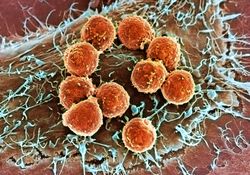
1_14422-M0500637-Coloured_SEM_of_a_T-cell_infected_with_AIDHIV infection causes a mass suicide of immune cells — a process that can be halted by an experimental drug that blocks cellular self-destruction, studies in cell cultures suggest. Researchers are now proposing a clinical trial of the drug in people with HIV. Current HIV therapies act by targeting key proteins made by the virus. But findings from cell cultures, published today in Science1 and Nature2, suggest that targeting proteins in host cells might be an alternative approach to preserving the immune system in the face of an HIV infection. The papers also address a decades-old mystery: why infection-fighting immune cells die off in people with HIV. A 2010 study3 showed that HIV does not directly kill most of these cells, called CD4 cells. Instead, the cells often self-destruct. “It’s much more a suicide than it is a murder,” says Warner Greene, a molecular virologist at the Gladstone Institute of Virology and Immunology in San Francisco, California, and a co-author of both the latest works.

In the latest studies, Greene’s team investigated these ‘abortive’ infections. They identified a sensor that detects viral DNA in the cell and activates the suicide response1. And they found that most of the cellular suicide occurs via a process called pyroptosis, in which the dying cells unleash a ferocious inflammatory response2. A key protein involved in pyroptosis is caspase 1, and an experimental caspase-1 inhibitor made by Vertex Pharmaceuticals in Cambridge, Massachusetts, had already been tested in humans as a potential treatment for epilepsy. The drug, VX-765, failed to help epileptics, but six-week-long studies suggested that it was safe. Greene and his colleagues tested VX-765 in HIV-infected cells cultured from human tonsils and spleens, and found that it blocked pyroptosis, prevented CD4 cell death, and suppressed inflammation. Greene hopes that the approach could one day provide an alternative or embellishment to the antiretroviral drugs currently used by 9.7 million people worldwide to manage HIV infection.

More here.

Friday poem

God or No God

.
Deer not clacking through snow crust
after apples, crows thankfully asleep,
coyotes whispering to young
not yet ready to test their pipes—
midnight is broken by my sump-pump
disgorging the day’s melt-seep. Yes.
What can I do without?

The first time I rode the ambulance
there was a hole in someone’s head.
Because all matter crumbles, because
chunk and mouth, bone of skull,
because this guy knew where to point.
That my hands did all the right things;
that he died as he meant to; that he made me
wildly alive—all true.

Ten years on, cumin seeds scorching in the pan
are my children, my slipknot, my go-to.
Because I believe myself fragrant
I am spitting me back out.
I renounce dog-eared and dog tired and even
dogged—no, dogged is good.
Because God or no god are both monstrous.
Because wrists don’t age. Because kisses
or memories of kisses. Because
hulland grave equally ravish.

The first time I gave myself an eyelash of a chance
to change, it will be tomorrow, and luckily
I’m watching. Because let the tenses be scrambled.
The world happens momentarily.


by Elle Dore Watson

Thursday, December 19, 2013

I Found Myself in a Dark Wood

Joseph Luzzi in the New York Times:

ScreenHunter_466 Dec. 19 18.19“In the middle of our life’s journey, I found myself in a dark wood.”

So begins one of the most celebrated and difficult poems ever written, Dante’s “Divine Comedy,” a more than 14,000-line epic on the soul’s journey through the afterlife. The tension between the pronouns says it all: Although the “I” belongs to Dante, who died in 1321, his journey is also part of “our life.” We will all find ourselves in a dark wood one day, the lines suggest.

That day came six years ago for me, when my pregnant wife, Katherine, died suddenly in a car accident. Forty-five minutes before her death, she delivered our daughter, Isabel, a miracle of health rescued by emergency cesarean. I had left the house that morning at 8:30 to teach a class; by noon, I was a father and a widower.

A few days later, I found myself standing in a cemetery outside Detroit in the cold rain, watching as my wife’s body was returned to the earth close to where she was born. The words for the emotions I had known till then — pain, sadness, suffering — no longer made sense, as a feeling of cosmic, paralyzing sorrow washed over me. My personal loss felt almost beside the point: A young woman who had been bursting with life was now no more.

More here.

The 2013 Darwin Awards

From My Underwood Typewriter:

Fsr38nickelfeature1. When his .38 caliber revolver failed to fire at his intended victim during a hold-up in Long Beach, California would-be robber James Elliot did something that can only inspire wonder. He peered down the barrel and tried the trigger again. This time it worked.

And Now, The Honorable Mentions:

2. The chef at a hotel in Switzerland lost a finger in a meat cutting machine and after a little shopping around, submitted a claim to his insurance company. The company expecting negligence sent out one of its men to have a look for himself. He tried the machine and he also lost a finger. The chef’s claim was approved.

3. A man who shoveled snow for an hour to clear a space for his car during a blizzard in Chicago returned with his vehicle to find a woman had taken the space. Understandably, he shot her.

4. After stopping for drinks at an illegal bar, a Zimbabwean bus driver found that the 20 mental patients he was supposed to be transporting from Harare to Bulawayo had escaped. Not wanting to admit his incompetence, the driver went to a nearby bus stop and offered everyone waiting there a free ride. He then delivered the passengers to the mental hospital, telling the staff that the patients were very excitable and prone to bizarre fantasies. The deception wasn’t discovered for 3 days.

More here. [Thanks to Frans de Waal.]

missing j. d. salinger

TLSsalinger_393324kJames Campbell at The Times Literary Supplement:

By the end of his life, in a paradox that itself seems to have come from the pages of fiction, Salinger, on the run from celebrity, not there but always there, was as prominent as any of his intermittently missing characters. What made him a fascinating presence in the minds of his predators, of which Shields and Salerno are perfect examples, was precisely his desire for self-effacement, his wish to go “underground” in Cornish, New Hampshire, just as Holden needed to do the same thing in New York City in order to straighten himself out after boarding school. For long periods, Salinger appeared to have satisfied his own wishes, but then there would be a snooper, a doorstepper, a photographer waiting to snap him as he exited the post office, a reporter on assignment for Time or Life, a woman pretending to be stranded at night after her car had broken down, a former lover eager to confess (Joyce Maynard, At Home in the World, 1998), even a daughter, Margaret, who felt that Daddy had been a disappointment (Dream Catcher, 2001) and that everyone ought to know.

All turn up, in one shape or another, in Salinger, “The official book of the acclaimed documentary film” that was released in the US earlier this year to various reactions, the least of which, it is fair to say, was acclaim. One contributor describes the pursuit of the shy author in terms that, under healthy scrutiny, would be regarded as perverse: “There was a bounty on Salinger’s head. Everyone wanted a photograph of this guy, and no one could get it”.

more here.

the music of Benjamin Britten

BrittenJames Wood at The London Review of Books:

For someone growing up with the music of Benjamin Britten, it was sometimes hard to recall that his last name was not ‘Britain’. The race that Nietzsche had deemed heavy-hoofed and unmusical, whose last truly great composer had been Purcell, a nation that had been doing nothing very much, musically, but warbling in cathedrals for a couple of centuries, had somehow managed to produce a 20th-century composer of international stature, whose last name was that of the nation itself. We’d done it! Here was Benjamin Britain OM, ‘Baron Britain of Aldeburgh’, whose Young Person’s Guide to the Orchestrawas as close to state music as a piece not actually the national anthem could be, and which cleverly merged spiky modern fugue with a stately theme from Purcell himself. In the same way, his many songs and adapted folk songs sounded a bit old and a bit new, or a bit English and a bit Continental. Palatable modernity: a good postwar flag under which to assemble. No wonder the school system flew it so often, in those countless ‘musical appreciation’ classes.

Approved, canonical Britten was also present outside school – fittingly, in church. No contemporary composer of similar standing had written as much sacred music for choirs. At Durham, as a cathedral chorister, I sang his sparkling Te Deum and Jubilate, and the beautiful anthems Hymn to St Cecilia (classy words by Auden, usefully decent treble solo)​♪ listen and Hymn to St Peter (eerie plainsong effect, also with coveted treble solo opportunity).​♪ listen In the cathedral, thrillingly at night, that enormous building dark and mysterious beyond our spotlit oasis, we thrashed our way through an evening performance of Noye’s Fludde, aided by a few glamorously affectless university string players.

more here.

Composer Nico Muhly on Beyoncé’s new album

by Nico Muhly in The Talkhouse:

NicoMuhly_2991x3696_smile_315_313_90auto_s_c1At first I was anxious about the description of it as a “visual album,” because these days, which albums aren’t? I’m not sure I’ve ever seen a Lady Gaga video, but I know that her appeal — even to me, not ever having beheld her on purpose — is partially to do with her Visual Presentation. Beyoncé’s songs, on this album, connect to one another not just musically, but via a seemingly personal, almost Forrest Gump-like time-traveling woman’s journey through various eras and — I shudder to say the word — styles. It’s unbelievably ambitious and through-composed; where the music can feel unrelated from one song to the next, the video is especially and carefully elided, and where the video is stylistically at variance from one song to the next, the music itself creates an emulsion between all the various incarnations of Beyoncé, our tour-guide through heaven and hell. Her voice feels, here, stretched in all the best ways, and she is experimenting with various modes of vocal production, vibrato, enunciation, and textual stylization. She is relishing the individual words of her lyrics, and savoring the shapes of the phrases the songs demand of her. When she freaks, as is her wont, a bridge or a second chorus, it is an insane and welcome delight.

Can we start with the statement that I basically loved this album? And then I will go song by song and talk about what, for me, felt like a reinforcement of this love, and where, in places, my love was challenged? I am going to talk, interchangeably, about the music and the videos, as that is how this thing was presented to me, as well as to the poor taxed wi-fi of the rural hotel and its staff. So if you’ve only heard the music, you should probably watch the videos, and if you’ve only watched the videos, you’re probably fine?

More here.

the coen’s Inside Llewyn Davis

Isaac-cat-train_jpg_600x627_q85Luc Sante at the New York Review of Books:

Then again, it could be said that historical fiction, like science fiction, is really always about the present. Llewyn Davis is a creature of the here and now, not of 1961. He has none of the communitarian goodwill, the erudite passion, or the optimistic idealism that marked the period. He is a confused, irascible striver who isn’t sure what he is striving for, apparently seeking a career when folk music was about the last place you’d look for one. It is suggested that he has been flopping on friends’ floors for months, when, at the time, people generally only did that when they first hit town, since it wasn’t hard to scratch up the twenty or thirty bucks a month it took to rent a tenement flat fifty years ago.

But if you excise the period details, he makes sense. Whereas in a better time he would spend five or ten years woodshedding and developing a soul, he has no choice but to enter some kind of race right away or die on the vine. He is consistently crass because he feels threatened by people and ideas he can’t dominate—and he can’t dominate very much because he feels threatened. (How else to explain his heckling an Appalachian singer, complete with autoharp and authentically awkward?) Somehow he has made a connection to something that is genuine and profound—the haunting music—but circumstances force him to treat it as a card to play rather than as a path to explore.

more here.

Thursday Poem

Catbirds, Mocking Birds, Starlings
.

Birds repeat their parents' songs
As if their lives depend on it.
They do:
Catbirds, mockingbirds, starlings

Mimic birds or fire alarms but sound
Like catbirds, mockingbirds, starlings.
I compare my tongue-tied goodbye:
“You're dying, Mum.”

Stupid: I only hope
She was unconscious. (Was there a hand-squeeze?
Sometimes I tailor comfortless memories.)
I spoke so she'd know I was there, that's all.

Her chest sank on each useless breath:
Her lungs were full of fluid. She was drowning.
Pneumonia, the friend of suffering.
Unthinking, comfortless: at last, a truth we knew.

by John Donlan
July 23, 2004

When You Fail Once, Try Again. When You Fail Twice, Try Again.

David L. Ulin in The Paris Review:

Ryan-sandbox-Paris-ReviewI wrote my first first book over the course of three months, from July 23 to October 23, 1979. Four weeks in, I turned eighteen. This was a novel, and not the first I’d attempted; in fifth grade, I had written forty pages of a saga called Gangwar in Chicago, inspired by The Godfather and taking place in a city where I’d never been. Setting the story in Chicago meant scouring the map in World Book for locations: Canal Street, I recall, was one. I chose it because I knew Canal Street in New York, and it seemed the sort of landscape in which a gang war could take place. To this day, I have never seen Chicago’s Canal Street, despite the twenty years I spent visiting my wife’s family in a suburb on the North Shore.

The other novel, the one I finished, was motivated almost entirely by a specific case of envy—of my friend Fred, who had spent the same summer working on a novel of his own. Fred and I were high school writing buddies, confiding to each other, as we wandered the grounds of our New England boarding school, that we both wanted to win the Nobel Prize. Now, he’d written a campus novel, tracing his difficulties as a one-year senior, parsing the school’s social hierarchy in a way that seemed enlightening and true. Fred was more serious, more focused; he not only knew what symbolism was but also how to use it. It made sense that he would write a novel, and that it would be good. A year later, he would write another one, and then we lost track of each other, until six or seven years later, when his short stories started to appear in magazines.

More here.

365 days: Nature’s 10 people who mattered this year

Daniel Cressey in Nature:

Feng%20ZhangFENG ZHANG: DNA’s master editor: Borrowing from bacteria, a biologist helps to create a powerful tool for customizing DNA. With a nip here and a tuck there, a DNA-cutting mechanism that bacteria use to protect themselves from viruses became one of the hottest topics in biomedical research in 2013. And a young neuroscientist with a penchant for developing tools helped to make it happen. Thirty-two-year-old Feng Zhang of the Massachusetts Institute of Technology in Cambridge is among those leading the charge in using a system called CRISPR/Cas to edit genomes cheaply, easily and precisely. In January, his group showed that the system works in eukaryotic cells — ones with membrane-bound nuclei, including those of all animals and plants. This confirmed its potential for tweaking the genomes of mice, rats and even primates to aid research, improve human-disease modelling and develop treatments (L. Cong et al. Science 339, 819–823; 2013). But as hot as the story has been this year, “the CRISPR craze is likely just starting”, says Rodolphe Barrangou, a microbiologist at North Carolina State University in Raleigh. CRISPRs (clustered regularly interspaced palindromic repeats) are DNA sequences that many bacteria and archaea use to defend themselves. They encode RNAs that can specifically recognize a target sequence in a viral genome. The RNAs work in complex with a CRISPR-associated protein, or Cas, which snips the DNA of the invader.

…Zhang now says that he feels challenged to be creative with other applications. One particularly ambitious project on his slate is to build a library of CRISPRs that can delete any sequence in an organism’s entire genome in 100–200 base-pair increments. This could make it easier to investigate the function of non-coding DNA. But he is most interested in using CRISPR to treat neuro­psychiatric conditions such as Huntington’s disease and schizophrenia by repairing genes in human tissues. To pursue therapeutic use of the technology, he and other CRISPR pioneers last month launched a company called Editas Medicine, based in Cambridge, that is backed by US$43 million in venture-capital funding. CRISPR “allows us to start to make corrections in the genome”, says Zhang. “Because it’s easy to program, it will open up the door to addressing mutations that affect few people but are very devastating.”

More here. (Note: I am convinced that CRISPR is one of the most important discoveries of the century)

Wednesday, December 18, 2013

Contemporary Scottish Friction

GMA-5131-383x439

Cal Flyn in The New Inquiry:

Next year the people of Scotland will go to the polls to decide whether their country will stay in the United Kingdom or strike out on its own as an independent country. The crowd were gathered on Edinburgh’s Calton Hill to mark one year to go until the referendum, held on the 700th anniversary of the Battle of Bannockburn – the legendary Scottish victory led by Robert the Bruce.

Although the referendum itself could go either way (latest polls gives 47 percent for the no’s, 38 percent yes and 15 percent “don’t know”) what is clear is the resurgence in national self-confidence it has brought. With discussions of Scottish culture and identity at the top of the agenda, it has brought clarity and purpose to many young Scots.

And it is outside politics, in the arts, where this transformation has been most marked. In the bookshops and in the bars, there has been a surge of enthusiasm for Scottish writing – poetry, prose and polemic alike – quietly consumed, circulated online, or called to crowds atop stages and soapboxes.

No longer is Scottish literature the preserve of the tartan-clad elderly, the public-spirited librarian, the council-funded initiative, nor the staid set-texts of Scottish school curricula, but a thriving literary scene. These writers are modern, relevant, speaking to their neighbors and friends. Voices of a generation, all of them, and excited to find themselves living through a monumental cultural event. For what is independence but the escape of a culture from the dominance of another?

Back on Calton Hill, the novelist Alan Bissett took the stage. “I don’t know how tae tell you this, Scotland, but I’ve changed ma mind. I had a visitor tae the door last night fae Better Together [the unionist campaign], and what can I say? He brought me round. With… logic.”

Laughter from the crowd. Someone catcalled from the back. Better Together, lapdogs of the English, are always good for a laugh.

More here.

Endless Fun

Playstation-Home-960-courtesy-IGN

Michael Graziano in Aeon:

Imagine a future in which your mind never dies. When your body begins to fail, a machine scans your brain in enough detail to capture its unique wiring. A computer system uses that data to simulate your brain. It won’t need to replicate every last detail. Like the phonograph, it will strip away the irrelevant physical structures, leaving only the essence of the patterns. And then there is a second you, with your memories, your emotions, your way of thinking and making decisions, translated onto computer hardware as easily as we copy a text file these days.

That second version of you could live in a simulated world and hardly know the difference. You could walk around a simulated city street, feel a cool breeze, eat at a café, talk to other simulated people, play games, watch movies, enjoy yourself. Pain and disease would be programmed out of existence. If you’re still interested in the world outside your simulated playground, you could Skype yourself into board meetings or family Christmas dinners.

This vision of a virtual-reality afterlife, sometimes called ‘uploading’, entered the popular imagination via the short story ‘The Tunnel Under the World’ (1955) by the American science-fiction writer Frederik Pohl, though it also got a big boost from the movie Tron (1982). ThenThe Matrix (1999) introduced the mainstream public to the idea of a simulated reality, albeit one into which real brains were jacked. More recently, these ideas have caught on outside fiction. The Russian multimillionaire Dmitry Itskov made the news by proposing to transfer his mind into a robot, thereby achieving immortality. Only a few months ago, the British physicist Stephen Hawking speculated that a computer-simulated afterlife might become technologically feasible.

It is tempting to ignore these ideas as just another science-fiction trope, a nerd fantasy. But something about it won’t leave me alone. I am a neuroscientist. I study the brain. For nearly 30 years, I’ve studied how sensory information gets taken in and processed, how movements are controlled and, lately, how networks of neurons might compute the spooky property of awareness.

More here.

Remembering Peter O’Toole

Peter-otoole-deadDavid Thomson at The New Republic:

To meet O’Toole was to be thrilled, if bewildered, by the restless panache that managed to be life-affirming and self-destructive at the same time. He was very well read, and he wrote two memoirs that are better than most books by actors. Without doubt, he slammed many doors in his career, and earned the reputation of being too difficult. It’s easy to say his Lawrence is all wrong historically, but he carries that film along. The Stunt Man is seldom seen these days, but it is a sardonic dark comedy. In addition, in years when he was working as an alternative to being smashed, he did Captain Tom Cat in Under Milk Wood; Don Quixote in the lumbering Man of La Mancha; Tiberius in the Bob Guccione Caligula; the Roman general in Masada; a brilliant Svengali to Jodie Foster’s Trilby; Henry Higgins in a TV Pygmalion (with Margot Kidder as Eliza); the bicycling tutor in Bertolucci’s The Last Emperor, and an enormous amount of rubbish.

He was not like the others. That may have been his cause all along, and there will be O’Toole stories long after respectable actors are forgotten.

more here.