
Category: Recommended Reading
The Drone Philosopher
Marco Roth in n + 1:
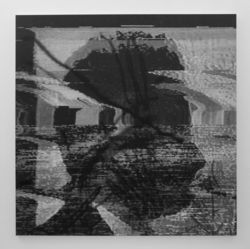
I can make out a bit of wide-striped collegiate tie, a white collar, and the padded shoulders of a suit jacket in the photograph. I know I’m being unfair, but I don’t trust his looks. Since Republicans have become so successful at branding themselves the party of white men, I now suspect that any white guy in a suit may harbor right-wing nationalist tendencies, much as the CIA’s rules governing drone strikes have determined that groups of “military age” men in certain regions of Pakistan and Yemen may be profiled as terrorists.
More here.
Monday, June 23, 2014
The Winners of the 3QD Arts & Literature Prize 2014


Mohsin Hamid has picked the three winners from the nine finalists:
- Top Quark, $500: Ali Eteraz, The Death of the Urdu Script
- Strange Quark, $200: Olga Tokarczuk, Everywhere and Nowhere
- Charm Quark, $100: Matthew Jakubowski, Honest work: an experimental review of an experimental translation
Here is what Mohsin had to say about them:
It was a great collection of pieces — a real pleasure to read during a hot summer week in Lahore. Here are the winners.
1. Ali Eteraz, “The Death of the Urdu Script” (Medium). Typography, a “murder” mystery, geopolitics, history, D.E.I.T.Y., Apple vs Microsoft vs Twitter, a third way between Arabization and the West, penmanship — this piece had it all. Succinctly far-ranging and wonderfully poignant, I hope it's widely read and helps save the script it champions.
2. Olga Tokarczuk, “Everywhere and Nowhere” (n + 1). For the traveler in each of us. A lovely flow, supple musings. Fabulous. “Fluidity, mobility, illusoriness–these are precisely the qualities that make us civilized. Barbarians don't travel. They simply go to destinations or conduct raids.”
3. Matthew Jakubowski, “Honest work: an experimental review of an experimental translation” (3:AM Magazine). A brief flickering of something that brings to mind “Pale Fire,” this text about a text about a text about a text is magical and wise. It shimmers.
Congratulations also from 3QD to the winners (remember, you must claim the money within one month from today–just send me an email). And feel free, in fact we encourage you, to leave your acceptance speech as a comment here! And thanks to everyone who participated. Many thanks also, of course, to Mohsin Hamid for doing the final judging.
The three prize logos at the top of this post were designed by Sughra Raza, me, and Carla Goller. I hope the winners will display them with pride on their own blogs!
Details about the prize here.
Perceptions
Catspeak
Sunday, June 22, 2014
Is Real Inclusiveness Possible?
Justin E. H. Smith in the New York Times:

It may be, however, that the full implications of the project of inclusiveness have not fully been grasped by the people promoting it. A dwindling number believe that it would be enough to simply change the make-up of philosophy departments without changing the content. Increasingly, these two projects are seen as connected: philosophy will not attract long-excluded groups of people if members of these groups do not see themselves — their traditions, standpoints, and idioms — represented in syllabi and in publications. But what would it mean to reconceive philosophy in order to adequately represent these?
Let us start by doing some math: not the number-crunching of human resources or admissions offices, but the mathematics of infinite series.
There is a formula for calculating the value of π that runs as follows:
1 – 1/3 + 1/5 – 1/7 + 1/9 – … = π/4.
This, to be precise, is an alternating series that converges toward a value of the ratio of the circle’s circumference to its diameter.
More here.
Chasing the Elusive Arrow of Time with Computer Algorithms
Michael Byrne in Motherboard:

As it is with really all of the mind's deepest intuitions, this directionality is not so easy. It's possible to imagine a wide variety of schemes involving information and information hiding that make time's arrow less clear. In fact, physics, at its smallest, deepest roots has really no interest in forward and backward; it could really go either way. Time, or the direction of time, arises as physics gets bigger and more complicated. Zoom way in, all the way in actually, and what you'll find is enviable oblivian: cause-effects, effect-causes, effect-effects, cause-causes. Something like that.
More here.
66 Facts You May Not Have Known About The English Language
Paul Anthony Jones in the Huffington Post:
1. In the 17th century, magpies were nicknamed pie-maggots.
2. The part of a wall between two windows is called the interfenestration.
3. If you were to write out every number name in full (one, two, three, four...), you wouldn't use a single letter B until you reached one billion.
4. The part of your back that you can't quite reach to scratch is called the acnestis.It's derived from the Greek word for “cheese-grater.”
5. A hecatompedon is a building measuring precisely 100ft × 100ft.
6. A growlery is a place you like to retire to when you're unwell or in a bad mood. It was coined by Charles Dickens in Bleak House (1853).
7. There was no word for the color orange in English until about 450 years ago.
8. The infinity sign, ∞, is called a lemniscate. Its name means “decorated with ribbons” in Latin.
9. A Dutch feast is one at which the host gets drunk before his hosts do.
10. Schoolmaster is an anagram of “the classroom.”
More here.
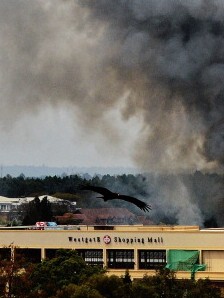
Why Obama’s $5 Billion Counterterrorism Fund Will Actually Support Terrorism
Alex de Wall in the Boston Review:
More here.
mike wallace with frank lloyd wright
Death and Burial of Poor Cock Robin
gerry goffin (1939-2014)
Happy are the Happy
Louise Jury in The Independent:

…Yet, somewhat surprisingly, the strictures of the structure do allow some emotions to flow. The Hutners appear to have the perfect life but it proves anything but. At the end, the widow's reaction to the sudden end of her loveless marriage is genuinely moving and believable. The title speaks of happiness but it is the sadnesses that prevail. Paola visits the marital home of her lover Luc, surveys the decor and immediately concludes he will never leave his wife. It is hard not to agree with Jeannette Blot that “women are attracted to appalling men”. “Happy are the happy” is the second half of a quote by Jorge Luis Borges with which the novel begins and reads, more fully: “Happy are the loved ones and the lovers and those who can do without love.” So the happinesses are small; the medical secretary's memory of a cigarette shared with the son of a patient; the lover biting his tongue when the woman he realises he genuinely cares for demonstrates a painful lack of self-knowledge; the husband who throws away his newspaper of racing tips to agree to a museum visit with the wife he has publicly shamed. Most significantly, perhaps, at the end, the pleasure of two friends fishing. Reza is the mistress of subtle detail.
More here.
war made into a poem: a remarkable Iraq memoir
Joanna Bourke in The Telegraph:
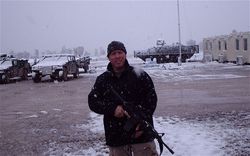
“Every morning the war gets up from sleep.
So I place it in a poem, make the poem into a boat, which I throw into the Tigris.
This is war, then.”
This extraordinary image of heavily armed soldiers reciting the exquisitely sensitive poetry of an Arab intellectual appears about a third of the way through Turner’s memoir of military service in Iraq, My Life as a Foreign Country. Turner doesn’t mention al-Azzawi by name, but he does cite parts of his poem. In an interview al-Azzawi gave last year, he recalled that his mother had not been impressed when he confessed that his ambition in life was to become a writer. “What is the real job of the Arab poets?” she scoffed. Surely it was “nothing but selling their praise poems full of lies, to this sheikh or that governor, to this vizier or that king”. The young al-Azzawi solemnly replied: “I promise you, I will not be like these people.” That is the reason a soldier like Turner reads his poems. Like al-Azzawi, Turner also refuses to write “praise poems full of lies”. His memoir is an uncompromising story of violence and beauty, searing trauma and a dreamlike circulation between the past and the present. There is no future.
More here.
Sunday Poem
Grief
When grief comes to you as a purple gorilla
you must count yourself lucky.
You must offer her what’s left
of your dinner, the book you were trying to finish
you must put aside
and make her a place to sit at the foot of your bed,
her eyes moving from the clock
to the television and back again.
I am not afraid. She has been here before
and now I can recognize her gait
as she approaches the house.
Some nights, when I know she’s coming,
I unlock the door, lie down on my back,
and count her steps
from the street to the porch.
Tonight she brings a pencil and a ream of paper,
tells me to write down
everyone I have ever known
and we separate them between the living and the dead
so she can pick each name at random.
I play her favorite Willie Nelson album
because she misses Texas
but I don’t ask why.
She hums a little,
the way my brother does when he gardens.
We sit for an hour
while she tells me how unreasonable I’ve been,
crying in the check-out line,
refusing to eat, refusing to shower,
all the smoking and all the drinking.
Eventually she puts one of her heavy
purple arms around me, leans
her head against mine,
and all of a sudden things are feeling romantic.
So I tell her,
things are feeling romantic.
She pulls another name, this time
from the dead
and turns to me in that way that parents do
so you feel embarrassed or ashamed of something.
Romantic? She says,
reading the name out loud, slowly
so I am aware of each syllable
wrapping around the bones like new muscle,
the sound of that person’s body
and how reckless it is,
how careless that his name is in one pile and not the other.
by Matthew Dickman
from American Poetry Review, 2008
Saturday, June 21, 2014
Guns made civil rights possible: Breaking down the myth of nonviolent change
Charles E. Cobb Jr. in Salon:
We who believe in freedom cannot rest until it comes.
—Ella Baker
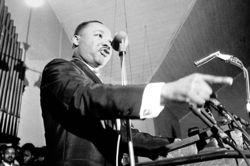
It has been a challenge to reconcile this fact with nonviolence, the chosen tactic of the southern civil rights movement of which I was a part. yet in some circumstances, as seen in the pages of this book, guns proved their usefulness in nonviolent struggle. That’s life, which is always about living within its contradictions. More than ever, an exploration of this contradiction is needed. The subjects of guns and of armed self-defense have never been more politicized or more hotly debated than they are today. Although it may seem peculiar for a book largely about armed self-defense, I hope these pages have pushed forward discussion of both the philosophy and the practicalities of nonviolence, particularly as it pertains to black history and struggle. The larger point, of course, is that nonviolence and armed resistance are part of the same cloth; both are thoroughly woven into the fabric of black life and struggle. And that struggle no more ended with the passage of the Civil Rights Acts of 1964 and 1965 than it began with the Montgomery bus boycott, Martin Luther king Jr., and the student sit-ins.
More here.
The Great War and the Remaking of Global Order 1916-1931
Mark Mazower in The Guardian:
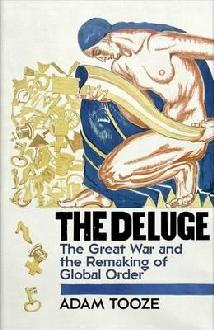
In the late 19th century, the world was dominated by imperial European great powers, happily carving up between them any available territories in Africa and Asia. The United States watched from the sidelines, a bit-player in international affairs, the energies of its politicians dedicated to overcoming the bitter internal legacy of the civil war. With a negligible navy and a tiny diplomatic service, it was scarcely a power of even the second rank, and, apart from the unfortunate inhabitants of Cuba and the Philippines, people around the world could live their entire lives in ignorance of the Stars and Stripes. Tooze shows, more emphatically than any other scholar I have read, how decisively and how sweepingly the first world war ended this state of affairs. In the midst of the war, financial and naval power in particular moved across the Atlantic never to return. In this situation, Woodrow Wilson did not seek merely to replace the British as the hegemon of a liberal trading order, as historians used to tell us. Rather, he wanted to move the international system as a whole beyond the practices of imperial great-power rivalry that he blamed for the war itself.
More here.
The Letters of Robert Frost: Volume 1, 1886-1920

In the early fall of 1912, a blandly handsome, tousle-headed American schoolteacher arrived in London. Nearing 40, coming without introduction or much of a plan — except, as he later confessed, “to write and be poor” — he was making a last attempt to write himself into poetry. It would have taken mad willfulness to drag his wife and four children out of their settled New Hampshire life in a quixotic assault on the London literary scene. Still, he was soon spending a candlelit evening with Yeats in the poet’s curtained rooms, having come to the attention of that “stormy petrel” Ezra Pound, who lauded him in reviews back home. Little more than two years later, the schoolteacher sailed back, having published his first two books, “A Boy’s Will” (1913) and “North of Boston” (1914). He had become Robert Frost.
The modernists remade American poetry in less than a decade, but like the Romantics they were less a group than a scatter of ill-favored and sometimes ill-tempered individuals. Frost was in most ways the odd man out: He despised free verse, had only a patchy education and wrote about country life. He knew the dark and sometimes terrible loneliness that descended upon stonewalled farms and meager villages. Looking back on his work, this throwback to Chaucer and Virgil plaintively asked one of his correspondents, “Doesnt [sic] the wonder grow that I have never written anything or as you say never published anything except about New England farms?” (“North of Boston” was originally titled “Farm Servants and Other People.”)
more here.
THE HISTORIES OF HERODOTUS, TRANSLATED BY TOM HOLLAND
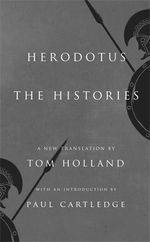
For centuries, men of letters and plenty of his fellow historians took great pleasure in reducing the prototypical chronicler, Herodotus of Halicarnassus, to the status of a mere wonder-monger, the garrulous and credulous counter-weight to the austere objectivity of his younger contemporary and immediate successor, Thucydides. In fact, it was a thinly veiled slight in Thucydides’s great work on the Peloponnesian War that got the tradition of Herodotus-bashing started; after that, a bitterly moralizing essay by Plutarch kept it going, it flourished in the Renaissance, and it persisted into modern times. Even fifty years ago, the great classicist Peter Green was gently mocking the standard reduction of “The Father of History”:
Here is Herodotus: a garrulous, credulous collector of sailors’ stories and Oriental novelle, ahistorical in method, factually inaccurate, superstitious and pietistic, politically innocent, his guiding motto cherchez la femme et n’oubliez pas le Dieu
more here.
World War I: The War That Changed Everything
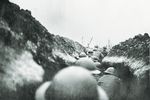
A hundred years ago next week, in the small Balkan city of Sarajevo, Serbian nationalists murdered the heir to the throne of Austria-Hungary and his wife. People were shocked but not particularly worried. Sadly, there had been many political assassinations in previous years—the king of Italy, two Spanish prime ministers, the Russian czar, President William McKinley. None had led to a major crisis. Yet just as a pebble can start a landslide, this killing set off a series of events that, in five weeks, led Europe into a general war.
The U.S. under President Woodrow Wilson intended to stay out of the conflict, which, in the eyes of many Americans, had nothing to do with them. But in 1917, German submarine attacks on U.S. shipping and attempts by the German government to encourage Mexico to invade the U.S. enraged public opinion, and Wilson sorrowfully asked Congress to declare war. American resources and manpower tipped the balance against the Central Powers of Germany and Austria-Hungary, and on Nov. 11, 1918, what everyone then called the Great War finally came to an end.
more here.