
Karen Simecek in Psyche:
 We rely on narratives because they help us understand the world. They make life more meaningful. According to Sartre, to turn the most banal series of events into an adventure, you simply ‘begin to recount it’. However, telling a story is not just a powerful creative act. Some philosophers think that narratives are fundamental to our experiences. Alasdair MacIntyre believes we can understand our actions and those of others only as part of a narrative life. And Peter Goldie argues that our very lives ‘have narrative structure’ – it is only by grappling with this structure that we can understand our emotions and those of others. This suggests that narratives play central, possibly fundamental, roles in our lives. But as Sartre warns in Nausea: ‘everything changes when you tell about life.’
In some cases, narratives can hold us back by limiting our thinking. In other cases, they may diminish our ability to live freely. They also give us the illusion that the world is ordered, logical, and difficult to change, reducing the real complexity of life. They can even become dangerous when they persuade us of a false and harmful world view. Perhaps we shouldn’t be too eager to live our lives as if we were ‘telling a story’. The question is: what other options do we have?
More here.
Enjoying the content on 3QD? Help keep us going by donating now.
 O
O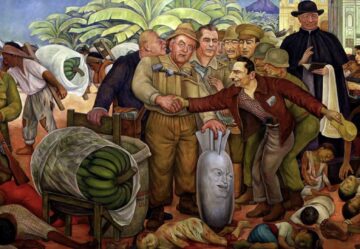 When people point to the US-influenced historical causes underlying emigration from Central America, Guatemala is one of the case studies. It’s also an example of the “
 Pico Iyer seems to have spent his life in motion, shuttling between homes in Japan and the United States, not to mention journeys to Ethiopia, Tibet, Cuba and beyond. But there’s one place he’s gone to seek out stillness ever since he was young: the Santa Barbara Vedanta Temple. Perched in the hills above his childhood home, the temple offers sweeping views of the bucolic California town and the ocean shimmering in the distance, and it provided Iyer with an early sense of refuge, he said.
 I remember the moment
 OpenAI
 ‘R
‘R During the 1950s and ’60s, Norman Holmes Pearson was one of Yale’s most successful and beloved professors. On the first day of each term, he would crab-walk to the front of the class, his misshapen body—the result of a childhood fall—on full display. Former students often remarked that the uneasy silence of that first day gave way to a dramatic crescendo of applause following Pearson’s lectures. One such student, journalist Thomas Wolfe, called Pearson “the most superbly theatrical teacher I have ever seen.”
 Flu is a disease caused by a family of related influenza viruses. Pandemic flu is always caused by the influenza A virus. Influenza A has two surface antigen proteins, hemagglutinin (18 flavors) and neuraminidase (11 flavors). A particular flu strain is named after which flavors of these two proteins it has – for example, H3N2, or H5N1.
 Shortly after the recent election, the New York Times reported the results of
  Let me sum all this up because it’s too much information to process: What o3 just did is leap into uncharted territory. OpenAI
  There are three rules for avoiding a cinematic flop. Rule one: don’t pick a title that is boring, misleading or hard to pronounce. The title wasn’t the only thing that was bad about the misfiring romantic drama Gigli (2003), starring Jennifer Lopez and Ben Affleck, but the fact that cinemagoers weren’t sure if they should be asking for ‘two tickets to Giggly’ didn’t help. Synecdoche, New York (2008) and The Hudsucker Proxy (1994) had more people reaching for their dictionaries than their wallets. But what about a title that has nothing whatsoever to do with the story?
 P
P