
by Brooks Riley
Category: Recommended Reading
Sunday, March 23, 2014
Matt Power: Headlamp a Must
Donovan Hohn in Harper's:
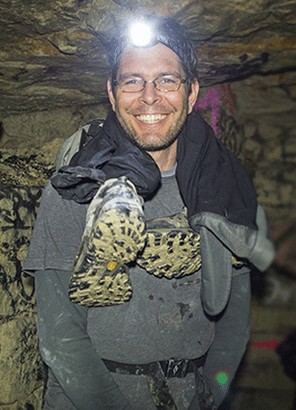
If you had Matt power, you could take up with a bunch of squatters in a derelict building in the South Bronx, as Matt did the year after we met. For some reason, I’ve always pictured him camped out on the building’s roof, hanging his flannel underwear out to dry on a telephone wire, perhaps, or roasting a pigeon on a spit.
For all of his brainy bookishness and street smarts, Matt in the spring of 1998 was a greenhorn. We all were, but there was an innocence about him, some portion of which he never lost. I was only two years older, twenty-six to his twenty-four, which at the time seemed like a big difference and now seems like nothing.
More here.
Virtual Gaming Worlds Are Revealing the Nature of Human Hierarchies
From MIT Technology Review:
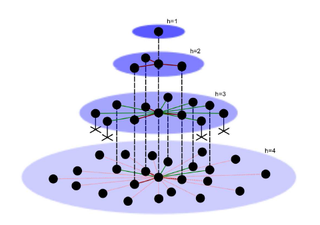
But exactly what kinds of structures form and to what extent these groupings depend on the environment is still the subject of much debate. So an interesting question is whether humans form the same kinds of structures in online worlds as they do in real life.
Today, we get an answer thanks to the work of Benedikt Fuchs at the Medical University of Vienna in Austria and a couple of pals. These guys have studied the groups humans form when playing a massive multiplayer online game called Pardus.
Their conclusion is that humans naturally form into a fractal-like hierarchy in which people belong to a variety of groups on different scales. In fact, the formation of hierarchies seems to be an innate part of the human condition.
More here.
The digital humanities
Mark O'Connell in The New Yorker:
Occasionally, I would be cc’ed on an e-mail asking everyone in the building to provide brief outlines of our research projects so that they could be included in promotional materials for the Long Room Hub, but I consistently managed, without consequence, to avoid answering these. (A lot of the other postgraduate and postdoctoral researchers were working on forbiddingly technical-sounding projects involving things like the “systematic evaluation of archeological digital epistemology” and “digital genetic dossiers.” I was basically just trying to think of clever things to say about the work of John Banville.) When I mentioned to fellow literary academic types where I happened to work—or work from—they tended to suspect that this work of mine had something to do with the digital humanities, and to ask me what the mysterious business was supposed to be about. To this, I usually replied that I wasn’t totally sure, but that I thought it had something to do with using computers to read books. As far as I could tell, there was a general skepticism about the digital humanities, combined with a certain measure of unease—arising, perhaps, from the vague aura of utility, even of outrightscience, emanating from the discipline, and the sense that this aura was attracting funding that might otherwise have gone to more low-tech humanities projects.
Having read “Uncharted: Big Data as a Lens on Human Culture,” a new book by the scientists Erez Aiden and Jean-Baptiste Michel, I am now experiencing a minor uptick in my understanding of this discipline.
More here.
404: Identity Not Found
Daniel E. Pritchard in The Critical Flame:
Cancer came as a highly unpleasant surprise […] but psychologically it just confirmed my sense of my body as frail and vulnerable at best, or set on betraying me yet again at worst. I’ve never really identified with my body, have always seen it as distinct and separate from, even in opposition to, my “self.” It has felt more like a burden than anything else. Perhaps all these illnesses are my body’s revenge, its way of reminding me that I am it and it is mine, that it is me. What, after all, would I be without a body, however frail and ailing?
A few weeks later, the poet Linh Dinh juxtaposed this confession with Kenneth Goldmsith’s conceptualist assertion that “Now is the time of possibility we can be everyone and no one at all.” A person in pain, Dinh argued, could not possibly assent to the idea of an ultimately mutable self. Neither technology nor any poetic practice could actually disperse the stability at the center of lived experience. As Franz Kafka wrote, “people are sewn into their skins for life and cannot alter any of the seams.”
Displaying a typical largesse of intellect, Shepherd acknowledged in his response that “the most decentered self still has boundaries,” but wrote that “it is exactly the fact that I have other identities besides ‘a person with HIV’ or ‘a person with cancer’ that enable me to make it through my physical trials and travails.” The lack of stable identity was as a series of possibilities to be explored rather than a conflict to be resolved. Unfortunately, his illness placed boundaries before Shepherd that could not be overcome. By September of that year, he was gone.
More here.
Louisiana French, Cajun, and Zydeco music
old time cajun music
sad steps
Devotion and Defiance
Pamela Constable in The Washington Post:
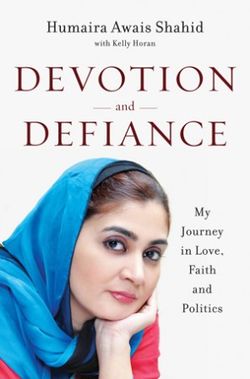
First came an appeal to the newspaper’s hotline from a poor man whose daughter had been raped. Shahid, rushing to assist, was coldly rebuffed by village elders who decreed that the victim must marry her rapist. It was a typical verdict in Pakistan’s tribal justice system, where such crimes are viewed through a prism of family honor and community peace, and where the state organs of law and justice rarely interfere. “You from the city need to understand some basic facts about village life,” one elder explained. “If we don’t marry her to the man who assaulted her . . . she will elope with another. That will bring more shame on the community and could incite a bloodbath.” Shahid withdrew in defeat, while the victim sobbed hopelessly in a dark hut. From this incident the author plunges into an account of her furious, often frustrated campaign for women’s rights in a conservative, patriarchal society of 180 million — and “Devotion and Defiance” becomes a book worth reading.
More here.
How to explode brain-cancer cells
From KurzweilAI:
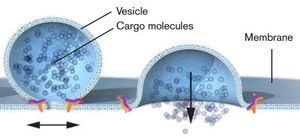
The researchers transplanted human glioblastoma cells into mice and fed them Vacquinol-1 for five days. The average survival was about 30 days for the control group that did not receive the substance. Of those who received the substance, six of eight mice were still alive after 80 days. The study was then considered of such interest that the journal Cell wanted to publish the article immediately, said Ernfors. The researchers found that Vacquinol-1 gave the cancer cells uncontrolled vacuolization, a process in which the cell carries substances from outside the cell into its interior. This carrying process is accomplished via vacuoles, a type of vesicle. The 2013 Nobel Prize in physiology or medicine was awarded for the discovery of how cellular vesicles move things in cells. When cancer cells were filled with a large amount of vacuoles, the outer wall of the cell collapsed and the cell simply exploded and died.
More here.
Sunday Poem
Cockspur Bush
I am lived. I am died.
I was two-leafed three times, and grazed,
but then I was stemmed and multiplied,
sharp-thorned and caned, nested and raised,
earth-salt by sun-sugar. I was innerly sung
by thrushes who need fear no eyed skin thing.
Finched, ant-run, flowered, I am given the years
in now fewer berries, now more of sling
out over directions of luscious dung.
Of water crankshaft, of gases the gears
my shape is cattle-pruned to a crown spread sprung
above the starve-gut instinct to make prairies
of everywhere. My thorns are stuck with caries
of mice and rank lizards by the butcher bird.
Inches in, baby seed-screamers get supplied.
I am lived and died in, vine woven, multiplied.
.

by Les Murray
.
.
.
.
Saturday, March 22, 2014
Scientia Salon: A manifesto for 21st century intellectualism
Massimo Pigliucci at his new site Scientia Salon:
While I have been thinking for years about a venture like Scientia Salon, and have indeed slowly ratcheted up my involvement in public discourse, first as a scientist and more recently as a philosopher, the final kick in the butt was given to me by my City University of New York (Brooklyn College) colleague Corey Robin. I have never (yet) met Corey, but not long ago I happened across his book, The Reactionary Mind [9], which I found immensely more insightful than much of what has been written of late about why conservatives think the way they do.
More recently, though, I read his short essay in Al Jazeera America, entitled “The responsibility of adjunct intellectuals” [10] and it neatly crystallized a lot of my own unease. Corey points out that academics have always loved to write for other academics using impenetrable jargon (his example of choice is Immanuel Kant), while other thinkers have forever complained about it. He quotes Thomas Hobbes, for instance, as saying that the academic writing of his time was “nothing else … but insignificant trains of strange and barbarous words.”
And yet, observes Robin, we live in an unprecedented era where more and more academics engage openly and vigorously with the public. This, of course, has been made possible by the technologies of the information age, and especially by social networking platforms like blogs, Twitter, Facebook, Google+ and the like.
More here.
a moving debut of life after Chernobyl
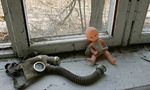
Towards the end of Darragh McKeon's powerful and moving account of the Chernobyl disaster, two old dissidents are discussing the past. The younger, a former journalist named Maria, wants to know if her elderly acquaintance would have “put up some kind of resistance” if he could “have those years back”, to which he replies: “There was no resistance. Resist what? There were no rights or wrongs, no grey areas, there was just the system. I did all I could do, I survived.” The man – mischievously named Leibniz, after that most optimistic of philosophers – had survived 10 years in the gulag camps; now he earns a living by teaching piano to children. One of them is Maria's troubled nephew, Yevgeni, a child “genius” who, shamed by his poverty and bullied daily by his classmates, takes to the streets during a spontaneous demonstration. It's a scene that brilliantly captures the random fury that breaks out among the oppressed; ironically, this one night of violent catharsis allows him to find his true direction, a path that will lead to international stardom as a concert pianist. That fury will remain with him, the bright, fierce ember of another kind of resistance, in his music and in his soul.
more here.
ON THE INIMITABLE LYDIA DAVIS

Among other things, Lydia Davis is a keen observer of her own mind. Terse sentences delineate some of the most intimate and urgent experiences of inner life, while characters seem to stand for isolated aspects of the self in duress as it tries to put into words the unintelligible stuff of human behavior and emotion. To assemble these voices into a portrait of the author, however, would be to miss the point of Davis’ obsessive logic. Less a collection of individual stories than a precisely crafted architecture, each story leads into the next like rooms in a dream where hidden stairways and secret chambers feel eerily familiar. Whereas Break It Down explores the shock dealt to the mind in the wake of lost love, Almost No Memory converges around our tenuous connection to our past.
“Foucault and Pencil” describes in truncated prose a scene in which the narrator is reading Foucault as she waits to talk to what is presumably a therapist or marriage counselor. The argument she has had with her husband or lover entwines in her mind with an account of the difficulties she experiences in trying to understand the French text:
Short sentences easier to understand than long ones. Certain long ones understandable part by part, but so long, forgot beginning before reaching end. Went back to beginning, understood beginning, read on, and again forgot beginning before reaching end. Read on without going back and without understanding, without remembering, and without learning, pencil idle in hand.
more here.
a frank look at Cesar Chavez
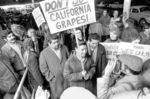
Those intent on hero worship will detest Miriam Pawel's honest, exhaustively researched biography of Cesar Chavez, the charismatic leader and founder of the United Farm Workers who famously led strikes and boycotts to improve the lot of grape pickers in the 1960s. “The Crusades of Cesar Chavez” is a biography for readers who find real human beings more compelling than icons and history more relevant than fantasy.
Chavez's accomplishments, extensively detailed by Pawel, a former Los Angeles Times writer and editor who also wrote “The Union of their Dreams,” a well-received book on the UFW, are stunning. He started a movement by organizing some of the nation's poorest workers and confronting some of the richest and most powerful bosses in California. He could inspire people to give up everything else in their lives to fight for social change. In a country generally sympathetic to capitalists, Chavez made conditions in the fields a matter of nationwide outrage.
As the farmworker movement grew, it became a serious political force, feared by growers and cultivated by politicians.
more here.
Saturday Poem
Uncle Dog : The Poet At 9
I did not want to be old Mr.
Garbage man, but uncle dog
who rode sitting beside him.
Uncle dog had always looked
to me to be truck-strong
wise-eyed, a cur-like Ford
Of a dog. I did not want
to be Mr. Garbage man because
all he had was cans to do.
Uncle dog sat there me-beside-him
emptying nothing. Barely even
looking from garbage side to side:
Like rich people in the backseats
of chauffeur-cars, only shaggy
in an unwagging tall-scrawny way.
Uncle dog belonged any just where
he sat, but old Mr. Garbage man
had to stop at every single can.
I thought. I did not want to be Mr.
Everybody calls them that first.
A dog is said, Dog! Or by name.
I would rather be called Rover
than Mr. And sit like a tough
smart mongrel beside a garbage man.
Uncle dog always went to places
unconcerned, without no hurry.
Independent like some leashless
Toot. Honorable among scavenger
can-picking dogs. And with a bitch
at every other can. And meat:
His for the barking. Oh, I wanted
to be uncle dog—sharp, high fox-
eared, cur-Ford truck-faced
With his pick of the bones.
A doing, truckman’s dog
and not a simple child-dog
Nor friend to man, but an uncle
traveling, and to himself—
and a bitch at every second can.
.
by Robert Sward
Tony Benn: Dare to be a Daniel
Peter Wilby in The Guardian:
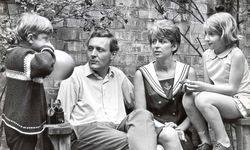
…He drifted away from religion but not from Christian principles. In his memoir, he wrote: “I certainly was not influenced by atheistic arguments, which were extreme and threw doubt on the value of the Bible and the historical truth of Jesus's life.” He specifically rejected the label “humanist”, saying in 2005 “I'm a Christian agnostic … I believe in Jesus the prophet, not Christ the king.” He objected to how the established churches used power structures to build their own authority and particularly to the doctrine of original sin, which was “destructive of any hope that we might succeed together in building a better world”. On the walls of his office, he hung a Salvation Army hymn that had been sung to him by his parents:
Standing by a purpose true,
Heeding God's command,
Honour them, the faithful few!
All hail to Daniel's band!
Dare to be a Daniel,
Dare to stand alone!
Dare to have a purpose firm!
Dare to make it known.
Dare to be a Daniel was the title chosen by Benn for his early life memoir. According to the Biblical story, Daniel braved and survived a night in a den of lions rather than renounce his faith. This sense that one must remain true to one's faith and bear witness whatever the odds is the key to understanding Benn's political career, its failures as well as its successes. The lesson he took from his upbringing – and particularly from his father, whom he adored and admired – was that he must always do and say what was right, regardless of whether or not it left him alone in the world. David Runciman's argument, in his book Political Hypocrisy, that “liberal democratic politics are only sustainable if mixed with a certain amount of dissimulation and pretence” would have been incomprehensible to Benn.
More here.
The Cutting Edge
Victoria Sweet in The New York Times:
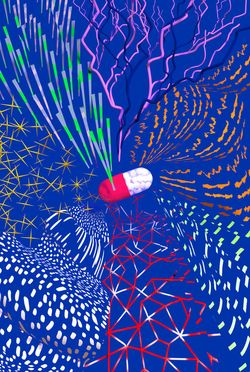
In “Extreme Medicine,” Kevin Fong, an honorary lecturer in physiology at University College London who has worked with NASA and trained in anesthesiology and intensive care medicine, surveys how far medicine has come in the treatment of hypothermia, severe burns, heart disease, lung disease, complex trauma care, viral epidemics. This “is a book about life: its fragility, its fractal beauty and its resilience,” he writes. “It is about a century during which our expectations of life transformed beyond all recognition, when we took what was routinely fatal and made it survivable . . . this exploration of the human body was no less extreme than our forays in the physical world.” In fact, his premise is that the cause of this transformation in medicine was exploration.
More here.
Alan Lightman on the theory of everything, technology as mediator of human experience, and empathizing with the religious impulse
Trevor Quirk at Harper's:
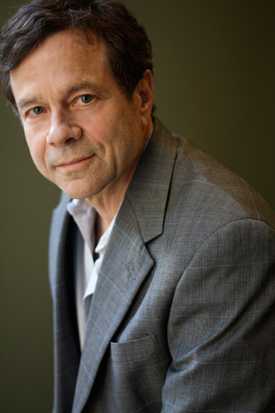
1. I suppose my first question has to concern the assembly of this collection. Did you write these essays in thematic isolation at first? Did you have any notion of employing the Universe as their organizing agent?
I wrote “The Accidental Universe” and “The Spiritual Universe” first, both concerning areas of thought that had been under my skin and disturbing me for some years. I published the first in Harper’s and the second in Salon. At that point, it occurred to me to write a series of connected essays, all with “Universe” in the title, that explored the philosophical, moral, and theological issues raised by modern science.
More here.