
More from Wired here.
Category: Recommended Reading
2014 Pulitzer Prize Winners in Journalism, Letters, Drama and Music
From the New York Times:
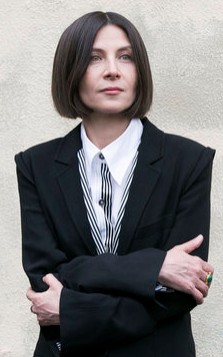
DONNA TARTT
“The Goldfinch” (Little, Brown)
Ms. Tartt’s best-selling novel is about a boy who comes into possession of a painting after an explosion at a museum.
In a phone conversation on Monday, Ms. Tartt, 50, said the novel “was always about a child who had stolen a painting,” but it was only two years into writing the book that she saw “The Goldfinch,” a 17th-century work by Carel Fabritius.
“It fit into the plot of the book I was writing in ways I couldn’t have imagined,” she said. “It had to be a small painting that a child could carry, and that a child could be obsessed by.”
Finalists Philipp Meyer, “The Son”; Bob Shacochis, “The Woman Who Lost Her Soul.”
More here.
Why Nobody Can Tell Whether the World’s Biggest Quantum Computer is a Quantum Computer

Leo Mirani and Gideon Lichfield in Quartz (via Jennifer Ouellette, D-Wave Systems photo):
For the past several years, a Canadian company called D-Wave Systems has been selling what it says is the largest quantum computer ever built. D-Wave’s clients include Lockheed Martin, NASA, the US National Security Agency, and Google, each of which paid somewhere between $10 million and $15 million for the thing. As a result, D-Wave has won itself millions in funding and vast amounts of press coverage—including, two months ago, the cover of Time (paywall).
These machines are of little use to consumers. They are delicate, easily disturbed, require cooling to just above absolute zero, and are ruinously expensive. But the implications are enormous for heavy number-crunching. In theory, banks could use quantum computers to calculate risk faster than their competitors, giving them an edge in the markets. Tech companies could use them to figure out if their code is bug-free. Spies could use them to crack cryptographic codes, which requires crunching through massive calculations. A fully-fledged version of such a machine could theoretically tear through calculations that the most powerful mainframes would take eons to complete.
The only problem is that scientists have been arguing for years about whether D-Wave’s device is really a quantum computer or not. (D-Wave canceled a scheduled interview and did not reschedule.) And while at some level this doesn’t matter—as far as we know, D-Wave’s clients haven’t asked for their money back—it’s an issue of importance to scientists, to hopeful manufacturers of similar machines, and to anyone curious about the ultimate limits of humankind’s ability to build artificial brains.
More here.
russia and the history of ‘eurasianism’

There is thus a lively debate in Russia itself on the country’s orientation. The question is, where does the leadership stand in this debate? The answer is difficult, because not only has Russia become more autocratic under Putin, but the circle of real decision-makers has become ever smaller. According to some accounts, it may consist of no more than five people. But, reviewing the period since 2000, when Putin assumed power, it is plausible that it began with a continuation of a commitment to democracy and a market economy, associated with a growing resentment at lack of consideration on the part of the West to certain deep Russian concerns – NATO enlargement, treatment as a poor supplicant, disregard for what are seen as legitimate interests in the neighbourhood etc. Angela Stent cites a senior German official complaining of an “empathy deficit disorder” in Washington in dealing with Russia. The pathology that this caused became progressively more virulent in the intervening years, culminating in 2003 in the invasion of Iraq without any Security Council mandate, indeed, in open defiance of the UN. After this, the New York Times magazine’s Ron Suskind reported on a visit to the Bush White House in 2004 in the course of which he recounts that “an aide” (commonly supposed to be Karl Rove) “said that guys like me were ‘in what we call the reality-based community’, which he defined as people who ‘believe that solutions emerge from your judicious study of discernible reality’… ‘That’s not the way the world really works any more’, he continued. ‘We’re an empire now, and when we act, we create our own reality. And while you’re studying that reality – judiciously, as you will – we’ll act again, creating other new realities, which you can study too, and that’s how things will sort out. We’re history’s actors … and you, all of you, will be left to just study what we do.’”
more here.
The Guggenheim’s Futurism exhibition
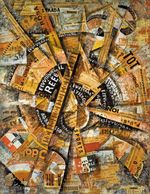
For years I’ve been hearing it said that young artists think art began with Andy Warhol. It’s never been true. But now what I hear is art historians complaining that none of their students want to study anything but contemporary art. Among young art historians, it seems, to delve as far back as the 1960s is to be considered an antiquarian. “They only take my courses because they think they need some ‘background,’” one Renaissance specialist told me. “We have to accept almost anyone who applies saying that they want to study anything before the present, just to give our current faculty something to do.” What a time, when the art historians have less historical consciousness than the artists—and no wonder that the former, these days, show so little interest in what the latter actually do.
When I was a grad student (in a different field), the budding art historians I knew were studying medieval, they were studying mannerism, they were studying the Maya. No one thought of studying living artists. The most adventurous ones might be investigating Italian Futurism. Now the Futurists seem as distant as the Maya. But might this be their own fault?
more here.
The Mental Life of Plants and Worms
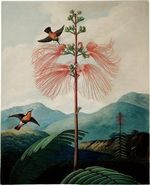
We all distinguish between plants and animals. We understand that plants, in general, are immobile, rooted in the ground; they spread their green leaves to the heavens and feed on sunlight and soil. We understand that animals, in contrast, are mobile, moving from place to place, foraging or hunting for food; they have easily recognized behaviors of various sorts. Plants and animals have evolved along two profoundly different paths (fungi have yet another), and they are wholly different in their forms and modes of life.
And yet, Darwin insisted, they were closer than one might think. He wrote a series of botanical books, culminating in The Power of Movement in Plants (1880), just before his book on earthworms. He thought the powers of movement, and especially of detecting and catching prey, in the insectivorous plants so remarkable that, in a letter to the botanist Asa Gray, he referred to Drosera, the sundew, only half-jokingly as not only a wonderful plant but “a most sagacious animal.”
Darwin was reinforced in this notion by the demonstration that insect-eating plants made use of electrical currents to move, just as animals did—that there was “plant electricity” as well as “animal electricity.”
more here.
Samuel Beckett’s lost work
Tim Martin in The Guardian:

At home, however, his problems were far from over. It soon became clear that Dream of Fair to Middling Women, the madcap, erudite, Joycean book he had written at speed in Paris earlier that year, was not going to be the success he imagined. During a miserable spell in London, feeling “depressed, the way a slug-ridden cabbage might expect to be”, he shopped the manuscript around to several publishers: Chatto & Windus, the Hogarth Press, Jonathan Cape and Grayson & Grayson. The letter he wrote later to a friend summarised the results of the trip. “Shatton and Windup thought it was wonderful but they simply could not. The Hogarth Private Lunatic Asylum rejected it the way Punch would. Cape was écoeuré [disgusted] in pipe and cardigan and his Aberdeen terrier agreed with him. Grayson has lost it or cleaned himself with it.” Back in Dublin, wearily recognising that Dream might be unpublishable (it appeared posthumously in 1992), Beckett devoted his remaining energy to compiling a volume of short stories. Like his novel, these covered episodes in the life of Belacqua Shuah, a Dublin student who shared the author’s obsession with Dante and Augustine as well as his hang-ups about sex.
More here.
Sperm RNA carries marks of trauma
Virginia Hughes in Nature:

Trauma’s impact comes partly from social factors, such as its influence on how parents interact with their children. But stress also leaves ‘epigenetic marks’ — chemical changes that affect how DNA is expressed without altering its sequence. A study published this week in Nature Neuroscience finds that stress in early life alters the production of small RNAs, called microRNAs, in the sperm of mice (K. Gapp et al. Nature Neurosci. http://dx.doi.org/10.1038/nn.3695; 2014). The mice show depressive behaviours that persist in their progeny, which also show glitches in metabolism. The study is notable for showing that sperm responds to the environment, says Stephen Krawetz, a geneticist at Wayne State University School of Medicine in Detroit, Michigan, who studies microRNAs in human sperm. (He was not involved in the latest study.) “Dad is having a much larger role in the whole process, rather than just delivering his genome and being done with it,” he says. He adds that this is one of a growing number of studies to show that subtle changes in sperm microRNAs “set the stage for a huge plethora of other effects”.
More here.
Tuesday Poem
.
I remember your square jaw
father
Strong and viselike
Your grip
Of my hand father
That wouldn’t let go
I remember you at the bottom of the stairs
father
Telling me
We had to go son
now
I remember the hat
The small brim
With its feather
father
You always wore
As if leaving without it
Was like being naked in the sun
I remember you standing
father
Behind the old glass counter
With its huge crack
weight upon your right foot
father
I remember that subtle smile
father
Showing only a portion
Of the false teeth
You despised
I remember you father asking me
father
With your worried look father
Why I liked that girl
With the dark skin
I never knew father
What you father
were thinking
.
by Bill Schneberger
.
.
Monday, April 14, 2014
perceptions
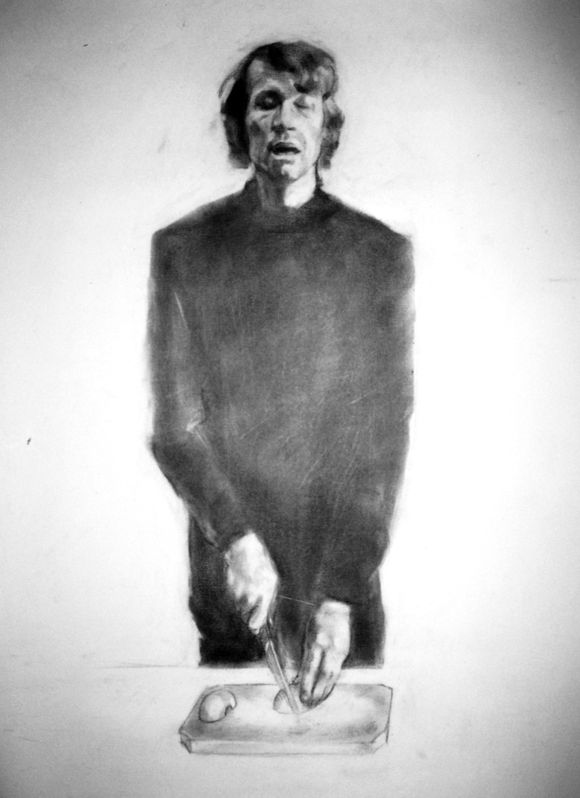
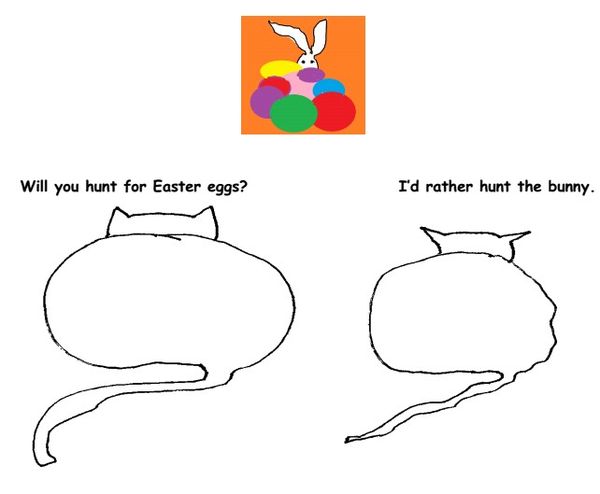
CATSPEAK
by Brooks Riley
Sunday, April 13, 2014
Welcome to the Jungle
Steven Malanga in City Journal:

Chagnon later learned that the men were edgy because raiders from a neighboring settlement had abducted seven of their women the day before. The next morning, the villagers counterattacked and recovered five of the women in a brutal club fight. As Chagnon recounts in Noble Savages: My Life Among Two Dangerous Tribes—The Yanomamo and the Anthropologists (originally published in 2013 and now appearing in paperback), he spent weeks puzzling over what he had seen. His anthropology education had taught him that kinsmen—the raiders were related to those they’d attacked—were generally nice to one another. Further, he had learned in classrooms that primitive peoples rarely fought one another, because they lived a subsistence lifestyle in which there was no surplus wealth to squabble about. What other reason could humans have for being at one another’s throats?
More here.
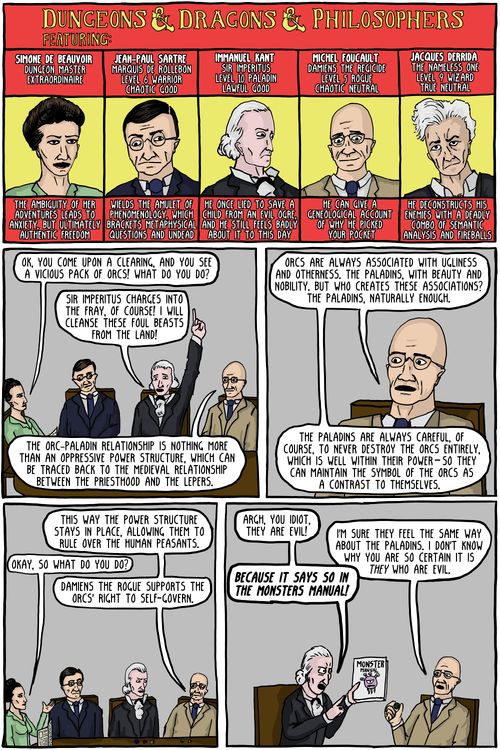
Dungeons and Dragons and Philosophers
Over at Existential Comics:
Five Ways of Looking at Steve Reich

David Meir Grossman in Tablet (Steve Reich, 2005. (Photo treatment Tablet Magazine; original photo Jeffrey Herman):
1. “You’re floating 10 feet off the Earth. Try to put your feet on the ground and ask the next question.” It’s Wednesday, March 26, and Steve Reich is haranguing me for my sucky interviewing skills. We’re talking over the phone because it’s two days before the Big Ears Festival, in Knoxville, Tenn., which Reich is headlining. That he’s less than pleased with my interviewing ability is in fact only making me more nervous, because Reich is a legitimate genius who has changed the shape of his chosen field. The New York Times called him “our greatest living composer,” and The New Yorker has said he’s “the most original musical thinker of our time.” So, if he says I’m blowing this, he’s probably right.
Reich is impatient, a quality that surely comes from having a mind that works 10 times faster than everyone else’s, most definitely including mine. At one point in our conversation I try to suggest that “WTC 9/11,” his disturbing 15-minute meditation on Sept. 11 that came out in 2011, reminds me of the Internet. The piece, written for the Kronos Quartet, uses one of Reich’s several trademark techniques, that of vocal sampling. Unlike other Sept. 11-related pieces, “WTC” does not offer redemption. Reich bumps the pre-recorded voices—friends, air-traffic controllers, first responders, cantors—shoulder-to-shoulder and cuts off the words mid-sentence, only to complete them later. It’s a tension-filling technique and can call to mind the way conversations take place over the Internet. Reich sees where I’m going with this and pointedly cuts me off. “I don’t follow chats, I don’t find it very interesting to do that. What I was doing on ‘WTC’ had nothing to do with the Internet whatsoever, OK?”
More here.
Wherever You Live, it is Probably Egypt: Thoughts on Passover

Corey Robin in Crooked Timber (image from Wikimedia Commons):
The first night of Passover is on Monday, and I’ve been thinking about and preparing for the Seder. I had a mini-victory this morning, when I was shopping for fish in Crown Heights. The guy at the fish store told me that thanks to the Polar Vortex, 90% of Lake Huron is frozen. Which means no whitefish. Which means no gefilte fish. So I put on my best impression of Charlotte in Sex and the City —”I said lean!”—and managed, through a combination of moxie and charm, to get him to give me the last three pounds of whitefish and pike in Crown Heights. Plus a pound of carp. Which means…gefilte fish!
Food is the easy part of the seder. The hard part is making it all mean something. When I was a union organizer, I used to go to freedom seders. Being part of the labor movement, I found it was easy to to see points of connection between what I was doing and this ancient story of bondage, struggle, and emancipation (a story, however, that we never seem to really tell at Passover).
Then, as my feelings about Zionism became more critical, I found a new point of connection to Passover: using the Seder, and the Exodus story, as a moment to reflect upon the relationship between the Jews, the land of Israel, and possession of that land, to ask why we think of emancipation in terms of possession. For a while there, we’d hold seders with readings fromMichael Walzer’s Exodus and Revolution and Edward Said’s brilliant critique of Walzer inGranta: “Michael Walzer’s Exodus and Revolution: A Canaanite Reading.”
But nowadays, the Seder is harder for me. I’m more puzzled by the meaning of slavery and emancipation; I find it more difficult to make the connections I used to make. The Haggadah seems stranger, more remote, than ever.
More here.
Parental Involvement Is Overrated
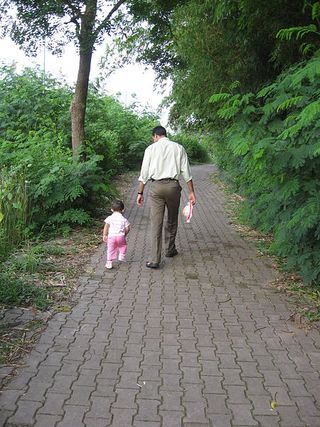
Keith Robinson and Angel Harris in the NYT (image from Wikimedia Commons):
Over the past few years, we conducted an extensive study of whether the depth of parental engagement in children’s academic lives improved their test scores and grades. We pursued this question because we noticed that while policy makers were convinced that parental involvement positively affected children’s schooling outcomes, academic studies were much more inconclusive.
Despite this, increasing parental involvement has been one of the focal points of both President George W. Bush’s No Child Left Behind Act and President Obama’s Race to the Top. Both programs promote parental engagement as one remedy for persistent socioeconomic and racial achievement gaps.
We analyzed longitudinal surveys of American families that spanned three decades (from the 1980s to the 2000s) and obtained demographic information on race and ethnicity, socioeconomic status, the academic outcomes of children in elementary, middle and high school, as well as information about the level of parental engagement in 63 different forms.
What did we find? One group of parents, including blacks and Hispanics, as well as some Asians (like Cambodians, Vietnamese and Pacific Islanders), appeared quite similar to a second group, made up of white parents and other Asians (like Chinese, Koreans and Indians) in the frequency of their involvement. A common reason given for why the children of the first group performed worse academically on average was that their parents did not value education to the same extent. But our research shows that these parents tried to help their children in school just as much as the parents in the second group.
Even the notion that kids do better in school when their parents are involved does not stack up.
More here.
The Real Darwin Fish
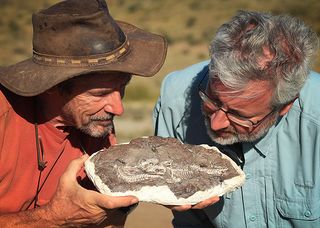
Chris Mooney in Slate (photo via PBS):
We all know the Darwin fish, the car-bumper send-up of the Christian ichthys symbol, or Jesus fish. Unlike the Christian symbol, the Darwin fish has, you know, legs.
But the Darwin fish isn't merely a clever joke; in effect, it contains a testable scientific prediction. If evolution is true, and if life on Earth originated in water, then there must have once been fish species possessing primitive limbs, which enabled them to spend some part of their lives on land. And these species, in turn, must be the ancestors of four-limbed, land-living vertebrates like us.
Sure enough, in 2004, scientists found one of those transitional species: Tiktaalik roseae, a 375-million-year-old Devonian period specimen discovered in the Canadian Arctic by paleontologist Neil Shubin and his colleagues. Tiktaalik, explains Shubin on the latest episode of the Inquiring Minds podcast, is an “anatomical mix between fish and a land-living animal.”
“It has a neck,” says Shubin, a professor at the University of Chicago. “No fish has a neck. And you know what? When you look inside the fin, and you take off those fin rays, you find an upper arm bone, a forearm, and a wrist.” Tiktaalik, Shubin has observed, was a fish capable of doing a push-up. It had both lungs and gills. In sum, it's quite the transitional form.
More here.