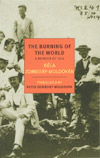
The Burning of the World: A Memoir of 1914

PI_GOLBE_BURNING_SR_002Stefany Anne Golberg at The Smart Set:

The Burning of the World: A Memoir of 1914 is a document of one man’s attempt to repaint his broken landscape. It is remarkable how quickly his world was lost. In hindsight, we think of the First World War as a four-year affair. We forget, though, that Austria-Hungary lost half of its men within the first two weeks of the war — 400,000 men, including 100,000 who were taken prisoner by the Russians. At the war’s start, the grand Austro-Hungarian soldier, with his long ridiculous sword, was often killed or maimed within days of reaching the battlefield. The injured and insane were sent home to wander their cities like ghosts, to parade before the horrified eyes of their neighbors. And the war kept going on.

The Burning of the World covers only the first eight months of the war, but carries a lifetime of experience. When the book opens, Hungarian painter Béla Zombory-Moldován is enjoying a summer holiday with friends at resort on the Adriatic. By the second page, war has started and Zombory-Moldován must report for duty. Before he sees any action, Zombory-Moldován finds himself in the abandoned, burned-out town of Rava Ruska, musing on its ruined state. By the middle of his memoir, Zombory-Moldován has been sent to the Galician front, been severely injured, and then been sent back to Budapest to recover. The remainder of the book follows his attempt to come to terms with life as a veteran, even though the war goes on, even though it has just started. Within weeks, his Budapest – his Hungary – is already a thing of the past. Béla Zombory-Moldován inhabits the city in a state of limbo. He passes by his favorite cafés but can’t bring himself to go in. The young ladies who once admired him now stare at his bloodied head, appalled. When the book ends, Zombory-Moldován reports once again for duty. It is March 1915. World War I still has three years and eight months to go.

more here.
The Future of Science…Is Art?

Jonah Lehrer in Seed:

ArtIn the early 1920s, Niels Bohr was struggling to reimagine the structure of matter. Previous generations of physicists had thought the inner space of an atom looked like a miniature solar system with the atomic nucleus as the sun and the whirring electrons as planets in orbit. This was the classical model. But Bohr had spent time analyzing the radiation emitted by electrons, and he realized that science needed a new metaphor. The behavior of electrons seemed to defy every conventional explanation. As Bohr said, “When it comes to atoms, language can be used only as in poetry.” Ordinary words couldn’t capture the data. Bohr had long been fascinated by cubist paintings. As the intellectual historian Arthur Miller notes, he later filled his study with abstract still lifes and enjoyed explaining his interpretation of the art to visitors. For Bohr, the allure of cubism was that it shattered the certainty of the object. The art revealed the fissures in everything, turning the solidity of matter into a surreal blur.

Bohr’s discerning conviction was that the invisible world of the electron was essentially a cubist world. By 1923, de Broglie had already determined that electrons could exist as either particles or waves. What Bohr maintained was that the form they took depended on how you looked at them. Their very nature was a consequence of our observation. This meant that electrons weren’t like little planets at all. Instead, they were like one of Picasso’s deconstructed guitars, a blur of brushstrokes that only made sense once you stared at it. The art that looked so strange was actually telling the truth.

More here.

Rustle, Tingle, Relax: The Compelling World of A.S.M.R.

Stephanie Fairyington in The New York Times:

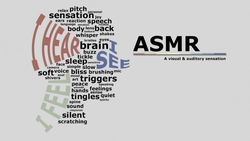
ASMR_type-620x350A few months ago, I was on a Manhattan-bound D train heading to work when a man with a chunky, noisy newspaper got on and sat next to me. As I watched him softly turn the pages of his paper, a chill spread like carbonated bubbles through the back of my head, instantly relaxing me and bringing me to the verge of sweet slumber. It wasn’t the first time I’d felt this sensation at the sound of rustling paper — I’ve experienced it as far back as I can remember. But it suddenly occurred to me that, as a lifelong insomniac, I might be able to put it to use by reproducing the experience digitally whenever sleep refused to come. Under the sheets of my bed that night, I plugged in some earphones, opened the YouTube app on my phone and searched for “Sound of pages.” What I discovered stunned me. There were nearly 2.6 million videos depicting a phenomenon called autonomous sensory meridian response, or A.S.M.R., designed to evoke a tingling sensation that travels over the scalp or other parts of the body in response to auditory, olfactory or visual forms of stimulation. The sound of rustling pages, it turns out, is just one of many A.S.M.R. triggers. The most popular stimuli include whispering; tapping or scratching; performing repetitive, mundane tasks like folding towels or sorting baseball cards; and role-playing, where the videographer, usually a breathy woman, softly talks into the camera and pretends to give a haircut, for example, or an eye examination. The videos span 30 minutes on average, but some last more than an hour.

…Dr. Carl W. Bazil, a sleep disorders specialist at Columbia University, says A.S.M.R. videos may provide novel ways to switch off our brains. “People who have insomnia are in a hyper state of arousal,” he said. “Behavioral treatments — guided imagery, progressive relaxation, hypnosis and meditation — are meant to try to trick your unconscious into doing what you want it to do. A.S.M.R. videos seem to be a variation on finding ways to shut your brain down.”

More here.

Monday, July 28, 2014

Sunday, July 27, 2014

Smallpox: The long goodbye

Jeanne Guillemin in Bulletin of the Atomic Scientists:

ScreenHunter_731 Jul. 27 20.41Last week, six vials of smallpox virus were discovered in a disused closet at the National Institutes of Health, where they had lain, forgotten and misplaced, for over 30 years. Some of them were found to contain live specimens, meaning that this dangerous virus—once considered to have been eradicated from the face of the planet—had the capacity to infect and spread.

At nearly the same time, on July 16, the director of the Centers for Disease Control and Prevention, Thomas Frieden, admitted to a Congressional committee that he was advised of a somewhat similar blunder at the CDC, more than two months after its discovery. (Members of the CDC had accidentally contaminated an innocuous strain of avian influenza with the dangerous H5N1 strain and shipped this unknown hazard to a less secure laboratory.) And not long before, dozens of CDC lab employees had been exposed to virulent anthrax bacteria.

These incidents raise doubts about government vigilance, with the case of the misplaced smallpox vials being arguably the most shocking, because the 1979 global eradication of smallpox is rightly celebrated as one of the most important public health achievements in history.

More here.

Once you know what plankton can do, you’ll understand why fertilising the ocean with iron is not such a crazy idea

David Biello in Aeon:

ScreenHunter_730 Jul. 27 20.33Call me Victor,’ says the mustachioed scientist as he picks me up from the airport on a brisk, fall afternoon in Germany. Victor Smetacek is an esteemed marine biologist, but he’s decided to spend his golden years on an ambitious new pursuit. He has devised a plan to alter the mix of gases in Earth’s atmosphere, in order to ward off climate change. He is, in other words, an aspiring geoengineer.

I came to the ancient city of Bremen to ask Smetacek about an extraordinary experiment he performed more than half the world away, in a forbidding sea seldom visited by humans. This sea surrounds the vast, white continent of Antarctica with a chilly current, locking it in a deep freeze. This encircling moat reaches from the surface waters to the ocean bottom, spanning thousands of kilometres. It is known as the Southern Ocean and it is famously dangerous on account of icebergs that hide in the gloom that hovers above its surface. The churn of its swells sometimes serves up freak waves that tower so high they can flip ships over in a single go. It is in this violent, lashing place that Smetacek hopes to transform Earth’s atmosphere.

More here.

Why Probability in Quantum Mechanics is Given by the Wave Function Squared

Sean Carroll in Preposterous Universe:

Blogpic1One of the most profound and mysterious principles in all of physics is the Born Rule, named after Max Born. In quantum mechanics, particles don’t have classical properties like “position” or “momentum”; rather, there is a wave function that assigns a (complex) number, called the “amplitude,” to each possible measurement outcome. The Born Rule is then very simple: it says that the probability of obtaining any possible measurement outcome is equal to the square of the corresponding amplitude. (The wave function is just the set of all the amplitudes.)

Born Rule: mathrm{Probability}(x) = |mathrm{amplitude}(x)|^2.

The Born Rule is certainly correct, as far as all of our experimental efforts have been able to discern. But why? Born himself kind of stumbled onto his Rule.

More here.

The secret report that helps Israelis to hide facts

Patrick Cockburn in The Independent:

ScreenHunter_729 Jul. 27 20.18Israeli spokesmen have their work cut out explaining how they have killed more than 1,000 Palestinians in Gaza, most of them civilians, compared with just three civilians killed in Israel by Hamas rocket and mortar fire. But on television and radio and in newspapers, Israeli government spokesmen such as Mark Regev appear slicker and less aggressive than their predecessors, who were often visibly indifferent to how many Palestinians were killed.

There is a reason for this enhancement of the PR skills of Israeli spokesmen. Going by what they say, the playbook they are using is a professional, well-researched and confidential study on how to influence the media and public opinion in America and Europe. Written by the expert Republican pollster and political strategist Dr Frank Luntz, the study was commissioned five years ago by a group called The Israel Project, with offices in the US and Israel, for use by those “who are on the front lines of fighting the media war for Israel”.

Every one of the 112 pages in the booklet is marked “not for distribution or publication” and it is easy to see why.

More here.

Natural rights celebrated democracy; human rights emasculate it

Jon Holbrook in Spiked:

Paine_rightsAlthough the word ‘rights’ appears in ‘natural rights’ and ‘human rights’, the two concepts are profoundly different. One seeks to restrict the power of government and the other seeks to expand it. Whereas natural rights seek freedom from the state, human rights seek the state’s protection and assistance. More importantly, and this is the point rarely appreciated by today’s human-rights industry, whereas natural rights made democracy possible, the human-rights discourse is securing democracy’s emasculation. Democracy can only thrive if three conditions are satisfied: (a) man is treated as rational, (b) the state is restrained and (c) politics is freed of legal constraints. Whereas the natural-rights advocate champions each condition, the human-rights advocate assumes the first condition is impossible and the next two are undesirable.

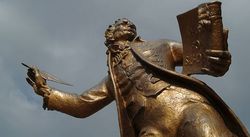
Tom Paine, an English radical who participated in the American Revolution, wrote Rights of Man in defence of the French Revolution of 1789. His celebration of natural rights was premised on his belief in human rationality. He noted that ignorance, once dispelled, could not be re-established – ‘[it] is only the absence of knowledge’ that could keep a man ignorant. He observed that while man ‘may be kept ignorant, he cannot be made ignorant’. Truth, said Paine, is so irresistible ‘that all it asks – and all it wants – is the liberty of appearing’. Paine’s recognition of man’s rationality led to his celebration of natural rights. For if truth needed only to be revealed in order to be supported, then man needed freedom to seek it, discuss it, promote it and act on it. Left to his own devices, man would find truth and cooperate with his fellow citizens to create a mutually beneficial society. With a human-rights approach, however, man is seen as less than rational. From this perspective, if man is left to his own devices, then all sorts of negative consequences follow: minorities tend to be oppressed by majorities; the weak tend to fall prey to the powerful; the vulnerable tend to suffer at the hands of the strong; and the poor tend to be exploited by the rich.

More here.

Wounded Tiger: a History of Cricket in Pakistan

Kevin Telfer in The Telegraph:

Imram_khan_2985567bPakistani cricket: what a subject. What players – and what characters: the regal Imran, the street-fighter Javed, the mesmerising Qadir. Controversy and drama seems to surround the Pakistani Test team wherever and whenever it plays, be it in terms of spot-fixing, umpires, ball-tampering, on-field confrontations, sporting brilliance or terrorism.

Of all the world’s cricket teams, they are the least antiseptic and the most mercurial. Such, at least, is the conventional wisdom. But this encyclopedic work by Peter Oborne avoids these tabloid stereotypes – both in terms of the country’s most famous individuals who are the stuff of cricketing legend – as well as Pakistani cricket in general. It makes for a rich, fascinating and sometimes surprising read. Since its birth in 1947, the country of Pakistan has had an exceptionally turbulent and violent history. This forms the backdrop to Oborne’s carefully researched and meticulously constructed narrative, starting with the bloodshed of partition, all the way through to a modern Pakistan that is considered so unsafe following the attack on the Sri Lankan cricket team and umpires in Lahore in 2009 that the national side must play its matches in exile.

More here.

Sunday Poem

No More Clichés

Beautiful face
That like a daisy opens its petals to the sun
So do you
Open your face to me as I turn the page.

Enchanting smile
Any man would be under your spell,
Oh, beauty of a magazine.

How many poems have been written to you?
How many Dantes have written to you, Beatrice?
To your obsessive illusion
To you manufacture fantasy.

But today I won't make one more Cliché
And write this poem to you.
No, no more clichés.

This poem is dedicated to those women
Whose beauty is in their charm,
In their intelligence,
In their character,
Not on their fabricated looks.

This poem is to you women,
That like a Shahrazade wake up
Everyday with a new story to tell,
A story that sings for change
That hopes for battles:
Battles for the love of the united flesh
Battles for passions aroused by a new day
Battle for the neglected rights
Or just battles to survive one more night.

Yes, to you women in a world of pain
To you, bright star in this ever-spending universe
To you, fighter of a thousand-and-one fights
To you, friend of my heart.

From now on, my head won't look down to a magazine
Rather, it will contemplate the night
And its bright stars,
And so, no more clichés.

by Octavio Paz

Saturday, July 26, 2014

Longtime 3QD Friend Sean Carroll Wins 2014 Gemant Award

Congratulations, Sean! Jason Socrates Bardi at the American Institute of Physics website:

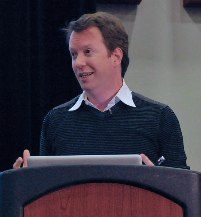
Gemant 2014 Sean Carroll-resizedThe American Institute of Physics (AIP) today announced that Sean Carroll, a physicist at the California Institute of Technology, is the winner of the 2014 Andrew Gemant Award, an annual prize recognizing significant contributions to the cultural, artistic or humanistic dimension of physics.

In recognizing Carroll, the AIP prize committee cited him “for extraordinary public outreach on particle physics and cosmology, as an educator, author, public lecturer, and consultant for TV and radio programs, and for his pioneering work communicating with a variety of international audiences using social networking.”

“Few people can make complicated topics like the nature of space and time as accessible as Sean Carroll does,” said Catherine O'Riordan, AIP vice president of Physics Resources. “He doesn't just inspire the public’s scientific imagination — he provides the tools for his readers and viewers to answer some of life’s biggest, most fundamental questions themselves.”

Carroll (on Twitter: @seanmcarroll) followed his own curiosity to a career in theoretical physics and cosmology, focusing especially on the origin and constituents of the universe. He received his Ph.D. in 1993 from Harvard University, and has worked at MIT, the Institute for Theoretical Physics at UC Santa Barbara and the University of Chicago. He has made significant contributions to models of interactions between dark matter, dark energy, and ordinary matter; alternative theories of gravity; violations of fundamental symmetries; and the theory of time.

More here.

Pakistan: A country where liberal journalists risk death

Mohammed Hanif at the BBC:

ScreenHunter_727 Jul. 26 20.16The life of a liberal journalist in Pakistan is not an easy one. Write about someone fighting a blasphemy case, or someone whose faith is considered heresy, and you may very soon find yourself in deep trouble.

Shoaib Adil, a 49-year-old magazine editor and publisher in Lahore, has many well-wishers and they all want him to disappear from public life or, even better, leave the country.

Since blasphemy charges were filed against him last month, the police have told him that he can't return home, he can't even be seen in the city where he grew up and worked all his life. It wouldn't be safe.

As a journalist, Adil has been a vocal critic of religious militarism. But the threat to his life doesn't come from the Taliban.

He is the victim of an everyday witch hunt by Pakistan's powerful religious groups – the kind of witch hunt that's so common and yet so scary that it never makes headlines.

For the past 14 years, Adil has been editing and publishing a monthly current affairs magazine, a rare liberal voice in Pakistan's Urdu media. Back issues of Nia Zamana read like a catalogue of human rights abuses.

The June issue's cover story, for example, reports on the murder of a human rights lawyer, Rashid Rehman in the city of Multan in central Pakistan. Rehman, defending a literature professor accused of blasphemy, was told in the court by the prosecuting lawyers that if he didn't drop the case he would not live to see the next hearing.

Sure enough, Rehman was gunned down in his office before the next hearing.

More here.

How to Save Gaza

William Saletan in Slate:

After two weeks of protests and denunciations, it’s time to acknowledge that outrage won’t end the war in Gaza. The most plausible way to stop this cycle of violence is through internationally supervised demilitarization. Amid so much death and destruction that may seem utterly hopeless. But in fact, many of the tools we need are already in place. Here’s an analysis of the problem and how to fix it.

ScreenHunter_726 Jul. 26 20.101. Gazans have no government to protect them. Every day, more civilians die in Gaza. Israel, the country that’s killing them, has agreed to cease-fire proposals. But Hamas, which controls Gaza (though many of its political leaders don’t even live there), rejects these proposals and continues to fire rockets into Israel. You can argue that the rockets justify Israel’s attacks or that they serve merely as a pretext. Either way, they get more Gazans killed.

The only way to make sense of Hamas’ behavior is to recognize that its goal is not to stop the killing but to exploit it. That explains why Hamas encouraged Gazans to stand atop targeted buildings and ordered them to stay in areas where Israel had issued pre-invasion evacuation warnings. It also explains why Hamas insists that Israel grant concessions in exchange for a cease-fire. Hamas thinks a cease-fire is a favor to Israel. Given the gross imbalance in casualties, that’s a pretty clear statement that Hamas thinks Gazan deaths should bother Israel more than they bother Hamas.

That is just the latest display of Hamas’ warped priorities. Another illustration is its tunnels. It has diverted hundreds of thousands of tons of building materials from civilian projects to tunnel construction. The tunnels to Egypt, which are largely for commerce, are rudimentary. The tunnels to Israel, which are for military attacks, are elaborate. Hamas cares more about hurting Israelis than about helping Gazans.

More here.

how many children should we have? The case for none

From More Intelligent Life:

The Big Question: we asked six writers, how many children should we have? David Benatar believes that the only way to prevent harm is not to have any

No_children

Millions of years of evolutionary history have programmed you to reject the notion that procreation is wrong. Bear this in mind if you rush to reject my argument, and to defend a deeply harmful practice. Morally responsible parents wish to spare their children pain. There are ways they can minimise the chances of their children suffering certain types of harm, but the only way to prevent harm altogether is to desist from bringing children into existence. Any child will, inevitably, suffer considerable harm. Privileged procreators in developed countries are inclined to respond that their children are likely to be spared the chronic deprivation, insecurity and violence that blight the lives of so many. This response ignores the discomfort, distress, frustration and unhappiness that characterise even the most charmed lives. It also ignores the appalling fates that can befall anybody. These include assault, devastating injury, degenerative disease and depression.

Nor can these fates be dismissed as improbable. For example, 40% of men and 37% of women in Britain develop cancer at some point. Add to these odds the cumulative risks of other terrible conditions and we find that the chance of escaping calamity approaches zero. It reaches zero if we include death. In creating a child you are ultimately responsible for its death, and for the ensuing ripples of bereavement.

More here.